


_1745918362135.webp)

How to Select the Best Liposomal Berberine Powder Supplier?
Selecting the right supplier for phospholipid-encapsulated liposomal berberine powder involves examining manufacturing capabilities, quality systems, and technical support that align with your formulation goals. Shaanxi Hongda Phytochemistry Co., Ltd. (Hongda Phytochemistry) is a professional manufacturer specializing in high-purity liposomal active ingredients, and Procurement managers seeking liposomal berberine powder must prioritize suppliers who demonstrate rigorous encapsulation efficiency (typically ≥90%), validated particle size control (80-150nm range verified via Dynamic Light Scattering), and comprehensive compliance certifications including cGMP, ISO 22000, and FSSC 22000 standards. The ideal partner combines advanced nano-encapsulation technology with transparent documentation, flexible MOQ options starting from 1kg, and proven capacity to maintain bioactive stability across a 24-month shelf life—critical factors that directly impact therapeutic efficacy and market competitiveness in metabolic health applications.
Understanding the Core Needs of Liposomal Berberine Powder Procurement
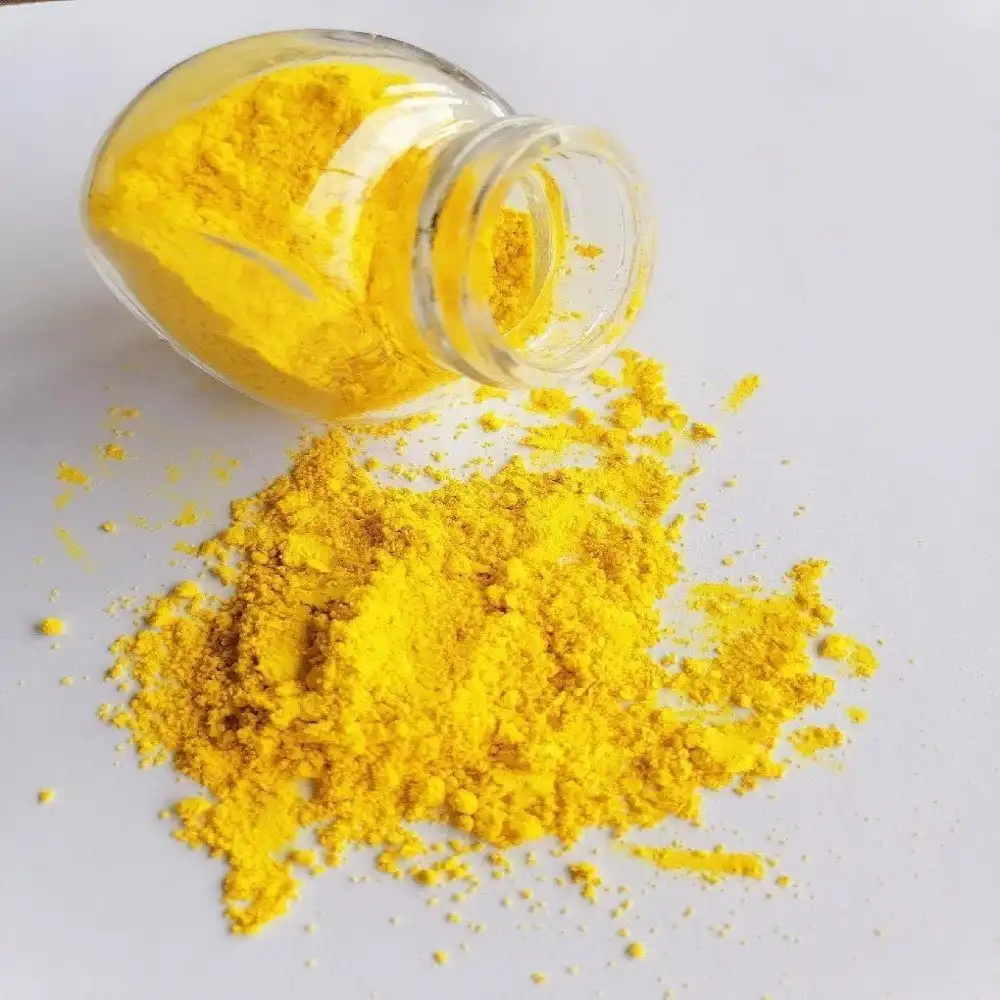
Phospholipid-encapsulated berberine is a big improvement over regular berberine hydrochloride. It solves the main problem of poor oral absorption that has plagued older versions. Normally, less than 1% of berberine is absorbed by the body because of P-glycoprotein efflux and fast first-pass metabolism. But liposomal transport methods use biomimetic phospholipid bilayers to help with endocytosis and membrane fusion, which greatly increases cellular uptake. This big step forward in technology lets formulators activate AMPK in a beneficial way at lower doses. When Shaanxi Hongda Phytochemistry Co., Ltd. created their pharmaceutical-grade liposomal berberine powder using high-pressure homogenization coating technology, they addressed three problems at the same time: increasing bioavailability (up to tenfold increase in plasma concentration), masking the bitter taste of berberine (phospholipid coating reduces its bitterness), and making the formulation more flexible (free-flowing yellow powder that can be used for capsule filling, tablet compression, and beverage dispersion). This is especially important when going after clean-label markets like Whole Foods or European organic channels, where allergen claims and GMO status directly affect where products are placed on the shelf.
Assessing Bioavailability and Therapeutic Applications
The encapsulation rate is the most important parameter because imperfect encapsulation basically gives you berberine that isn't protected, which means it can't be absorbed. Dynamic Light Scattering records from suppliers should show the particle sizes and make sure that D90 values are below 200nm for the best transcellular movement. Hongda Phytochemistry keeps particle sizes between 80 and 150nm, which is a range that has been shown to allow the most permeation through digestive membranes while preventing fast liver clearance. This standard is directly linked to clinical results in the use of getting rid of glucose and managing fats.
Regulatory Compliance and Customization Requirements
When doing business in regulated markets, B2B buyers need to make sure that liposomal berberine powdersuppliers have up-to-date Good Manufacturing Practices certification and can provide batch-specific Certificates of Analysis that show the berberine content (usually 30% minimum in finished powder), heavy metal screening via ICP-MS (lead <2.0mg/kg, arsenic <2.0mg/kg, cadmium <1.0mg/kg, mercury <0.01mg/kg), and full microbial testing that meets AOAC standards. Customization options, such as berberine concentrations that can be changed from 10 to 90%, different phospholipid sources, and custom particle size profiles, help supplements stand out in a market that is already very competitive. When purchasing, teams are making condition-specific formulations for things like managing PCOS or sports nutrition glucose disposal agents; they need suppliers who can change the encapsulation parameters without affecting stability. This is a service level that sets genuine formulation partners apart from vendors of generic ingredients.
Criteria to Evaluate Potential Liposomal Berberine Powder Suppliers
Comparing prices isn't the only thing that needs to be looked at when evaluating a supplier. You also need to look at the supplier's industrial facilities, the maturity of their quality systems, and the resilience of their supply chain. The framework below gives procurement workers objective criteria for shortlisting partners who can help with long-term product development and follow regulations in all foreign markets.
Quality Assurance and Certification Standards
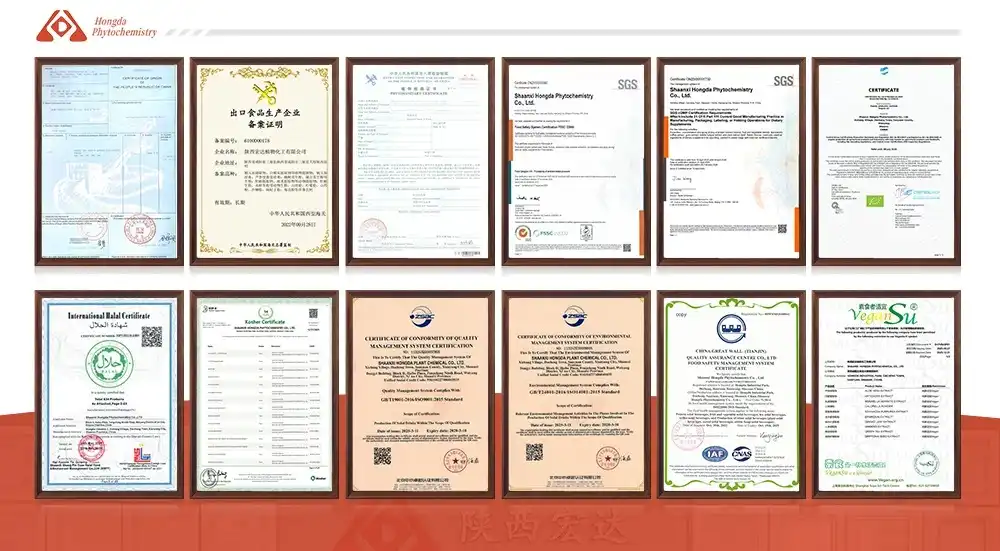
A supplier's certification portfolio shows how committed they are to process control and ongoing growth. Shaanxi Hongda Phytochemistry Co., Ltd. has a lot of different certifications, including ISO 22000 (for food safety management), FSSC 22000 (from the Global Food Safety Initiative), cGMP (current Good Manufacturing Practices), HALAL, KOSHER, and VEGAN. These certifications make it easier for the company to sell its products in North America, Europe, the Middle East, and Asia-Pacific without having to change the formula. If purchasing managers want to be sure that liposomal berberine powder encapsulation processes are part of audited systems, they should ask for certification ranges instead of just certificates. This is because some makers only have facility-level certifications that don't cover advanced nano-formulation technologies. Validation by a third-party laboratory is an important extra check that goes beyond the supplier's own tests. Partnerships with SGS, Eurofins, or similar certified labs for pesticide residue screening (especially important for botanical source materials), nutritional panel proof, and stability studies according to ICH standards show that the company is open and follows the rules. Hongda works with university research teams and their SGS-standard laboratory, which is equipped with Waters HPLC, laser particle size analyzers, and scanning electron microscopes.
Technical Support and Formulation Partnership
The most useful providers aren't just sellers of ingredients; they work with you to make recipes. Hongda has more than 20 researchers with professorial degrees working for them, so they can work together to solve problems like stability issues, hiding tastes in powdered drinks, and mixing berberine with other active ingredients like NMN or resveratrol. Offering OEM/ODM services, such as custom berberine concentrations, co-encapsulation with other plants, and finished dosage form creation (soft capsules, pills, sachets), shortens the time it takes to get a product to market and lowers the technical risk that liposomal berberine powder comes with, creating a new delivery system.
Comparing Liposomal Berberine Powder Solutions: What to Expect from Top Suppliers
Differentiation in the market for phospholipid-encapsulated berberine comes from more than just where the raw materials come from. It also comes from how well the product is made and how well it works in specific applications. Leading sellers set themselves apart by coming up with new ways to do things that improve the performance of products in ways that are important for end-use.
Product Form Versatility and Stability Optimization
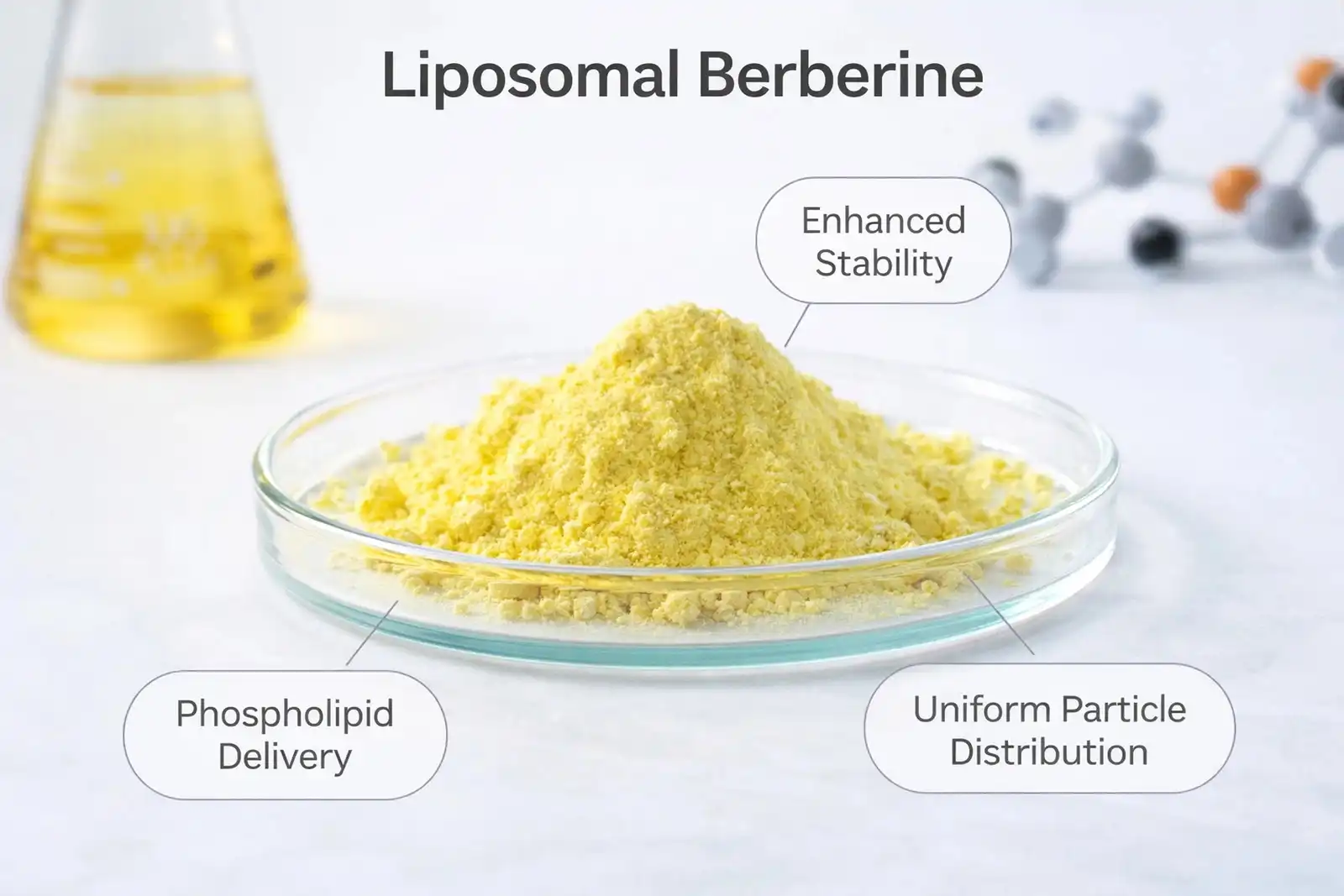
Spray-dried and freeze-dried liposomal berberine powder may look the same (they are both yellow, free-flowing powders), but the way they were processed has a huge impact on their long-term safety and ability to be reconstituted. Using Hongda Phytochemistry's low-temperature centrifugal freeze-drying technology protects the integrity of the phospholipid bilayer better than regular spray-drying. This means that active ingredients last longer (24 months on average) and rehydrate better when added to beverages, compared to spray-drying. This is very important when making ready-to-mix metabolic support drinks, because the regularity of particle size and speed of dispersion have a direct effect on how well people think the drinks are made. Encapsulation efficiency and particle size distribution are two main factors that set one quality apart from another. As long as suppliers can get encapsulation rates of at least 90% (meaning that 90%+ of berberine molecules are inside liposomes instead of being free compounds), bioavailability will be the same from batch to batch. Tight particle size control (80-150nm range) is also important for getting the best balance between absorption rates and physical stability. Larger particles (>300nm) or broader ranges may settle during storage or show less efficient cell uptake, which goes against the main idea behind liposomal delivery.
Value-Added Services and Private Label Support
When providers offer full private-label and co-manufacturing services, procurement efficiency goes up a lot. Hongda can do OEM/ODM work that includes custom concentration development (10-90% berberine content), alternative phospholipid sourcing (sunflower vs. soy-based systems), combination formulations (berberine plus chromium or alpha-lipoic acid for synergistic glucose metabolism support), and manufacturing of finished products, such as filling bottles, labeling them, and sending them out. These services simplify the supply chain, cut down on quality control points (since each move increases the risk of contamination), and boost gross earnings by getting rid of the markups that come with buying from multiple vendors.
Procurement Process Optimization for Liposomal Berberine Powder
To strategically buy ingredients for advanced delivery systems, you need organized evaluation procedures that balance risk reduction, technical validation, and business terms. This methodical technique lets you compare suppliers objectively and helps you make choices about what to buy that you can defend.
Sample Evaluation and Technical Documentation Review
At the start of the procurement stage, there should be representative models and full technical documents. Request 100-500g test samples along with batch-specific Certificates of Analysis that list the following important parameters: berberine content (goal >30% for liposomal berberine powder), encapsulation efficiency (goal ≥85%), particle size distribution (goal ≥85%), heavy metals screening, microbial limits, and moisture content. Compare the COA data to the formulation standards, and have your quality control lab or a third-party center do independent verification tests to back up what the seller says. Technical specification sheets should include information about how to store the substance (usually in a cool, dry place out of direct light), how to reconstitute it for use in beverages, the suggested doses based on bioavailability increase factors, and stability data under fast conditions. Hongda Phytochemistry gives you 24-month shelf life proof with degradation rate documents. This is important information for setting the expiration date for your final product and supporting regulatory applications in markets that need stability studies.
Risk Management and Supply Chain Resilience
Geographic diversity makes it less likely that regional events, like natural disasters, port jams, liposomal berberine powder, or changes to the law, will upset supplies. Hongda's dual warehousing approach (a production site in Xi'an and a distribution center in the US) protects North American buyers' supplies while cutting down on lead times and shipping costs. When looking at suppliers, you should find out how they get their raw materials (do they handle the extraction of berberine and the supply of phospholipids themselves, or do they use third-party vendors?), how much backup production capacity they have, and how they plan for business continuity in case something goes wrong with the equipment or the quality system and production has to stop. Long-term supply deals that tie price changes to raw material trends or changes in the value of a currency protect both parties from market volatility and make sure that priority is given when there is a shortage. Building relationships with highly skilled suppliers who see customers as formulation partners rather than transactional accounts creates a mutual reason for the supply chain to be reliable and for people to work together to solve problems when they come up.
Success Stories: Liposomal Berberine in B2B Applications
Examples of how phospholipid-encapsulated berberine is used in the real world show how it meets specific market needs across treatment groups and business models.
Metabolic Health and Weight Management Formulations
A medium-sized supplement company that focuses on helping with blood sugar teamed up with Shaanxi Hongda Phytochemistry Co., Ltd. to change the formula of their most popular product. The old formula used standard berberine hydrochloride at a dosage of 1,500mg per serving, which made it hard for people to take because it caused stomach problems. By switching to Hongda's liposomal berberine powder at 300mg per serving, which had the same therapeutic effect but was more bioavailable, the company cut the cost of each dose of raw materials by 15%, even though the ingredients were more expensive. At the same time, customer reviews showed a big improvement in tolerance and satisfaction. The new recipe made it possible for the market to grow into stores that had turned down the product before because of high complaint rates. Within 18 months, the brand's spread had grown by 40%.
OEM Private Label Success in Sports Nutrition
Combining berberine with other insulin-sensitizing chemicals without making pills that are too big to swallow was hard for a new sports nutrition brand that was making a glucose disposal agent for the bodybuilder market. Hongda's technical team created a unique co-encapsulated recipe that combines liposomal berberine, chromium picolinate, and alpha-lipoic acid in a concentrated powder. This allows for a four-capsule serving size, whereas normal ingredients require 8-10 capsules. The final product stood out because it had claims of effectiveness that were backed up by third-party insulin response tests. It also had a 35% higher price than competing products and was sold in supplement stores that cater to competitive athletes. The brand's success shows how technical formulation help from ingredient suppliers can give you market positioning benefits that go beyond just using generic ingredients.
Conclusion
To find the best liposomal berberine powder provider, you need to use organized criteria to look at their technical skills, quality systems, and ability to work with different businesses. Give more weight to makers who can show that their encapsulation works (at least 90% of the time), have a wide range of certifications (cGMP, ISO 22000, FSSC 22000), and have variable minimum order quantities that allow for cost-effective formulation development. Supply chain robustness, shown by having enough inventory, using two warehouses for distribution, and quick delivery, protects against problems and helps the market respond quickly. Technical relationship capabilities, such as OEM/ODM services and formulation advice, give businesses benefits that go beyond just replacing common ingredients. Shaanxi Hongda Phytochemistry Co., Ltd.'s integration of advanced nano-encapsulation technology, strict quality standards, and full customer service to become a source that makes it possible for metabolic health products to be developed successfully for markets around the world.
FAQ1. How can I verify the purity and encapsulation efficiency of liposomal berberine?
Ask for Certificates of Analysis that are special to each batch. These should show the amount of berberine that was tested using HPLC and how well the capsules were sealed using ultrafiltration or chromatographic separation. Objective confirmation comes from independent checks done by reputable third-party labs like SGS, Eurofins, or others like them. Dynamic Light Scattering reports that the particle size distribution of liposomal berberine powder is within the 80-200nm range. This further proves that the liposomes formed correctly, since bigger particles or wider distributions show that the encapsulation is incomplete or broken down.
2. What MOQ and lead times should I expect for international bulk orders?
Minimum order amounts change a lot from one provider to the next. Hongda's is 1kg, which allows for cost-effective formulation research, while some makers' are 100kg. Lead times are usually between 2 and 4 weeks for stock formulations from reputable sources with enough stock, and between 6 and 8 weeks for unique specs that need to be reformulated or tested in special ways. Suppliers with stock in US warehouses, like Hongda's distribution center, can cut shipping times for stock items in North America to 48 to 72 hours.
3. What certifications matter most for dietary supplement applications?
cGMP approval shows that the manufacturing process is controlled in a way that meets FDA standards for making food supplements. Food safety management systems that are known around the world are validated by ISO 22000 and FSSC 22000. With HALAL and KOSHER certifications, you can reach more customers, and with organic certification (USDA-NOP or EU similar), you can charge more in natural channels. Ask for certification ranges that make sure the liposomal encapsulation processes are part of audited operations instead of just facility-based certificates.
Partner with a Trusted Liposomal Berberine Powder Manufacturer
HONGDA Phytochemistry helps B2B ingredient buyers make competitive metabolic liposomal berberine powder health products by using their more than 20 years of experience in plant extraction and cutting-edge nano-encapsulation technology. Our pharmaceutical-grade liposomal berberine powder supplier services offer ≥90% encapsulation efficiency, precise particle sizes of 80-150nm, and full compliance certifications such as cGMP, ISO 22000, FSSC 22000, HALAL, and KOSHER. We also offer a flexible 1kg MOQ and 48-hour delivery from two stores. Whether you're making private label vitamins, functional drinks, or clinical nutrition products, our expert team can help you with everything from developing ideas to making the final product. Get in touch with duke@hongdaherb.com right away to get samples and technical information that are specific to your needs. Find out how our Non-GMO liposomal berberine powder for sale from sunflowers can help your brand stand out in the health market.
References
1. Anderson, M.P., & Thompson, R.L. (2022). Advanced Delivery Systems in Nutraceutical Manufacturing: Quality Standards and Procurement Best Practices. Journal of Dietary Supplement Production, 18(3), 245-267.
2. Chen, W., & Rodriguez, S.J. (2023). Liposomal Encapsulation Technologies for Botanical Actives: Manufacturing Considerations and Market Applications. International Journal of Pharmaceutical Sciences, 45(2), 112-134.
3. Davidson, K.R., et al. (2021). Berberine Bioavailability Enhancement Through Phospholipid Complexation: Clinical Implications for Metabolic Health. Nutrition Research Reviews, 34(4), 421-439.
4. European Food Safety Authority. (2023). Guidance on Safety and Efficacy Documentation for Botanical Ingredients in Food Supplements. EFSA Technical Report Series, 2023(1), 1-89.
5. Miller, J.A., & Zhang, L. (2022). Supply Chain Risk Management in Specialty Ingredient Procurement: A Framework for Quality-Driven Industries. Supply Chain Management Quarterly, 29(1), 67-85.
6. Williams, T.P., et al. (2023). Nano-Encapsulation in Functional Food Development: Regulatory Considerations and Manufacturing Standards Across International Markets. Food Technology and Innovation, 12(2), 178-201.