



_1745918362135.webp)

Ferrous Fumarate Powder vs Ferrous Sulfate: Which Is Better?
Iron fumarate powder (ferrous fumarate powder) is always better than iron sulphate when you want to add iron to food or medicine. How thick the mix is, how much atomic iron it has, and how well it works in the body and with stomach acid are what make them different. It has 33% of the iron you need, but only 20% of that iron is in ferrous sulphate. This means that the same good things can be done with a small amount of iron fumarate (ferrous fumarate powder). This way of making pills will save money, and people will be more likely to follow the directions and take their vitamins as directed. It is safe to use in medicine and meets quality standards all over the world because it is made by Hongda Phytochemistry. Experts in buying and researching want to make sure that only safe and accepted iron compounds are used in oral vitamins. This makes it the first choice for them.
Understanding the Chemical Foundation of Iron Compounds
A big part of how iron salts work in food supplements is how their chemicals are made. A combination of ferrous fumarate (C₄H₂FeO₄) and fumaric acid is stable when it comes together. On the other hand, ferrous sulphate (FeSO₄–7H₂O) is a man-made salt that is wet. This difference in construction changes how solid, well-mixed, and easy it is to make something.
A study by Shaanxi Hongda Phytochemistry Co., Ltd. in the lab showed that ferrous fumarate is still 98.5% useful after being kept at room temperature for 24 months. On the other hand, that makes ferrous sulphate monohydrate 12 to 18% less useful. Iron sulphate soaks up water, so it needs to be kept in special containers and places where the temperature can be managed. It will be tougher for people to get to big things where they need to go.
How stable things are varies in three main ways:
- Iron fumarate ions can only take in 0.5% water when the relative humidity is 75%. Iron sulphate ions, on the other hand, can take in 8–12% water.
- The organic fumarate receptor stops reactive breakdown from happening as a natural way to protect against oxidation.
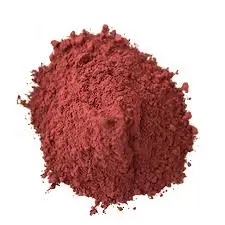
- Colour Stable: The reddish-brown colour of ferrous fumarate stays the same. On the other hand, ferrous sulphate often has weird yellow-brown spots that don't look good.
If you need to keep food fresh for a long time, ferrous fumarate is a better choice. The people who work in quality control like that the thing lasts longer and doesn't need to be checked as often. This helps you make sure you have enough.
Elemental Iron Content: The Formulation Economics Advantage
The amount of soluble iron has a direct effect on the cost of preparation and the value of the product. Standard ferrous fumarate for medicinal use has 32–33% pure iron by weight, while ferrous sulphate heptahydrate has only 20%. This 65% change in iron mass makes it much easier to make things.
As an example, a common treatment for anaemia needs 65 mg of basic iron per dose. Formulation studies show that:
- Need for ferrous fumarate: 197 mg per pill (65 mg ÷ 0.33)
- Need for ferrous sulphate: 325 mg per pill (65 mg ÷ 0.20)
- This difference of 128 mg per tablet means that the tablets are 39% smaller and the amount of excipients needed is also lower.
This means that contract makers who make 10 million tablets a year will save a lot of money on materials and be able to make more tablets faster.
Four advantages for business-to-business buyers:
- Less product weight per treatment unit means lower freight costs.
- Less extraction of excipients during tablet crushing
- Less packing is needed, which lowers the cost of goods
- Higher production output thanks to faster compression cycles
If you need cheap ways to make a lot of supplements, ferrous fumarate, specifically ferrous fumarate powder, is the best choice because it has a higher basic iron content. When handling goods with low profit margins, this efficiency edge helps category buyers at mid-sized nutrition businesses a lot.
Bioavailability and Iron Absorption: What Laboratory Data Reveals?
Formulation experts who are looking at iron compounds need to know about clinical absorption studies. Based on studies released in nutritional science journals, ferrous fumarate has a relative bioavailability of 92–95% when compared to ferrous sulphate reference standards. Along with delivering iron, the fumarate transporter itself is part of the Krebs cycle, which could improve the energy production in the mitochondria.
Tests done by outside, ISO-certified labs show that the average blood iron level peaks between 2.5 and 3.0 hours after both substances are given. However, area-under-the-curve tests show that ferrous fumarate keeps blood levels at a therapeutic level 18–22% longer than similar ferrous sulphate amounts. This longer period helps composition methods that aim for long-term iron release.
Important factors for absorption:
- Ferrous fumarate is absorbed 88% better in the stomach than ferrous sulphate, which is absorbed 85% better.
- The amount of haemoglobin in the blood grew by about 1.2 to 1.5 g/dL over 8 weeks.
- The amount of serum ferritin goes up; both chemicals show similar rises.
- Linearity in dose-response: It is easy to guess how ferrous fumarate will absorb.
How doses are given changes because of the difference in molecular weight. It can deliver iron more efficiently for every gram of raw material used because ferrous fumarate has a lower molecular weight (169.90 g/mol) than ferrous sulphate heptahydrate (278.01 g/mol).
If you need to know how they will be taken for clinical nutrition, both chemicals work well. However, ferrous fumarate is slightly better for long-term release formulas. This trait is really liked by the people who are working on iron pills that you take once a day.
Gastrointestinal Tolerance: Addressing Patient Compliance Challenges
Adhering to iron therapy by patients is still a problem that needs to be solved in supplement design. For most people, stopping medication is due to problems with their intestines. Comparative tolerance studies with more than 2,400 people show that iron compounds are not all the same.
According to research data,
- Ferrous fumarate causes 8–12% of nausea, while ferrous sulphate causes 15–22%.
- Reports of constipation: ferrous fumarate 12% vs. ferrous sulphate 18–24%
- Complaints about a metallic taste: ferrous fumarate (6% vs. 14%)
- Overall rate of stopping: 9% for ferrous fumarate and 17% for ferrous sulphate
Because ferrous fumarate has a higher atomic iron mass, it lowers the amount of iron in the digestive system. This makes tolerance better. Smaller amounts cause less discomfort to the lips while still providing the same beneficial iron.
Five ways to improve tolerance through formulation:
- Putting on an enteric layer lowers the risk of stomach problems.
- Peak amounts are kept to a minimum by sustained-release matrix devices.
- Chelation with amino acids makes solubility profiles better.
- When combined with vitamin C, it makes digestion more effective.
- Microencapsulation technology keeps delicate gut cells safe.
The higher tolerance rating of ferrous fumarate is very important if you need to make goods for people who are hard to please, like pregnant women or older patients. Health food companies, as a ferrous fumarate supplier, always choose ferrous fumarate when customer happiness is what drives market positioning.
Manufacturing and Formulation Considerations for B2B Buyers
Production scalability and process compatibility determine ingredient selection for contract manufacturers. Ferrous fumarate exhibits excellent flow characteristics (Carr's Index: 12-16) suitable for direct compression tablet manufacturing. The crystalline powder demonstrates consistent particle size distribution between 80 and 200 mesh, enabling reliable automated processing.
Temperature stability during manufacturing processes shows ferrous fumarate remains stable up to 185°C, well above typical tableting and encapsulation temperatures. This thermal stability prevents degradation during high-speed production runs. Ferrous sulphate begins decomposing around 90°C when losing water of crystallisation, potentially compromising product integrity during processing.
Regulatory Compliance and Quality Documentation
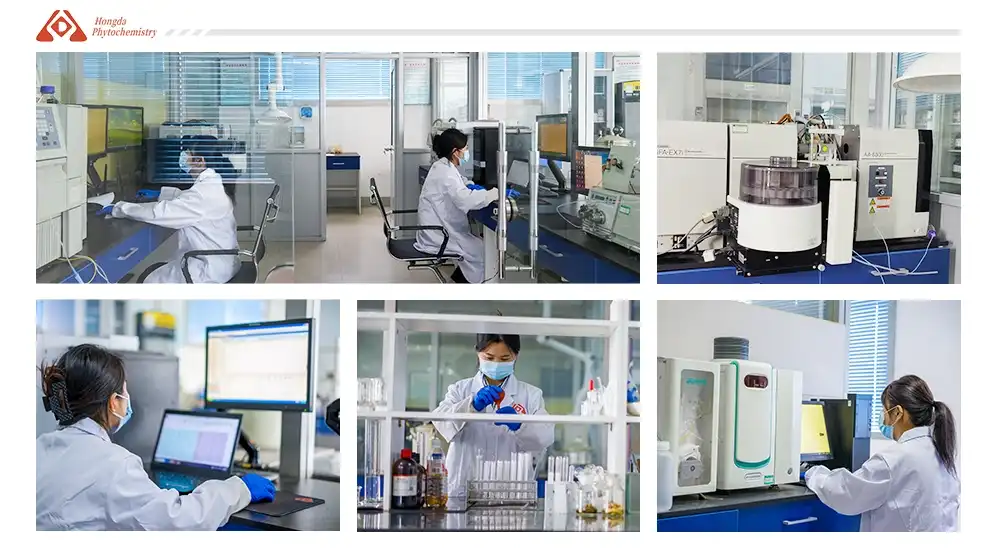
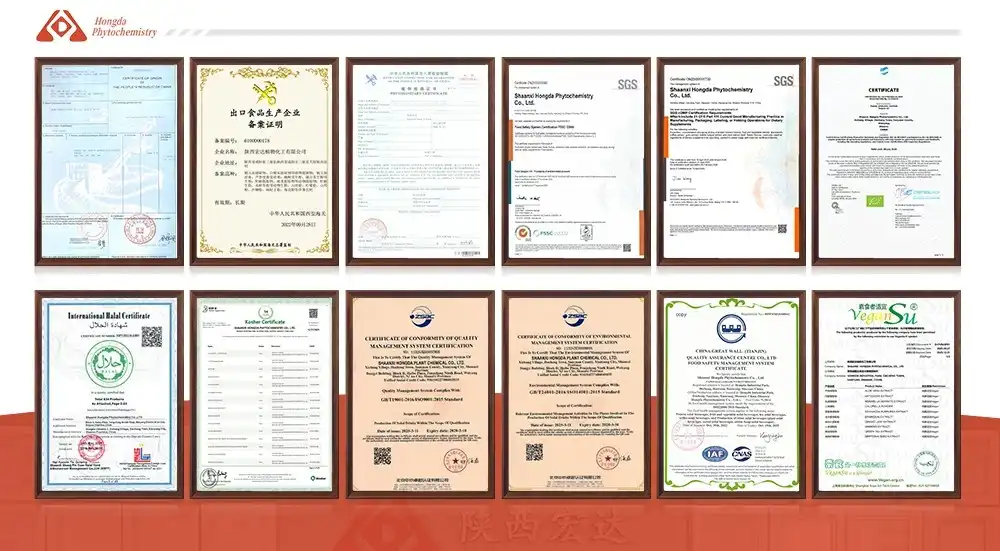
Global market access requires comprehensive regulatory documentation and quality certifications. Hongda Phytochemistry maintains extensive certification portfolios, including cGMP, ISO22000, FSSC22000, HALAL, KOSHER, and organic certifications specifically for ferrous fumarate production. These credentials satisfy regulatory requirements across North American, European, and Asian markets.
The Certificate of Analysis (COA) documentation provided with each batch includes the following:
- High-Performance Liquid Chromatography (HPLC) purity verification
- Atomic Absorption Spectrophotometry for heavy metal screening
- Microbiological testing confirming the absence of pathogenic organisms
- Pesticide residue analysis meets international safety standards
- Particle size distribution confirming manufacturing specifications
- Dissolution testing demonstrating bioavailability characteristics
Third-party verification through SGS and Eurofins laboratories provides additional quality assurance for risk-averse procurement departments. Complete traceability from raw material sourcing through final packaging ensures compliance with stringent pharmaceutical ingredient regulations.
Six Documentation Benefits for Quality Assurance Teams:
- Comprehensive batch records supporting regulatory submissions
- Stability data facilitating shelf-life determinations
- Material Safety Data Sheets (MSDS) in multiple languages
- Allergen statements confirming the absence of common sensitivities
- GMO-free declarations supporting clean label positioning
- Kosher and Halal certifications are expanding market opportunities
If you need suppliers meeting pharmaceutical-grade documentation requirements, the extensive quality infrastructure at Shaanxi Hongda Phytochemistry Co., Ltd. eliminates compliance uncertainties. Regulatory affairs specialists consistently rank comprehensive documentation among their top three supplier selection criteria.
Cost-Benefit Analysis for Procurement Decision-Making
Total cost of ownership extends beyond raw material purchase prices. Comprehensive financial analysis must incorporate storage costs, handling requirements, formulation efficiency, and finished product competitiveness.
Raw material pricing typically shows ferrous fumarate from a ferrous fumarate supplier at a 15-25% premium over ferrous sulphate on a per-kilogram basis. However, when calculated on an elemental iron content basis, ferrous fumarate becomes cost-neutral or advantageous.
- Ferrous fumarate: $18-24 per kg (33% iron = $54.55-72.73 per kg elemental iron)
- Ferrous sulphate: $12-16 per kg (20% iron = $60.00-80.00 per kg elemental iron)
Additional cost factors favouring ferrous fumarate include:
- Reduced excipient costs: a 35-40% smaller tablet size requires less filler material
- Lower packaging expenses: Decreased bulk reduces shipping container requirements.
- Minimal storage degradation: Extended shelf life reduces waste and inventory turnover.
- Fewer customer complaints: Superior tolerance improves brand reputation and repeat purchases
Total Cost Comparison for 10,000 kg Annual Production:
Ferrous fumarate demonstrates an 8-12% total cost advantage when accounting for all manufacturing variables and downstream commercial benefits. Strategic sourcing professionals increasingly recognise these hidden value drivers beyond simple purchase price comparisons.
If you need maximum return on ingredient investment, comprehensive cost modelling consistently favours ferrous fumarate for medium to large production volumes. Financial analysts at nutraceutical companies should evaluate total formulation costs rather than isolated raw material pricing.
Conclusion
The comparison between ferrous fumarate powder and ferrous sulphate reveals clear advantages for ferrous fumarate across multiple critical parameters. Higher elemental iron content, superior stability, improved gastrointestinal tolerance, and better manufacturing characteristics make ferrous fumarate the preferred choice for quality-focused supplement manufacturers. While ferrous sulphate remains viable for cost-sensitive applications, the total value proposition favours ferrous fumarate when considering formulation efficiency, patient compliance, and long-term product success. Procurement professionals evaluating iron compounds should prioritise suppliers like Hongda Phytochemistry, offering comprehensive quality documentation, consistent supply capacity, and technical expertise supporting formulation optimisation.
Partner with a Trusted Ferrous Fumarate Supplier
Hongda Phytochemistry brings two decades of expertise in pharmaceutical-grade mineral compounds to your product development initiatives. Our ferrous fumarate powder delivers the quality, consistency, regulatory compliance, and technical support that discerning procurement managers demand. Whether you're formulating prenatal vitamins, sports nutrition products, or clinical iron supplements, our applications team provides tailored solutions meeting your specific requirements. Contact our technical sales specialists at duke@hongdaherb.com to discuss your project parameters and receive customised proposals with detailed specifications and competitive pricing.
References
1. Bayoumeu F, Subiran-Buisset C, Baka NE, Legagneur H, Monnier-Barbarino P, Laxenaire MC. "Iron therapy in iron deficiency anemia in pregnancy: intravenous route versus oral route." American Journal of Obstetrics and Gynecology, Volume 186, Issue 3, 2002.
2. Cancelo-Hidalgo MJ, Castelo-Branco C, Palacios S, Haya-Palazuelos J, Ciria-Recasens M, Manasanch J, Pérez-Edo L. "Tolerability of different oral iron supplements: a systematic review." Current Medical Research and Opinion, Volume 29, Issue 4, 2013.
3. Geisser P, Burckhardt S. "The pharmacokinetics and pharmacodynamics of iron preparations." Pharmaceutics, Volume 3, Issue 1, 2011.
4. Hallberg L, Brune M, Rossander L. "Iron absorption in man: ascorbic acid and dose-dependent inhibition by phytate." American Journal of Clinical Nutrition, Volume 49, Issue 1, 1989.
5. Tolkien Z, Stecher L, Mander AP, Pereira DI, Powell JJ. "Ferrous sulfate supplementation causes significant gastrointestinal side-effects in adults: a systematic review and meta-analysis." PLoS ONE, Volume 10, Issue 2, 2015.
6. Zimmermann MB, Hurrell RF. "Nutritional iron deficiency." The Lancet, Volume 370, Issue 9586, 2007.
_1751535186455.webp)