


_1745918362135.webp)

What Storage Factors Affect Uridine 5' - Monophosphate Disodium Salt Powder?
The quality of a nucleotide ingredient is only as good as the state in which it comes, and storage is where many well-formulated products may lose potency discreetly before they ever make it to a formulator’s mixing tank. Our uridine 5' - monophosphate disodium salt powder is manufactured by Shaanxi Hongda Phytochemistry Co., Ltd., dba Hongda Phytochemistry. Our uridine 5'-monophosphate disodium salt powder is stable from the time it leaves the production line, backed by warehouse infrastructure and packaging instructions to help ensure potency through shipping, storage, and delivery to the end user. This article covers the precise storage factors that impact this ingredient, including temperature, humidity, packaging, and shelf life, and how Hongda’s handling standards enable formulators to prevent potency loss that bad storage circumstances may insidiously create.

Why Storage Conditions Matter for Uridine 5'-Monophosphate Disodium Salt Powder?
What Happens When Storage Conditions Slip?
When storage conditions slip, nucleotide compounds such as uridine 5'-monophosphate disodium salt powder are chemically stable under correct circumstances, but over time, when exposed to excess heat, humidity, or light, the active molecule may slowly degrade, and quantifiable purity can be reduced.[1][2][3] This deterioration doesn’t happen all at once but rather adds up silently over weeks or months of less-than-ideal storage, so a batch that tested at 99% purity on arrival might test markedly lower when it makes it to a manufacturing line. Formulators who presume that the Certificate of Analysis on an ingredient represents its state for all time, independent of subsequent storage conditions, are generally the ones who only uncover potency concerns when a final product fails its own release testing.[1][3]
Hongda's Approach to Stability-First Manufacturing
From the 3,000-square-meter warehouse divided into six separate storage zones to maintain various ingredient categories under optimal circumstances, Hongda incorporates stability concerns throughout the handling of uridine 5'-monophosphate disodium salt powder. Each zone has trained people to supervise sterilization and environmental monitoring, rather than considering storage as an afterthought once manufacture is complete. And that stability-first approach carries through to packing options and shipping recommendations too, providing overseas customers with a supplier that considers potency preservation as part of the product, not a separate problem to be left solely to the buyer after the package leaves the facility.
Why Does This Matter More for Nucleotide Ingredients?
By and large, nucleotide raw materials are less tolerant of environmental conditions than many bulk botanical powders, since their molecular frameworks are more prone to damage from moisture absorption and long-term heat exposure, whereas simpler constituents can better withstand.[1][3][5] Uridine 5’-monophosphate disodium salt powder is often employed in applications where the ingredient is added in exact doses, such as in newborn feeding and clinical formulae.[4][6] Even a little potency drift caused by improper storage conditions may move a completed product beyond its labelled specification. It is this heightened sensitivity that renders storage instructions as important to formulators as the first purity criterion they consider when initially assessing a supplier.
The Cost of Getting Storage Wrong
Beyond the potential for an under-dosed finished product, improper storage of uridine 5'-monophosphate disodium salt powder can lead to costly downstream consequences, including failed quality control testing, production run delays, and, in regulated categories, label accuracy problems. The financial and reputational cost of retesting a contaminated batch, finding emergency replacement inventory, or reformulating a product mid-launch are very real and significantly more costly than following good storage instructions in the first place. Companies that build storage procedures into their receiving and warehousing process from the outset avoid these expensive shocks later in the manufacturing cycle.
The Core Storage Variables That Affect StabilityTemperature Control and Thermal Sensitivity
Temperature is usually the most important storage variable for uridine 5'-monophosphate disodium salt powder. Cool, stable temperatures aid in maintaining the molecular integrity of the chemical during long-term storage. For buyers sourcing china uridine powder, suppliers should also be able to provide appropriate storage and handling recommendations to help preserve product quality during transportation and warehousing. Constant storage at a slightly higher but constant temperature is not as damaging as frequent temperature cycling.[1][2] Formulators selling into warmer locations should think about climate-controlled storage space, particularly for nucleotide ingredients, rather than believing that normal warehouse settings that may be adequate for less delicate raw materials would automatically safeguard this particular molecule.
Humidity and Moisture Exposure
Uridine 5'-monophosphate disodium salt powder is water-soluble and hence very sensitive to ambient humidity. Repeated opening and closing of containers in humid situations may lead to caking, clumping, and progressive deterioration due to moisture. Keeping the powder well packed when not in use and stored in a very dry environment, preferably with desiccant packing for areas of high humidity, may greatly increase the useful shelf life. Facilities located in coastal or tropical areas should pay special attention to this variable, as ambient humidity in these places might exceed levels that are acceptable for long-term nucleotide powder storage absent adequate moisture control systems in place.
Light Exposure and Packaging Opacity
Uridine 5'-monophosphate disodium salt powder is not as light-sensitive as certain pharmaceutical chemicals; nonetheless, extended direct light exposure, especially when paired with heat, may contribute to slow deterioration during lengthy storage periods, especially in transparent or translucent packaging. The danger is minimized by the use of opaque or light-blocking packing materials. Hongda’s standard packaging is chosen based on this consideration and not just using generic containers that are suited for less sensitive substances. The formulator's repackaging bulk powder into smaller working containers should keep the same quality of protection from light and not change to transparent jars only for the visual convenience of inventory on the shelf.
Container Integrity and Seal Quality
The process of deterioration will begin if uridine 5'-monophosphate disodium salt powder is kept in a poorly sealed container and exposed to ambient air and humidity for a short time between uses.[1][3][5] Any additional storage precautions are useless if the seal is breached. Hongda provides a product in a package designed to sustain an airtight barrier during repeated partial usage, decreasing the cumulative exposure that takes place when a container is opened numerous times throughout a manufacturing cycle. Buyers who repackage items into secondary containers should be sure that the replacement packing meets the same airtight requirement, since a drop in container quality may destroy much of the protection incorporated into the original shipment packaging.
Specification
|
Items
|
Requirements
|
Results
|
|
Description
|
White or almost white powder
|
Conformity
|
|
Identification
|
Have the largest absorption at 262+lnm wavelength
A250/A260 =0.70-0.78
A280/A260 =0 34-0.4
|
261.9nm
A250/A260 =0.74 A280/A260 =0.39
|
|
Potential of hydrogen
|
1.0-2.5
|
1.2
|
|
Water content
|
≤10.0%
|
4.1%
|
|
Clarity and color
|
Clear and Colorless
|
Conformity
|
|
Transmittance of solution
|
≥95.0 %
|
99.1%
|
|
Heavy metals
|
≤0.002%
|
<0.002%
|
|
Purity(HPLC)
|
≥98.0%
|
99.8%
|
|
Packing
|
25kgs/drum (standard packing)
|
|
|
Storage
|
Tight container, protect from light
|
|
Best Practices for Handling Uridine Powder Through the Supply Chain
Recommended Storage Conditions at the Warehouse
Once uridine 5'-monophosphate disodium salt powder arrives at a formulator's own facility, warehouse conditions should mirror the same principles used during transit and manufacturing storage: cool, dry, and shielded from direct light in a dedicated storage area rather than a general receiving dock.[1][3] Ingredient rotation practices matter as well, since older inventory should be used before newer shipments to avoid unnecessarily long storage periods for any single batch sitting in the warehouse. Facilities handling multiple nucleotide or nootropic raw materials benefit from grouping sensitive ingredients together under consistent climate control rather than scattering them across a warehouse with variable environmental conditions in different zones.
Packaging Choices That Protect Potency
Beyond the primary shipping container, formulators repackaging bulk uridine 5'-monophosphate disodium salt powder into smaller working quantities should choose airtight, opaque containers with minimal headspace to limit air and moisture exposure during storage between production runs. These packaging choices also become increasingly relevant when assessing the disodium 5 uridylate ump market, where consistent product quality and proper storage practices can influence handling requirements across different supply and processing environments. Vacuum-sealed or nitrogen-flushed packaging offers additional protection for facilities processing very large bulk quantities that will sit in inventory for extended periods before full use. These packaging choices matter most for facilities operating in humid or warm climates, where ambient conditions place additional stress on an ingredient that is already sensitive to moisture and inconsistent temperature exposure over time.
Shipping and International Logistics Considerations
International shipments of uridine powder can pass through a range of temperature and humidity conditions during transit, from ocean freight containers to customs holding facilities, making packaging resilience during shipping just as important as warehouse storage afterward. Hongda's standard export packaging accounts for these variable transit conditions, helping protect potency even when a shipment cannot be guaranteed climate-controlled handling at every point along its journey to an international buyer. Buyers importing into particularly hot or humid regions should factor typical transit time into their ordering schedule, minimizing the total time the ingredient spends in transit before reaching climate-controlled storage.
Shelf Life Expectations Under Proper Storage
When uridine 5'-monophosphate disodium salt powder is stored according to recommended guidelines, cool, dry, sealed, and shielded from light, it maintains stable potency for an extended shelf life that supports realistic production planning without requiring frequent reordering. Deviating from these conditions can shorten effective shelf life meaningfully, even if the powder does not show obvious physical signs of degradation like clumping or discoloration to the naked eye. Formulators should treat the shelf life listed on a specification sheet as a best-case figure tied directly to proper storage, not a guaranteed timeline regardless of how the ingredient is actually handled after arrival.[1][3]
Need storage or handling guidance for uridine 5'-monophosphate disodium salt powder? Our technical team can share packaging specifications and shelf-life data at duke@hongdaherb.com.
How does Hongda safeguard storage quality from factory to shipment?
Inside Hongda's Six-Zone Warehouse System
Hongda's 3,000-square-meter warehouse is divided into six distinct storage zones, labeled A through F, each dedicated to a specific ingredient category and maintained under conditions appropriate to that material, with professionals in every zone responsible for sterilization and environmental oversight. This zoned approach prevents cross-contamination risk and allows more precise environmental control than a single undifferentiated storage space could offer across such a wide range of ingredient types. For a moisture- and temperature-sensitive compound like uridine 5'-monophosphate disodium salt powder, this level of organized storage infrastructure meaningfully reduces the risk of potency loss compared with less structured warehousing.
Testing That Confirms Stability Before and After Storage
Hongda's SGS-standardized laboratory, built jointly with university researchers and staffed by more than twenty professor-level R&D and testing personnel, verifies purity and stability using high-performance liquid chromatography and related analytical instruments before any shipment leaves the facility. This testing confirms not just initial purity but also that storage conditions up to the point of shipment have not compromised the ingredient's specification. Buyers receive documented testing data alongside each shipment, giving them a verified baseline to compare against their own incoming quality control testing once the ingredient arrives at its final destination.
China Uridine Powder Manufacturing Standards
As an established China uridine powder manufacturer, Hongda applies the same rigorous storage and handling standards used throughout its 20,000-square-meter production facility to every batch, regardless of order size or destination market. National patent technologies support several stages of the manufacturing and stabilization process, reflecting years of refinement rather than a generic approach borrowed from less specialized producers in the same category. Buyers sourcing nucleotide ingredients from China increasingly prioritize manufacturers who can document storage and stability practices alongside purity data, and Hongda's infrastructure is built specifically to meet that growing expectation from international formulators.
Supporting the Disodium 5 Uridylate UMP Market with Reliable Supply
The broader disodium 5-uridylyl-UMP market depends on manufacturers who can maintain consistent inventory without sacrificing storage quality, since supply gaps often push buyers toward less-vetted suppliers under time pressure during a production shortfall. For buyers sourcing uridine-5'-mp disodium, Hongda's sufficient standing inventory across its organized storage zones allows the company to fulfill orders reliably while maintaining the storage conditions each batch requires throughout its time in the warehouse. This combination of reliable supply and disciplined storage practice is increasingly what separates a dependable long-term ingredient partner from a supplier who can only guarantee one or the other at any given time.
|
Attribute
|
Detail
|
|---|---|
|
Established
|
2001
|
|
Facility size
|
20,000 m², 10+ production lines
|
|
Warehouse
|
3,000 m², six storage zones
|
|
R&D staff
|
20+ professor-level researchers, 2 R&D institutions
|
|
Annual output capacity
|
Up to 3,000 tons
|
|
Key certifications
|
cGMP, FSSC22000, ISO22000, ISO9001, EU & NOP Organic, Halal, Kosher, BRC, FDA
|
Sourcing and Documentation for Long-Term Stability
What to Ask an Uridine-5'-MP Disodium Supplier About Storage?
Before finalizing a supplier relationship, formulators sourcing uridine-5'-mp disodium salt powder should ask specific questions about warehouse conditions, packaging materials, and how long a typical batch sits in storage before shipment, rather than relying solely on a general purity specification sheet. Suppliers who can answer these questions in detail, with documented environmental controls and testing data to support their claims, demonstrate a level of operational transparency that generic commodity suppliers often cannot match. This line of questioning is particularly important for buyers in humid or high-heat regions, where storage conditions during transit and at the destination warehouse carry outsized influence over final product potency.
Specification Sheets and Storage Guidance
Every order of uridine 5'-monophosphate disodium salt powder from Hongda includes a complete specification sheet covering recommended storage temperature, humidity guidance, and packaging handling instructions alongside standard purity and testing data. This documentation is designed to plug directly into a formulator's own internal storage and quality-assurance protocols, removing the guesswork that often accompanies sourcing from suppliers who provide only a bare-bones certificate of analysis. Having this storage guidance in writing also gives quality assurance teams a documented reference point when auditing internal warehouse practices against manufacturer recommendations for a sensitive nucleotide ingredient.
Certifications That Reflect Quality Systems
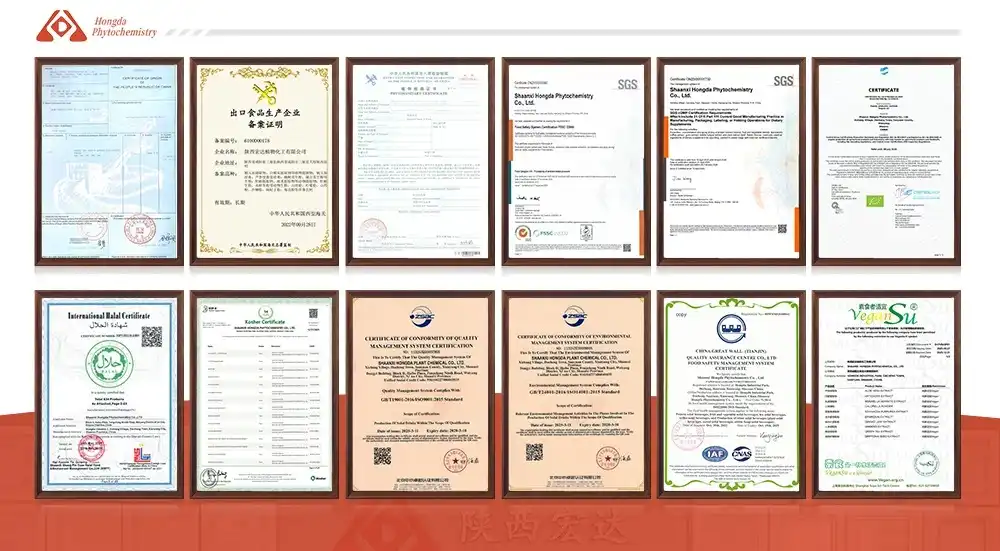
Hongda's certification portfolio, including cGMP, FSSC22000, ISO22000, and ISO9001, alongside EU and NOP organic certification and longstanding halal, kosher, BRC, and FDA-related credentials built since 2001, reflects quality management systems that extend into storage and handling practices, not just manufacturing output. These certifications typically require documented environmental controls and standard operating procedures for ingredient storage as part of the audit process, giving buyers indirect confirmation that storage practices meet recognized international standards. [1][3]For brands building regulatory files around uridine powder, citing these certifications adds credibility to storage and handling claims beyond a supplier's own marketing language.
Flexible Ordering Without Compromising Freshness
Hongda's ordering structure accommodates both small sample quantities for formulation trials and larger wholesale volumes, but the company maintains the same storage discipline across every order size rather than reserving careful handling for larger commercial shipments only. This consistency matters for smaller brands placing modest orders, since freshness and proper storage should not become a lower priority simply because an order is smaller in volume. Buyers can request shipment timing that aligns with their own production schedule, minimizing the time uridine powder spends in transit or secondary storage before it reaches active use in a formulation.
Conclusion
Storage conditions play a bigger role in preserving uridine 5'-monophosphate disodium salt powder's potency than many formulators initially expect, and getting temperature, humidity, light, and packaging right protects both product quality and production timelines. For brands also sourcing uridine powder, proper storage practices are equally important to maintain ingredient stability throughout handling and transportation. Hongda Phytochemistry's zoned warehouse system, documented testing, and storage-focused packaging give international buyers a manufacturer built around stability from factory to formulation. Brands sourcing these nucleotide ingredients are encouraged to request full storage and specification guidance directly from Hongda's technical team.
FAQ
1. What temperature should uridine powder be stored at?
Cool, stable conditions are best; avoid repeated temperature swings and direct heat exposure.
2. Does humidity really affect this ingredient?
Yes, as a water-soluble compound, it is sensitive to moisture and should be kept dry and sealed.
3. How long does the powder last under proper storage?
It maintains stable potency for an extended shelf life when stored cool, dry, and sealed from light.
4. Does Hongda provide storage guidance with each order?
Yes, every shipment includes a specification sheet with storage and handling recommendations.
Get Storage Guidance From HONGDA
If you're sourcing uridine 5' - monophosphate disodium salt powder and want to protect potency from factory to formulation, Hongda Phytochemistry's storage-focused packaging, zoned warehouse system, and documented testing give you a manufacturer built for reliability. Reach our technical team at duke@hongdaherb.com to request specification sheets, storage guidance, or a wholesale quote. We'll help match the right packaging and shipment timing to your production schedule, wherever your facility is located.
References
1. Connors, K. A., Amidon, G. L., & Stella, V. J. — Chemical stability of pharmaceuticals: a handbook for pharmacists.
2. Waterman, K. C., & Adami, R. C. — Accelerated aging: prediction of chemical stability of pharmaceuticals.
3. Carstensen, J. T. — Drug stability: principles and practices.
4. Cansev, M. — Uridine and cytidine in the brain: their transport and utilization.
5. Bott, R. F., et al. — Influence of moisture on the solid-state stability of pharmaceutical compounds.
6. Carver, J. D. — Dietary nucleotides and their role in infant nutrition and immune development.