




NAD+ is one of the hottest vitamin constituents right now, but you don’t see it very frequently on its own. Brands strive to couple it with Vitamin C, glutathione, CoQ10, Vitamin E, or polyphenols to provide a more complete picture of antioxidants. This makes it harder to formulate in the actual world. Does mixing liposomal NAD+ powder with other antioxidants hurt the liposomes? Short answer: it does happen frequently as long as you pay attention to pH, moisture, ionic strength, and how each partner operates at a lipid barrier. This is a firm known to people as Hongda Phytochemistry. They offer liposomal NAD+ powder. It includes more than 10 manufacturing lines and a 20,000-square-meter location, including an SGS-certified lab. This article explains what to mix, what to look for, and how to make sure the mix works.[1][4][5][6]
The Short Answer: Yes, With Rules
Hongda's Dry Powder Gives Blenders a Strong Starting Point
Formulators love dry dust because liposomes are most likely to break when they are in water. Hongda Phytochemistry has a 100,000-level workshop that can make liposomal NAD+ powder under controlled drying and processing. The workshop can handle up to 3,000 tons of powder per year and has more than 150 workers. Before it goes on its way, we check each batch for bacteria, chemical leftovers, ingredients, and moisture. More than twenty researchers and testers work in the lab, which has high-performance liquid chromatographs and spectrophotometers that can be used for nucleotide analysis. Certifications like FSSC 22000, ISO 22000, cGMP, FDA, halal, and kosher help brands in the US and Europe make sure that the food they buy is safe. Before any antioxidant is added, there is a solid base: a liposomal NAD+ powder that is dry, well-documented, and reliable.
Why NAD+ Is a Delicate Molecule
The coenzyme NAD+ is big and likes water, so it can't handle harsh conditions. It breaks down in alkaline solutions, when heated, and over time, enzymes and water may also break it down. Liposomes do this by putting this water-loving molecule inside a shell of phospholipids that protects the aqueous core. That wall, though, is only as strong as the vesicle that makes it, so anything that breaks it lets NAD+ out again. This is why it's important to have blending partners. A good antioxidant keeps the shell whole and might even help it stay that way. A bad one, on the other hand, could let the core escape, cause aggregation, or speed up breakdown. All liposomal NAD+ powder forms are made to protect both the NAD+ inside and the shell that surrounds it.
What "Breaking Liposomes" Really Looks Like
Broken liposomes don't usually come out in a big way. Instead, three mistakes are not seen. The encapsulated NAD+ leaks into the medium around it because of leakage. Fusion, also called aggregation, is when small vesicles join together to form bigger ones. This makes particles bigger and changes how easily they can be spread. When the phospholipids break down or oxidize, the shell gets weaker over time. It is possible to measure each failure: leaking can be done by measuring free and total NAD+; particle size and polydispersity can be used to measure particle aggregation; and lysophospholipids or peroxide value can be used to measure shell damage. When you mix a liposomal NAD+ powder with other antioxidants, you want all three measurements to stay the same compared to a sample that wasn't mixed. By making failure clear in this way, compatibility testing is easy, and your quality team doesn't have to guess what a pass or fail means.[4][5][6]
How Antioxidants Can Disturb a Liposome
pH and Ionic Strength Shifts
Often, antioxidants are acids or salts. This means that as soon as the powder hits water, the pH and ionic strength change. Mineral salts make the ionic strength stronger, while ascorbic acid, lipoic acid, and some antioxidants make the drink very acidic. NAD+ works best in a slightly acidic to neutral environment. It breaks down quickly in alkaline conditions, so buffers that are too basic are dangerous. Also, phospholipid shells break down more quickly when the pH is very high, and high ionic strength could push down the charge barrier that separates vesicles, which would make them stick together. The safest way to use liposomal NAD+ powder is to check the pH of the finished drink, make sure it stays in a healthy range, and then check the particle size after mixing. A buffer and a small change can often fix the problem before the user even notices it. [2]
Membrane Insertion and Fluidity
Antioxidants that dissolve in fat don't just sit next to liposomes; a lot of them move inside the membrane. Vitamin E and CoQ10 are well-known examples. They may help strengthen the barrier and keep lipids from oxidizing in small amounts. But too much can mess up the packing, change how fluid the system is, and make it more likely to leak. Amphiphilic chemicals, like lipoic acid or other surfactants, may act a lot like cleansers when they are present in large amounts. For liposomal NAD+ powder to be useful, you need to know the dose. You need to find out how much of each lipophilic partner the shell can hold and add it either in the lipid phase during production or as a separate dry component. It shouldn't be added randomly at the end. Measured gentle combinations keep NAD+ where it goes and keep the structure of the vesicles.[3][4]
Redox Reactions and Trace Metals
As the name suggests, antioxidants are redox-active. When trace metals like iron or copper are present, they may sometimes act as pro-oxidants to make reactive species that attack lipids. Vitamin C is the most common example. It is helpful in a clean system, but it can be harmful if metal ions are present and there is too much moisture. Thiols and polyphenols might interact with other things or the redox chemistry of NAD+; it depends on the situation. You can lower these risks by using clean raw materials, chelating agents in some formulas, low moisture, and good packaging. For liposomal NAD+ powder, get heavy metal and trace metal data from each partner ingredient provider. Also, look into how mineral-rich chemicals in the same mix can impact the vesicles. If there are any secret redox reactions, a simple storage test at a higher temperature will show them.
|
Trigger
|
Effect on Liposomes
|
Early Sign
|
|---|---|---|
|
pH extremes
|
Phospholipid hydrolysis; NAD+ degradation
|
Drifting pH, odour or colour change
|
|
High ionic strength
|
Charge screening and aggregation
|
Rising particle size
|
|
Excess lipophilic additive
|
Membrane disruption and leakage
|
Increase in free NAD+
|
|
Metal-catalysed oxidation
|
Lipid peroxidation
|
Rancid odour, higher peroxide value
|
|
Moisture
|
Hydrolysis and caking
|
Clumping, rising moisture
|
Planning an antioxidant blend? Email duke@hongdaherb.com with your target partner ingredients, format, and dose, and ask the Hongda team about samples of liposomal NAD+ powder for a compatibility trial.
Partner-by-Partner Compatibility
Water-Soluble Partners: Vitamin C, Glutathione, and Friends
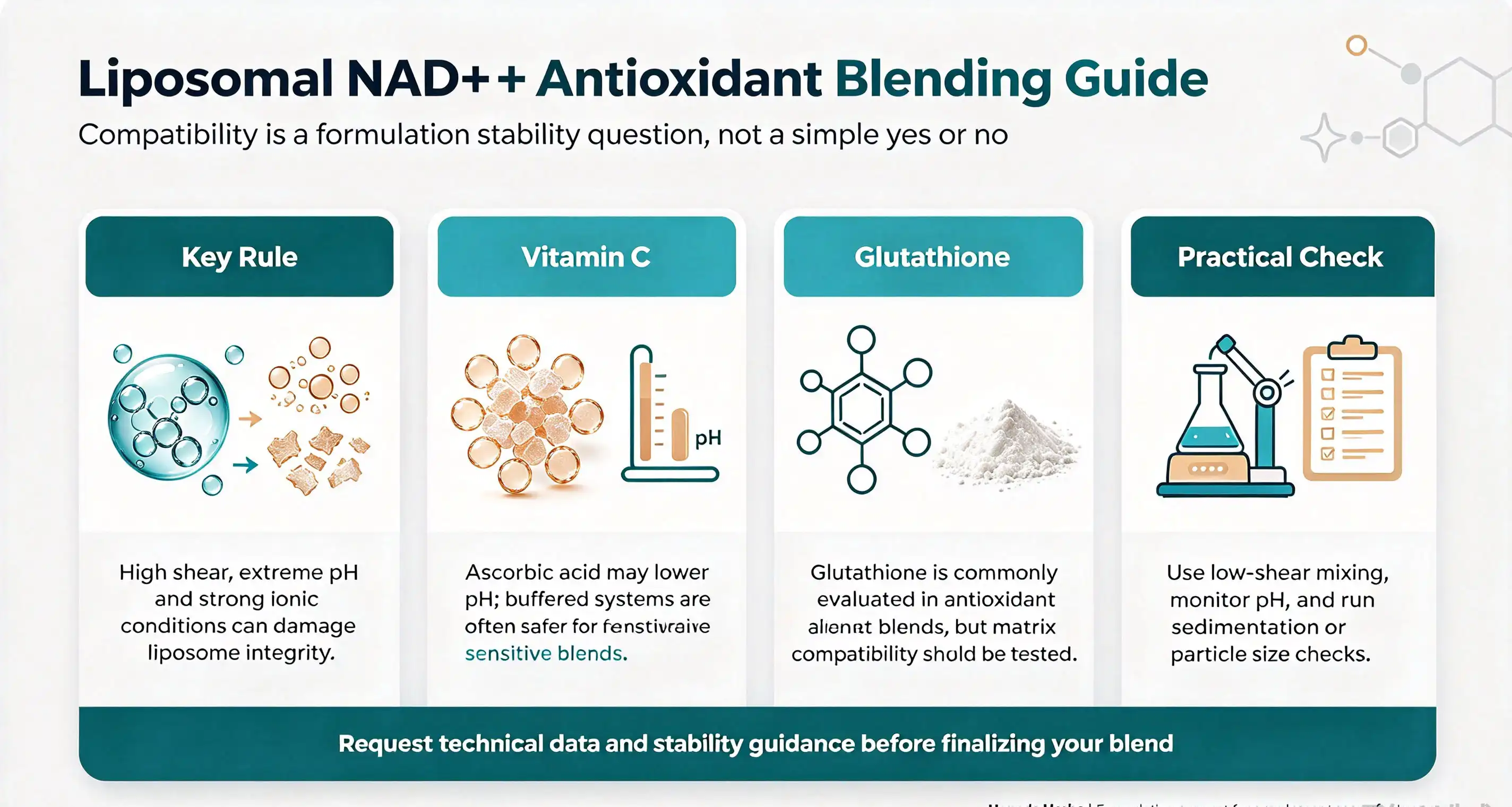
Since antioxidants are usually acids or salts, the pH and ionic strength change as soon as the powder hits the water. There is a lot of acid in the drink because of ascorbic acid, lipoic acid, and some antioxidants. Mineral salts make the electric charge stronger. NAD+ itself likes a slightly acidic to neutral pH and is quickly destroyed by a basic alkaline pH. For this reason, buffers that are too basic are harmful. At the same time, phospholipid shells break down more quickly when the pH is very high, and high ionic strength may push down on the charge barrier that separates vesicles, making them stick together more. A safe way to use liposomal NAD+ powder is to check the pH of the finished drink, make sure it stays in the right range, and then look at the particle size after mixing. Just making a small change to the border can sometimes fix the issue before it even gets to the user.[5]
Membrane Insertion and Fluidity
A lot of the fat-soluble antioxidants don't just hang out next to the liposomes; they also get into the membrane. Vitamins like E and CoQ10 are well-known examples. In small amounts, they may help to strengthen the membrane and protect lipids from oxidation. But too much can make packing harder, change how flexible the system is, and cause it to leak. When present in higher amounts, amphiphilic substances such as lipoic acid or other surfactants work a lot like detergents. When using liposomal NAD+ powder, it's important to know how much to use, how much of each lipophilic partner the shell can hold, and whether to add it during production as part of the lipid phase or as a separate dry component. It should not be added without planning ahead. Combinations that are gentle have been tried to keep NAD+ and vesicle structure where they belong.
Redox Reactions and Trace Metals
By definition, antioxidants are redox-active, and when trace metals like iron or copper are present, they may sometimes work as a pro-oxidant to make reactive species that attack lipids. Vitamin C is the most well-known example. This is good when the system is clean, but it can be dangerous when metal ions are present and there is a lot of moisture. If the conditions are right, thiols and polyphenols may react with other chemicals or the redox chemistry of NAD+. Clean raw materials, chelating agents in some formulations, low moisture, and good packaging can help lower these risks. To get liposomal NAD+ powder, ask each partner ingredient provider for heavy metal and trace metal data. Also, think about what will happen to the vesicles when mineral-rich substances are mixed in with the powder. Any secret redox reactions will be shown by a simple storage test at high temperature.[3][6]
|
Partner Class
|
Examples
|
Rating and Note
|
|---|---|---|
|
Water-soluble
|
Vitamin C, glutathione
|
Green in dry blends; Amber in drinks (pH, metals)
|
|
Fat-soluble
|
Vitamin E, CoQ10, astaxanthin
|
Green as a dry premix; Amber if oils or surfactants are added
|
|
Polyphenols
|
Resveratrol, quercetin, EGCG
|
Amber dose-dependent; pilot test
|
|
Minerals
|
Magnesium, zinc, calcium
|
Amber raises ionic strength
|
|
Surfactants and alcohol
|
Emulsifiers, alcohol-based flavours
|
Red can dissolve membranes
|
Building and Proving a Compatible Blend
Dry Blending, Moisture Control, and Packaging
Keep everything dry to keep the liposomes safe. Mix liposomal NAD+ powder with antioxidant powders in a low-humidity location with dry, non-water-absorbing materials. Don’t blend it so much that it causes a lot of shear or heat. Store in sealed foil-laminate bags or bottles with desiccant. Make sure you explain how to keep it clearly. Hongda Phytochemistry’s facility is divided into six storage rooms, and the firm has a lot of stock on hand so companies can arrange mixing runs without having ingredients sitting around waiting for terrible things to happen. Record the moisture contents before and after each blending session. The first clue that anything is amiss with a recipe is an increase in moisture. Liposomal NAD+ powder may happily co-exist with a variety of antioxidants throughout the whole shelf life of a bag or tablet, with dry processing and careful packaging.
A Practical Pilot Test Plan
Before full output, compare the mix to a control of liposomal NAD+ powder that has not been combined. Check the quantity of NAD+ present (free vs. total NAD+), the particle size and polydispersity after rehydration, the pH, the moisture content, and the appearance of the sample at the start. Repeat this again at room temperature, at defined time intervals, and at a quicker pace. Keep numbers similar using the same approaches throughout. If the mix contains items that may oxidize, include peroxide value or any other signal of lipid oxidation. A scheme like that may provide early guidance in a matter of weeks and save months of effort that would have to be re-done. Tell your supplier what you have discovered. In many cases, the technical team will recommend improvements that need to be made to bring the mix back to acceptable boundaries. For example, they may propose modifying the sequence of mixing ingredients or reducing the dose of one of the ingredients.
Choosing a Liposomal NAD+ Powder Supplier for Long-Term Support
If you have a formulation task, you really want to deal with a supplier that can answer high-level queries. Hongda Phytochemistry was founded in 2001 and is a National High-tech Enterprise. It also has BRC, FDA, organic, cGMP, FSSC 22000, and ISO 9001 credentials that make it simpler for brands to market in the US and Europe. The talks are backed by two R&D institutions and a lab equipped with high-performance liquid chromatographs and spectrophotometers. Any provider of liposomal NAD+ powder should offer you a standard paper, evidence of analysis, particle size data, and storage instructions. Then ask for a little sample so you can investigate compatibility. Good providers prefer this method since it allows for a reliable and well-documented product. As time passes, you gather additional data, which you may use to create new mixes. This accelerates the development process and increases confidence among retailers and distributors.
|
Test
|
Purpose
|
Pass Signal
|
|---|---|---|
|
NAD+ assay
|
Confirms content
|
Close to the unmixed control
|
|
Free versus total NAD+
|
Detects leakage
|
No rise in the free fraction
|
|
Particle size and PDI
|
Detects aggregation
|
Stable compared with control
|
|
pH and moisture
|
Early warning
|
Within the planned range
|
|
Peroxide value
|
Tracks lipid oxidation
|
No upward trend
|
|
Appearance
|
Visual check
|
No clumping or colour change
|
Conclusion
If you understand how the science works, you can combine liposomal NAD+ powder with enough vitamins without breaking down the liposomes. Make sure the formulations are dry, check the pH and ionic strength, and offer the partners a dry premix that they dissolve in fat. No alcohol or detergents. Add the ingredients slowly and evaluate each combination against an unmixed control. Observe the quantity of NAD+, the loss, and the particle size as a function of time: With a 20,000-square-meter factory, an SGS-standard laboratory, strict pre-shipment testing, a lot of inventory, and globally recognized certifications, Shaanxi Hongda Phytochemistry Co., Ltd. is well-positioned to help brands in the US and Europe to confidently make antioxidant blends and products that are stable from the first pilot batch to the last sachet.
FAQ
1. Can I mix liposomal NAD+ powder with vitamin C?
Yes, in a low-moisture dry blend. In drinks, check pH and particle size after mixing.
2. What most often breaks liposomes in blends?
Moisture, extreme pH, high ionic strength, surfactants, and excess lipophilic additives.
3. How do I know the liposomes survived mixing?
Compare free versus total NAD+ and particle size with an unmixed control.
4. Should fat-soluble antioxidants be added directly?
Use a separate dry premix and blend gently in a low-moisture room.
Test Your Blend | HONGDA
If you are building an antioxidant formula around NAD+, start with an ingredient you can test and a supplier who answers technical questions. Shaanxi Hongda Phytochemistry Co., Ltd. offers liposomal NAD+ powder supported by a modern factory, an SGS-standardized laboratory, ample inventory, and certifications that open doors in the United States and Europe. Tell us your partner ingredients, target format, and market, and our specialists will reply with documentation, practical suggestions, and sample options. Whether you are a formulator, an OEM brand, or a distributor, begin today and prove compatibility before you scale. Write to duke@hongdaherb.com and let HONGDA help you launch a stable, well-documented blend.
References
1. Covarrubias AJ, Perrone R, Grozio A, Verdin E. NAD+ Metabolism and Its Roles in Cellular Processes During Ageing. Nature Reviews Molecular Cell Biology. 2021;22(2):119-141.
2. Wu JT, Wu LH, Knight JA. Stability of NADPH: Effect of Various Factors on the Kinetics of Degradation. Clinical Chemistry. 1986;32(2):314-319.
3. Fukuzawa K, Chida H, Tokumura A, Tsukatani H. Antioxidative Effect of Alpha-Tocopherol Incorporation Into Lecithin Liposomes on Ascorbic Acid-Fe2+-Induced Lipid Peroxidation. Archives of Biochemistry and Biophysics. 1981;206(1):173-180.
4. Laouini A, Jaafar-Maalej C, Limayem-Blouza I, Sfar S, Charcosset C, Fessi H. Preparation, Characterization and Applications of Liposomes: State of the Art. Journal of Colloid Science and Biotechnology. 2012;1(2):147-168.
5. Grit M, Zuidam NJ, Underberg WJM, Crommelin DJA. Hydrolysis of Partially Saturated Egg Phosphatidylcholine in Aqueous Liposome Dispersions and the Effect of Cholesterol Incorporation on Hydrolysis Kinetics. Journal of Pharmacy and Pharmacology. 1993;45(6):490-495.
6. Waraho T, McClements DJ, Decker EA. Mechanisms of Lipid Oxidation in Food Dispersions. Trends in Food Science & Technology. 2011;22(1):3-13.