


_1745918362135.webp)

Not all liposomal resveratrol powders on the market contain what the label says, and purchasers who don’t verify frequently find out the hard way after a product has already been manufactured and packed. Shaanxi Hongda Phytochemistry Co., Ltd. tackles this issue head-on by integrating purity testing into the manufacturing process itself rather than considering it as an optional extra, offering customers a supply of liposomal resveratrol they can verify at every step. In this essay, we’ll explore what “verified purity” should imply for this ingredient category, what tests truly confirm it, and how buyers may create a recurring habit of verification into their sourcing process.
What "Verified Purity" Really Means for Liposomal Resveratrol Powder?
Trans-Resveratrol Content Versus Encapsulation Rate
There are two different figures that tell you whether a batch of liposomal resveratrol powder is of good quality, and consumers who just look at one of them are missing half the story. The first is the content of trans-resveratrol, usually stated as a percentage of purity, validated by chromatographic analysis.[1] The second, and often-overlooked, is encapsulation rate—the percentage of that resveratrol that is really encapsulated within intact phospholipid vesicles, rather than floating free in the powder. A batch might have a high purity number on its label but a poor encapsulation rate. This means most of the stated liposomal benefit never makes it to the finished product. Serious purchasers will ask for both numbers before placing their order.
Why Standard Purity Labels Can Be Misleading?
A printed purity percentage gives the consumer little or nothing about how the percentage was tested or which batch it relates to. Other providers may use the same reference certificate for many shipments, and others will state the purity of the raw resveratrol input, not the final liposomal resveratrol powder that actually arrives. Buyers used to buying traditional plant extracts may carry over those same behaviors to finding liposomal ingredients, not appreciating the additional layer of complexity. The first genuine step to meaningful verification beyond surface-level label confidence is to read beyond the headline statistic and ask what process, equipment, and batch reference created it.
The Role of Particle Uniformity in True Purity
In the liposomal context, purity is associated with particle uniformity. Inconsistent vesicle sizes are generally a sign of an unstable manufacturing process, even if the overall resveratrol assay looks acceptable. The best liposomal resveratrol powder usually has vesicles packed densely in the 80 to 120 nm range, created using a controlled high-pressure shear-compression embedding process rather than a crude emulsification shortcut. Wide particle size fluctuation in a single batch is generally associated with reduced encapsulation efficiency and less predictable absorption performance downstream. Buyers should consider particle size distribution data as a purity indication in itself, not just another secondary specification to glance at.[3][4]
How does Shaanxi Hongda Defines Purity Internally?
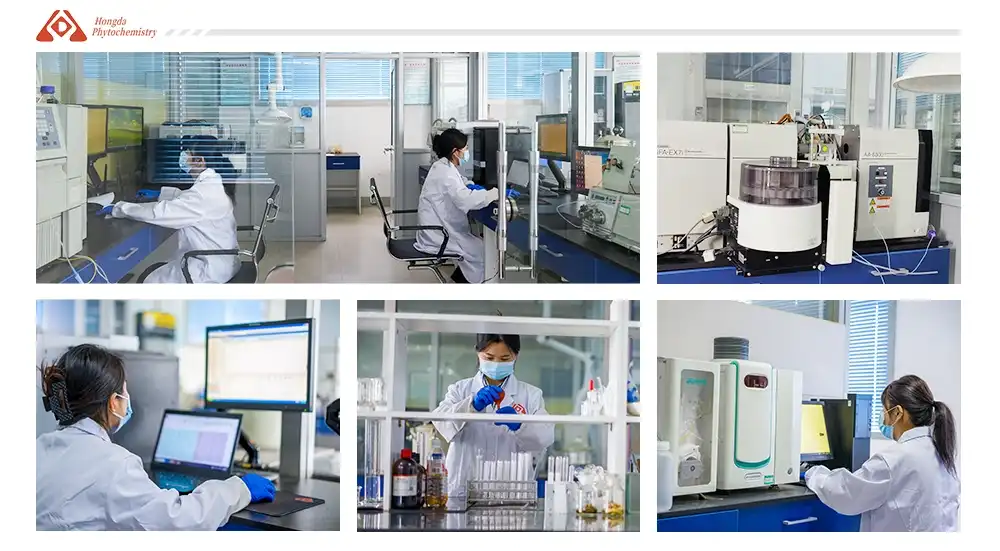
Shaanxi Hongda Phytochemistry Co., Ltd. does not provide a single isolated number for purity but rather a combined purity measurement that includes the level of trans-resveratrol, encapsulation efficiency, and particle uniformity. All of these inspections are performed in the firm’s own SGS-standardized laboratory before any batch of liposomal resveratrol powder is allowed for export. The company operates out of a roughly 20,000-square-meter facility with more than ten manufacturing lines and 100,000-level purification workshops. This internal standard acknowledges that downstream purchasers, especially those making bioavailability claims on finished goods, need more than a passing purity grade; they want verifiable confirmation across every dimension that characterizes a truly functioning liposomal ingredient.
The Verification Toolkit: Tests That Prove Liposomal Resveratrol Powder Is Genuine
HPLC Assay for Active Content
Buyers should anticipate nothing less than high-performance liquid chromatography when purchasing liposomal resveratrol powder, since it separates and measures trans-resveratrol to a degree that simpler screening techniques are incapable of achieving. A reliable resveratrol powder manufacturer should provide an HPLC report containing the chromatogram, not simply a summary percentage, along with a batch number that links the result to the actual shipment. Shaanxi Hongda’s laboratory, with high-performance liquid chromatographs and more than twenty research and testing personnel, conducts this assay on every manufacturing batch as a routine release requirement, not a special request for careful clients.
TEM Imaging for Structural Proof
While HPLC verifies the amount, transmission electron microscopy verifies the structure and gives purchasers a physical image of the liposomes themselves. Real liposomal resveratrol powder is distinguished by spherical vesicles at TEM magnification, a visual hallmark that no basic powder mix can mimic, no matter how it is sold. This test is particularly important for purchasers assessing a new factory or an unknown facility, since it’s easier to fake a picture than it is to fake a percentage on a data sheet. One low-cost method to identify vendors who are reluctant to provide visual evidence to support their liposomal claims is to request current TEM photos prior to making a trial purchase.[5]
Zeta Potential and DLS Particle Analysis
The particle size distribution is measured by dynamic light scattering, and the surface charge stability of the liposomal vesicles is measured by zeta potential testing, both of which provide a more complete view of the stability of the formulation over time. A liposomal resveratrol powder with an overall negative or positive zeta potential value is more resistant to particle aggregation during storage. This is correlated with extended functional shelf life in final goods. Most buyers don’t think to ask for zeta potential data along with typical particle size reports, yet the two metrics combined convey a more comprehensive stability picture than either one alone. Suppliers that provide both as a matter of course tend to have more robust internal quality procedures.
Ultracentrifugation Separation Testing
Ultracentrifugation is still one of the most straightforward methods to prove that resveratrol is indeed encapsulated and not merely combined with a phospholipid carrier. The spinning creates a high-speed sample that separates intact liposomes from free-floating active ingredients. The ratio of the two gives you a genuine encapsulation efficiency that a purity percentage cannot.[2][6] Batches of liposomal resveratrol powder that exhibit little free-ingredient separation following this test suggest a really functioning encapsulation, whereas large amounts of precipitation suggest a weaker or incomplete process. This approach is particularly helpful when comparing estimates from different resveratrol bulk powder vendors when the documentation seems almost similar.
|
Test
|
What a Failed Result Would Reveal
|
|---|---|
|
HPLC Assay
|
Diluted or substituted resveratrol content
|
|
TEM Imaging
|
Absence of true liposome structures
|
|
DLS / Zeta Potential
|
Unstable, inconsistent, or oversized particles
|
|
Ultracentrifugation
|
Poor or incomplete encapsulation efficiency
|
|
Heavy Metal / Pesticide Screening
|
Contaminated raw material inputs
|
Documentation Buyers Should Demand Before Payment
Certificate of Analysis Essentials
A usable certificate of analysis for liposomal resveratrol powder needs to go beyond a bare purity figure. Buyers should expect batch number, production and expiry dates, particle size range, carrier composition, and results for microbial, heavy metal, and pesticide residue testing, all tied to the specific lot being shipped rather than a generic template. When evaluating resveratrol bulk powder suppliers, documentation missing several of these fields should raise questions before payment is released, not after the shipment has already cleared customs. Suppliers confident in their process rarely hesitate to provide this level of batch-specific detail on request.
|
ANALYSIS
|
SPECIFICATION
|
RESULTS
|
||
|
Appearance
|
White powder
|
Complies
|
||
|
Odor
|
Characteristic
|
Complies
|
||
|
Tasted
|
Characteristic
|
Complies
|
||
|
Assay
|
50%(Resveratrol 50% Liposome 50%)
|
Complies
|
||
|
Sieve Analysis
|
100% pass 80 mesh
|
Complies
|
||
|
Loss on Drying
|
5% Max.
|
1.02%
|
||
|
Sulphated Ash
|
5% Max.
|
1.3%
|
||
|
Extract Solvent
|
Ethanol & Water
|
Complies
|
||
|
Heavy Metal
|
5ppm Max
|
Complies
|
||
|
As
|
2ppm Max
|
Complies
|
||
|
Residual Solvents
|
0.05% Max.
|
Negative
|
||
|
Microbiology
|
|
|
||
|
Total Plate Count
|
1000/g Max
|
Complies
|
||
|
Yeast & Mold
|
100/g Max
|
Complies
|
||
|
E.Coli
|
Negative
|
Complies
|
||
|
Salmonella
|
Negative
|
Complies
|
||
Batch Traceability Records
Traceability connects the finished liposomal resveratrol powder back through processing and raw material sourcing, and it matters most when something eventually needs investigating, whether that is a customer complaint or a routine compliance audit. Shaanxi Hongda's own planting bases and agronomist-supervised cultivation give the company a documented chain from raw botanical material through to the finished, encapsulated powder shipped to formulators. Buyers evaluating a resveratrol powder manufacturer should ask directly whether raw material origin can be traced to a specific harvest or planting record, since suppliers relying on unverified third-party trading intermediaries usually cannot answer this question with any real specificity.
Certification Portfolio Review
A manufacturer's certification history offers useful context for purity claims, even though certifications alone do not replace batch testing. Shaanxi Hongda's credentials span food production and feed additive licenses and halal, kosher, BRC, and FDA certifications earned over more than two decades, with cGMP, ISO9001, ISO22000, FSSC22000, and EU/NOP organic certifications added in 2025. If your compliance team needs current certificate copies or wants to walk through how these credentials map to a specific import market, reach out directly to duke@hongdaherb.com, and Shaanxi Hongda's team can supply documentation tailored to your regulatory requirements before you finalize a supplier decision.
Sample-to-Shipment Consistency Checks
A strong pre-order sample means little if the eventual bulk shipment does not match it, so buyers should build a consistency check into their process rather than assuming a single approved sample guarantees every future order. Comparing HPLC and particle size results from an initial sample against results from the first commercial shipment confirms whether a supplier's process holds steady at scale. Discrepancies at this stage are worth raising immediately, since they often indicate a difference between showcase-quality samples and standard production output, a gap that matters far more with liposomal resveratrol powder than with simpler, unencapsulated ingredients.
Comparing a Verified Manufacturer to an Unverified Trader
Vertically Integrated Production Versus Reselling
Buyers sourcing liposomal resveratrol powder frequently encounter two very different types of suppliers: manufacturers that control the full production process and trading companies that resell material sourced from unnamed third parties. A resveratrol powder manufacturer with its own planting bases, encapsulation lines, and laboratory can trace and document purity at every stage, while a reseller typically can only pass along whatever documentation the original producer chose to share. This distinction matters most when a purity dispute arises, since a vertically integrated manufacturer can investigate and correct a process issue directly, while a trading intermediary has far less ability to do so.[1]
In-House Lab Versus Outsourced Testing
An in-house laboratory allows a China resveratrol powder factory to test every single batch before release, while outsourced testing usually means only sampled batches are checked, leaving gaps in the documentation trail. Shaanxi Hongda's SGS-standardized laboratory, developed jointly with university researchers and staffed by more than twenty professor-level personnel, runs purity and particle-level verification internally as a routine part of production rather than an occasional spot check. Buyers comparing quotes should ask directly whether testing happens on every batch or only periodically, since the answer has a direct bearing on how confidently a purity claim can be trusted for any individual shipment.
Certification Depth as a Trust Signal
The depth and recency of a supplier's certification portfolio say something about how seriously purity and compliance are treated as an ongoing priority rather than a one-time box to check. A China resveratrol powder factory that has added cGMP, ISO22000, and organic certification within the past year is signaling continued investment, while a supplier whose certifications have not been updated in a decade may not reflect current manufacturing practices. Buyers should treat certification currency as part of the same due diligence process applied to batch-level test results, not as a separate or lower-priority consideration.
Long-Term Supply Reliability
Purity verification is not a one-time hurdle; it needs to hold steady across every future order for a supply relationship to remain worthwhile. Manufacturers with sufficient production scale, including facilities capable of roughly 3,000 tons of annual output, are generally better positioned to maintain consistent liposomal resveratrol powder quality across recurring bulk orders than smaller operations working near capacity. Buyers planning long-term sourcing relationships should weigh this production scale alongside individual batch test results, since a supplier's capacity to remain consistent over years of repeat orders is just as important as any single certificate of analysis.
|
Capability
|
Vertically Integrated Manufacturer
|
Trading Intermediary
|
|---|---|---|
|
Raw Material Traceability
|
Direct, documented
|
Often unavailable
|
|
Batch-Level Testing
|
In-house, every batch
|
Dependent on the original producer
|
|
Ability to Resolve Disputes
|
Can investigate and correct the process
|
Limited leverage
|
|
Certification Access
|
Direct, current copies
|
May be outdated or unverifiable
|
A Practical Verification Roadmap for First-Time and Repeat Buyers
Before the First Order
Before requesting a formal quote, buyers should ask any prospective resveratrol powder supplier for a recent COA, TEM image, and particle size report tied to an actual production batch rather than marketing material. Suppliers unwilling to share this basic documentation before a purchase order exists are unlikely to become more transparent once payment has been made. This early screening step filters out a meaningful share of unqualified suppliers before any real money or production time is committed to liposomal resveratrol powder that has not been properly vetted.
At the Sample Stage
Once a supplier passes initial documentation review, requesting a physical sample for independent laboratory testing is the next logical step, particularly for buyers planning a first bulk order. Independent HPLC and DLS results provide a check against the supplier's own reported figures, catching discrepancies while the cost of correction is still limited to a small sample rather than an entire shipment. This stage is where many purity problems surface for the first time, making it one of the more valuable, if occasionally skipped, steps in the sourcing process.[1][3]
At Bulk Shipment
When the first full commercial order ships, buyers should request updated batch-specific documentation rather than assuming it will automatically match the earlier sample. Spot-checking a portion of the shipment against the original sample's test results confirms the supplier's process held steady at production scale. Any meaningful deviation at this stage deserves a direct conversation with the supplier before the batch is accepted into inventory or moved into finished-product manufacturing.
Ongoing Quality Monitoring
Verification does not end once a supplier relationship is established; periodic re-testing and documentation review remain good practice for any brand relying on liposomal resveratrol powder in an active product line. Tracking particle size and purity trends across shipments over time helps buyers catch gradual process drift before it becomes a larger issue, and reputable manufacturers generally welcome this ongoing scrutiny rather than treating it as a sign of distrust. Consistent monitoring is what turns a single successful order into a dependable, long-term supply relationship.
Conclusion
Verifying liposomal resveratrol powder purity requires layered evidence: HPLC content data, TEM structural proof, particle size and zeta potential results, and complete batch documentation. Shaanxi Hongda Phytochemistry serves as a reliable resveratrol powder supplier, building this verification into standard practice across a certified, vertically integrated production process. Buyers who request this evidence before their first order and continue checking it over time protect both their formulations and their brand. Careful sourcing decisions deserve equally careful proof.
FAQ
1. Is a high purity percentage enough to confirm good liposomal resveratrol powder?
No, encapsulation rate and particle uniformity matter just as much as the raw purity figure.
2. What is the fastest way to catch a falsified certificate of analysis?
Check that the batch number and test values match the physical shipment labels exactly.
3. Should I test every shipment, or just the first one?
Periodic spot-checks across ongoing shipments are recommended, not just a one-time initial test.
4. Why does zeta potential matter for a resveratrol powder manufacturer's product?
It indicates how well the liposomal particles resist aggregation, supporting longer shelf stability.
Confirm Purity With HONGDA Before You Order
If your team needs verifiable proof before committing to a bulk purchase, Shaanxi Hongda Phytochemistry Co., Ltd. provides full batch-level documentation for every shipment of liposomal resveratrol powder, including HPLC assays, TEM imaging, particle size data, and complete certificates of analysis. Our SGS-standardized laboratory and vertically integrated facility exist to give buyers exactly the evidence their quality teams require. Contact duke@hongdaherb.com to request current documentation, a verification sample, or a full purity report, and source your next batch from HONGDA with real proof in hand.
References
1. Walle, T. "Bioavailability of Resveratrol." Annals of the New York Academy of Sciences, 2011.
2. Neves, A.R., et al. "Resveratrol in Medicinal Chemistry: A Critical Review of its Pharmacokinetics, Drug-Delivery, and Membrane Interactions." Current Medicinal Chemistry, 2012.
3. Davidov-Pardo, G., and McClements, D.J. "Nutraceutical Delivery Systems: Resveratrol Encapsulation in Grape Seed Oil Nanoemulsions Formed by Spontaneous Emulsification. "Food Chemistry," 2015.
4. Summerlin, N., et al. "Colloidal Delivery Systems: Bioavailability Enhancement of Resveratrol." Journal of Pharmacy and Pharmacology, 2015.
5. Caddeo, C., et al. "Effect of Resveratrol Encapsulated in Liposomes on Oxidative Stress and Skin Inflammation." International Journal of Pharmaceutics, 2019.
6. Amri, A., et al. "Administration of Resveratrol: What Formulation Solutions to Bioavailability Limitations?" Journal of Controlled Release, 2012.