



_1745918362135.webp)

Start With Quick Screens You Can Run in Minutes
The Tyndall Effect Light Test
On Hongda’s product site, there’s an easy visual cue: a real liposome preparation that’s dissolved should have a distinct Tyndall effect, or band of light, when a beam passes through the dispersion. Nanoscale vesicles scatter light, unlike ordinary dissolved molecules; therefore, a laser pointer or tiny flashlight will show the beam path in a transparent glass. Make a dilute dispersion of the liposomal curcumin powder in water and let it hydrate. Illuminate the hydrated powder from the side in a dim environment. A sharp, even band means colloidal particles of the correct size, but if the beam is dull and patchy, or you can see grit, it means something different. It can’t tell you a percentage, but it costs pennies, takes minutes, and it lets you determine whether a sample is worth more lab work.
Hydration Behavior and Sediment
Free curcumin is simple to recognize since the curcumin crystals are a vivid yellow-orange and do not readily dissolve in water. For a good liposomal curcumin powder, the dispersion of the powder in water should be homogeneously colored and stable enough for manipulation, but not in the form of a floating film, a speckled surface, or a layer of silt. Photograph a sample next to a plain curcumin control, made in precisely the same manner, for one hour. The contrast is typically sharp. Hongda’s product site also makes the point that it’s worth evaluating how the powder behaves in acidic beverages (a question that’s worth trying yourself in your desired beverage). This comparison helps your team determine whether the powder is suitable for ready-to-drink sachets where the quality of the dispersion is something customers will quickly notice.[1][3]
Color, Odor, and Basic Physical Properties
You should also include simple physical observations on your initial screen. Check the color of the liposomal curcumin powder from batch to batch. A movement toward brown may indicate oxidation or exposure to light, both of which curcumin hates. Note odor, flowability, and any clumping that may suggest moisture absorption. A reputable provider of liposomal curcumin will supply a specification sheet detailing appearance so that these findings have a reference. Curcumin is light-sensitive; therefore, keep samples in tight, opaque containers, and do your screening quickly. These checks will not replace analytical effort, but they form a habit of comparison, and it is comparison that reveals discrepancy. Keep a brief diary of everything, including dates, lot numbers, and images, so you can share results with your quality team or the manufacturer.
|
Screen
|
What You Do
|
What It Suggests
|
|---|---|---|
|
Tyndall effect
|
Shine a light through a dilute dispersion
|
Colloidal-scale particles are present
|
|
Dispersion and sediment
|
Hydrate and let stand for one hour
|
Grit or film points to free curcumin
|
|
Color and odor
|
Compare lots side by side
|
Drift may signal oxidation or handling issues
|
|
Acidic drink trial
|
Disperse at your beverage pH
|
Suitability for beverage formats
|
Quantify It: A Step-by-Step Encapsulation Efficiency Assay
Separating Free Curcumin From Vesicle-Bound Curcumin
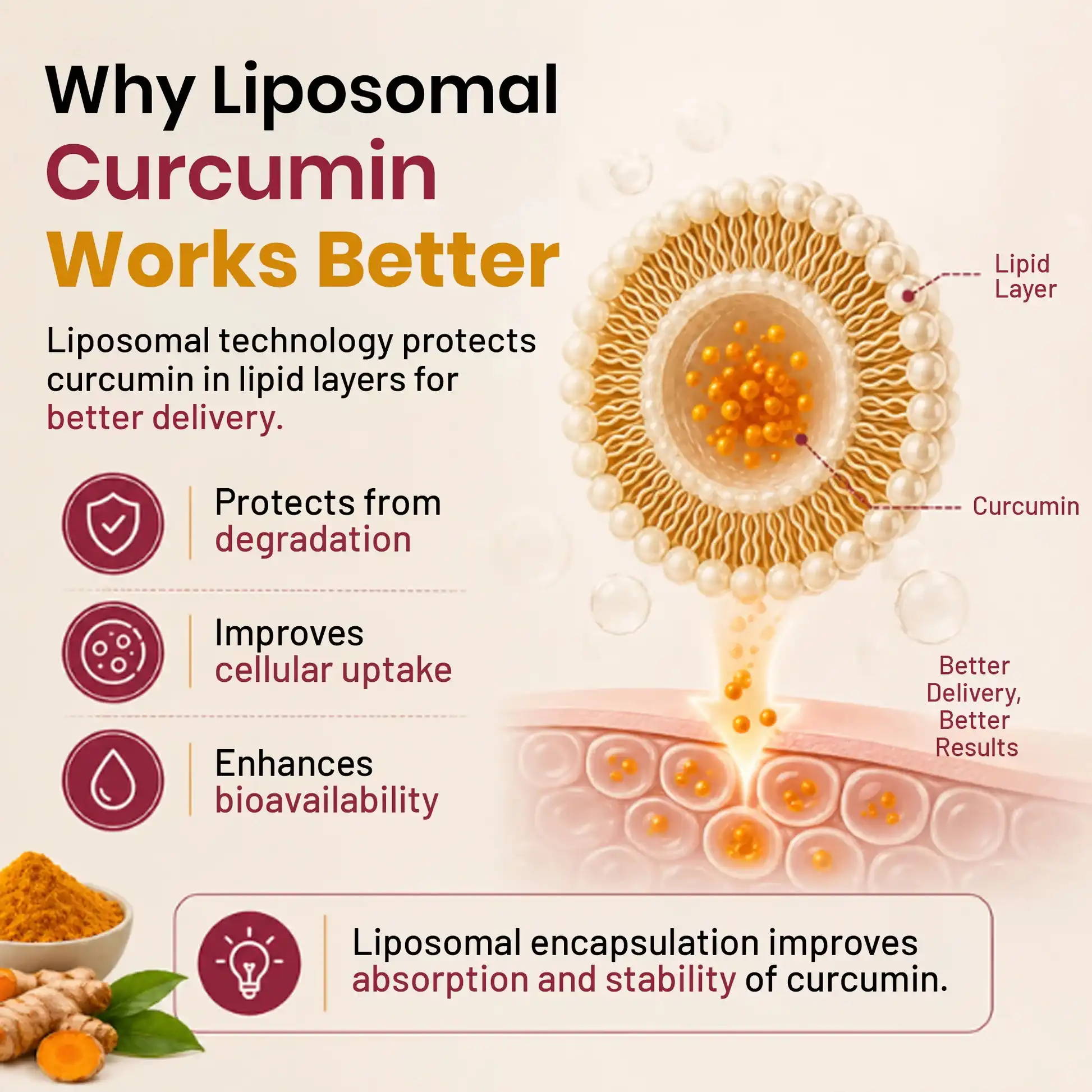
Encapsulation efficiency compares curcumin contained in the vesicles with total curcumin present; therefore, the first duty is to separate the two. However, free curcumin is poorly soluble and tends to crystallize or collect, so it can typically be removed by centrifugation or by passing the dispersion through a filter that catches particles bigger than the liposomes, while intact vesicles remain afloat. Gentler options include size-exclusion approaches and dialysis. Any provider of liposomal curcumin powder should be able to tell you what separation it employs and how it made sure the process does not split vesicles. Include a plain curcumin control (should be substantially cleared) disseminated in the same manner and an untreated liposome control (should be mainly kept). These controls are to check that your separation is doing its thing on the liposomal curcumin powder manufacturer.[4][6]
Breaking the Vesicles and Measuring Total Curcumin
To determine the amount of curcumin in the vesicles, release it. The phospholipid bilayer is broken down by a suitable organic solvent such as ethanol or methanol, and the curcumin is dissolved, which may be measured by HPLC or, for a rapid estimate, by UV-visible spectrophotometry. Buyers who seek specificity should pick HPLC, since it can separate the three curcuminoids in the extract: curcumin, demethoxycurcumin, and bisdemethoxycurcumin. Waters HPLC equipment is used in Hongda’s facility. Protect from light at all times. Prepare calibration standards fresh and run duplicates. Compare the percent of total and segregated vesicle measured. If your lab reports a different number than a supplier, address the technique before the value, since the choice of solvent, dilution, and separation conditions may all alter the result for the identical liposomal curcumin powder.[2][3]
Calculating and Reporting the Result
The calculation is straightforward: divide the amount of curcumin detected in the vesicle fraction by the total amount of curcumin measured after disruption and multiply by one hundred. What is striking is the reporting. A relevant result specifies the technique, the number of duplicates, the dispersion between them, and the lot tested. A single figure without context cannot be compared with anything. Hongda released industry guidelines which indicate that quality liposomal curcumin powder has an encapsulation rate of more than 80% for food-grade purposes and over 90% for pharmaceutical-grade, which offers purchasers a suitable baseline for debate. Use those statistics as benchmark points to verify against your own data, not as guarantees, and enter your approved technique and minimum result into the buy specification so subsequent lots are appraised the same way.
|
Step
|
Purpose
|
Key Control
|
|---|---|---|
|
Disperse the powder
|
Prepare a uniform sample
|
Fixed medium, time, temperature
|
|
Separate free curcumin
|
Isolate the vesicle fraction
|
Plain curcumin and intact-liposome controls
|
|
Disrupt vesicles
|
Release encapsulated curcumin
|
Suitable solvent, light protection
|
|
Quantify by HPLC
|
Measure curcumin content
|
Fresh standards, replicate injections
|
|
Calculate percentage
|
Encapsulated ÷ total × 100
|
Report method and spread
|
Prove the Structure: Microscopy, Size, and Original Chromatograms
TEM Images of Bilayered Vesicles
"A percentage of encapsulation is a computation; a TEM picture is proof. In addition to HPLC data, Hongda’s product site claims its TEM structural photos show physical confirmation of the encapsulation of curcumin inside the bilayered vesicles. When you get photographs, check for circular vesicles with apparent outlines, a scale bar, and information connecting the picture to your lot. Curcumin-laden liposomes should not appear like angular crystals or amorphous aggregates. Ask the provider how the sample was prepared for imaging, since the preparation might affect the look. Combine the picture with your own test result, and you’ve got a far more compelling story: a high encapsulation number backed by clear photos of vesicles, and you provide your marketing team with a strong foundation for portraying liposomal curcumin powder supplier appropriately.[4][6]
Particle Size and Distribution
Vesicle size impacts dispersion, stability, and performance of the product in the final recipe. The industry guideline of the Hongda knowledge library demonstrates that the desired particle size of liposomal curcumin powder is 100-200 nanometers, and a good report also shows the narrowness of the distribution, not simply the average. Request dynamic light scattering or laser particle size data performed on the same lot as your test and verify the apparatus, dispersion medium, and temperature specified in the report. The same size helps to make sure that capsules, sachets, and drinks work the same way, while a broad spread might mean clumping together or uneven processing. One of the fastest methods to assess repeatability of a manufacturer’s process is to compare size data across many batches.
Original Chromatograms and Heavy Metal Data
Summary certificates are easier to polish. Original data are harder to polish. Hongda says it provides COAs and also helps clients to obtain original test chromatograms. Its plant has Waters HPLC and ICP-MS for content and elemental analysis. When evaluating a liposomal curcumin producer, seek to examine the underlying HPLC trace behind the declared curcuminoid content, including peak identification and integration. Safety data . ICP-MS findings for heavy metals should be given with each element and its limit. Pesticide, moisture, and microbiological data complete the picture, and Hongda examines them before shipping. A glance at the raw data shows you whether numbers were created in a controlled laboratory. It inspires trust, since a provider that publishes chromatograms is confident in their liposomal curcumin powder.
|
No.
|
TEST ITEM
|
SPECIFICATION
|
RESULT
|
|||
|
1
|
Description
|
Yellow Powder
|
Conform
|
|||
|
2
|
Particle size (20 mesh)
|
≥90%
|
Conform
|
|||
|
3
|
Loss on drying
|
≤5.0%
|
2.33%
|
|||
|
4
|
Bulk Density
|
Measured value
|
368g/L
|
|||
|
5
|
Tapped Bulk Density
|
Measured value
|
721g/L
|
|||
|
6
|
Heavy Metals
|
Arsenic (As)
|
≤2.0ppm
|
Conform
|
||
|
Lead (Pb)
|
≤0.5ppm
|
Conform
|
||||
|
Mercury (Hg)
|
≤0.3ppm
|
Conform
|
||||
|
Cadmium (Cd)
|
≤0.3ppm
|
Conform
|
||||
|
7
|
Microbiological
|
Total plate count
|
≤10000cfu/g
|
10cu/g
|
||
|
Total molds and yeasts
|
≤1000cfu/g
|
10cfu/g
|
||||
|
Coliforms
|
≤10MPN/g
|
≤0.3MPN/g
|
||||
|
E.Coli
|
Negative/25g
|
Negative
|
||||
|
Salmonella
|
Negative/25g
|
Negative
|
||||
|
Staphylococcvs
|
Negative/25g
|
Negative
|
||||
|
8
|
Assay
|
Curcumin
|
70.0%±5%
|
71.6%
|
||
|
Phospholipids (NON-GMO)
|
15.0%±5%
|
12.9%
|
||||
|
Fatty Acids
|
15.0%±5%
|
13.8%
|
||||
|
Conclusion
|
Meet the in house standard.
|
|||||
Turn Test Results Into Sourcing Decisions
Benchmarks for Food-Grade and Pharmaceutical Applications
Different end uses justify different standards. Hongda's guidance describes encapsulation above 80% as a reasonable benchmark for food-grade applications and above 90% for pharmaceutical use, with particle sizes in the 100 to 200 nanometer range and curcuminoids standardized to 95%. Use these as a starting framework, then adjust for your product. A beverage concentrate, a soft-gel capsule, and a clinical nutrition product each place different demands on the ingredient. Hongda can customize liposome specifications with different curcumin loadings according to end-user needs, so define your requirements early and request samples that match them. Documenting the benchmark, the method, and the tolerance in your purchase specification turns testing from a one-time exercise into a repeatable quality standard for every lot of liposomal curcumin supplier you receive.[1][4][5][6]
|
Item
|
Reference Point
|
Basis
|
|---|---|---|
|
Encapsulation efficiency
|
Above 80% food-grade; above 90% pharmaceutical
|
Hongda buying guidance
|
|
Particle size
|
100–200 nm
|
Hongda buying guidance
|
|
Curcuminoid standardization
|
95%
|
Hongda buying guidance
|
|
Certifications
|
ISO22000, FSSC, Halal, Kosher, US FDA
|
Product page
|
|
Analytical support
|
COA, HPLC, TEM, ICP-MS, original chromatograms
|
Product page
|
Comparing Offers on Evidence
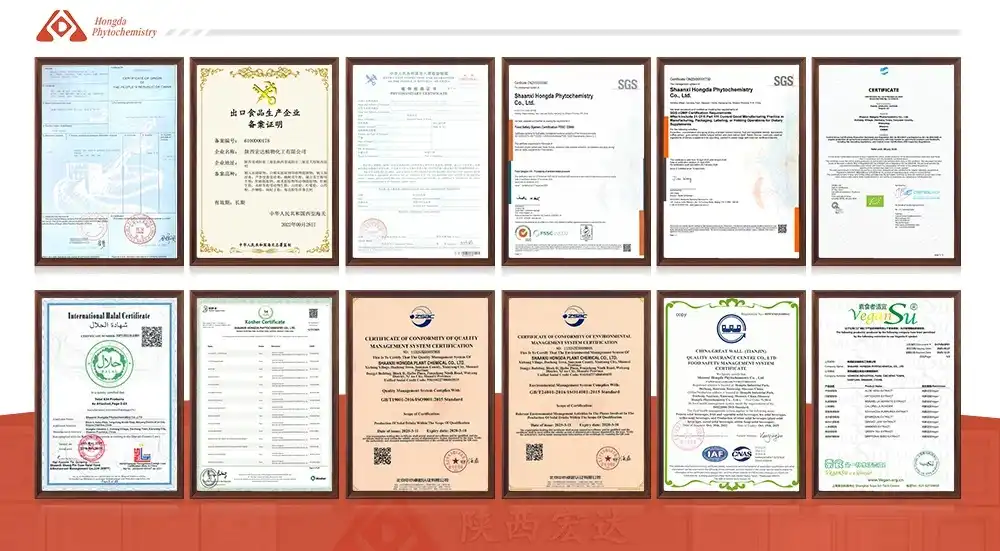
When several offers arrive, put the test evidence side by side. Which supplier provides the encapsulation method, replicate data, TEM images, particle size reports, and original chromatograms? Which one answers technical questions specifically? Price differences for liposomal curcumin powder often reflect real differences in carrier quality, process control, and analytical support, so a lower quote deserves scrutiny rather than immediate enthusiasm. Hongda offers its analytical documents together with sample orders, and its quality system carries ISO22000, FSSC22000, halal, kosher, and US FDA credentials. Build a simple scorecard with weighted criteria for evidence, capacity, certifications, and service, share it with purchasing and quality colleagues, and let the results guide your shortlist. A structured comparison reduces bias and helps you defend your choice to management and to customers.[6]
Choosing a Manufacturer for Long-Term Supply
Passing a test on a sample matters only if the same result can be repeated at scale. As a liposomal curcumin powder manufacturer, Shaanxi Hongda was established in 2001, operates a factory of about 20,000 square meters with more than 10 production lines and 100,000-level purification workshops, and employs more than 150 workshop technicians. An SGS-standardized laboratory built with university professors supports quality control, and a 3,000-square-meter warehouse supports on-time delivery. Together, these capabilities help brands move from a pilot batch to regular replenishment without changing partners. Share your forecast, keep your acceptance criteria current, and review lot data with your supplier regularly so that quality remains a shared, evidence-based conversation as your product grows in the market.
Conclusion
Testing encapsulation efficiency is a matter of layers. Quick screens such as the Tyndall effect and dispersion checks show whether a sample deserves attention; a controlled separation and HPLC assay produce the number; and TEM images, particle size data, and original chromatograms prove that the number rests on real structure. Shaanxi Hongda Phytochemistry Co., Ltd. supports every layer with HPLC and ICP-MS analysis, TEM images, customizable curcumin loadings, and certified facilities. Buyers who test for themselves choose better partners and build stronger products. Request samples, run the assay in your own laboratory, and let the evidence guide your next order from a liposomal curcumin manufacturer.
FAQ
Q1. Can I check whether it is liposomal without a laboratory?
Quick screens like the Tyndall effect and side-by-side dispersion tests give a first indication, though not a percentage.
Q2. How is encapsulation efficiency calculated?
Curcumin in the vesicle fraction divided by total curcumin, multiplied by 100, measured by HPLC.
Q3. What benchmarks apply?
Hongda guidance cites above 80% for food-grade and above 90% for pharmaceutical use, with 100–200 nm particles.
Q4. Which documents does Hongda provide?
COA, HPLC data, TEM structural images, and access to original test chromatograms.
Q5. Can the curcumin loading be customized?
Yes, liposome specifications with different curcumin loadings can be customized to your end-user needs.
Request Test Samples and Chromatograms From HONGDA
If you are sourcing liposomal curcumin powder and want to test encapsulation for yourself, HONGDA is ready to help. Our team will send samples with a COA, TEM images, and HPLC data, explain the methods behind each figure, and provide access to original test chromatograms on request. We can also customize curcumin loadings and quote factory-direct prices with OEM support. Tell us your dosage form, target grade, and timeline, and we will suggest a practical verification plan from pilot lot to repeat orders. Write to duke@hongdaherb.com today and let the evidence speak.
References
1. Anand P, Kunnumakkara AB, Newman RA, Aggarwal BB. Bioavailability of curcumin: problems and promises. Molecular Pharmaceutics. 2007;4(6):807–818.
2. Nelson KM, Dahlin JL, Bisson J, Graham J, Pauli GF, Walters MA. The essential medicinal chemistry of curcumin. Journal of Medicinal Chemistry. 2017;60(5):1620–1637.
3. Schneider C, Gordon ON, Edwards RL, Luis PB. Degradation of curcumin: from mechanism to biological implications. Journal of Agricultural and Food Chemistry. 2015;63(35):7606–7614.
4. Takahashi M, Uechi S, Takara K, Asikin Y, Wada K. Evaluation of an oral carrier system in rats: bioavailability and antioxidant properties of liposome-encapsulated curcumin. Journal of Agricultural and Food Chemistry. 2009;57(19):9141–9146.
5. Jäger R, Lowery RP, Calvanese AV, Joy JM, Purpura M, Wilson JM. Comparative absorption of curcumin formulations. Nutrition Journal. 2014;13:11.
6. Stohs SJ, Chen O, Ray SD, Ji J, Bucci LR, Preuss HG. Highly bioavailable forms of curcumin and promising avenues for curcumin-based research and application: a review. Molecules. 2020;25(6):1397.