



Berberine is a common compound, but researchers keep facing the same issue: when given orally, only a small amount gets into the circulation. This is why there is increased interest in liposomal delivery. This is why the question title has meaning. How does bioavailability change when liposomal berberine and regular berberine HCl are mixed together to make a supplement? Hongda Phytochemistry (Shaanxi Hongda Phytochemistry Co., Ltd.) offers liposomal berberine powder. The firm has a plant of 20,000 square meters with more than 10 manufacturing lines and an SGS-certified lab. This article presents an honest appraisal of the differences between the two kinds, discusses how liposomes may be beneficial, and illustrates how to apply that knowledge to produce a better pill, tablet, or bag.
The Quick Comparison and Where Hongda Fits
Hongda's Liposomal Berberine Powder, in Brief
The quality of a liposomal berberine powder company is determined by three factors: consistency of product, ability to check, and ability to deliver on time. Hongda Phytochemistry has a purification workshop of 100,000 grades with an annual production capacity of 3,000 tons of material. It also boasts over 150 workshop technicians and a lab with over twenty R&D and testing experts. All lots are tested for ingredients, pesticide residues, moisture, heavy metals, and microorganisms before shipment. Six storage spaces stock a lot of things that assist in ensuring on-time delivery. FSSC 22000, ISO 22000, cGMP, FDA, halal, and kosher are just a few of the certifications that verify to buyers in the US and Europe where their products originate from. This supply base is a suitable beginning for a company to start comparing liposomal berberine powder to a normal version.
Standard Berberine HCl: What It Does Well
Berberine hydrochloride has established itself as a standard medication. It’s inexpensive, simple to get hold of, and has been well researched; thus, many capsule and tablet products employ it as their major constituent. The hydrochloride salt is more soluble in water than the free base. It is known among formulators for its vivid yellow hue and unpleasant flavor. Its fundamental difficulty is not safety or handling but absorption: multiple studies reveal that just a tiny fraction of an oral dosage reaches the circulation in the body. That’s the issue liposomal techniques strive to tackle. I would start with the premise that ordinary berberine is a nice substance with a recognized problem, rather than saying that liposomal berberine powder is a remedy to all that came before it, which is a fair comparison.[3][4]
Where the Two Forms Diverge at a Glance
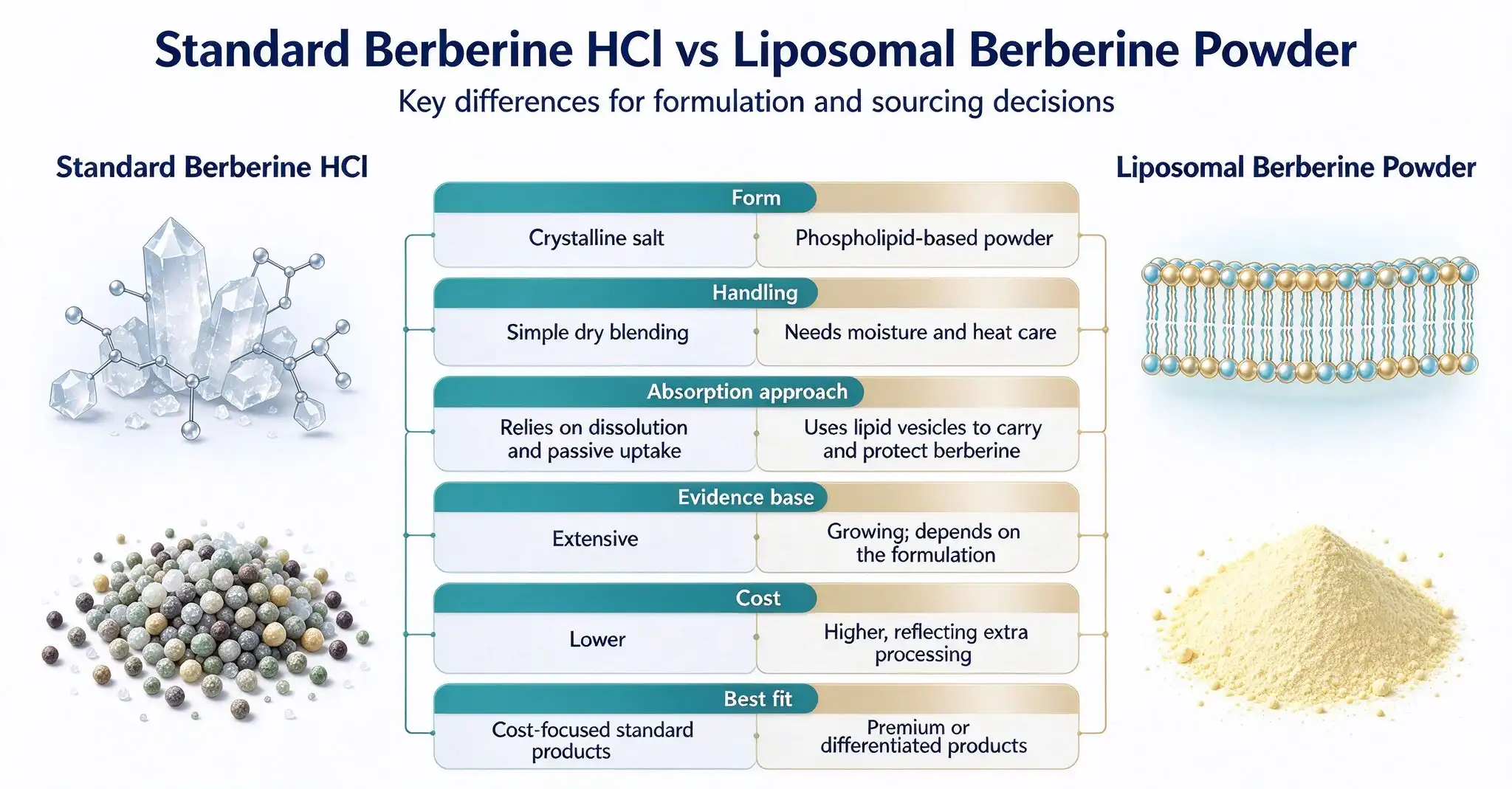
In the two types, the active molecule is provided and packaged in various ways. Regular Berberine HCl is a crystalline salt that dissolves in the digestive fluids and then needs to make its way through the gut wall on its own. Liposomal berberine powder is berberine encapsulated in or on phospholipid vesicles that are dried into a free-flowing powder. That might modify how the chemical is protected, distributed, and exposed to cells in the gut. There are additional variances in price, handling, label placement, and level of evidence behind the claim. The two options are shown side-by-side in the table below so product teams may review the advantages and downsides on one page before talking to sellers about the details. This is merely a planning tool and not a guarantee, since outcomes might differ depending on the particular composition and amounts employed.
|
Feature
|
Standard Berberine HCl
|
Liposomal Berberine Powder
|
|---|---|---|
|
Form
|
Crystalline salt
|
Phospholipid-based powder
|
|
Handling
|
Simple dry blending
|
Needs moisture and heat care
|
|
Absorption approach
|
Relies on dissolution and passive uptake
|
Uses lipid vesicles to carry and protect berberine
|
|
Evidence base
|
Extensive
|
Growing; depends on the formulation
|
|
Cost
|
Lower
|
Higher, reflecting extra processing
|
|
Best fit
|
Cost-focused standard products
|
Premium or differentiated products
|
Why Berberine Absorption Is the Real Challenge
Poor Permeability and Efflux Pumps
Berberine powder bulk is a positively charged chemical that does not cross the cell membranes of intestinal cells readily. Even if it does get inside a cell, transport proteins like P-glycoprotein may push it back out into the stomach. This decreases net uptake. One reason plasma levels are low after oral dosage is this outflow. Companies that create berberine hydrochloride powder have attempted a variety of approaches over the years, including dividing the dosage, combining it with things that help the body absorb it better, and making it spread out better. Each of them helps a bit, but none of them cures the fundamental issue. Understanding this process is useful because it explains why you need more than a purer or finer powder to affect bioavailability. You need a delivery method as well. More of either liposomal berberine powder or a standard product usually doesn’t provide comparable improvements.[2][3]
First-Pass Metabolism in Gut and Liver
Berberine crosses the stomach wall, where it is altered by enzymes in the lining of the gut and the liver before it enters the circulation. This is known as “first-pass metabolism.” In animal experiments, it has been shown that a lot of berberine is excreted via the intestines, and a lot of berberine is concentrated in the liver rather than in the plasma. This implies that low blood levels don’t necessarily imply no activity, but make it tougher to calculate dosages and compare items. The lesson for formulators is that any claim of increased bioavailability has to be justified by unambiguous definitions such as greater berberine in plasma, longer residence time, or better tissue distribution. Often you will hear people speak about liposomal berberine powder in response to these inquiries. But each goal requires its own evidence.[1]
The Gut Environment and Solubility Limits
Gut bacteria also convert berberine into other compounds. The conditions in the stomach, notably the pH and bile salt concentration, will influence the amount that is still spread out and accessible. Berberine may clump together in the stomach, and at greater amounts it’s not as simple to dissolve. Such connections may help explain why individuals respond differently and why studies don’t always reach the same conclusions. This variance might be reduced by using a transport system that maintains berberine well-dispersed and somewhat sheltered from the environment inside the gut. That’s how liposomal berberine powder works, but the real-life benefits rely on the quality of the vesicles, the dosage, and the final shape. Therefore, brands should include absorption as a product name attribute to be examined as a consequence of the recipe.
|
Barrier
|
What Happens
|
Formulation Strategy
|
|---|---|---|
|
Low permeability
|
A charged molecule crosses membranes poorly
|
Carrier systems such as liposomes; absorption-supporting excipients
|
|
Efflux transporters
|
Berberine is pumped back into the gut
|
Lipid-based delivery that may improve net uptake
|
|
First-pass metabolism
|
Gut and liver transform much of the dose
|
Delivery that changes absorption kinetics, plus dose design
|
|
Gut environment
|
pH, bile, and microbes alter availability
|
Better dispersion and protection from aggregation
|
Comparing forms for a new product? Email duke@hongdaherb.com and ask the Hongda team about samples and technical information for liposomal wholesale berberine, so you can run your own side-by-side evaluation.
What Liposomal Delivery Changes, and What It Does Not
How Liposomes May Improve Uptake
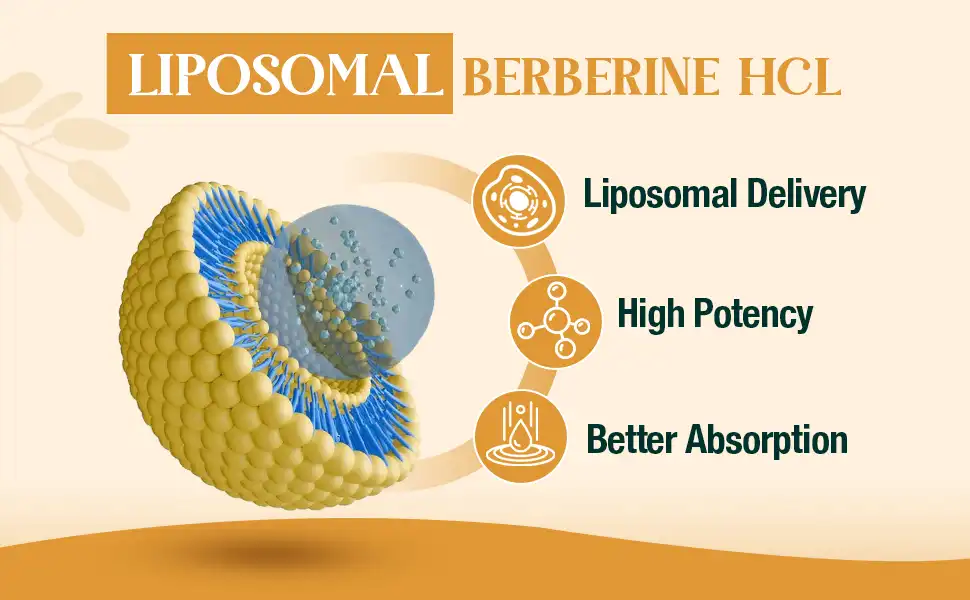
A liposome is a tiny bubble of phospholipids, the same molecules that form the walls of cells. A liposomal berberine powder has the berberine attached to these vesicles. This can aid in several ways: protecting the molecule from the gut environment, distributing it more uniformly, and allowing it to interact with the gut wall via lipid-to-lipid contact. Some studies investigating liposomes and other lipid-based carriers for poorly absorbed drugs have shown increased plasma exposure in comparison to the standard forms. But the consequences are not always the same, depending on the composition, size, and dosage of the molecule. It is thus reasonable to speak about liposomal administration as a means to raise the odds of absorption and not as a definite way of increasing absorption. Smart wording keeps your brand secure, regulators pleased, and allows you to communicate a clear, honest narrative about why a liposomal format is a smart option.[5][6]
What the Evidence Can and Cannot Tell You
There is much evidence for ordinary berberine, but human head-to-head data on some of the liposomal berberine formulations is still being collected. “Animal pharmacokinetic studies and in vitro permeability models can show trends that look good but don’t always work out in real life. Brands should seek information on the formulation they are buying, such as particle size, encapsulation rate, and, if possible, pharmacokinetic comparisons. Hongda Phytochemistry may provide the technical data available for their liposomal berberine powder so formulation teams can arrange their own inspections. If you don’t have a lot of evidence to support your claims, don’t put them on the label or in marketing. And also, don’t forget to obey the regulations of the sites you wish to visit. Honesty in your positioning creates confidence with consumers and distributors over time, and also makes it simpler to defend your product if a regulator or merchant asks for evidence.
Quality Factors That Decide Whether Liposomes Help
Some liposomal products are more effective than others. The effectiveness of liposomal berberine powder in the gut relies upon the size and form of the vesicles, the degree of encapsulation, the kind of lipids, and the ability of the powder to maintain its integrity after drying. A badly produced product might be nothing more than a blend of berberine and lecithin, which is not much better than plain old berberine HCl, but costs more. Request information on particle size and polydispersity after soaking, capsule data obtained by a reputable technique, and an analytical report that includes the quantity of berberine and the amount of moisture. Look at these figures from various groupings. To assist with this kind of documentation, Hongda Phytochemistry’s lab is equipped with high-performance liquid chromatographs and spectrophotometers. That instance, a really better ingredient is a distinct quality data point than a label promise.
From Ingredient to Finished Supplement: Practical Decisions
Capsules, Tablets, Sachets, and Softgels
Shape is everything. A capsule is the ideal container for liposomal berberine powder, since they are simple to fill and have little exposure to moisture. Tablets employ heat and squeezing force that might harm vesicles. They need to be tried on a limited number of patients beforehand. In low-moisture formulations, sachets and stick packs do well when combined while dry. Softgels may be used with lipid-based solutions if shell moisture is controlled. If you are purchasing a liposomal berberine powder manufacturer for multiple applications, try tiny quantities for each usage, then rehydrate and check the particle size to make sure the structure is the same. All of them can tolerate regular berberine HCl better, which is one of the reasons it’s still so popular. Don’t assume that one form will work for every line, but rather select the form that suits the tale you want to tell and the handling your tools can manage.
Dose, Cost, and Positioning for International Buyers
Cost and dosage interact in fascinating ways. Typical berberine HCl tends to be dosed the same; however, a liposomal version may require something else to perform the same thing. The liposomal chemicals are more expensive per kilogram; thus, companies should calculate the cost of the product per serving rather than per kilogram. Then they may evaluate whether the product is worth becoming a premium tier. Most of the time, overseas purchasers are looking for good documentation, a constant supply, and honest claims, not huge claims. Liposomal Berberine Powder should be sold as a premium delivery system for clients who are looking for something different. Standard berberine HCl should be preserved for value lines. The two-tier method allows a brand to provide a variety of pricing from one single reputable source, with one set of quality papers. That makes it simpler to acquire and gives the brand greater leverage.”
Sourcing Both Forms Under One Roof
Most companies like it when their suppliers can provide both, since it makes it easy to test and compare. If you are buying berberine in bulk for use in more than one product line, be sure to receive samples of both regular berberine HCL and liposomal berberine powder together with certifications, specifications, and how the samples were manufactured. Hongda Phytochemistry is a National High-tech Enterprise, established in 2001. It also offers certifications like BRC, FDA, organic, cGMP, and ISO 9001 that assist businesses in accessing the US and European markets. A big inventory and well-organized storage rooms facilitate on-time delivery, while two R&D institutes aid with continual innovation. Test side by side in your own lab or a respected contract lab. Then choose the form that most closely matches each line on the basis of evidence, cost, and consumer preference.
|
Format
|
Suitability for Liposomal Berberine Powder
|
Key Consideration
|
|---|---|---|
|
Capsule
|
High
|
Gentle filling; control moisture
|
|
Tablet
|
Moderate; pilot trials needed
|
Compression and heat may stress vesicles
|
|
Sachet or stick pack
|
High in dry, low-moisture blends
|
Foil packaging and clear mixing instructions
|
|
Softgel
|
Possible
|
Control shell water; lipid-compatible fill
|
|
Ready-to-drink
|
Demanding
|
Water activity, stability, and taste
|
Conclusion
Standard berberine hydrochloride powder manufacturers: HCl is still a trusted and affordable substance, although it is difficult for the body to absorb, as it has poor permeability, efflux, and first-pass metabolism. Berberine hydrochloride powder is a possible delivery method of berberine, designed to avoid these difficulties, but its usefulness relies on the quality of the vesicles, how they are produced, and verifiable claims supported by proof. Choose the format of each product that you are placing on a shelf carefully; examine the particle size and packing and work out the cost per serve. Shaanxi Hongda Phytochemistry Co., Ltd. has a 20,000 square meter factory, an SGS-certified lab, extensive testing before shipping, large inventory, and internationally recognized certifications that help brands in the US and Europe confidently compare both forms and make supplements that live up to their promises to customers, retailers, and regulators.
FAQ
1. Why is standard berberine HCl poorly absorbed?
Limited permeability, efflux pumps, and extensive first-pass metabolism reduce how much reaches circulation.
2. How might liposomal berberine powder help?
Phospholipid vesicles may protect and disperse berberine, improving the odds of absorption.
3. Is liposomal always better?
Not automatically. Results depend on vesicle quality, dose, and the finished format.
4. Which format suits liposomal berberine powder best?
Capsules and dry sachets are the easiest; tablets need pilot testing.
Compare Both Forms | HONGDA
If you are deciding between standard berberine HCl and a liposomal option, let real samples and real data guide you. Shaanxi Hongda Phytochemistry Co., Ltd. offers a modern factory, an SGS-standardized laboratory, ample inventory, and certifications that open doors in the United States and Europe. Tell us your target format, dose, and market, and our specialists will reply with documentation, practical suggestions, and sample options for liposomal berberine powder. Whether you are a formulator, an OEM brand, or a distributor, start the conversation today and build a tiered product line on one dependable supply base. Write to duke@hongdaherb.com and let HONGDA help you choose the right berberine for every product.
References
1. Liu YT, Hao HP, Xie HG, et al. Extensive Intestinal First-Pass Elimination and Predominant Hepatic Distribution of Berberine Explain Its Low Plasma Levels in Rats. Drug Metabolism and Disposition. 2010;38(10):1779-1784.
2. Maeng HJ, Yoo HJ, Kim IW, Song IS, Chung SJ, Shim CK. P-Glycoprotein-Mediated Transport of Berberine Across Caco-2 Cell Monolayers. Journal of Pharmaceutical Sciences. 2002;91(12):2614-2621.
3. Chen W, Miao YQ, Fan DJ, et al. Bioavailability Study of Berberine and the Enhancing Effects of TPGS on Intestinal Absorption in Rats. AAPS PharmSciTech. 2011;12(2):705-711.
4. Feng X, Sureda A, Jafari S, et al. Berberine in Cardiovascular and Metabolic Diseases: From Mechanisms to Therapeutics. Theranostics. 2019;9(7):1923-1951.
5. Sercombe L, Veerati T, Moheimani F, Wu SY, Sood AK, Hua S. Advances and Challenges of Liposome Assisted Drug Delivery. Frontiers in Pharmacology. 2015;6:286.
6. Bozzuto G, Molinari A. Liposomes as Nanomedical Devices. International Journal of Nanomedicine. 2015;10:975-999.