


_1745918362135.webp)

Liposomal Curcumin Powder vs Liquid: Which Is Better?
It can be hard for sourcing managers to find curcumin ingredients for useful foods or health supplements. There are two kinds of liposomal curcumin powder that they need to choose from. How you want to move the product, what you need to make it, and what you want to achieve with the design all play a role. Liposomal curcumin powder doesn't change much over time and is easy to put back together. It works well for many things because of these qualities, from pills to drinks that are already mixed. It is a main ingredient in pharmaceutical-grade pills that works up to 90% of the time. The particles stay between 100 and 200 nm, and they are absorbed more than 40 times better than regular curcumin. The first company to use phospholipids from non-GMO sunflower seeds in a new way to package phospholipids was Hongda Phytochemistry. Well-known names believe the raw materials they give them. This guide will explain the technical changes, show you how to use them, and tell you where to buy them. Because of this, you'll know where to get the things you need to make your goals and spread the word about your business.
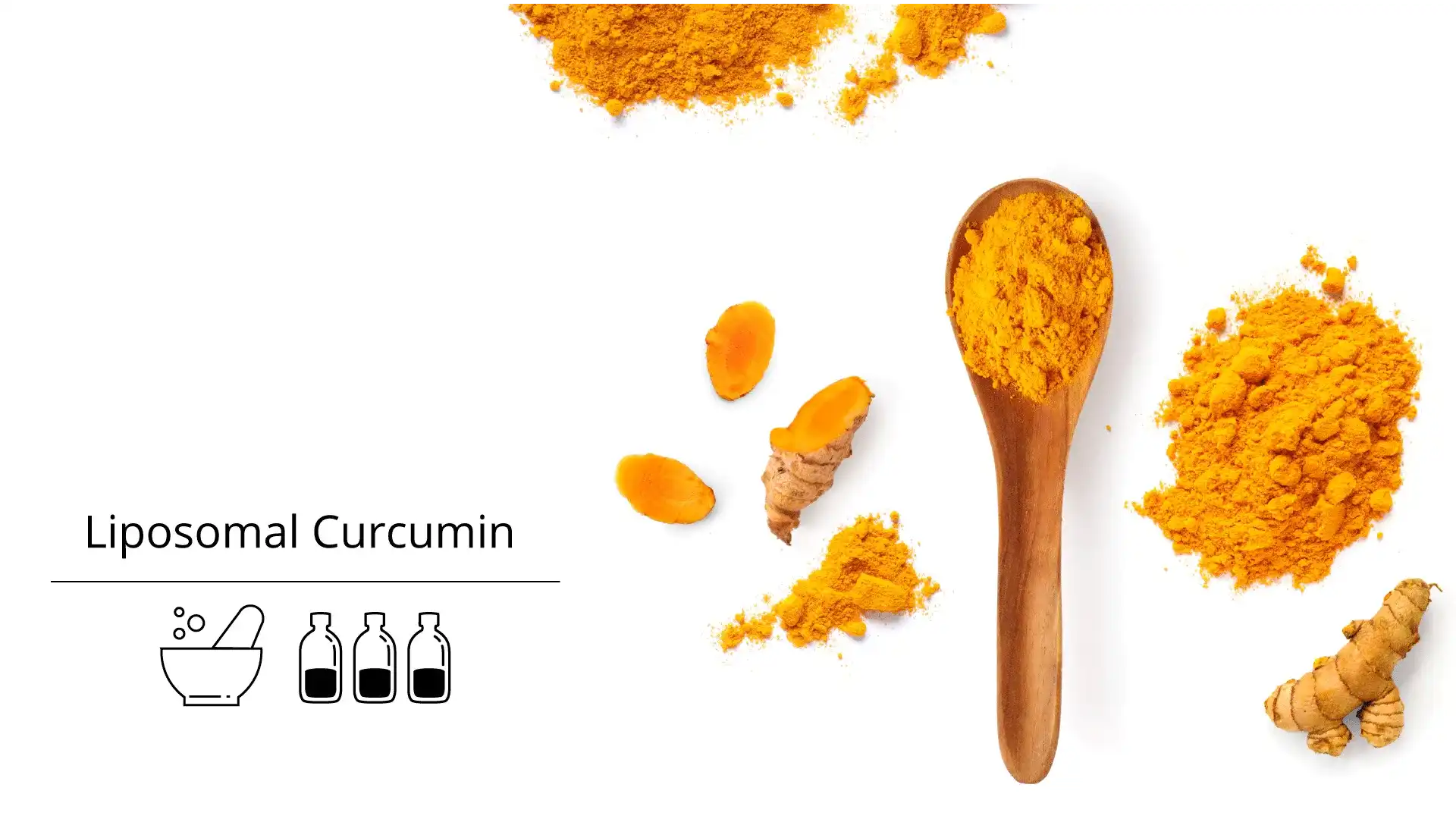
Understanding Liposomal Curcumin: Powder vs Liquid
People have known for a long time that curcumin, which comes from turmeric root (CAS No. 458-37-7), can effectively reduce inflammation and protect cells from damage. On the other hand, normal curcumin is not very accessible because it doesn't like water and breaks down quickly in the body. Curcuminoids are put inside bilayer phospholipid discs that look like the walls of human cells. This is solved by liposome transport technology. This helps the body absorb things better in the gut and move things around better all over.
The Science Behind Liposomal Encapsulation
Liposomal products use high-pressure microfluidic cutting to put curcumin molecules into very small bubble-like structures that are usually 100 to 200 nm across. These structures keep the active chemical from breaking down in stomach acid and make it easier for it to move across intestine walls. Shaanxi Hongda Phytochemistry Co., Ltd. uses dynamic light scattering measurement to keep the particle size distribution very small. This makes sure that all production runs work the same way. The capsule rate is at least 80% for food-grade uses and at least 90% for pharmaceutical-grade uses. The active ingredients are curcuminoids and natural phospholipids from non-GMO sources.
Physical Form Distinctions
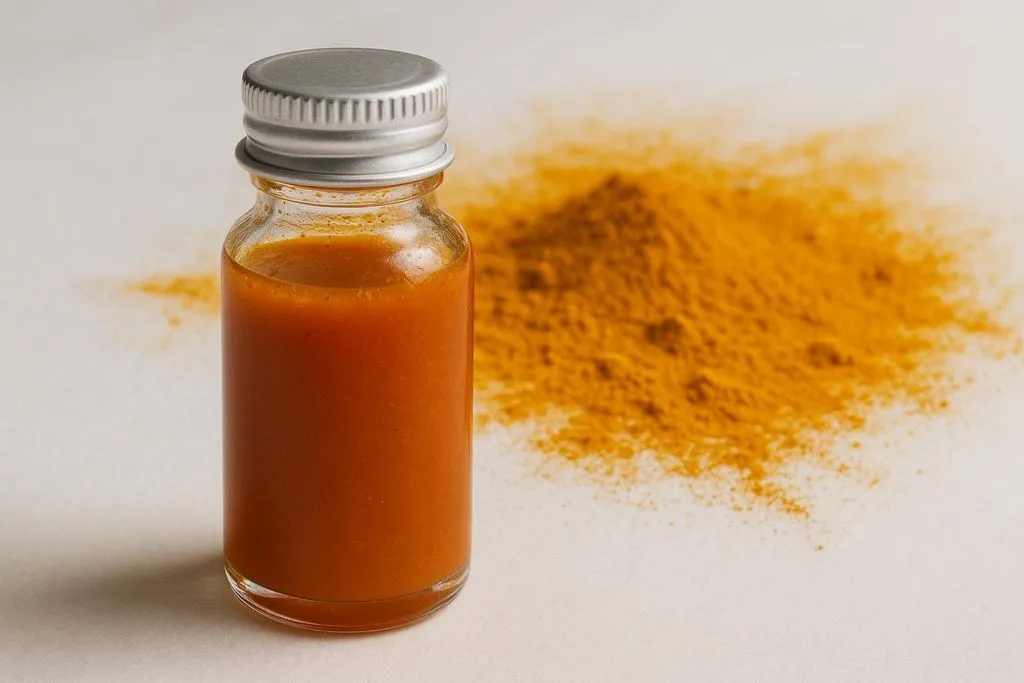
It looks like a yellow-to-orange drink because it's powder. It can be poured out or mixed with water. It goes back to being a microemulsion very fast and doesn't settle down. The form of the phospholipid membrane stays the same when the sample is dried in a vacuum at low temperatures. But there is another kind that is made in a different way. It is a clear, thick liquid that needs to be kept cooler. It weighs about 368 grammes per litre when mixed with powder. It weighs about 721 grammes per litre when crushed. This makes it easier to mix and measure.
Stability and Shelf Life Considerations
One important difference between these two types is their stability. Powders that are properly packed and stored stay effective for 24 months when kept in dark places at 2 to 25°C. Liquids, on the other hand, need tighter temperature controls and have shorter storage periods. The powder form is better at resisting reactive decay, so the curcuminoid content stays within the required ranges (70.0% ± 5%), along with the phospholipid levels (15.0% ± 5%) and fatty acid levels (15.0% ± 5%) throughout the product's lifecycle.
Comparative Analysis: Powder vs Liquid Liposomal Curcumin
Knowing about performance measures helps buying teams choose ingredients that give end-user goods results that can be measured. Liposomal curcumin in powder and liquid form are both much more bioavailable than normal extracts, but they are used in different ways in real life.
Bioavailability and Absorption Rates
The release of curcumin through liposomes, such as from Liposomal Curcumin Powder, is 20 to 40 times more accessible than pills, according to researchers. It is possible for the drug to pass through the blood-brain barrier because of the lipophilic phospholipid layer. This helps protect brain function. Liposomal shield curcumin slowly gets into the gut over time. This means that it stays in the blood for 6 to 8 hours longer than regular amounts. This slower metabolism profile helps control chronic inflammation, keep joints healthy, and keep cells safe from free radical damage.
Dosage Flexibility and Formulation Compatibility
Powder formulas work best when exact weight-based doses and uniform blend quality are needed. They work well with pill production lines, operations that crush tablets, and dry premix uses that need to keep the amount of wetness to a minimum. For ready-to-drink drinks, emulsion-based delivery systems, and skin treatments where quick dispersion is more important than long-term stability, liquid forms work best. When purchasing powder ingredients for automatic filling equipment, procurement managers should check that the particles meet certain size requirements (≥90% passing 20 mesh) and that there is no more than 5% loss on drying.
Manufacturing and Quality Control
In controlled markets, batches still need to be the same. Following microbiological safety rules is also important, as are heavy metal rules (arsenic ≤ 2.0 ppm, lead ≤ 0.5 ppm, mercury ≤ 0.3 ppm, and cadmium ≤ 0.3 ppm). Plate counts for moulds, yeasts, coliforms, and viruses must be kept to tight rules, and they should not be higher than 10,000 cfu/g. Facilities that have HPLC, UV spectroscopy, and ICP-MS technology can give you a full Certificate of Analysis. This includes the original test chromatograms that help with quality checks and regulatory records.

Procurement Considerations for B2B Clients
To choose the best turmeric liposome provider, you need to look at more than just the price quotes that they give you. The ability to manufacture, the number of certifications, and the availability of expert support services are all important for long-term relationship success.
Supplier Qualifications and Certifications
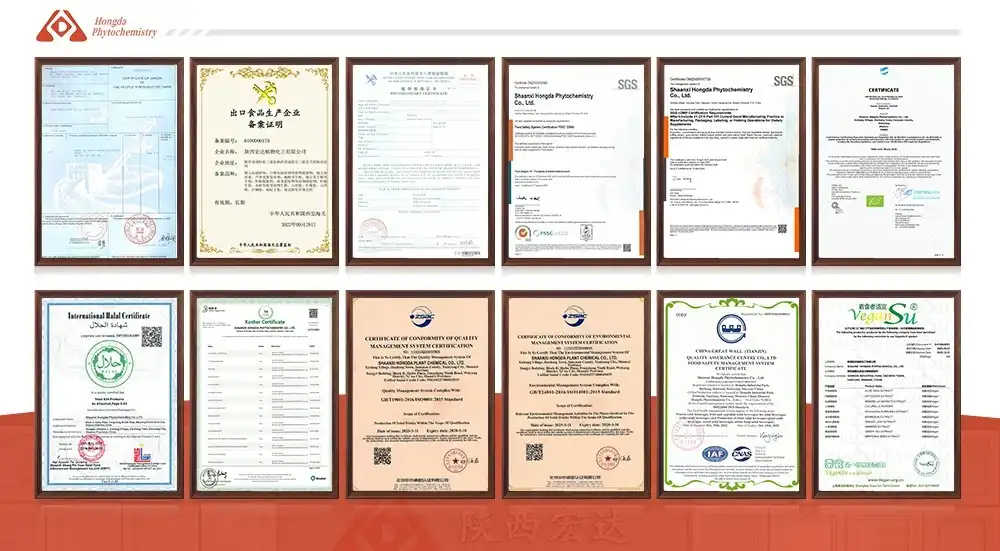
Leading makers have a number of globally recognised certificates that show they are committed to quality processes and following the rules. Food safety management methods are checked by ISO 22000 and FSSC 22000 licences, and pharmaceutical-grade output standards are checked by cGMP registration. With Halal and Kosher certifications, you can reach a wider range of customers, and with EU and NOP guidelines for organic certifications, you can meet the growing demand for clean labels. Buyers should ask for proof of these qualifications, as well as building audit results from outside groups such as SGS or Eurofins.
Cost Structures and Volume Pricing
Strategies for buying in bulk have a big effect on the total cost of acquisition. For samples, standard packaging comes in 1 kg foil bags, and for production amounts, it comes in 25 kg fibre drums. Each drum has a net weight of 25 kg and a gross weight of 28 kg, which means that 27 drums can fit on a normal crate. At certain amounts, you can get volume savings, and makers often use tiered price systems that reward customers who buy from them on a regular basis. Because powders are lighter and can be shipped at room temperature, they are cheaper to ship than liquids that need to be kept cold.
Supply Chain Logistics and Lead Times
Reliable sellers of liposomal curcumin powder keep a lot of stock in a variety of warehouses, which lets them quickly fill urgent orders while still sticking to planned production schedules. Facilities that cover 3,000 square metres and have separate store areas for different types of products make sure that the environment is controlled properly and that products don't get contaminated with each other. Manufacturing flexibility that can meet rising customer needs is shown by an annual production capacity of more than 5,000 tonnes. Delivery success measures, such as the percentage of on-time shipments and the number of errors in orders, should be used to judge suppliers.
Application & Industry Use Cases for Liposomal Curcumin Powder and Liquid
Different types of products use liposomal curcumin forms based on how they need to be made and what their target customers want. Knowing these application trends helps buying teams guess what needs to be made in the future.
Dietary Supplement Applications
The most common way that powder ingredients are used is in capsule formulas. People can easily take liposomal curcumin powder by putting it in hard gelatin or veggie capsules. These capsules don't affect the taste of the powder. Manufacturers like the flowability properties that make automatic filling operations work well and require little cleaning of the equipment. Powder forms that mix evenly with excipients while keeping their compaction qualities are also useful for tablet compression uses. Liquid liposomal formulations can be put into soft gelatin capsules, but to keep them stable, it's important to carefully check how well the shells work together and how the capsules are stored.
Functional Beverage Formulations
Bioactive ingredients are being added to more and more ready-to-drink drinks and quick powder mixes in the beverage industry. Liposomal curcumin powder works great in these situations because it quickly reconstitutes, which keeps the product's visual appeal throughout its shelf life. When mixed with water, particles between 100 and 200 nm make stable microemulsions that don't cloud up or separate into different phases like regular curcumin suspensions do. The neutral taste profile and colour stability that phospholipid encapsulation offers are valued by beverage makers. This lets them be creative with formulations without affecting the sense qualities.
OEM and Contract Manufacturing Services
Custom recipe creation is a big plus for ingredient providers that work with private label brands and contract makers. Shaanxi Hongda Phytochemistry provides full OEM/ODM services that go beyond just providing raw materials. These services include recipe optimisation, stability testing, and advice on how to create packing. Technical teams work with clients to change the amounts of curcumin that are loaded, the shapes of the particles, and how well they dissolve based on the needs of each application. This partnership method speeds up the time it takes to get a product to market and lowers the development risks that come with adding new ingredients.
Making the Right Choice: Powder or Liquid?
Decision Matrix for Product Selection
Stability requirements should top your evaluation criteria. Products destined for warm-climate distribution or extended retail cycles benefit from powder formats that resist thermal degradation and moisture uptake. Liquid formulations suit applications where immediate use follows mixing operations and refrigerated storage infrastructure exists throughout the supply chain. Dosage form compatibility represents another key consideration—powder excels in solid dose applications, while liquid may integrate more easily into certain beverage matrices or topical emulsions.
Cost analysis must extend beyond unit pricing to encompass total landed costs, including transportation, storage, and handling expenses. Powder typically demonstrates lower logistics costs due to ambient shipping and higher concentration per unit volume. Manufacturing efficiency considerations include equipment compatibility, cleaning validation requirements, and batch changeover times. Production lines designed for dry powder handling may require substantial modifications to accommodate liquid ingredient feeds, affecting capital investment decisions.
Emerging Technology Trends
Innovation continues to advance liposomal delivery platforms towards enhanced performance characteristics. Recent developments include pH-responsive release mechanisms that time curcumin delivery to specific intestinal regions and dual-encapsulation systems combining multiple bioactive compounds within single vesicles. Spray-drying technologies improve powder flowability while maintaining encapsulation integrity, and novel phospholipid sources expand formulation options for allergen-sensitive markets. Procurement teams should maintain dialogue with technical suppliers to stay informed about capabilities that may provide competitive differentiation, including liposomal curcumin powder.
Building Supplier Partnerships
Long-term success depends on relationships built through transparent communication and mutual value creation. Manufacturers offering technical consultation services help clients optimise formulation performance while troubleshooting production challenges. Access to laboratory resources, including stability study support and analytical method development, accelerates product development timelines. Flexible minimum order quantities accommodate market testing phases before scaling to commercial volumes, reducing financial exposure during new product launches.
Conclusion
Selecting between liposomal curcumin powder and liquid formats requires careful analysis of your specific manufacturing environment, product applications, and market distribution channels. Powder formulations deliver exceptional stability, convenient handling, and broad compatibility across supplement formats from capsules to beverage mixes. The 24-month shelf life, pharmaceutical-grade encapsulation efficiency, and superior reconstitution properties make it the preferred choice for most B2B applications. When partnering with certified manufacturers holding ISO, FSSC, Halal, and Kosher credentials, you gain access to consistent quality, comprehensive technical support, and scalable supply capacity. Your procurement decision should align with regulatory requirements, cost optimisation goals, and long-term product roadmap considerations that position your brand for sustainable growth.
FAQ1. What differentiates pharmaceutical-grade from food-grade liposomal curcumin?
Pharmaceutical-grade liposomal curcumin achieves encapsulation efficiency ≥90% compared to ≥80% for food-grade versions. This higher efficiency translates to more consistent bioavailability and tighter specification ranges for active ingredient content. Manufacturing facilities producing pharmaceutical-grade materials typically maintain more stringent environmental controls, enhanced testing protocols, and comprehensive documentation systems that support regulatory submissions for therapeutic applications.
2. How should liposomal curcumin powder be stored to maintain potency?
Proper storage requires sealed containers kept in dark conditions at temperatures between 2 and 25℃. Exposure to light accelerates curcuminoid degradation, while excessive heat compromises phospholipid membrane integrity. Moisture control proves equally important—keep containers tightly closed in low-humidity environments to prevent clumping and maintain flowability. Under these conditions, products maintain full potency throughout the 24-month shelf life specification.
3. Can liposomal curcumin powder dissolve completely in water?
The powder rapidly disperses in aqueous solutions, forming a stable microemulsion rather than a true molecular solution. The 100-200nm liposomal particles remain suspended without visible sedimentation, creating translucent dispersions suitable for beverage applications. This reconstitution behaviour stems from phospholipid surface characteristics that facilitate interaction with water molecules while protecting the hydrophobic curcumin core.
Partner With HONGDA for Premium Liposomal Curcumin Solutions
Shaanxi Hongda Phytochemistry Co., Ltd. stands ready to support your liposomal curcumin sourcing requirements with pharmaceutical-grade powder manufactured using advanced phospholipid encapsulation technology. Our 20,000-square-meter facility operates under cGMP, ISO 22000, and FSSC 22000 certifications while maintaining organic, Halal, and Kosher credentials that meet global regulatory standards. As an established liposomal curcumin powder manufacturer serving more than 2,000 companies annually, we deliver consistent quality backed by comprehensive Certificates of Analysis and original HPLC chromatograms. Our technical team provides formulation consultation, custom particle size specifications, and flexible OEM/ODM services tailored to your product development objectives. Connect with our procurement specialists at duke@hongdaherb.com to request sample kits, discuss bulk pricing structures, or explore custom formulation possibilities that differentiate your product line in competitive markets.
References
1. Hewlings, S.J. and Kalman, D.S. (2017). "Curcumin: A Review of Its Effects on Human Health." Foods, examining bioavailability enhancement through delivery system innovations.
2. Stohs, S.J., Chen, O., Ray, S.D., Ji, J., Bucci, L.R., and Preuss, H.G. (2020). "Highly Bioavailable Forms of Curcumin and Promising Avenues for Curcumin-Based Research and Application." Journal of the American College of Nutrition, analyzing comparative absorption studies.
3. Prasad, S., Tyagi, A.K., and Aggarwal, B.B. (2014). "Recent Developments in Delivery, Bioavailability, Absorption and Metabolism of Curcumin." Cancer Research and Treatment, reviewing pharmaceutical applications.
4. Schiborr, C., Kocher, A., Behnam, D., Jandasek, J., Toelstede, S., and Frank, J. (2014). "The Oral Bioavailability of Curcumin from Micronized Powder and Liquid Micelles Is Significantly Increased in Healthy Humans." Molecular Nutrition & Food Research, providing clinical evidence for liposomal systems.
5. Antony, B., Merina, B., Iyer, V.S., Judy, N., Lennertz, K., and Joyal, S. (2008). "A Pilot Cross-Over Study to Evaluate Human Oral Bioavailability of BCM-95CG (Biocurcumax)." Indian Journal of Pharmaceutical Sciences, establishing baseline comparisons for enhanced formulations.
6. Jamwal, R. (2018). "Bioavailable Curcumin Formulations: A Review of Pharmacokinetic Studies in Healthy Volunteers." Journal of Integrative Medicine, synthesizing data on various delivery technologies including liposomal encapsulation methods.