




Liposomal curcumin powder stability data is that quiet document standing between a confident purchase and a pricey surprise. People buying liposomal items know that even if you obtain a beautiful, brilliant orange powder, the punch may be gone months down the road if the vesicles, phospholipids, or curcuminoids were not adequately protected. Hongda Phytochemistry was established in 2001. It has a 20,000 square meter factory, 100,000 grade purification workshops, an SGS-standardized laboratory, and a yearly output of up to 3,000 tons. It is Shaanxi Hongda Phytochemistry Co., Ltd. that maintains Hongda Phytochemistry. This book will explain exactly what to ask for, what results matter most, and how to evaluate them—so your next sourcing decision is based on evidence, not promises.
Start Here: The Stability Questions Every Buyer Should Ask
What Does Stability Really Mean for Liposomal Curcumin Powder?
Stability of liposomal curcumin powder 4.1. Chemical retention of curcuminoids 4.2. Physical integrity of the phospholipid carrier 4.3. Microbiological safety 4.4. Consistency in appearance and flow. Curcumin is naturally sensitive to light, heat, and alkaline conditions; therefore, encapsulation is designed to preserve it.[2][3][4][5][6] But that protection only counts if it makes it from the production line to your blending room. One test at release tells you very nothing. What you want is a historical record of how the liposomal curcumin powder functions under certain storage conditions, tested in the same manner at each pull point. If a supplier can prove that trend across several batches, then you may be sure that the result is characteristic of the process, rather than simply one lucky batch.
Why Hongda's Liposomal Curcumin Powder Begins with Controlled Manufacturing
Stability is built long before the first sample makes it to a test bench. Hongda is a liposomal curcumin manufacturer with more than ten innovative production lines. Raw material procurement, extraction, purification, and drying are all under one organization. Traceability is ensured by company-owned planting bases and expert agronomists, while process consistency is guaranteed by more than 150 workshop technicians and more than 20 professor-level R&D and testing staff. A nice place to start is the Hongda product page for liposomal curcumin powder. Every batch is backed by testing for ingredients, pesticide residues, moisture, heavy metals, and microorganisms. That’s the discipline that buyers are better served beginning with, since a well-controlled batch is a lot easier to keep consistent than a diversified one.
How Much Shelf-Life Evidence Is Enough?
The shelf life statement is only as good as the facts on which it is based. Ask whether that timeframe is based on real-time research, fast-tracked studies, or an estimate based on a similar product. A credible package for liposomal curcumin powder normally contains at least three lots with defined pull points (zero, three, six, and twelve months and beyond) and a clear pass or fail limit for each parameter. Ask for the study protocol and the summary. The protocol explains the storage conditions, containers, and analytical processes performed. If a supplier just offers you one statement that they have a two-year shelf life, consider it a signal to ask for the underlying report before you make a greater buy.
Stability Tests Worth Requesting in Writing
Real-Time and Accelerated Storage Studies
Most buyers are aware of the framework for international stability rules that describes long, intermediate, and expedited storage settings. The same structure for liposomal ingredients bulk enables you to speak the same language with your supplier and with your own quality team. Ask for what conditions were used, how many lots were tested, and whether the findings were generated in the final commercial package. Accelerated data is an early warning, useful to quickly assess packaging possibilities, and real-time data is the final proof, with only the latter clearly indicating what really happens on a warehouse shelf over the months. The following table shows the standard format that permits any proposal to be compared with a recognized benchmark.[1]
|
Study Type
|
Storage Condition
|
Typical Minimum Duration
|
What It Tells You
|
|---|---|---|---|
|
Long-term
|
25°C ± 2°C / 60% RH ± 5%
|
12 months
|
Real shelf-life behavior
|
|
Intermediate
|
30°C ± 2°C / 65% RH ± 5%
|
6 months
|
Bridge for warmer markets
|
|
Accelerated
|
40°C ± 2°C / 75% RH ± 5%
|
6 months
|
Early warning for heat and humidity
|
Curcuminoid Assay Retention and Degradation Markers
The number one thing your formulators fret over is retention of potency. Could you please provide us with HPLC data for total curcuminoids, and also for curcumin, demethoxycurcumin, and bisdemethoxycurcumin individually at each time point so we can observe if one portion is fading quicker than the other. Stable liposomal curcumin powder will show a smooth, predictable slope with no surprises in dips between draw points. See if the procedure was validated for specificity. Sometimes degradation products can interfere with the major peaks.[3][4][5] Hongda’s lab has high-performance liquid chromatographs, spectrophotometers, and other instruments, so all testing is done in-house and may be repeated anytime a customer wants to check a particular batch.
Moisture, Water Activity, and Flow Behavior
The main variable is moisture. If you buy liposomal components in bulk, this is what makes a drum open as a free-flowing powder or a hard block. Request moisture results at each stability pull point and, when possible, request water activity, since water drives both caking and the threat of microbes. Descriptive and physical properties are also important. Chemistry should be explained by color, smell, bulk density, and flowability. When liposomal curcumin powder is to be filled into capsules, tablets, or stick packs, small adjustments in flow may change fill weight and line speed. Asking for these simple physical checks costs the supplier almost nothing but demonstrates how seriously their quality system takes the realities of production on your side.
Packaging, Storage, and Shipping Conditions That Protect the Data
Light, Oxygen, and Barrier Packaging
The proper bottle exists for every recipe. Send liposomal ingredients wholesale in clear, well-sealed containers with an inner liner to safeguard curcumin, which is light-sensitive, and phospholipids, which can break down when exposed to air.[4][6] Ask about the package (liner, closure, etc.) in the stability study and make sure you obtain it. Glass jar information doesn't matter for a fiber drum. Many consumers request desiccant or nitrogen flushing for long hauls. The graphic also demonstrates how to keep the items, their lot number, production date, and retest date. Your warehouse workers can move products correctly and keep them out of direct sunlight and heated regions because these details are clearly noted.
Temperature Control Across Export Routes
Since bulk shipments go through oceans, ports, and warehouses, the temperature profile of the trip is just as important as the lab chart. If you are buying a lot of liposomal materials to send abroad, ask the seller about the best way to ship them for the time of year and where they are going, as well as how well they've done when the temperature has gone above or below the suggested level. The knowledgeable provider will talk about cold and dry storage, as well as how to place and move pallets at the target building. The warehouse owned by Hongda has 6 storage rooms that cover 3,000 square meters. They are sterilized by trained professionals. We keep a good amount of merchandise on hand so that orders can be shipped on time. And knowing how long it will take to get the liposomal curcumin powder means it spends less time in transit, which keeps it stable and makes the results in your file more like the ones that get to your dock.
|
Item
|
What to Confirm
|
Why It Matters
|
|---|---|---|
|
Container
|
Opaque, sealed, barrier-lined
|
Limits light and oxygen exposure
|
|
Moisture protection
|
Inner liner, desiccant if needed
|
Prevents caking and microbial risk
|
|
Storage advice
|
Cool, dry, away from light
|
Slows curcuminoid and lipid change
|
|
Labeling
|
Lot number, manufacturing and retest dates
|
Supports rotation and traceability
|
Batch Records and Lot Traceability
If you can't connect stability data to the lot you already have, it's not useful. Each delivery should come with an analysis certificate, batch production records should be available upon request, and samples should be kept so they can be tested again if there is a problem. People who buy liposomal curcumin powder should be able to trace the raw material. This is why Hongda's own growing bases and agronomists are so important. Email the team at duke@hongdaherb.com to get some sample stability reports or to talk about what paperwork is best for your market. Tell us about your app and where you plan to deploy it: Having these papers prepared in advance also speeds up your regulatory filings, retailer audits, and customer surveys, which is essential when launch dates are set and retailers need full paperwork.
Judging a Supplier Beyond the Datasheet
Reading a Certificate of Analysis Beyond the Headline Numbers
This is not the end, this is only the beginning. Look at the test technique for each result, the date of the test, and the factors: how much curcuminoid, how much dampness, the look of the food, heavy metals, pesticide residues, and bacterial limitations. Check the numbers for several lots to see if the results are closely grouped (this means the process is under control) or if there are big changes from one lot to the next (this means the process still needs to be improved). When a provider gives you a liposomal curcumin supplier, ask them how they check the consistency of the product after it has dried. Can they show the results of both the released and kept samples next to each other? Before shipping, Hongda checks the ingredients, pesticide residues, moisture, heavy metals, and microbes, so you can be sure of all of these things.
|
No.
|
TEST ITEM
|
SPECIFICATION
|
RESULT
|
|||
|
1
|
Description
|
Yellow Powder
|
Conform
|
|||
|
2
|
Particle size (20 mesh)
|
≥90%
|
Conform
|
|||
|
3
|
Loss on drying
|
≤5.0%
|
2.33%
|
|||
|
4
|
Bulk Density
|
Measured value
|
368g/L
|
|||
|
5
|
Tapped Bulk Density
|
Measured value
|
721g/L
|
|||
|
6
|
Heavy Metals
|
Arsenic (As)
|
≤2.0ppm
|
Conform
|
||
|
Lead (Pb)
|
≤0.5ppm
|
Conform
|
||||
|
Mercury (Hg)
|
≤0.3ppm
|
Conform
|
||||
|
Cadmium (Cd)
|
≤0.3ppm
|
Conform
|
||||
|
7
|
Microbiological
|
Total plate count
|
≤10000cfu/g
|
10cu/g
|
||
|
Total molds and yeasts
|
≤1000cfu/g
|
10cfu/g
|
||||
|
Coliforms
|
≤10MPN/g
|
≤0.3MPN/g
|
||||
|
E.Coli
|
Negative/25g
|
Negative
|
||||
|
Salmonella
|
Negative/25g
|
Negative
|
||||
|
Staphylococcvs
|
Negative/25g
|
Negative
|
||||
|
8
|
Assay
|
Curcumin
|
70.0%±5%
|
71.6%
|
||
|
Phospholipids (NON-GMO)
|
15.0%±5%
|
12.9%
|
||||
|
Fatty Acids
|
15.0%±5%
|
13.8%
|
||||
|
Conclusion
|
Meet the in house standard.
|
|||||
Certifications and Third-Party Verification
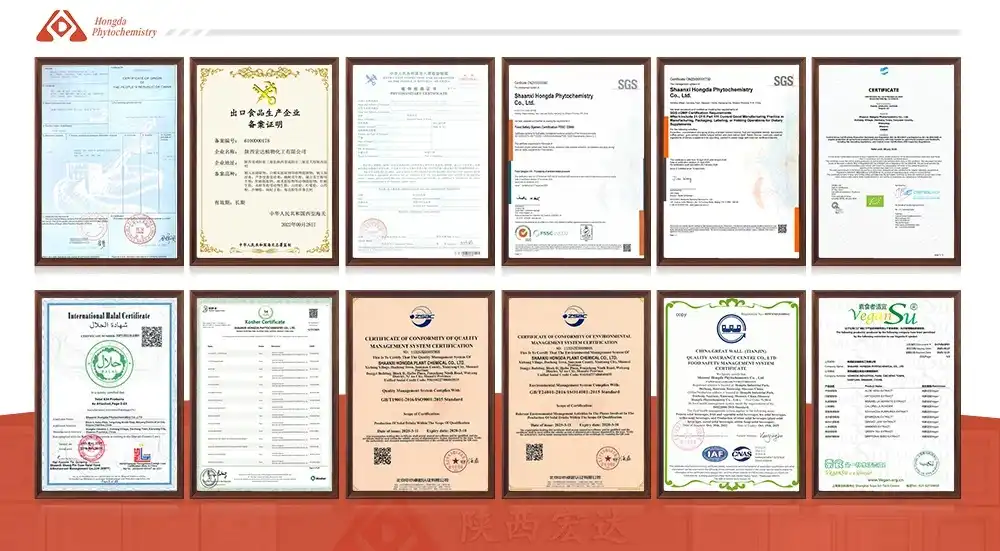
When you see a certificate, it means that someone from outside your company has looked at the system that makes your security data. Hongda also says it has licenses to make food, as well as halal and kosher certifications, as well as BRC, FDA, and organic certifications. More approvals, like cGMP, FSSC22000, ISO22000, ISO9001, and organic clearances from the EU and NOP, will be added in 2025. The company also works with testing organizations in other countries and has built a lab with the help of university experts. When looking at liposomal curcumin powder for the US or European markets, find out what certifications are needed for the specific manufacturing location, make sure they are up to date, and then match them to what your customers want. The paperwork that most buyers get before they work with a new supplier is shown in the table below.
|
Document
|
What It Shows
|
When to Request
|
|---|---|---|
|
Certificate of analysis
|
Lot-level potency, moisture, safety results
|
With every shipment
|
|
Stability protocol and report
|
Conditions, lots, pull points, trends
|
Before the first order
|
|
Specification sheet
|
Agreed limits and test methods
|
During quotation
|
|
Quality certificates
|
cGMP, ISO, organic, halal, kosher, and more
|
During supplier audit
|
Sampling, Pilot Lots, and Supplier Fit
The ultimate test of the pudding for any liposomal curcumin supplier is how effectively the relationship works in reality. Take a sample, verify your final formulation is stable, and compare against the seller's data. Do trial runs to ensure the taste, color, dispersion, and shelf life satisfy your expectations before you scale up. These also provide your personnel with solid insight into how the chemical acts on your own equipment. Discuss minimum order quantities, alternative packing options, lead times, and how they deal with changes to needs with the supplier. Hongda has more than 10 production lines producing over 3,000 tons of items a year and two research and development facilities, enabling it to handle one-off orders and recurrent programs. If your brand needs anything particular, you can discuss custom liposomal curcumin powder specs with the team.
Conclusion
Liposomal curcumin is not a hopeful material, but a reliable one, as shown by good stability data. Ask for quick and real-time studies, retention curves for potency, moisture and physical testing, packaging data, batch records that can be tracked, and up-to-date certificates. Before going big, test your samples with your own recipe. Check out all of the answers by lot. Hongda Phytochemistry lets customers go from asking questions to buying with confidence. They have controlled manufacturing, an in-house lab, a lot of different certifications, and a lot of products in stock. It's easier for a source to give you proof instead of just making claims when you're clear about what you need. When you review your next supplier as a liposomal curcumin manufacturer, use this list as a guide, and make sure that all of your documents are formatted for audits, customers, and long-term growth.
FAQ
1. What stability data should I request for liposomal curcumin powder?
Ask for real-time and accelerated studies on multiple lots, with curcuminoid assay, moisture, and appearance reported at every time point.
2. How is shelf life confirmed?
Shelf life is confirmed by storing samples in final packaging under defined conditions and testing them at set intervals against written limits.
3. Does packaging affect stability?
Yes. Opaque, sealed barrier packaging protects curcumin and phospholipids from light, oxygen, and moisture during storage and transport.
4. Which certifications support export sales?
Buyers commonly look for cGMP, ISO22000, FSSC22000, BRC, FDA certification, halal, kosher, and organic approvals relevant to their market.
Partner with HONGDA for Reliable Liposomal Curcumin Powder
Ready to evaluate liposomal curcumin powder with the documentation your quality team expects? HONGDA offers controlled production, in-house testing, broad certifications, and the inventory to deliver on schedule. Share your target market, application, and monthly volume, and our team will help you match specifications, packaging, and documentation to your project. Whether you are building a new capsule, powder blend, or functional beverage, we can discuss samples, stability documentation, and logistics that suit your timeline. Email duke@hongdaherb.com today to request a quote, ask about available reports, or start a pilot order. Turn your next stability checklist into a confident purchase and build a long-term partnership with a manufacturer that treats quality as a daily habit.
References
1. International Council for Harmonisation. ICH Harmonised Tripartite Guideline Q1A(R2): Stability Testing of New Drug Substances and Products. 2003.
2. Anand P, Kunnumakkara AB, Newman RA, Aggarwal BB. Bioavailability of Curcumin: Problems and Promises. Molecular Pharmaceutics. 2007;4(6):807-818.
3. Nelson KM, Dahlin JL, Bisson J, Graham J, Pauli GF, Walters MA. The Essential Medicinal Chemistry of Curcumin. Journal of Medicinal Chemistry. 2017;60(5):1620-1637.
4. Schneider C, Gordon ON, Edwards RL, Luis PB. Degradation of Curcumin: From Mechanism to Biological Implications. Journal of Agricultural and Food Chemistry. 2015;63(35):7606-7614.
5. Wang YJ, Pan MH, Cheng AL, et al. Stability of Curcumin in Buffer Solutions and Characterization of Its Degradation Products. Journal of Pharmaceutical and Biomedical Analysis. 1997;15(12):1867-1876.
6. Sercombe L, Veerati T, Moheimani F, Wu SY, Sood AK, Hua S. Advances and Challenges of Liposome-Assisted Drug Delivery. Frontiers in Pharmacology. 2015;6:286.