




The Realistic Encapsulation Efficiency Range for Liposomal Iron Powder
The Short Answer: 85 Percent or Higher, With 90 Percent as the Premium Benchmark
Published supplier specs for liposomal iron products generally indicate encapsulation efficiencies of more than 85 percent, with premium listings setting that standard at 90 percent or more, as proven by HPLC or UV-based measurement. That’s a fair expectation for liposomal iron powder from a professional manufacturer, and it’s the quantity you should hold a provider accountable to when you compare quotes. If there is a substantial free iron fraction, it weakens the stability, taste, and absorption benefits that justify the liposomal price; therefore, look for values far under 80 percent as an indication to ask tougher questions regarding the formulation. The chart below translates these ranges into practical bands for procurement teams. Use it to screen candidates and then ask all candidates for the lot-specific result and procedure before shortlisting.
|
Reported Efficiency
|
Typical Interpretation
|
Recommended Buyer Action
|
|---|---|---|
|
Below 70%
|
Large free iron fraction
|
Request reformulation or decline
|
|
70-84%
|
Acceptable for pilots and entry-level products
|
Ask for method and improvement plan
|
|
85-89%
|
Solid commercial benchmark
|
Confirm with batch COA and stability data
|
|
90% and above
|
Premium tier
|
Verify with HPLC or UV data, particle size, and TEM
|
Why Iron Is Harder to Encapsulate Than Water-Soluble Vitamins
Iron is not like vitamins, which neatly dissolve in the aqueous center of a vesicle. In the design of Hongda, the liposomal iron powder is formed from micronized ferric pyrophosphate, a chemical that is weakly soluble and must be finely disseminated before the phospholipid bilayers can wrap around it. If the iron particles aggregate or are too big, they cannot be trapped, and the encapsulation effectiveness is lowered. The academic work backs this up: One 2025 study on iron pyrophosphate nanoparticles found that liposomal encapsulation effectiveness went from 27.8 percent to 74.9 percent following modification for greater dispersion.[1] The message for purchasers is clear. If you see a high encapsulation number on a liposomal iron powder, it is a sign of actual engineering in the particle formation, not simply a great phospholipid, and it is worth a closer look.
What Hongda's Liposomal Iron Powder Is Built to Deliver
Hongda’s pharmaceutical-grade bulk suppliers of liposomal iron products are around 50 percent specification among bulk producers of liposomal iron products, a phospholipid bilayer carrier and particles in the 150 to 250 nanometer range that mimic natural cell membranes.[2][4] Hongda’s scientific documents indicate absorption up to 3.5 times quicker than ferrous sulfate and a formulation that does not have the metallic taste typical of standard iron salts, assisting marketers in building luxury goods for Europe, North America, and Asia. Behind those promises is a plant with cGMP, FSSC 22000, ISO 22000, HALAL and KOSHER credentials and laboratory capabilities in HPLC, UV spectrophotometry and gas chromatography. For liposomal iron powder customers, that combination implies that the encapsulation figure you’re getting may be tracked back to an actual test instead of a marketing sheet. We can tailor concentration, particle size, and packaging to project-specific demands.
What Determines Encapsulation Efficiency Inside the Factory
Iron Source and Particle Preparation
The process starts with the iron itself. A provider must identify an iron source that is stable, compatible with phospholipids, and processed to a fine and homogeneous particle size before it comes into contact with the lipid phase. Hongda micronizes ferric pyrophosphate in its liposomal iron powder, which is conducive to stable and mild sensory performance. The consistency of micronization is important because more uniform iron particles are collected more fully, increasing the encapsulation efficiency and narrowing the size distribution of the produced vesicles.[1][3] Buyers should inquire of any manufacturer how the iron supply is milled or dispersed, what particle size criteria are involved, and how each lot is validated. A provider that can elaborate on this phase is far more likely to give consistent batch-to-batch encapsulation performance.
Phospholipid Carrier and Encapsulation Process
The second driver is the carrier and the process of shearing. Hongda’s liposome series uses non-GMO sunflower phospholipids and high-pressure homogenization technology to produce bilayer vesicles, therefore avoiding soy allergy issues and allowing for clean-label placement. The efficiency of iron capture and the uniformity of the vesicles are dependent upon the ratio of phospholipid to iron, pressure and number of passes, and temperature regulation. Instead of just accepting a percentage, while you are evaluating a liposomal iron company, inquire about these factors. That’s precisely how a good encapsulation number for liposomal iron powder is built rather than just stated. If you have a factory with specialized liposome R&D and customisation capabilities, as Hongda claims, they can customize the process to your goal concentration and particle size.
Drying, Stability, and Retention of Encapsulated Iron
Encapsulation may seem good in the liquid state but deteriorate after drying due to rupture of vesicles. In its liposomal powders, Hongda uses low-temperature spray drying, and cryoprotectants added during the drying process protect the liposome structure from temperature fluctuations, so it may be stored at room temperature. And the critical point for purchasers is retention: does the encapsulation efficiency obtained on the final liposomal iron powder correspond to the value determined prior to drying? Ask for findings on the dry powder. Ask whether stability studies look at encapsulation over time. Hongda’s technical documents state that their liposomal iron products are structurally stable. However, the greatest evidence that your product is stable will always be your own accelerated stability testing under your unique packaging circumstances. Retention testing needs a presence on every supplier scorecard.
How to Verify the Encapsulation Number You Are Quoted
Ask for the Method: Free Versus Total Iron
A trustworthy figure comes with a method. The usual approach separates free iron from the vesicle fraction, measures total iron after the vesicles are disrupted, and calculates encapsulation efficiency from the difference, with quantification by HPLC, UV spectrophotometry, or atomic absorption. Hongda's laboratory operates HPLC, UV spectrophotometers, gas chromatographs, and atomic absorption instruments, which cover the techniques a buyer is most likely to request for a liposomal iron manufacturer. Ask which separation technique was used, how many replicates were run, and whether the result was measured on the dried powder. If you want to discuss the test method, a sample, or a certificate of analysis for your project, email duke@hongdaherb.com and the Hongda team will respond with the documents that match your specification.
Particle Size, PDI, and TEM as Supporting Evidence
Encapsulation efficiency should never travel alone. Dynamic light scattering gives the average particle size and polydispersity index, and supplier specifications for liposomal iron commonly target sizes of roughly 100 to 300 nm with a PDI of 0.25 or lower. Hongda's technical materials cite droplets of 150 to 250 nanometers for its liposomal iron powder. Transmission electron microscopy adds visual proof of spherical bilayer vesicles, and Hongda supports customers with TEM photos and particle size reports across its liposome series. When the encapsulation number, size distribution, and images all agree, confidence in the liposomal iron powder rises sharply. When one of them is missing or inconsistent, ask for a repeat measurement before you commit.
Stability and Batch Consistency Separate the Leaders
The top-rated liposomal iron producers for bulk orders share one habit: they report consistency, not just peak performance. Ask for encapsulation results from several consecutive batches, along with heavy metal, microbial, and moisture data, so you can see whether the process holds steady. Published supplier benchmarks include accelerated stability testing, such as six months at 40 degrees Celsius and 75 percent relative humidity, and buyers can reasonably request similar data. Hongda tests ingredients, pesticide residues, moisture, heavy metals, and microorganisms before every shipment, and its complete batch documentation supports audit requests. A liposomal iron powder that holds its encapsulation across batches and storage conditions is the only kind that protects your formulation, your reputation, and your repeat orders.
|
Evidence
|
What It Shows
|
Hongda Capability
|
|---|---|---|
|
Encapsulation test data
|
Free versus total iron
|
HPLC, UV spectrophotometry, and atomic absorption in the SGS laboratory
|
|
Particle size and PDI
|
Vesicle uniformity
|
Droplets of 150-250 nm; laser particle size reports
|
|
TEM images
|
Bilayer vesicle structure
|
Supported across the liposome series
|
|
Batch certificate
|
Iron content, moisture, metals, microbes
|
Tested before every shipment
|
|
Drying and stability
|
Retention of structure
|
Low-temperature spray drying with cryoprotectants
|
|
Certifications
|
Compliance
|
cGMP, FSSC 22000, ISO 22000, HALAL, KOSHER
|
Choosing a Partner Who Delivers Consistent Encapsulation at Scale
Manufacturing Capacity and Laboratory Strength
Encapsulation consistency depends on size, technology, and how deep you test. Shaanxi Hongda Phytochemistry Co., Ltd. was founded in 2001 and was awarded as a National High-tech Development Enterprise in 2010. Its plant encompasses an area of around 20,000 square meters, more than 10 manufacturing lines, 100,000-level purification workshops, and over 150 workshop experts, with an annual output capacity of up to 3,000 tons. SGS laboratory, established with university academics and more than 20 professor-level R&D and testing personnel, enables analysis by HPLC, gas chromatography, spectrophotometry, and atomic absorption. Two R&D institutes are working on novel liposomal compositions. Inventory is kept available in six storage sections in a 3,000 square meter warehouse. The consumer of top-rated liposomal iron producers for bulk orders may repeat the encapsulation outcomes, not only obtain them once. This infrastructure explains the reason.
Certifications and Documentation Buyers Can Audit
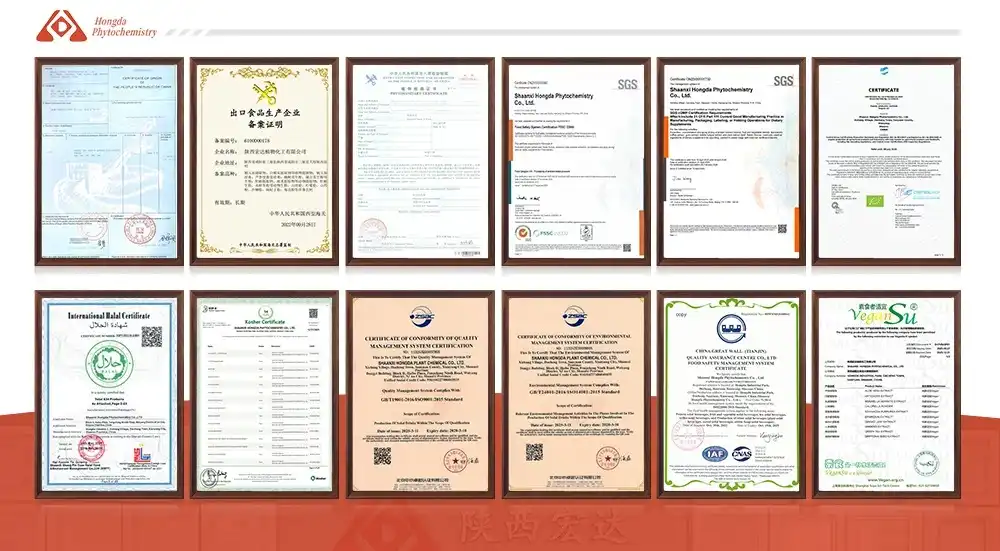
It should be straightforward to check the compliance of a trusted liposomal iron provider. Hongda is certified with cGMP, FSSC 22000, ISO 22000, HALAL, and KOSHER. The bigger firm is also ISO 9001, EU, and NOP organic and other certifications until 2025, which helps companies register goods in the US, Europe, and Asia. Customers may obtain supporting spectra, particle size reports, and TEM photos of the liposomal iron powder they are interested in buying. Consistent documentation is not only a formality, but it also enables your quality team to check the encapsulation claim, preserves your product’s regulatory file, and cuts time spent in store and marketplace audits. Ask to examine example papers before you sign a purchase order, and compare them to the promises stated in the quote.
Ordering: MOQ, Lead Time, and Customization
Liposomal iron powder from Hongda is ordered for pilots and production runs. Shipping is 3-7 working days according to Hongda’s technical materials, which keeps development schedules on track. Order quantities start at 1 kilogram, with pricing at competitive factory levels. Concentration, particle size, transport, and packaging may be customized, and your R&D team can mix iron with companion nutrients when your recipe requires it. Reorders will not impede your launch schedule as the firm maintains good inventories throughout its liposome series. Batch documentation with each lot allows your quality team to assess findings before production and samples are available for examination. Table 3 highlights everything you need to know to arrange your first order.
Conclusion
A reliable liposomal iron supplier should come with an encapsulation efficiency of at least 85 percent, ideally 90 percent or higher, backed by a transparent method, particle size data, TEM images, and batch consistency. Because iron is a poorly soluble compound, that number reflects genuine skill in particle preparation, phospholipid selection, and low-temperature drying. Hongda combines micronized ferric pyrophosphate, a phospholipid bilayer carrier, a well-equipped SGS laboratory, and a documented supply chain to meet that standard. When you compare suppliers, favor the one that answers your questions with data instead of adjectives. Clear evidence today protects your formula, your brand claims, and your customers tomorrow. Contact Hongda to request specifications, samples, and the documents behind every claim.
FAQ
Q: What encapsulation efficiency is reasonable for liposomal iron powder?
A: At least 85 percent is a solid commercial benchmark, and 90 percent or higher is the premium tier.
Q: Why do encapsulation figures vary so much between suppliers?
A: Iron particle preparation, phospholipid ratio, shearing conditions, and drying methods all influence how much iron is captured.
Q: How is encapsulation efficiency measured?
A: By separating free iron, measuring total iron after breaking the vesicles, and quantifying by HPLC, UV, or atomic absorption.
Q: What supporting evidence should I request?
A: Particle size and PDI data, TEM images, batch certificates, and stability results for the dried powder.
Q: What are Hongda's minimum order and delivery time?
A: Orders start at 1 kg, and shipping takes three to seven working days according to Hongda's technical materials.
Source Verified Liposomal Iron Powder from HONGDA
HONGDA welcomes buyers who want proof, not promises. Shaanxi Hongda Phytochemistry Co., Ltd. offers pharmaceutical-grade liposomal iron powder built on micronized ferric pyrophosphate and a phospholipid bilayer carrier, produced in a cGMP-standard facility and tested in an SGS laboratory. Our team will share specifications, encapsulation data, particle size reports, and sample options that fit your product plan, along with flexible order sizes from 1 kg and fast delivery. Whether you are launching a capsule, a sachet, or a fortified product for Europe, North America, or Asia, we will help you match the specification to your goals. Email your target application, volume, and quality requirements to duke@hongdaherb.com, and let HONGDA turn a strong encapsulation claim into a dependable supply.
References
1. Wei, Y.-S., Gao, W., Li, Y., & Liu, K.-L. (2025). Preparation of highly-dispersed iron pyrophosphate nanoparticles via ultrasound-assisted carboxymethyl cellulose modification to enhance their liposome encapsulation and cell absorption. International Journal of Biological Macromolecules.
2. Allen, T. M., & Cullis, P. R. (2013). Liposomal drug delivery systems: From concept to clinical applications. Advanced Drug Delivery Reviews, 65(1), 36-48.
3. Danaei, M., Dehghankhold, M., Ataei, S., et al. (2018). Impact of particle size and polydispersity index on the clinical applications of lipidic nanocarrier systems. Pharmaceutics, 10(2), 57.
4. Bozzuto, G., & Molinari, A. (2015). Liposomes as nanomedical devices. International Journal of Nanomedicine, 10, 975-999.