


_1745918362135.webp)

What Should You Know Before Importing Magnesium Bisglycinate Chelate Powder?
The first time you import magnesium bisglycinate chelate powder into your nation, you face a new set of considerations beyond just picking a suitable mineral chelate. Sourcing, paperwork, and quality verification all become central to the selection. Hongda Phytochemistry has spent years assisting supplement companies, distributors, and contract manufacturers in working through just those issues, providing magnesium bisglycinate chelate powder that is all-chelated, third-party tested, and supported by export-ready paperwork. Shaanxi Hongda Phytochemistry Co., Ltd. has a dedicated facility in Xi'an with the certifications, laboratory equipment, and manufacturing capacity that importers seek when evaluating a new foreign supplier. This tutorial leads you through the specs, documentation, and supplier due diligence that matter most when purchasing magnesium bisglycinate chelate powder from China.
Why Are International Buyers Importing Magnesium Bisglycinate Chelate Powder?
The Global Shift Towards Chelated Magnesium
The demand for magnesium bisglycinate chelate powder has risen as brands and formulators shift away from magnesium oxide and other poorly absorbed salts. When consumers investigate magnesium supplements, they’re more likely to seek the phrase 'chelate' or 'bisglycinate' on a label, which they associate with smoother digestion and greater outcomes. This has prompted merchants and private-label companies to ask their producers for this precise form. Therefore, import quantities into North America and Europe have increased, as local blending operations have chosen to buy a completed, completely reacted chelate rather than try to produce one in-house, which needs specialised equipment and quality control that most supplement firms do not possess. This has led to an increase in the number of first-time importers joining the category each year, often not even sure what a compliant shipment of magnesium bisglycinate chelate powder should look like on paper.[1][2][3][6]
Why does China lead in bulk production?
A significant portion of the global supply of bulk magnesium bisglycinate chelate powder originates in China, driven by the concentration of chemical manufacturing infrastructure, glycine production, and mineral processing competence in a few industrial zones. The province of Shaanxi, where Hongda Phytochemistry is situated, has become a centre of amino acid chelate synthesis, aided by collaborations with universities and well-developed supply chains for the necessary raw materials, such as magnesium oxide and pharmaceutical-grade glycine. This concentration of knowledge enables reasonable manufacturing costs with maintained quality, provided the importer picks a manufacturer that follows necessary testing and certification. This allows customers to set realistic expectations about price and lead time.
Cost, Scale, and Supply Reliability
Cost per kilogram is seldom the main consideration when an import connection is established, but it is generally what attracts customers to consider magnesium bisglycinate chelate powder from Chinese suppliers in the first place. For Hongda, large-scale manufacturing means more than 10 sophisticated production lines in a 20,000-square-metre facility, which keeps unit prices competitive despite fluctuations in worldwide demand for raw glycine and magnesium oxide. Scale also encourages dependability. A factory with numerous parallel lines and warehouse goods in designated storage zones is significantly less likely to miss a shipping deadline than a smaller business that works to order. This combination of cost savings and reliability of supply is generally the deciding factor in who wins the long-term contract for importers making regular purchases.
What does Hongda Phytochemistry bring to Importers?
Founded in 2001, Hongda Phytochemistry has more than 20 years’ experience and has built the infrastructure that the import-oriented buyers are looking for: an SGS-standardised laboratory built in cooperation with university professors, more than 20 professor-level R&D and testing personnel, and testing equipment from HPLC systems to atomic absorption spectrophotometers. The laboratory capability ensures that every batch of magnesium bisglycinate chelate powder leaving the plant is tested for assay, heavy metals, and microbiological safety before release for transportation, rather than relying on infrequent third-party spot inspections. For buyers sourcing wholesale manganese bisglycinate, the same laboratory and quality-control infrastructure provides a practical basis for evaluating specifications and batch consistency. In 2010, the firm was awarded the National High-Tech Development Enterprise. Currently, the company still has the national patent technology, which indicates that the company is constantly investing in the development of its processes, and not just once.
Specifications Every Importer Should Verify Before Ordering
Purity, Assay, and Elemental Magnesium Content
The first criterion every importer should verify is this one: the number tells how much of the drum is genuinely magnesium bisglycinate chelate powder as opposed to moisture, residual solvent, or production byproducts. Reputable manufacturers test assay by HPLC and should be willing to share results showing 98% or higher, and with a clearly stated elemental magnesium percentage, typically 12% for a fully chelated product, or closer to 20% for products that include some inorganic magnesium blended in. Importers should ask directly which category the quoted material falls under, as this distinction affects cost and the validity of any label claim built around the shipment, avoiding the common problem of receiving a technically compliant product that is not the composition the buyer thought..[1][2][6]
Particle Size and Solubility Requirements
Particle size and solubility aren’t commonly on a basic spec sheet, but they may often make or break an imported batch of magnesium bisglycinate chelate powder once it hits your manufacturing line. A powder to be filled into capsules is significantly different from a powder that will be used in a beverage or powder-stick application. Mismatched particle morphology may lead to flow issues, segregation in blends, or hazy solutions in liquid forms. Hongda’s normal grade is filtered through a specified mesh screen, and an Instant-Dissolve grade is provided for customers who are developing drink mixes or other clear liquid goods, which dissolve around 40% quicker than typical chelated magnesium. If you are an importer with a specific end-use application in mind, make sure to communicate this to the supplier before shipping. Ordering the wrong grade is one of the most common mistakes first-time buyers make.[2][3]
Heavy Metal and Microbial Testing Standards
International import rules for mineral supplement ingredients usually impose strict limitations on heavy metals and microbiological contamination, and magnesium bisglycinate chelate powder should be accompanied by proven findings against each threshold rather than a generic declaration of conformity. Below is a listing of testing categories an importer might anticipate to find on a certificate of analysis for a compliant cargo.[4][5][6]
|
Magnesium Amino Acid
|
|||
|
Analysis
|
Specification
|
Result
|
Test method
|
|
Physical Description
|
|
||
|
Assay
|
99%
|
99.5%
|
HPLC
|
|
Appearance
|
White Powder
|
Confirm
|
Visual
|
|
Odor&Taste
|
Characteristic
|
Confirm
|
Organoleptic
|
|
Mesh
|
95% through 80 mesh
|
100% through 80 mesh
|
80 mesh screen
|
|
Loss on drying
|
≤5.0%
|
3.20%
|
5g / 105℃/2hrs
|
|
Ash Contents
|
≤5.0%
|
4.10%
|
5g / 700-800℃ /3hrs
|
|
Solvent Used
|
-
|
85% Ethanol
|
/
|
|
Impurity
|
Negative
|
Negative
|
Picking
|
|
Heavy metals(As Pb)
|
2ppm Max
|
0.68ppm
|
Atomic Absorption
|
|
Microbiology
|
|
|
|
|
Total plate count
|
1000cfu/g Max
|
<1000cfu/g
|
GB T 4789.2-2016
|
|
Yeast & Mold
|
100cfu/g Max
|
<100cfu/g
|
GB T 4789.15-2016
|
|
E. Coli
|
Negative
|
Negative
|
GB T 4789.3-2016
|
|
Salmonella
|
Negative
|
Negative
|
GB T 4789.4-2016
|
|
Conclusion
|
Complies with the standards.
|
||
|
General Status
|
Non-GMO, ISO Certificated.
|
||
Requesting a Certificate of Analysis Before You Commit
No importer should purchase a whole container of magnesium bisglycinate chelate powder without first studying a certificate of analysis from a real manufacturing batch, not a generic template from a product brochure. A real COA will specify each standard, along with the precise test date, batch number, and results. A company that is confident in its procedure will freely disclose this. Buyers should also enquire as to whether or not third-party laboratory verification is available, for an extra price — especially on a first purchase, when confidence is still to be created. The most experienced importers looking for magnesium without magnesium stearate wholesale in China will insist on going over the COA against the spec sheet line by line before wiring a deposit, and any transparent supplier should welcome this request rather than dispute it.
Customs, Documentation, and Compliance for Import Shipments
Certifications That Simplify Customs Clearance
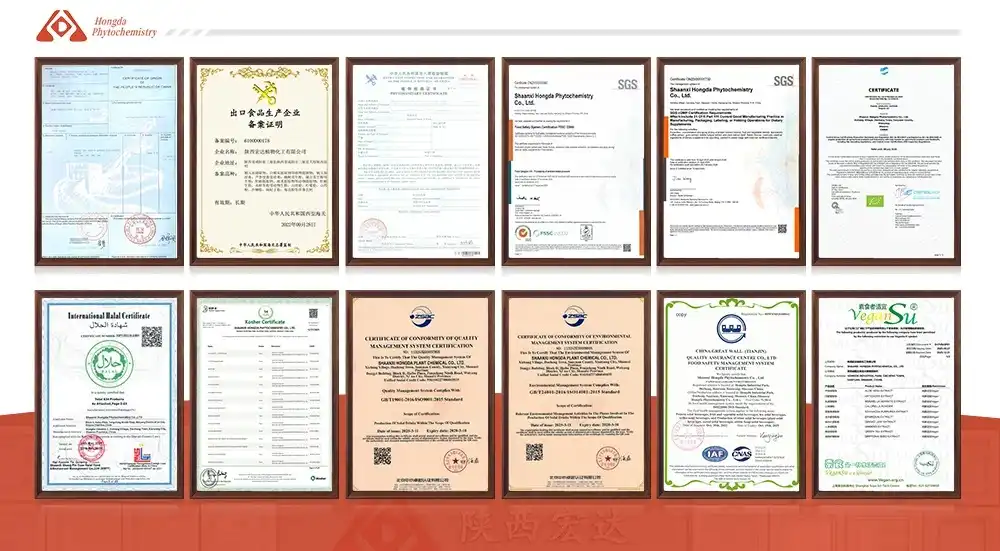
Certifications are more than just marketing assistance. They may make or break how easily a shipment of magnesium bisglycinate chelate powder passes through customs and store compliance checks. In recent years, Hongda has expanded its certification offering, adding cGMP, FSSC22000, ISO22000, ISO9001 and organic certifications for both EU and NOP in 2026, in addition to its current food production licences, Halal, Kosher, BRC and FDA certifications. The chart below shows which papers matter most based on your import destination.[4][5][6]
|
Document
|
Purpose
|
Typically Issued By
|
|---|---|---|
|
Certificate of Analysis
|
Confirms batch-specific test results
|
Manufacturer's QC lab
|
|
Certificate of Origin
|
Confirms country of manufacture
|
Chamber of Commerce / exporter
|
|
Halal / Kosher certificate
|
Confirms dietary compliance
|
Accredited certifying body
|
|
ISO22000 / FSSC22000
|
Confirms food safety management
|
Third-party certification body
|
|
Organic
|
Confirms organic sourcing
|
Accredited organic certifier
|
|
Safety Data Sheet
|
Supports customs & handling
|
Manufacturer
|
HS Codes and Regulatory Classification Basics
A seamless import procedure relies on correctly categorising magnesium bisglycinate chelate powder under the relevant Harmonised System code. This is one of the most ignored processes. Getting it wrong might lead to delays, inaccurate duty assessments, or extra inspection requirements. Mineral amino acid chelates are often categorised differently from raw mineral salts, and customs brokers unfamiliar with the supplement ingredient category can default to an inaccurate code that raises duty responsibility needlessly. Work with a manufacturer that has expertise in exporting to your target market and verify the classification with your own customs broker before the cargo leaves China to avoid expensive surprises at the port of entry. If you are importing for the first time, you should ask the provider what HS code they normally use and check this yourself against your country's tariff schedule.
Labelling and Country-Specific Requirements
Different label requirements exist for imported magnesium bisglycinate chelate powder in the United States, the European Union, and other destination markets, and they should be addressed before the product arrives, not after. US buyers usually want GRAS paperwork support and FDA facility registration confirmation from their supplier, while EU importers frequently want novel food status clarification or, at a minimum, certification that the ingredient has a history of use in the target category. The country-of-origin label, the batch code, and the storage condition statement will also change depending on the jurisdiction, and a supplier that has experience exporting to numerous locations should be able to advise you on what paperwork usually accompanies each shipment. Confirming these needs at the quote stage will keep your import schedule predictable.
Working with a Magnesium Bisglycinate Manufacturer on Paperwork
The import paperwork is fast-tracked because the magnesium bisglycinate producer sees the paperwork as part of the product, not an afterthought from a separate sales department. Working with a reliable magnesium bisglycinate powder supplier can make this process more efficient, as Hongda routinely issues COAs, certifications, and safety data sheets for each shipment and may provide extra paperwork, such as GRAS filing help for customers seeking the US market, especially. Create a paperwork checklist with your supplier before your first order ships – from the certificate of origin to religious dietary certificates that are important to your target merchants – and you will minimise the back-and-forth that typically slows customs clearance on a first shipment. Buyers who see this coordination as a collaborative effort rather than a one-time request usually find that renewals go more easily and following orders are processed more quickly.
Vetting Suppliers and Avoiding Common Import Pitfalls
Red Flags When Comparing a Powder Supplier
A good magnesium bisglycinate powder supplier at the best price may not be the best representative of an international import partnership, and several red flags tend to come up again and again in problematic sourcing experiences. Suppliers that cannot provide a batch-specific certificate of analysis, are imprecise about whether their product is totally chelated vs a physical mix, or cannot explain their own heavy-metal testing process should raise immediate caution. Other warning signs to take carefully include inconsistent pricing that changes substantially from quotation to quote, abnormally short or lengthy lead times, and a reluctance to set up a factory visit or video audit. Importers who raise specific technical concerns right away tend to be spared the quality and paperwork difficulties that emerge later, frequently after a deposit has been paid.
Why Does Direct-From-Factory Sourcing Reduce Risk?
Buying magnesium bisglycinate chelate powder directly from the manufacturer instead of from an untested intermediary removes a layer of uncertainty from the import process because technical questions go straight to the people who actually control production and testing, as opposed to a broker who may not fully understand the specification being discussed.
Magnesium bisglycinate chelate powder introduction. If you want to import magnesium bisglycinate chelate powder and want to know specifications, request a sample, and examine documents before making a purchase, please contact duke@hongdaherb.com. The team may review certificates of analysis, discuss country-specific labelling assistance, and validate lead times versus your intended delivery window.
Avoiding Confusion Between Chelate Grades and Blends
One of the most typical import blunders is to confuse a completely chelated magnesium bisglycinate chelate powder with a physical dry combination of magnesium oxide and glycine that has not really been through a chelation process. In writing, the two items may seem the same. There is no common labelling requirement to stop less transparent vendors from marketing the cheaper mix with bisglycinate language, as they sometimes do. FTIR spectroscopy may prove that the molecules of magnesium and glycine are bonded together, not only that the two chemicals are in the same container. This indicates the item is fully chelated. Ask importers if FTIR verification is possible, and ask for the underlying data, not just a verbal guarantee, since this test is frequently the most straightforward method to separate honest chelate suppliers from those that take shortcuts.[1][2][6]
Where Does Wholesale Manganese Bisglycinate Fit Your Import Plan?
Many importers who are developing a multi-mineral product line ultimately seek more than magnesium alone, and wholesale manganese bisglycinate is one of the most popular additions to an existing chelated mineral order. The import logistics are greatly eased by having the two minerals combined through the same manufacturer so that one shipment can have matching documentation, similar testing standards, and aligned container space, rather than two separate supplier relationships with different paperwork times. This strategy also lowers the administrative effort of managing several certificates of origin and safety data sheets for various shipments arriving on different dates. Buyers anticipating a bone-health, prenatal, or general multivitamin line can mention this consolidation option to their supplier early, as production scheduling for a combined order is frequently simpler to organise than two individual buy orders placed months apart.
Conclusion
The secret to a successful import of magnesium bisglycinate chelate powder is to confirm the right details before the shipment leaves the factory: confirmed assay and elemental magnesium content, a batch-specific certificate of analysis, current certifications for your destination market, and packaging built for ocean transit. When evaluating a magnesium bisglycinate manufacturer, buyers should also review its production capabilities and quality-control procedures. Shaanxi Hongda Phytochemistry Co., Ltd. has adapted its manufacturing, laboratory, and documentation procedures to the requirements of foreign customers. This includes FTIR-verified chelation and certifications such as cGMP, ISO 22000, and organic status introduced in 2025. For importers considering their first purchase or wishing to change to a more open supplier, the due diligence provided here is just what seasoned buyers already do. Get in early, read the documentation well, and create the relationship before the volume, not after.
FAQ
1. Do I need to verify FTIR testing before importing?
Yes — FTIR spectroscopy confirms the product is fully chelated rather than a physical blend, and reputable suppliers will share this data on request.
2. What certifications does Hongda hold for the US and EU markets?
Current certifications include cGMP, FSSC22000, ISO22000, ISO9001, FDA registration, Halal, Kosher, BRC, and both EU and NOP organic certifications.
3. What is the minimum order quantity for import?
The standard MOQ is 500kg, with volume discounts available at one metric tonne and above.
4. How is the powder packaged for ocean freight?
The product ships in fibre drums with double-layer PE liners, plus an aluminium-foil and nitrogen-flush dual-seal system for long-distance transit.
Start Your Import Order With HONGDA Today
If your company is preparing to import magnesium bisglycinate chelate powder, Hongda Phytochemistry can provide the documentation, testing transparency, and shipping support that make a first order straightforward rather than stressful. From certificates of analysis tied to your specific batch to packaging engineered for ocean freight, every step is designed with international buyers in mind. Whether you need a small sample to validate quality, a full container for an established product line, or guidance on which certifications apply to your destination market, the team at duke@hongdaherb.com is ready to help.
References
1. Schuette, S.A., Lashner, B.A., & Janghorbani, M. "Bioavailability of magnesium diglycinate vs magnesium oxide in patients with ileal resection." Journal of Parenteral and Enteral Nutrition.
2. Ranade, V.V., & Somberg, J.C. "Bioavailability and pharmacokinetics of magnesium after administration of magnesium salts to humans." American Journal of Therapeutics.
3. Walker, A.F., et al. "Mg citrate found more bioavailable than other Mg preparations in a randomised, double-blind study. "Magnesium Research.
4. Codex Alimentarius Commission. "General Standard for Food Additives (Codex STAN 192-1995)." FAO/WHO.
5. U.S. Food and Drug Administration. "Generally Recognised as Safe (GRAS) Notification Program Guidance". FDA Center for Food Safety and Applied Nutrition.
6. European Food Safety Authority. "Scientific Opinion on the Safety of Magnesium Bisglycinate as a Source of Magnesium." EFSA Journal.