



_1745918362135.webp)

Identity and Purity Lines Every COA Needs
Product Name, Lot Number, and Manufacturing Details
The first lines of a COA are administrative, but they anchor everything below them. A certificate of analysis gives the name of the product, the carrier, and also gives a unique lot number, date of manufacturing, date of re-test or expiration, and name of the producer. Without a lot number, laboratory results cannot be tracked to a physical batch, and a complaint inquiry is a shot in the dark. Hongda also reports a 24-month shelf life for its liposomal resveratrol powder, and a place of origin of Shaanxi, China, so customers may match papers to drums when they arrive. Also, make sure the carrier is specified, since sunflower phospholipids are a clean-label and non-soy claim that businesses regularly make on their own packaging. If any identification is missing, get the supplier to reissue the certificate before you accept the items.
Trans-Resveratrol Assay by HPLC
The assay line will tell you how much trans-resveratrol is in the powder. It should also include the technique, which is usually high-performance liquid chromatography. We establish the purity at 90% minimum of 90%; the number purchasers check against their formulation estimates. Most pure resveratrol powder producers will publish an assay on simple extract; thus, a purity number alone is just the admission ticket for a liposomal product. Note how the result is stated against the total powder or the active component, and ask the supplier to specify the basis of computation, the reference standard, and the analytical date. That piece of information helps your quality team re-run the test and verifies that it was liposomal resveratrol powder that was genuinely tested and not just written up in a sales sheet.[1][3][4]
Appearance, Solubility, and Physical Properties
Physical descriptors might seem simple, yet they can detect issues early. Any later lot of our liposomal resveratrol powder, which is white in color, that becomes yellow or gray or becomes clumpy is an indication that storage or process modifications need to be looked into. Some COAs additionally include bulk density, flowability, and dispersion behavior after hydration, which are essential to capsule fillers and stick-pack producers who rely on consistent handling. Freeze drying makes a light, porous powder, and moisture pickup in transit may change its behavior; thus, the physical lines are a heads-up before the lab data are looked at. Use this block as the rapid visual examination your receiving staff does at the dock, and further testing when the documentation matches the goods.
|
ANALYSIS
|
SPECIFICATION
|
RESULTS
|
||
|
Appearance
|
White powder
|
Complies
|
||
|
Odor
|
Characteristic
|
Complies
|
||
|
Tasted
|
Characteristic
|
Complies
|
||
|
Assay
|
50%(Resveratrol 50% Liposome 50%)
|
Complies
|
||
|
Sieve Analysis
|
100% pass 80 mesh
|
Complies
|
||
|
Loss on Drying
|
5% Max.
|
1.02%
|
||
|
Sulphated Ash
|
5% Max.
|
1.3%
|
||
|
Extract Solvent
|
Ethanol & Water
|
Complies
|
||
|
Heavy Metal
|
5ppm Max
|
Complies
|
||
|
As
|
2ppm Max
|
Complies
|
||
|
Residual Solvents
|
0.05% Max.
|
Negative
|
||
|
Microbiology
|
|
|
||
|
Total Plate Count
|
1000/g Max
|
Complies
|
||
|
Yeast & Mold
|
100/g Max
|
Complies
|
||
|
E.Coli
|
Negative
|
Complies
|
||
|
Salmonella
|
Negative
|
Complies
|
||
The Tests That Prove a Liposome Is Real
Particle Size and PDI by Dynamic Light Scattering
This is where a liposomal COA differs from a regular extract certificate. Dynamic light scattering reports the average vesicle size and the polydispersity index (a measure of the uniformity of the population). The target diameter of Hongda’s liposomal resveratrol is 80-120nm with PDI < 0.3, and each batch may be backed by a DLS particle size distribution report. A tight distribution represents vesicles that respond similarly during rehydration. A wide or multimodal curve represents aggregation or inadequate processing. These factors affect the number. The COA should mention the instrument, dispersion medium, and measurement temperature. If a certificate indicates a size, but does not describe how the size was determined, seek the raw report before using the figure for any formulation choice or marketing statement.[5][6]
Encapsulation Efficiency and Zeta Potential
Encapsulation efficiency says what percentage of the resveratrol is kept within the phospholipid vesicles, and our technique provides a value over 85%. This is likely the most economically relevant aspect of a liposomal COA since it directly relates to protection against stomach acid and lymphatic absorption. Zeta potential adds to this by explaining the surface charge, which keeps vesicles separate and stable in suspension. On a liposomal resveratrol powder certificate, check for both values combined. If you have high entrapment with poor stability, or the contrary, you have an incomplete tale. Ask how they separated free resveratrol from encapsulated resveratrol in testing, since the manner of separation influences the outcome. The clear technique notes demonstrate the lab knew the substance and that the amount was measured and not approximated.[2][3]
TEM Morphology Confirmation
Numbers are average, but a picture tells a story. The most direct indication that a powder is a real liposome and not a physical mixture is the presence of intact spherical vesicles as seen by transmission electron microscopy. Hongda gives TEM photos with every batch of particle size reports to let customers examine the consistency of the nanoparticles. The TEM line on a COA should include a picture with a scale bar, sample identity, and date. In a physically mixed product, you can’t have clean, intact spheres. For firms looking to sell a delivery method, a photograph associated with a particular batch of liposomal resveratrol powder is the single strongest piece of supporting material they may have in their files.
|
Test Item
|
Typical Method
|
Hongda Reference Value
|
|---|---|---|
|
Vesicle size
|
DLS
|
80–120 nm
|
|
Polydispersity index
|
DLS
|
Below 0.3
|
|
Encapsulation efficiency
|
Separation plus HPLC
|
Above 85%
|
|
Morphology
|
TEM
|
Intact spherical vesicles
|
|
Trans-resveratrol purity
|
HPLC
|
≥90%
|
Safety, Purity, and Compliance Lines
Heavy Metals and Pesticide Residues
Safety testing protects your customers and your import clearance. As a China resveratrol powder factory with an SGS-standardized laboratory, Hongda tests heavy metals and pesticide residues before every shipment, using equipment such as atomic absorption spectrophotometers and chromatographs. A meaningful COA lists each metal individually, typically lead, arsenic, cadmium, and mercury, with the result, the limit, and the method. Pesticide screening should name the panel used and confirm that findings fall within the limits of the destination market. Avoid certificates that only say conforms without a numerical result, because they cannot be audited. Retailers and marketplaces increasingly ask for these values when reviewing a China resveratrol powder factory listing, so having them on file speeds up approvals. Agree on the applicable limits in writing before ordering.
Microbiological Limits
Because a phospholipid-based powder can support microbial growth if handled poorly, microbiological limits deserve close attention. Expect total plate count, yeast and mold, and screening for pathogens such as Salmonella and E. coli, each reported with a result and a limit. Our certificates state that microbial testing complies with GMP standards for purity and safety, and production takes place in 100,000-level purification workshops. Ask that the method reference be included, since different pharmacopeial and food-industry methods can give different counts. For liposomal resveratrol powder destined for capsules, sachets, or functional beverages, microbial data are also essential to your own release testing plan, so consistent reporting from lot to lot makes internal quality control faster and helps auditors follow the chain of evidence.
Moisture and Loss on Drying After Freeze-Drying
Moisture is a quiet but important line for any freeze-dried liposomal product. Residual water influences flowability, microbial stability, and how well vesicles survive storage. Hongda tests moisture on each lot, and the value should appear on the COA with the method, such as loss on drying or Karl Fischer titration. Compare the number across batches, because a gradual upward trend can reveal packaging or humidity problems long before appearance changes. Our liposomal resveratrol powder carries a 24-month shelf life under proper storage, which depends on keeping moisture within specification and packaging sealed. You may also request a note on residual solvents used during processing, along with the supplier's statement of compliance. These extra lines show that the manufacturer monitors the whole process rather than only the final assay.
|
Test Item
|
What to Look For
|
Why It Matters
|
|---|---|---|
|
Heavy metals
|
Individual results against limits
|
Import clearance
|
|
Pesticide residues
|
Named panel and numeric result
|
Destination-market rules
|
|
Microbiology
|
Plate count, yeast/mold, pathogens
|
Consumer safety
|
|
Moisture
|
Value plus method
|
Shelf-life stability
|
|
Certificates
|
cGMP, ISO22000, FSSC22000, ISO9001
|
Audit readiness
|
Using the COA to Buy With Confidence
Batch Consistency and Retention Samples
One perfect certificate is encouraging, but a series of consistent ones is what builds trust. Line up the COAs from three consecutive lots and compare particle size, PDI, encapsulation efficiency, purity, and moisture; small movement within specification is normal, while drift suggests a process issue. Hongda produces at scale, with annual output of up to 3,000 tons and more than 10 production lines, which supports repeatable results across reorders. Keep a retention sample from each incoming lot of liposomal resveratrol powder so that any future question can be answered by retesting the same material. Retained samples, together with COA, TEM, and DLS files, create a traceable record that helps when customers, regulators, or marketplace reviewers ask for evidence months after production.[5][6]
Specification Agreements for Wholesale Orders
Turn the COA into a contract tool by attaching an agreed specification to every purchase order. When you negotiate wholesale resveratrol powder, list the required test items, the accepted limits, the analytical methods, and the delivery of TEM and DLS reports with each shipment. Hongda offers a minimum order of 1 kg and packaging from 1 kg to 25 kg, so pilot and commercial orders can follow the same document format. Add a clause describing how disputes will be settled, for example, by testing retained samples at an agreed third-party laboratory. Clear expectations protect both parties and reduce delays at customs or during customer audits. A defined specification also lets your team compare quotes for liposomal wholesale resveratrol powder fairly, since every supplier is measured against the same list.
|
Red Flag
|
What It Suggests
|
Follow-Up Request
|
|---|---|---|
|
No lot number
|
Results cannot be traced
|
Reissued, lot-specific COA
|
|
"Conforms" with no number
|
Result cannot be audited
|
Numerical result and limit
|
|
Size quoted without method
|
Figure is unverified
|
Raw DLS report
|
|
No TEM reference
|
Structure is unproven
|
TEM image with scale bar
|
Certifications and Supplier Audit Support
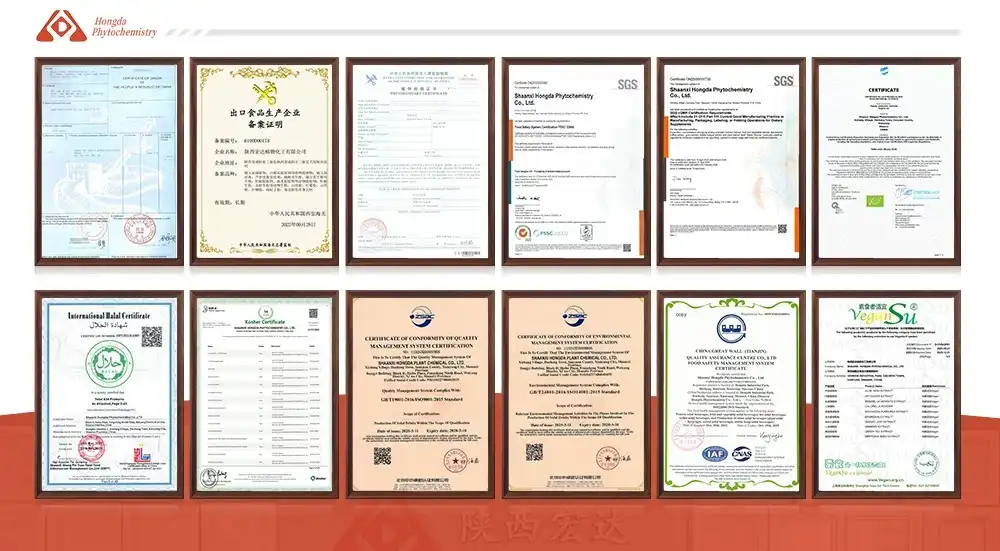
Paperwork is more persuasive when the factory behind it is open to inspection. Shaanxi Hongda was founded in 2001, covers about 20,000 square meters, and employs more than 150 workshop technicians. Its certifications include FDA, BRC, halal, kosher, and organic credentials, with 2025 additions such as cGMP, FSSC22000, ISO22000, and ISO9001, plus organic approvals for the EU and NOP. Three planting bases with agronomist supervision support traceability for botanical raw materials. When you plan an audit, use the COA as your checklist: ask to see the laboratory instruments that generate each line, the calibration records, and the sample handling procedure. Suppliers of liposomal resveratrol powder who welcome that conversation usually deliver more dependable documentation than those who avoid it.
Conclusion
A reliable COA for pure resveratrol powder manufacturers will include four things: identification, liposome structure, safety, and traceability. This implies a lot of numbers: an HPLC assay, particle size and PDI, encapsulation efficiency, TEM morphology, heavy metals, pesticide residues, microbiology, and moisture, each with a technique and a limit. Shaanxi Hongda Phytochemistry Co., Ltd. bases its liposomal resveratrol powder proofing on this framework and offers the TEM and DLS evidence at the batch level. Don't accept generic claims when qualifying a supplier; insist on figures; use the checklist in this article. The result: a more robust formulation, simpler audits, and more trust in every capsule you create.
FAQ
Q1. Which COA lines prove a powder is liposomal?
Vesicle size and PDI by DLS, encapsulation efficiency, and a TEM image of intact spheres.
Q2. What purity does Hongda specify?
Trans-resveratrol purity of 90% or higher, as a white powder.
Q3. What vesicle size should I expect?
About 80–120 nm, with a polydispersity index below 0.3.
Q4. Is a COA enough on its own?
No. Pair it with batch TEM and DLS reports and, for large programs, independent laboratory testing.
Q5. What are the MOQ and shelf life?
The MOQ is 1 kg, and the shelf life is 24 months.
Request a Sample COA From HONGDA Today
If you are qualifying a supplier and want documents you can actually audit, HONGDA is ready to help. Our team will send a sample COA, TEM image, and DLS report for liposomal resveratrol powder, review your target specification, and quote factory-direct prices with packaging from 1 kg to 25 kg. Tell us your market, your dosage form, and the test items your quality team requires, and we will match them line by line. Write to duke@hongdaherb.com today and let the data speak for our product.
References
1. International Council for Harmonisation. ICH Harmonised Tripartite Guideline Q2(R1): Validation of Analytical Procedures: Text and Methodology. 2005.
2. Akbarzadeh A, Rezaei-Sadabady R, Davaran S, et al. Liposome: classification, preparation, and applications. Nanoscale Research Letters. 2013;8(1):102.
3. Walle T. Bioavailability of resveratrol. Annals of the New York Academy of Sciences. 2011;1215:9–15.
4. Trela BC, Waterhouse AL. Resveratrol: isomeric molar absorptivities and stability. Journal of Agricultural and Food Chemistry. 1996;44(5):1253–1257.
5. Ruozi B, Tosi G, Forni F, et al. Atomic force microscopy and photon correlation spectroscopy: two techniques for rapid characterization of liposomes. European Journal of Pharmaceutical Sciences. 2005;25(1):81–89.
6. Danaei M, Dehghankhold M, Ataei S, et al. Impact of particle size and polydispersity index on the clinical applications of lipidic nanocarrier systems. Pharmaceutics. 2018;10(2):57.