


_1745918362135.webp)

For years, functional food producers have tried to incorporate CoQ10 into drinks, bars, and powdered mixes, only to hit the same wall: regular crystalline CoQ10 rarely dissolves and is poorly absorbed once it hits the body.[1][2] “We engineered liposomal coenzyme Q10 powder to take away that wall, and Hongda Phytochemistry, formerly known as Shaanxi Hongda Phytochemistry Co., Ltd., has built its version around nano-lipid encapsulation specifically so formulators can finally put a meaningful dose of CoQ10 into products that actually perform on the shelf and in the body. Hongda's liposomal CoQ10 powder disperses smoothly and generates much greater plasma levels than unencapsulated versions, unlike crystalline CoQ10, which clumps, floats, or settles out of solution. That combination of formulation-friendly behavior and enhanced absorption is precisely why this ingredient has progressed from being a nice-to-have to something approaching a need for serious functional food development. The next sections discuss why traditional CoQ10 fails, how the liposomal technology solves it, where it fits within functional food categories, and what to examine before obtaining it in bulk.[2][6]
Why Is Liposomal Coenzyme Q10 Powder Essential in Functional Foods?
The Bioavailability Problem Standard CoQ10 Creates for Formulators
Crystalline CoQ10 is unchanged and absorbed at less than 5 percent in this state, and this is a real formulation issue, not a mere annoyance. Brands that use normal CoQ10 sometimes have to put an unrealistically high quantity of it in a completed product to get to a clinically significant dosage, making it expensive and almost impossible to get into anything except a big capsule. The shapes of functional foods exacerbate this difficulty, since drinks and bars provide significantly less space to mask a large, poorly soluble ingredient than does a supplement pill. To overcome this bottleneck, liposomal coenzyme Q10 powder was created, providing formulators with a version of the chemical that acts reliably in food and beverage systems, rather than in opposition to them.[1][2]
How Does Liposomal Encapsulation Solve the Solubility Challenge?
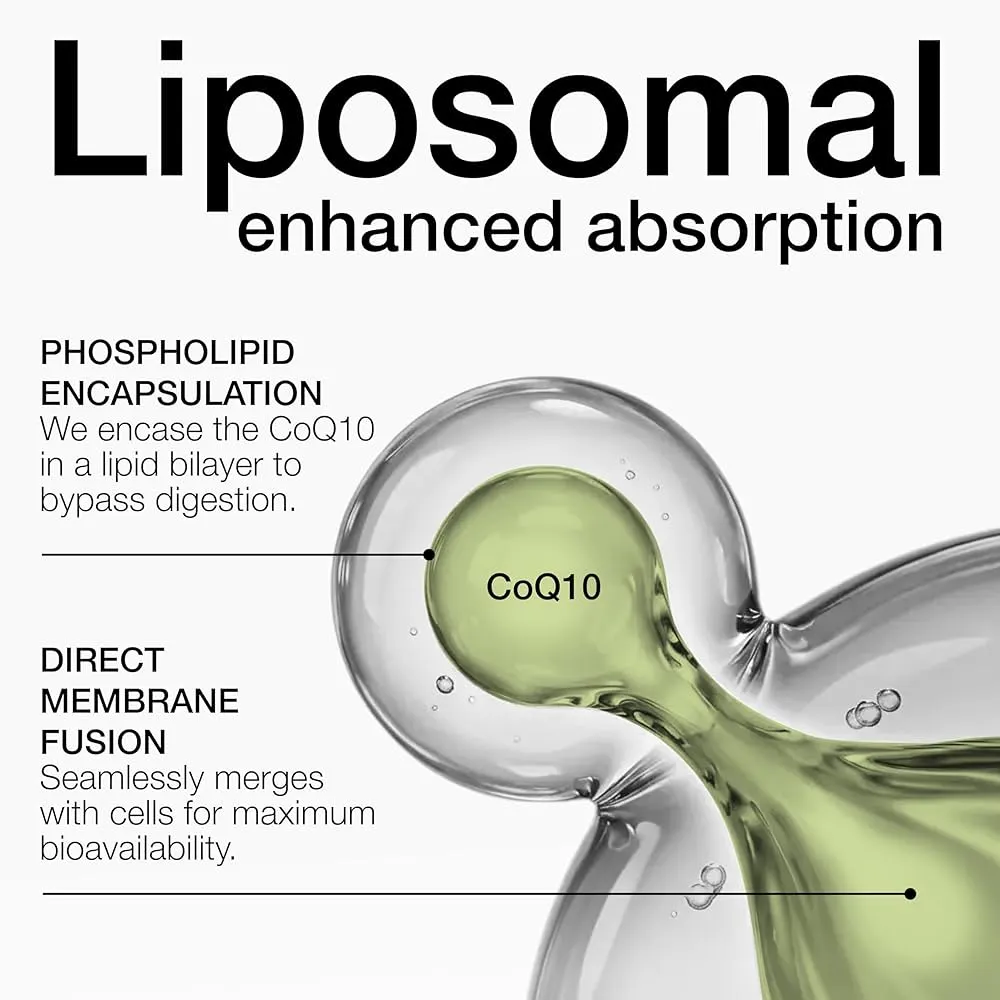
Hongda’s liposomal coenzyme Q10 powder encapsulates each molecule of CoQ10 in a phospholipid bilayer created from sunflower phospholipids, which significantly alters the performance of the ingredient in aqueous environments. Unlike crystalline CoQ10, which tends to float or clump, the encapsulated powder rapidly disperses and produces a stable solution—precisely the behavior a beverage or ready-to-mix product formulator requires from a raw ingredient. And this solubility improvement isn’t a cosmetic fix, either, as it directly correlates with how well the ingredient performs once it is consumed. That means that the same encapsulation that solves the formulation headache also solves the underlying absorption problem in one step, as opposed to requiring two separate technical solutions.
Why Functional Food Brands Are Making the Switch?
Functional food manufacturers who have put both forms head-to-head say they always get the same result: liposomal coenzyme Q10 powder is easier to produce and allows for a more defensible bioavailability claim on the label. By switching away from crystalline CoQ10, we also remove the cold-chain handling requirements and the oxidative stability issues that have previously restricted where CoQ10-fortified goods may be delivered and kept. For manufacturers seeking to stand out in an increasingly congested functional food area, the ability to state that a product employs an advanced, bioavailability-enhanced ingredient versus a generic bulk raw material has become a significant competitive advantage rather than merely a marketing footnote.[2]
Inside Hongda's Liposomal Coenzyme Q10 Powder Technology
Nano-Lipid Encapsulation and Particle Size Control
Hongda’s liposomal coenzyme Q10 powder is encapsulated in nano-lipids, with a particle size controlled between 100 and 400 nanometers, making the vesicles small enough to be efficiently absorbed, yet stable throughout processing. This control over particle size is not accidental; vesicles that are too big lose most of their absorption benefit, while vesicles that are too tiny might be unstable during manufacture or storage. Hongda’s technique is adjusted to a dependable middle ground, allowing formulators a constant raw material, rather than a batch-to-batch guessing game, as they grow from modest trials into full commercial production runs across several manufacturing locations.[6]
Carrier Selection and Encapsulation Efficiency
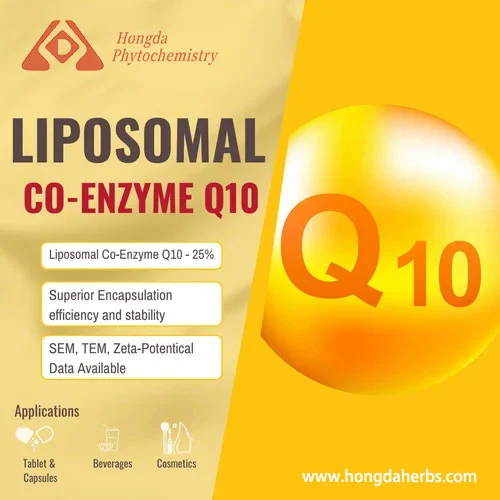
The carrier lipid is as important as the CoQ10 itself, and Hongda employs phospholipids made from sunflower to form the bilayer enveloping their liposomal CoQ10 powder, including China Coenzyme Q10 powder, with an encapsulation effectiveness of 90 percent or more. The high encapsulation rate guarantees that very little active ingredient is unprotected outside of the liposome structure. This is important since unencapsulated CoQ10 blended into the same batch would behave just like the poorly absorbed crystalline form that the liposomal version is designed to replace. This level of encapsulation data should be routine documentation for buyers who are purchasing from a true liposomal coenzyme Q10 source and not a specific requirement for a repackager.
Stability Advantages Over Crystalline CoQ10 in Food Systems
Liposomal coenzyme Q10 powder also provides far higher oxidative stability than crystalline CoQ10, which may degrade when exposed to heat, light, or long-term storage without proper care, plus it offers superior solubility. Hongda’s encapsulated form is stable for 24 months under optimal storage conditions, and the phospholipid shell offers some physical protection from environmental stresses that reduce the shelf life of unencapsulated forms. For functional food makers shipping into hotter areas or dealing with goods that stay on retail shelves for long periods of time, this stability difference might make the difference between a viable ingredient and one that produces ongoing quality control issues.
liposomal CoQ10 Specification
|
ITEM
|
SPECIFICATION
|
RESULTS
|
|
Assay(CoQ10)
|
70%士5%
|
73.1%
|
|
Appearance
|
Of-white to light yellow Powder
|
Conforms
|
|
Physical& Chemical Characteristics
|
||
|
Particle size(20Mesh)
|
90%
|
Conforms
|
|
Lose on dyring
|
≤5.0%
|
1.2%
|
|
Bulk Density
|
Actual Value
|
600g/L
|
|
Tapped Bulk Density
|
Actual Value
|
918g/L
|
|
Heavy metals
|
||
|
ead(Pb)
|
≤0.5ppm
|
Not Detected
|
|
Arsenic(As)
|
≤2.0ppm
|
Not Detected
|
|
Mercury(Hg)
|
≤0.3ppm
|
Not Detected
|
|
Cadmium(Cd)
|
≤0.3ppm
|
Not Detected
|
|
Microbiological Tests
|
||
|
Total Microbial Count
|
≤10000cfu/g
|
50cfu/g
|
|
Coliforms
|
<10MPN/g
|
0.310MPN/g
|
|
Conclusion:
|
Conform to In-house standard.
|
|
Formulating With Liposomal Coenzyme Q10 Powder Across Functional Food Categories
Beverages and Ready-to-Drink Formats
The increased solubility of liposomal coenzyme Q10 powder is most easily seen in beverages, since crystalline CoQ10 is almost unusable in a clear or pale-coloured liquid without the development of noticeable sediment or an oily film on the surface. Hongda's liposomal delivery system disperses cleanly and remains in stable suspension, enabling businesses to produce functional shots, wellness drinks and fortified waters that just wouldn't be feasible with unencapsulated CoQ10. This sector has seen rapid growth because consumers are moving away from capsules and toward liquid wellness delivery forms. CoQ10 has trailed behind other actives in this change historically, only because of solubility constraints, which are now solved by liposomal encapsulation.[2][5]
Powdered Mixes, Sachets, and Instant Products
Ready-to-mix powders and single-serve sachets rely on an ingredient dissolving rapidly and fully when mixed into water, and liposomal coenzyme Q10 powder is ideally suited to this purpose. Additionally, quick health blends or strengthened powdered drinks may be strengthened with significant measurements of CoQ10 without the issues of grittiness or partial dissolving that crystalline structures of the same organisation must manage. The liposomal structure means that these powdered formats do not require cold-chain shipping and can be distributed and stored under normal ambient conditions, which considerably simplifies logistics compared to less stable CoQ10 ingredient forms that require more careful handling from factory to shelf, especially across long international shipping routes.
Bars, Gummies, and Solid Functional Foods
The difficulty is different for solid functional food forms, where flavour, texture and uniform distribution within a matrix are just as critical as solubility during the mixing stage. When included in bars and gummies, liposomal coenzyme Q10 powder blends more consistently than crystalline CoQ10, which might result in pockets of grit or unequal potency at different points in a batch if it doesn’t fully integrate. The smaller and more consistent particle size of the liposomal form also decreases the possibility of an unpleasant mouthfeel, a typical problem formulators have when sourcing raw CoQ10 from a less reliable liposomal coenzyme Q10 supplier and attempting to fortify solid functional meals with poorly processed material.
Dosage Efficiency and Cost Considerations for Formulators
Because of the significantly higher bioavailability, formulators can often achieve the desired therapeutic effect of liposomal coenzyme Q10 powder at a lower per-serving dose than crystalline CoQ10. This means that there is more space in the formulation for complementary ingredients and that the overall cost efficiency may improve, even with a higher price per kg for the raw material. This dose efficiency is particularly significant in functional foods when component incorporation rates are closely controlled by flavour, texture, and overall serving size. If your team is doing this type of cost vs. performance study for a new product, drop a line to duke@hongdaherb.com, and Hongda’s technical staff can assist in simulating dosage scenarios particular to your formulation.
|
Format
|
Key Formulation Benefit
|
|---|---|
|
Beverages and shots
|
Clean dispersion, no sediment or oil separation
|
|
Powdered mixes and sachets
|
Fast, complete dissolution; no cold-chain requirement
|
|
Bars and gummies
|
Even distribution, reduced grittiness
|
|
Capsules and tablets
|
Lower dose needed for equivalent effect
|
The Manufacturing Backbone Behind Hongda's Liposomal Coenzyme Q10 Powder
Factory Capacity and R&D Infrastructure
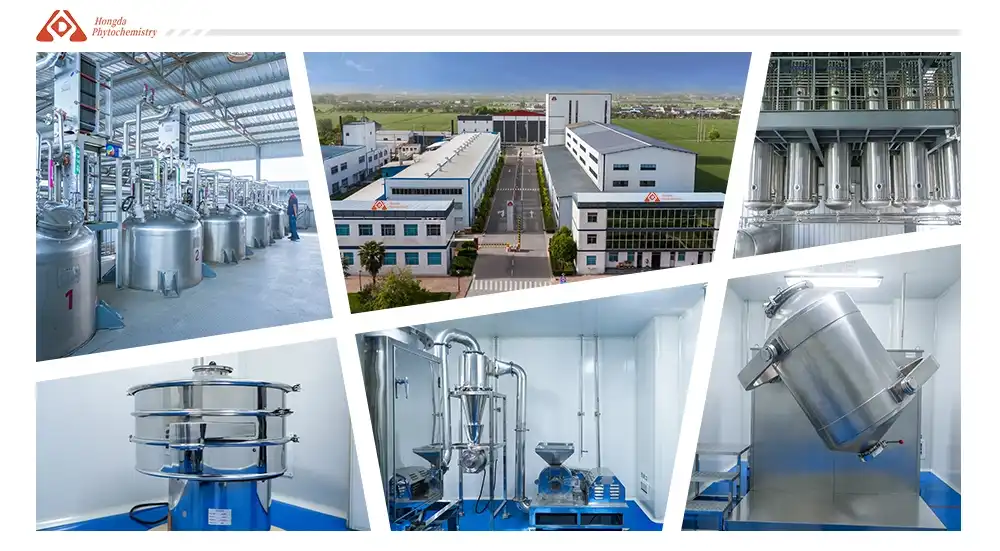
Shaanxi Hongda Phytochemistry Co., Ltd. was established in 2001 and operates a factory covering roughly 20,000 square meters, with more than ten modern production lines and 100,000-level purification workshops supporting its liposomal coenzyme Q10 powder line alongside the rest of its catalog. The company maintains two dedicated R&D institutions staffed by more than twenty researchers drawn from universities and scientific institutions across China, giving the encapsulation process ongoing technical oversight rather than a fixed formula left unchanged for years. With annual output capacity reaching up to 3,000 tons across the full product range, the factory has the scale to support functional food brands moving from pilot batches into full commercial production.
Testing Protocols and Quality Assurance
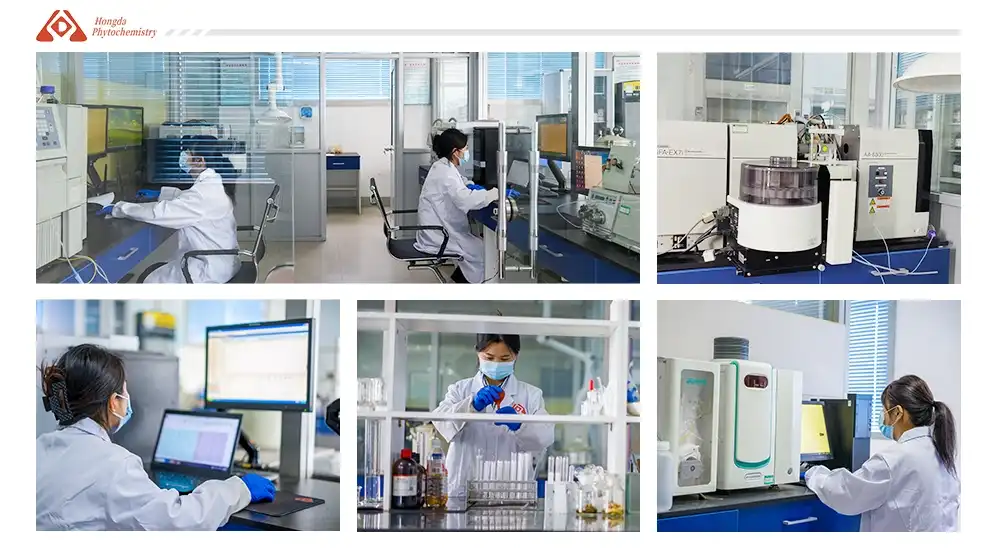
Every batch of liposomal coenzyme Q10 powder passes through Hongda's SGS-standardized laboratory, developed jointly with university professors and equipped with high-performance liquid chromatographs, atomic absorption spectrophotometers, and automatic titrators, among other testing instruments. This testing regime covers ingredient purity, moisture content, heavy metals, and microbial safety, with microbial testing compliant with GMP standards to ensure the product meets international expectations regardless of the destination market. A coenzyme Q10 powder factory that maintains this depth of in-house testing gives functional food manufacturers the documentation needed to satisfy their own quality assurance teams without additional third-party verification or delays before production begins.[3][4]
Certifications Supporting Global Functional Food Brands
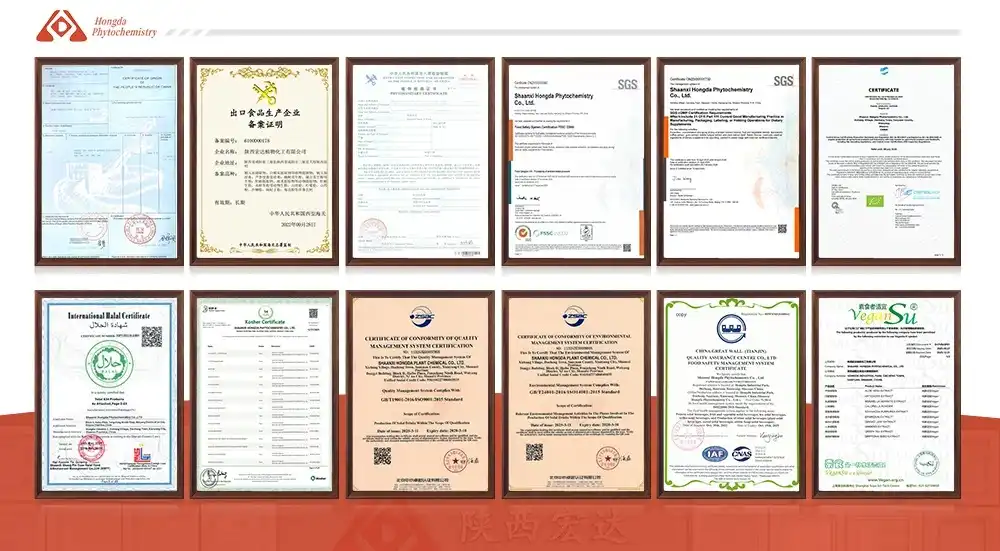
Between 2001 and 2024, Hongda built a certification portfolio covering national high-tech enterprise status, food production licenses, feed additive production licenses, HALAL, KOSHER, BRC, FDA registration, and organic certification. In 2025, the company added cGMP, FSSC22000, SC certification, ISO22000, ISO9001, and organic certification for both the EU and NOP standards. These credentials apply directly to functional food buyers sourcing from a coenzyme Q10 powder factory for products destined for regulated retail channels in North America, Europe, and beyond, removing much of the compliance uncertainty that comes with sourcing a novel ingredient format from an unfamiliar factory partway through a product launch cycle.[3][4][5]
What to Look for When Sourcing From a Coenzyme Q10 Powder Factory?
Verifying Particle Size and Encapsulation Data
Before committing to a bulk order, functional food buyers should request particle size distribution data and encapsulation efficiency figures specific to the batch they intend to purchase rather than relying on general product literature alone. This verification step is the clearest way to confirm that a supplier's liposomal CoQ10 powder is a genuine nano-encapsulated product rather than a standard CoQ10 powder marketed loosely under the liposomal label. Reputable manufacturers, including Hongda, provide this documentation as standard practice, and any reluctance to share batch-specific data should raise questions during supplier evaluation, particularly for buyers planning repeat purchases over an extended supply relationship.
Comparing a China Coenzyme Q10 Powder Source Against Overseas Options
Buyers weighing a China coenzyme Q10 powder source against manufacturers in other regions should compare not just price but production scale, certification breadth, and testing depth, since these factors often matter more over the life of a supply relationship than a small difference in unit cost. Hongda's combination of established production infrastructure, broad international certification, and in-house testing capability positions it competitively against suppliers in other manufacturing regions, particularly for functional food brands that value consistent, dependable batch-to-batch performance over the lowest possible quote from a factory they have never audited or visited in person before signing a long-term agreement.
Choosing a Coenzyme Powder Manufacturer That Understands Functional Food Requirements
Not every ingredient supplier understands the specific formulation constraints functional food developers work within, from taste masking to processing temperature limits to shelf-stability requirements for ambient distribution. A coenzyme powder manufacturer with direct experience supporting beverage, bar, and powdered-mix customers can offer more relevant technical guidance than a general bulk ingredient supplier focused primarily on capsule and tablet applications. Buyers should ask prospective suppliers directly about their experience with functional food formats before finalizing a sourcing decision, since this experience often shows up in fewer formulation surprises later in the development process, once a product is already close to launch.
|
Certification Period
|
Credentials Obtained
|
|---|---|
|
2001–2024
|
National high-tech enterprise, food production license, feed additive license, HALAL, KOSHER, BRC, FDA, organic certification
|
|
2025 (new)
|
cGMP, FSSC22000, SC certification, ISO22000, ISO9001, Organic (EU), Organic (NOP)
|
Conclusion
Liposomal coenzyme Q10 powder solves the solubility and absorption problems that have long kept CoQ10 out of serious functional food development, while Hongda Phytochemistry, an experienced liposomal coenzyme q10 manufacturer, backs its version with verified encapsulation data, broad certification, and manufacturing scale. Functional food brands ready to fortify their next product with a genuinely bioavailable CoQ10 ingredient should request samples and specifications soon to secure production capacity.[1][2][6]
FAQ
1. Why does crystalline CoQ10 perform poorly in functional foods?
It has under 5 percent absorption and poor solubility, making it difficult to dissolve and dose effectively in food and beverage formats.
2. How much more bioavailable is liposomal coenzyme Q10 powder?
Hongda's liposomal version delivers 3 to 10 times higher plasma concentrations than crystalline CoQ10.
3. What particle size does Hongda's liposomal coenzyme Q10 powder achieve?
Particle sizes are controlled within approximately 100 to 400 nanometers, with encapsulation efficiency above 90 percent.
4. Does this ingredient require cold-chain shipping?
No, the liposomal structure eliminates the cold-chain requirements associated with less stable CoQ10 formats.
Formulate Smarter With HONGDA's Liposomal Coenzyme Q10 Powder
If your functional food line needs a CoQ10 ingredient that actually dissolves, disperses, and absorbs the way your formulation requires, HONGDA's liposomal coenzyme Q10 powder is built for exactly that challenge. Shaanxi Hongda Phytochemistry Co., Ltd. backs every batch with particle size and encapsulation documentation, giving your development team the data needed to formulate with confidence. Contact our technical staff at duke@hongdaherb.com to request samples, review specifications, or discuss your next bulk order for beverages, powders, or solid functional food applications.
References
1. National Center for Complementary and Integrative Health. Overview of coenzyme Q10 research and clinical evidence.
2. Journal of Nutritional Biochemistry. Studies on liposomal delivery systems and nutrient bioavailability.
3. International Organization for Standardization. ISO 22000 Food Safety Management System documentation.
4. U.S. Food and Drug Administration. Dietary Supplement Labeling and Facility Registration Requirements.
5. British Retail Consortium. BRC Global Standard for Food Safety, certification framework overview.
6. International Journal of Pharmaceutics. Research on nano-lipid encapsulation and particle size engineering.