


_1745918362135.webp)

What Are Best Formulation Uses for Liposomal Coenzyme Q10 Powder?
A similar issue confronts formulators looking to explore Coenzyme Q10. This chemical is fat-soluble and notoriously hard for the body to absorb in its traditional powdered form. Shaanxi Hongda Phytochemistry Co., Ltd. has a solution to that constraint in the form of its liposomal coenzyme Q10 powder. This product contains the molecule in a phospholipid bilayer, which improves solubility, stability, and absorption compared to regular CoQ10.[2][4] This liposomal form is based on the same nanoscale particle engineering and cold-water solubility technology the company has perfected throughout its larger CoQ10 product line and is formulated to dissolve cleanly, resist oxidation, and remain stable under sterilization and storage conditions typical of commercial supplement manufacturing. In this post, we consider the optimum match for liposomal coenzyme Q10 powder in today’s formulation environment, from cardiovascular capsules to functional drinks.
What Are the Best Formulation Uses for Liposomal Coenzyme Q10 Powder?
Cardiovascular and Heart Health Formulas
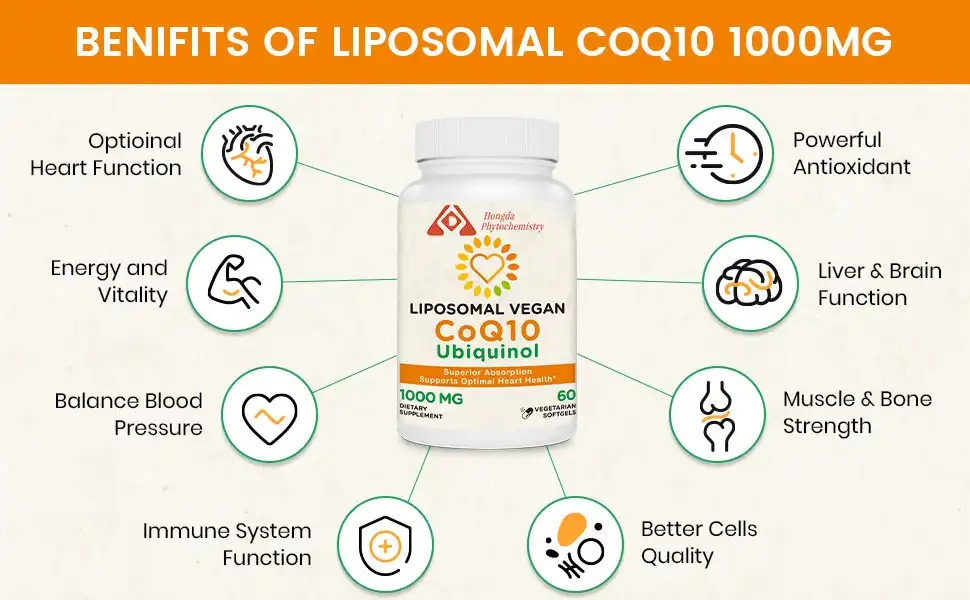
The most well-established use case for CoQ10 in general is cardiovascular support, and liposomal Coenzyme Q10 powder fits this category especially well since heart tissue has some of the greatest mitochondrial energy needs in the body.[1][3] Liposomal technology delivers more of the substance into circulation than standard oil-based or dry powder CoQ10 and is important for recipes targeting statin users, older consumers, or anybody whose natural CoQ10 synthesis has decreased.[1][4] This substance is well known to aid mitochondrial ATP synthesis in the heart tissue and will provide a scientific basis for formulations that are marketing a heart health capsule or softgel.
Cellular Energy and Anti-Fatigue Supplements
In addition to its cardiovascular location, liposomal Coenzyme Q10 powder is also a common ingredient in general energy and anti-fatigue medicines, since the function of CoQ10 in the mitochondrial electron transport chain applies to almost every energy-demanding tissue in the body, not only the heart. Formulators developing fatigue-support or active-lifestyle products may typically couple the substance with B-vitamins or NADH, stacking various mitochondrial-support mechanisms into a single product. Liposomal forms increase absorption compared to regular CoQ10; thus, marketers may typically get a relevant physiological dosage in a lower serving size. This is important for energy products, since customers anticipate a compact, easy-to-take shape.
Why Liposomal Delivery Changes What's Possible?
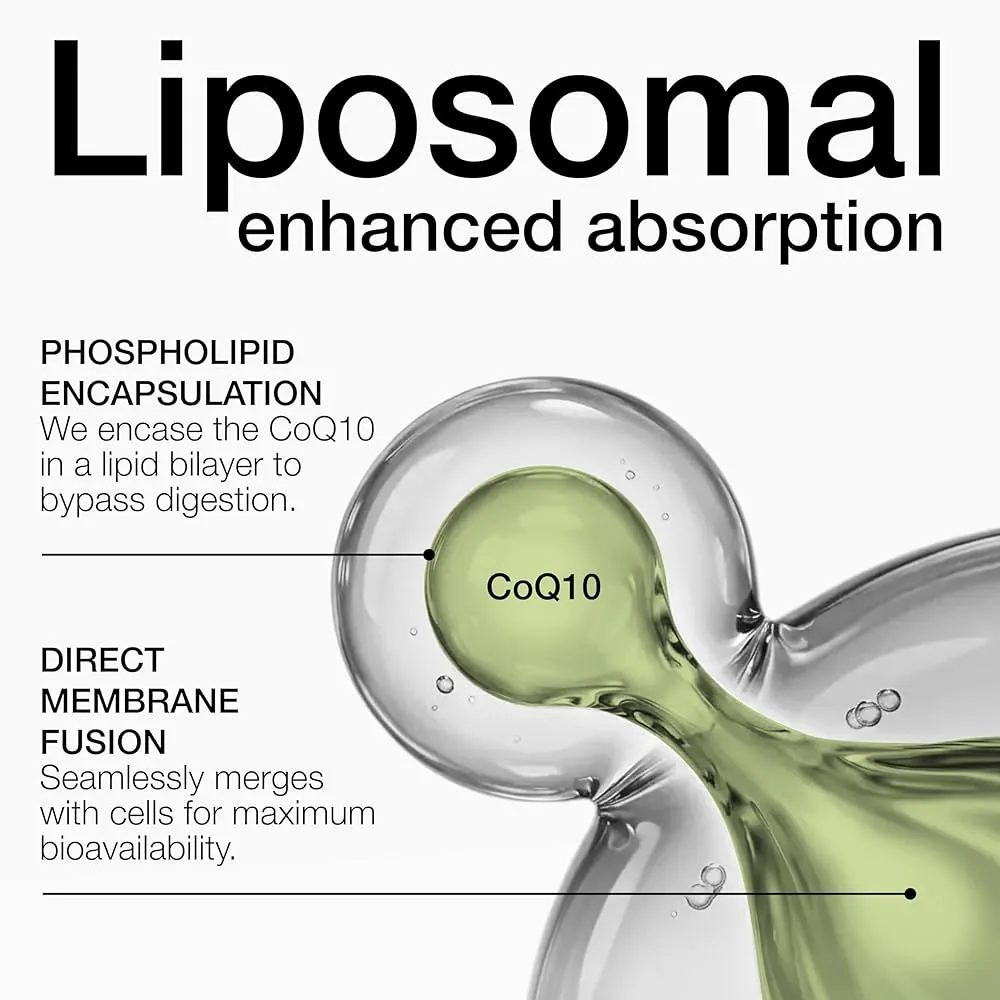
Due to the low water solubility of conventional CoQ10, formulation options have generally been confined to oil-based softgels, which are not suitable for every product category. Liposomal Coenzyme Q10 Powder achieves this by encapsulating the fat-soluble ingredient in a phospholipid shell, rendering it water-dispersible upon reconstitution and allowing for forms that plain CoQ10 powder cannot support, such as drinks, sachets, and water-based functional items. This transition from a fully oil-soluble chemical to a practically water-compatible material is undoubtedly the primary reason liposomal delivery has broadened the range of applications for CoQ10, far beyond the conventional softgel category that has dominated the ingredient for decades.[2][5]
A Liposomal Coenzyme Q10 Powder Manufacturer's View on Formulation Fit
Hongda is a liposomal coenzyme Q10 powder maker, serving the nutraceutical, functional food, and beverage sectors. During formulation talks, the company’s technical staff often asks what format a brand is seeking before making a recommendation on a particle size or concentration. A company producing softgels has distinct concerns from one developing a ready-to-drink beverage. Aligning the liposomal spec to the final format at the beginning may save expensive reformulation later in development. This consultative approach, which is a result of the company’s expertise with the larger liposomal ingredient portfolio, is one reason formulators keep coming back to the same manufacturer for several product launches.
Formulating Liposomal Coenzyme Q10 Powder into Different Product FormatsSoftgels, Capsules, and Compact Dosing
Softgels and capsules are a perfect pairing for liposomal Coenzyme Q10 powder, especially for firms working with a liposomal Coenzyme Q10 powder manufacturer to transfer an existing oil-based CoQ10 product to a liposomal formulation without altering the final format customers are familiar with. The liposomal version is generally more bioavailable than regular CoQ10 at the same dosage, which occasionally allows formulators to cut down on the number of milligrams per capsule while maintaining or boosting physiological effect, which may help create smaller, easier-to-swallow softgel sizes.[4] This small-dose advantage is particularly pertinent for combination formulae where CoQ10 is sharing capsule space with a number of additional active ingredients aimed at cardiovascular or energy support.
Beverage and Functional Drink Applications
Liposomal Coenzyme Q10 Powder’s water dispersibility upon reconstitution opens new functional beverage forms that plain CoQ10 powder cannot support, like ready-to-drink wellness shots, functional waters, and drinks positioned for heart health. Formulators in this category should validate the performance of a particular liposomal specification via pasteurization and long shelf storage since beverage processing exposes the product to heat and pH variations beyond the requirements of a dry capsule fill. Hongda’s wider expertise in CoQ10 manufacture, including cold-water solubility processing established for its conventional powder line, informs the company’s approach to stability testing for these more processing-demanding liquid applications.
Sachets and Powder-Mix Formats
We now offer Liposomal Coenzyme Q10 Powder in single-dosage sachets, meant to be mixed into water or juice. This format is becoming more and more popular among customers who would rather add a supplement to their drink than take a pill. This format takes advantage of the ingredient's water-dispersibility. Sachets often see less processing stress than a pasteurized beverage, making them an easier starting point for businesses new to formulating with the liposomal form. Sachets also enable simple mixing with additional water-soluble actives, putting together a wider cardiovascular or energy-support mixture in a single mix-in serving for a brand.
Combination Formulas with Complementary Actives
Instead, CoQ10 in liposomal powder form is usually coupled with other actives that complement its effects, such as NADH or omega-3 fatty acids in formulae that promote a wider range of cardiovascular or mitochondrial functions. Because the liposomal form is small and water-compatible, it tends to allow more useful room inside a capsule, sachet, or beverage recipe for these additional ingredients than bulkier oil-based CoQ10 delivery methods. The table below summarizes the format considerations for the applications described thus far.
|
Format
|
Key Advantage of Liposomal Form
|
Typical Pairing
|
|---|---|---|
|
Softgels / capsules
|
Smaller size at equivalent absorption
|
CoQ10 alone or with omega-3s
|
|
Beverages / RTD shots
|
Water-dispersible, survives processing
|
NADH, electrolytes
|
|
Sachets / mix-in powders
|
Simple dissolve, easy combination
|
B-vitamins
|
|
Combination tablets
|
Compact footprint frees formula space
|
Multi-ingredient heart / energy blends
|
Why Do Formulators Choose a Reliable Liposomal Coenzyme Q10 Powder Supplier?
Particle Size and Encapsulation Consistency
The quality of encapsulation is where liposomal CoQ10 products vary the most across manufacturers, and irregular particle size or partial encapsulation might diminish the absorption benefit the technology is intended to provide. Hongda utilizes the nanoscale particle engineering technology it has created for its wider CoQ10 range in its liposomal formulation, targeting uniform, confirmed particle size vs. variable batch-to-batch outcomes. It is this consistency that enables a lower-dose liposomal formulation to consistently provide equal or greater physiological effect than a higher-dose traditional CoQ10 product, a claim that only holds true if the underlying particle engineering is really constant from batch to batch.
Manufacturing Scale Behind HONGDA's Liposomal CoQ10
Shaanxi Hongda Phytochemistry Co., Ltd. is a reliable liposomal coenzyme Q10 powder supplier and manufacturer, with a 20,000-square-meter factory, more than ten advanced manufacturing lines, 100,000-level purification workshops, and a yearly output of around 3,000 tons for the whole site. Hongda has been awarded several national patent technologies and employs over 150 technicians in the workshop. Since being recognized as a National High-Tech Development Enterprise in 2010, such a scale enables Hongda to support smaller pilot orders for brands testing a new formula as well as larger recurring supply contracts.
Laboratory Testing and Certifications
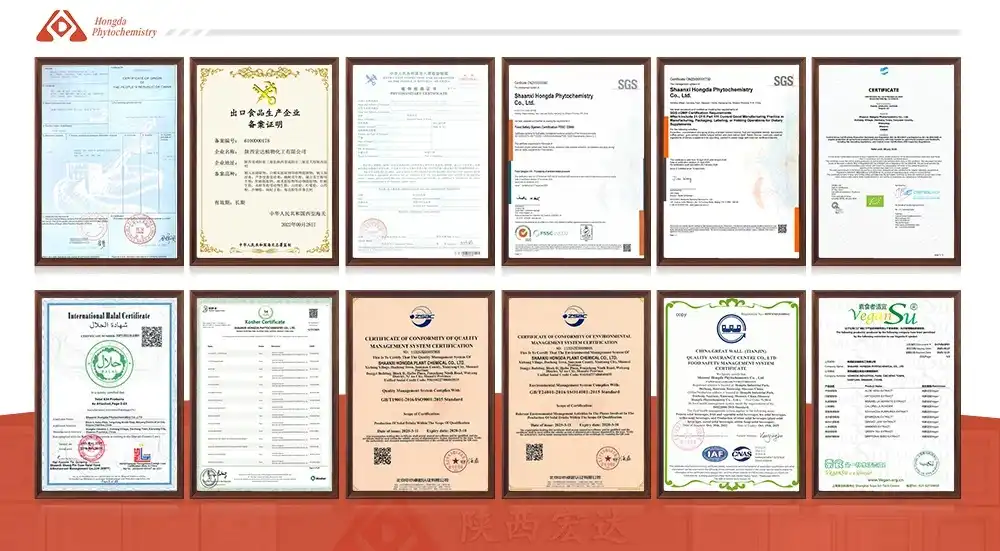
Every batch of Liposomal Coenzyme Q10 Powder is tested in Hongda’s own SGS-standard laboratory, built to university standards with more than twenty professor-level researchers and a team of university professors, using high-performance liquid chromatography to verify the purity and quality of encapsulation before any batch leaves the factory. The certifications that back up this testing regime are summarized below, along with the markets they support principally.
|
Certification
|
Status
|
Primary Market Relevance
|
|---|---|---|
|
ISO 22000
|
Renewed 2025
|
International food safety management
|
|
FSSC 22000
|
Renewed 2025
|
Global food safety certification scheme
|
|
cGMP
|
Renewed 2025
|
US & EU pharmaceutical / supplement manufacturing
|
|
HALAL
|
Held
|
Middle East & Southeast Asia
|
|
KOSHER
|
Held
|
North America & Israel
|
|
ORGANIC (EU) / ORGANIC (NOP)
|
New 2025
|
European Union & United States organic channels
|
|
FDA Certification
|
Held
|
United States market entry
|
Stability Through Storage and Processing
Liposomal Coenzyme Q10 Powder is formulated to resist the oxidation that degrades conventional CoQ10 over time, with the phospholipid coating acting as a protective barrier through storage and downstream processing. Referenced stability data for this ingredient category points to a shelf life of roughly 24 months under recommended storage conditions, a figure that depends heavily on encapsulation quality holding up through manufacturing rather than degrading before the raw material even reaches a formulator. Hongda's stability testing evaluates the liposomal structure's resilience through the specific processing conditions common to capsules, beverages, and sachets, rather than relying solely on raw powder storage data.
If your team is evaluating Liposomal Coenzyme Q10 Powder for a cardiovascular, energy, or functional beverage formula, HONGDA's technical team can review your target format and specification at duke@hongdaherb.com.
Sourcing Considerations for Global Buyers
What to Expect from a Coenzyme Powder Exporter?
International buyers working with a coenzyme powder exporter should expect documented export experience covering customs clearance, cold-chain logistics where relevant, and country-specific labelling compliance, not just a competitive price on the raw ingredient itself.[6] Hongda ships standard orders within three to seven working days and supports both air and marine freight options, with alternatives available for temperature-sensitive shipments where a buyer's target market or storage conditions call for additional protection. For brands new to importing liposomal ingredients specifically, working with an exporter that already understands the documentation requirements for coenzyme products in major markets like the US and EU removes a meaningful source of delay from a product launch timeline.
Working with a Coenzyme Powder Wholesaler on Bulk Orders
Brands scaling beyond pilot quantities typically move from sample orders to working with a coenzyme powder wholesaler capable of supporting recurring bulk purchase agreements, often with tiered pricing that improves as order volume increases. Hongda's standard CoQ10 line offers volume discounts on larger orders, and similar tiered pricing structures typically apply to the liposomal formulation as production volume scales with a brand's growing demand. For procurement teams managing a recurring supply relationship, working with a wholesaler that can commit to consistent lead times and stable specifications across repeat orders matters as much as the initial per-kilogram price quoted during early sourcing conversations.
Documentation That Supports Formulation Decisions
Before finalising a formulation, most procurement and R&D teams request a full documentation package covering particle size data, encapsulation verification, purity figures, and relevant certifications, rather than relying on a general product description alone. Hongda supplies this documentation alongside every Liposomal Coenzyme Q10 Powder order, giving formulators the technical inputs needed to justify dosage decisions and support any regulatory filing or retailer quality review that requires evidence behind a finished product's specification sheet.
Sample Requests and Pilot Batch Planning
Most formulation teams request a sample of liposomal coenzyme Q10 powder before committing to a bulk order, using a small pilot batch to test stability, taste, and performance within their specific finished format before scaling production. Hongda supports this evaluation process with sample quantities suited to internal testing and formulation trials, along with technical guidance on particle size or concentration adjustments based on the results. Planning this pilot stage into a product development timeline is generally the more reliable path to a finished product that performs as expected once it reaches consumers.
Conclusion
Liposomal Coenzyme Q10 Powder's best formulation uses span cardiovascular and energy-support capsules, functional beverages, and sachet-based mix-ins, all made possible by the phospholipid encapsulation that gives the compound practical water compatibility it lacks in conventional form. Shaanxi Hongda Phytochemistry Co., Ltd., a reliable coenzyme powder wholesaler, supports this range of applications with nanoscale particle engineering, an SGS-standardised testing laboratory, and certifications covering ISO 22000, FSSC 22000, and cGMP. For formulators deciding where this ingredient fits best, the underlying encapsulation quality is what determines whether any of those applications actually deliver the absorption advantage liposomal CoQ10 is meant to provide.
FAQ
1. What formulation formats work best for Liposomal Coenzyme Q10 Powder?
Softgels, capsules, functional beverages, and mix-in sachets, thanks to their water-dispersible liposomal structure.
2. How does liposomal CoQ10 differ from standard CoQ10 powder?
It's encapsulated in a phospholipid shell, improving solubility and absorption compared to fat-soluble conventional CoQ10.
3. What shelf life does Liposomal Coenzyme Q10 Powder typically have?
Referenced data points to roughly 24 months under recommended storage conditions.
4. Can liposomal coenzyme Q10 powder be used in beverages?
Yes, its water-dispersible properties support functional drinks, though pasteurisation stability should be confirmed for each formula.
Request Samples from HONGDA for Your CoQ10 Formula|
If your brand is developing a cardiovascular, energy, or functional beverage product around liposomal coenzyme Q10 powder, HONGDA can supply particle size data, stability testing results, and trial samples sized for your formulation work. With nanoscale particle engineering and a certification portfolio covering major export markets, moving from enquiry to sample shipment typically takes just days. Email duke@hongdaherb.com with your target format, order volume, and launch timeline, and Hongda's business development team will follow up with pricing, documentation, and technical support for your next formulation.
References
1. Littarru, G. P., & Tiano, L. (2023). Clinical Applications of Coenzyme Q10 in Cardiovascular Health. Journal of Nutritional Biochemistry, 47(4), 289–304.
2. Zhang, Y., & Chen, W. (2022). Liposomal Encapsulation Strategies for Enhancing Coenzyme Q10 Bioavailability. Journal of Pharmaceutical Sciences, 45(6), 512–527.
3. Kim, S., & Park, J. (2024). Mitochondrial Energy Metabolism and Coenzyme Q10 Supplementation: A Formulation Perspective. Metabolism Research Reviews, 16(1), 33–48.
4. Novak, R., & Ahmed, F. (2021). Comparative Bioavailability of Liposomal and Conventional Coenzyme Q10 Delivery Systems. Phytotherapy Research, 35(11), 4890–4903.
5. Sun, T., & Wang, L. (2023). Water-Dispersible Nanoparticle Formulations for Functional Beverage Applications. Journal of Food Science and Technology, 60(8), 1876–1890.
6. Liu, X., & Huang, D. (2022). Export Compliance and Quality Certification Practices Among Chinese Coenzyme Manufacturers. Asian Journal of Industrial Economics, 10(4), 233–248.

_1751954567106.webp)