




Calcium bisglycinate: why chelated calcium stands out for sensitive stomach supplement lines
The supplement category that most often silences desertion is calcium. Consumers open a bottle, become bloated, constipated, or feel that chalky heaviness after every dosage and just quit. Not because it failed chemically, but because it failed their stomach. That's the void chelated calcium was invented to fill, and why sensitive-stomach, prenatal, and senior-wellness lines are increasingly specifying glycinate over carbonate.[1][2][4] Hongda Phytochemistry furnishes the raw material to back up their assertions. Shaanxi Hongda Phytochemistry Co., Ltd. has been in operation since 2001, with around 20,000 m² of plant, more than ten manufacturing lines and 100,000-class purification workshops, with an SGS-standardised laboratory set up with university professors. Each batch of calcium bisglycinate powder is accompanied by a determined chelation rate, AAS calcium test, moisture stability data, adulteration screening, and thorough EU/US compliance documentation.
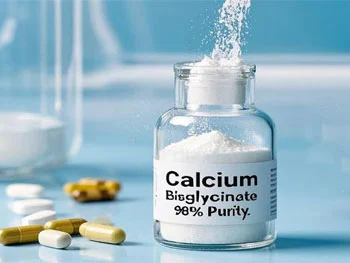
The Sensitive-Stomach Problem — and Why Chelation Answers It
Where Carbonate and Citrate Fall Short
Cheap and calcium-dense, but needs strong stomach acid to dissolve. (Calcium carbonate) In older consumers, in persons using proton-pump inhibitors, and in anybody dosing on an empty stomach, that acid just isn't there—so undissolved carbonate lingers in the tract, reacts to release carbon dioxide, and creates the bloating and constipation that drives customers away.[1][2][4]
Citrate is better in a low-acid environment, but it has a smaller elemental calcium content, which means larger tablets and more of them. Calcium bisglycinate powder addresses both of these issues. The calcium ion is already bonded in two glycine rings, so it doesn’t need an acid-mediated dissolving phase. It is also partially absorbed by amino-acid transport routes, rather than depending exclusively on passive mineral absorption.[3][5] For a sensitive-stomach SKU, that difference is the whole product offer.
The Glycine Factor
Glycine is not a passive transporter. It is the smallest amino acid, naturally prevalent in the human diet, is sweet-tasting rather than bitter, and is connected in the literature with stomach mucosal support. The resultant chelate is electrically neutral and chemically stable across a wide pH range when two molecules of glycine coordinate a calcium ion. It does not form the insoluble precipitates that free calcium ions easily create with phytates, oxalates, and dietary fiber.[3]
Formulators using calcium bisglycinate powder perceive less antagonism in the stomach and a far more pleasant consumer experience. There is also a further sensory benefit: glycinate chelates taste significantly less gritty than carbonate, opening the door to chewables, stick packs and functional drinks that carbonate just can't carry — properties rooted in the stable structure reflected by the calcium bisglycinate molecular weight.
Market Positioning and Who Is Buying
Four areas are the focus of demand: premium bone-health lines for consumers over fifty; prenatal and maternal formulas where tolerability is key to compliance; vegan and clean-label brands that do not use bone meal and oyster shell sources; and medical-nutrition for post-bariatric or low-acid populations.[1][2][4] All groups ask a food-grade calcium bisglycinate provider for three things: a chelation number that has been validated, heavy-metal data that passes the inspection of California Proposition 65, and paperwork that can withstand the audit of an EU importer. Hongda uses those specifications, format, market, and claim language as the basis for its quote process at the inquiry stage so the right grade and dossier come together rather than in a second round of emails.
Reading the Specification Sheet Properly
Molecular Identity and Calcium Loading
Precision here saves pricey misunderstandings. Calcium bisglycinate is a calcium ion coordinated by two deprotonated glycine molecules, with the chemical formula Ca(C₂H₄NO₂)₂. The molecular weight of anhydrous calcium bisglycinate is around 188.18 g/mol, and it contains roughly 21% theoretical elemental calcium.[3][5] Commercial material is a little less than that due to bound water. This is why the bulk 20 percent powder calcium bisglycinate is the usual trade grade and not a 21% claim.
Buyers should always differentiate between elemental calcium and compound weight. A 500 mg dose of elemental calcium will need around 2.5 g of 20% chelate, which has obvious implications for tablet size and number of capsules. Hongda clearly discloses both amounts on each certificate of analysis; thus the formulation maths is clear-cut from the very first sample.
Chelation Rate: The Figure That Separates Real Suppliers
A powder may have the proper amount of calcium and the right amount of glycine and yet be a dry physical mix, not a chelate, and provide none of the tolerability and absorption advantages that warrant a premium.[3][5][6] The extent of chelation is determined by Hongda using analytical methods. The unbound calcium ions are separated and measured. The total calcium is measured by atomic absorption spectroscopy. The percentage of calcium chelated is reported. Infrared spectroscopy confirms the coordination of the carboxylate and the amine as the bands of absorption shift characteristically. The number is a batch parameter, not a sales claim, for any calcium bisglycinate powder manufactured by Hongda. If a competitive provider cannot offer the identical data on demand, you are probably looking at a mix.
Adulteration Screening and Identity Confirmation
The economics say to switch. Calcium carbonate is a fraction of the price of chelated material; therefore, the usual deception is to have a carbonate or sulfate core and add some glycine to satisfy a nitrogen test or to dilute with maltodextrin and dicalcium phosphate to meet a target calcium figure inexpensively. Hongda screens on four fronts: IR fingerprint comparison to a reference chelate spectrum, effervescence with carbonate and sulfate ion testing (a positive result immediately disqualifies the lot), free-glycine quantification by HPLC for excess unbound amino acid, and total calcium cross-verification by AAS. Synthesis is done in-house and not via exchanged intermediates; therefore, there is no anonymous link in the chain where substituted bulk wholesale mineral powder calcium bisglycinate might enter.
Benchmarking suppliers at the moment? Send your target specification — elemental calcium percentage, mesh, chelation requirement, and certification needs — to duke@hongdaherb.com. Our technical team will respond with a live batch COA, the chelation-rate report, IR fingerprint, four-metal AAS data, and a free evaluation sample so your own laboratory can verify before any purchase commitment.
|
Item
|
Specification Details
|
|---|---|
|
Product Name
|
Calcium Bisglycinate Powder / Calcium Glycinate
|
|
CAS No
|
35947‑07‑0
|
|
Appearance
|
White fine powder
|
|
Grade
|
Food / Nutraceutical‑Grade
|
|
Elemental Calcium
|
~18‑20%
|
|
Chelate Ratio
|
Approx 2:1 glycine‑calcium chelate structure
|
|
Loss on Drying
|
≤0.5%
|
|
Mesh Size
|
80‑100 mesh (adjustable upon request)
|
|
Shelf‑life
|
24 months under sealed cool dry storage
|
|
Packing
|
25 kg food‑grade fibre drum with double inner PE bag
|
|
MOQ
|
Bulk:25 kg; lab trial samples available
|
Manufacturing Realities: Moisture, Compatibility and Batch ControlHygroscopic Behaviour, Caking and Real Warehouse Conditions
Glycinate chelates are fairly hygroscopic, and the effects are seen on the manufacturing floor, not in the lab. Above 60 % relative humidity, surface moisture forms bridges between neighboring particles, the drum becomes a crust, then solid cake, and fine grades start bridging in capsule-filler hoppers and tablet feeders. Hongda offers a calcium bisglycinate powder with ≤5% loss on drying. It is packaged in heat-sealed aluminium-foil bags with double PE liners within fiber drums. Desiccant sachets and nitrogen flush are offered for tropical routes. Our guidance to clients is pragmatic, not theoretical: condition your blending room to less than 45% RH, reseal barrels as soon as sampling is finished, and never allow unsealed material to sit overnight in a humid season.
Excipient and Co-Mineral Compatibility
Calcium is seldom formulated alone, and numerous combinations create problems. High dosages of calcium compete with iron, zinc and magnesium for absorption, so spacing them out throughout morning and evening doses — or utilizing chelated versions of each — maintains bioavailability. Excipients with high phosphate content may lead to local precipitation. Strong acids, such as ascorbic acid, decrease the pH of the mix and, along with moisture, may promote discolouration in multivitamin matrices containing B-vitamins.
Hongda's two in-house R&D institutes conduct binary rapid compatibility studies, combining calcium bisglycinate powder with each proposed excipient and active and monitoring assay, moisture, color and flow over set intervals. The data is sent to the clients before validation and not as a consequence of finding an interaction in a failed stability pull.
A Documented Customer Case
A European manufacturer producing a prenatal chewable approached Hongda after persistent complaints of a gritty, chalky mouthfeel and intermittent tablet capping. Two causes emerged: their previous carbonate-based blend was inherently abrasive, and the incoming chelate they had trialled arrived at 7.6% moisture, caking before it reached the press. Hongda supplied bulk 20 percent powder calcium bisglycinate at 3.8% moisture, nitrogen-flushed in foil, at a 100-mesh grade matched to their direct-compression line, with bulk density and angle-of-repose data supplied per lot. Six-month accelerated stability showed no caking, consistent tablet hardness, and sensory panels rating mouthfeel significantly improved. The customer now contracts quarterly volumes.
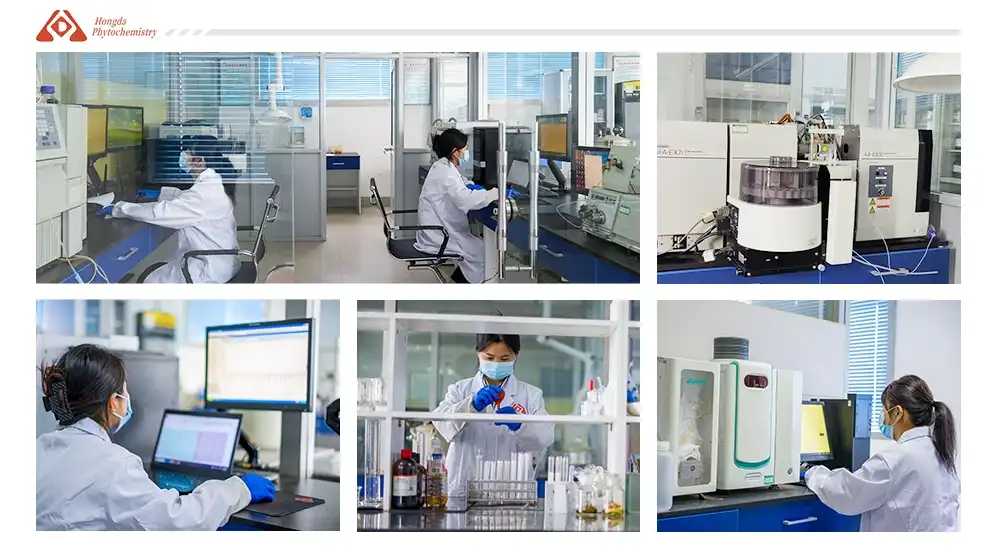
Batch Release and Factory Capability
|
Control Point
|
Hongda Practice
|
|---|---|
|
Production environment
|
100,000-class purification workshops, 10+ lines, 150+ trained technicians
|
|
In-process checks
|
pH, chelation progress, moisture monitored at defined stages
|
|
Release laboratory
|
SGS-standardised, 20+ professor-level analysts
|
|
Instrumentation
|
AAS, HPLC, GC, UV-Vis, automatic titrators, polarimeters, incubators
|
|
Release panel
|
Calcium assay, chelation rate, glycine ratio, moisture, pH, heavy metals, microbiology
|
|
Traceability
|
Batch record links raw lots, equipment, operators, in-process and release data
|
|
Retention samples
|
Held for full shelf life, available for investigation
|
|
Capacity
|
Up to 3,000 tonnes annually; six-zone, 3,000 m² warehouse
|
Sourcing, Compliance and Getting to Launch
Grades, Mesh and Format Matching
Does economics determine format choice? A 500 mg elemental calcium dosage requires around 2.5 g of chelate, eliminating single-capsule delivery and pushing manufacturers to tablets, chewables, stick packs and scoop powders – each with their own flow requirements.[1][2] Hongda produces 40 to 200 mesh in both granulated and direct-compression grades. It gives bulk density, tapped density, and angle of repose for each lot, not one nominal number, so mix consistency may be modeled before the pilot run. Working with a food grade calcium bisglycinate supplier that discloses flow data avoids the costly discovery of a hopper-bridging issue halfway through a validation batch.
Documentation for Western Markets
Complete COA, MSDS, specification sheet, production flow chart, allergies, GMO, irradiation and TSE/BSE declarations, heavy-metal and microbiological studies and stability data accompany shipments. Hongda's portfolio – National High-tech Enterprise since 2010, cGMP, ISO 9001, ISO 22000, FSSC 22000, BRC, SC license, FDA registration, Halal, Kosher, EU Organic and NOP – provides imported QA teams with a recognizable audit framework. The dossier is designed to facilitate the filing of calcium bisglycinate as an authorized mineral source under the food-supplement framework for EU purchasers. For US clients, the data provided is consistent with 21 CFR 111 supplier-qualification criteria.
Samples, Audits and Supply Reliability
Free samples are standard, and third-party verification is widely welcomed – a provider confident in its chelation rate has nothing to lose from an independent laboratory. Stock is maintained in six regulated storage zones and with dedicated personnel for cleanliness, such that ordinary grades of bulk wholesale mineral powder calcium bisglycinate often ship within days, while customized mesh, bulk density, or calcium % run on planned production slots. We are happy to have on-site and remote audits, and Hongda’s commercial team offers the regulatory pack that compliance colleagues will definitely ask for before a single shipment clears.
Conclusion
Sensitive-stomach calcium lines live or die on tolerability, and tolerability starts with chemistry. Calcium bisglycinate powder dissolves without stomach acid, resists precipitation with phytates and oxalates, tastes clean enough for chewable forms, and provides around 20% elemental calcium as a stable, neutral chelate. But these benefits are only valid if the material is a true chelate, dry on packaging, and free from contamination. Shaanxi Hongda Phytochemistry Verified ≥95% Chelation, AAS Calcium Assay, IR and Carbonate-Based Adulteration Screening, Moisture-Controlled Foil Packaging and Full cGMP, BRC, FSSC 22000 and FDA Documentation. Request Your Sample Now.
FAQQ1: What is the elemental calcium content?
A: 19–21%, with 20% as the standard commercial grade; both compound and elemental figures appear on every COA.
Q2: What chelation rate is guaranteed?
A: At least 95%, measured by free-ion separation with AAS and confirmed by IR fingerprinting.
Q3: Why is it better for sensitive stomachs than carbonate?
A: It dissolves without requiring strong gastric acid and produces no CO₂, so bloating and constipation complaints drop sharply.
Q4: How do you prevent caking in humid markets?
A: Moisture is held at ≤5%, packed in heat-sealed foil with double PE liners, plus desiccant and optional nitrogen flush.
Q5: How can I prove it is not a carbonate–glycine blend?
A: Request the IR spectrum, carbonate effervescence and sulphate ion tests, and the free-glycine HPLC result.
Build Your Next Calcium Line With HONGDA
All the suppliers put the label "chelaté". Ask Shaanxi Hongda Phytochemistry Co., Ltd for the evidence behind their calcium bisglycinate powder – a measured chelation-rate report, IR fingerprint, AAS elemental calcium assay, carbonate and sulfate screening, four-metal heavy-metal data and a six-month moisture-stability record – and test a free sample in your own laboratory and on your own tablet press. Let us know your desired elemental calcium, mesh, bulk density, dosage form, market destination, and yearly volume, and our technical team will get you a price with the entire compliance dossier attached, including cGMP, ISO 9001, ISO 22000, FSSC 22000, BRC, FDA registration, Halal and Kosher. Ship according to schedule. With an annual capacity of 3,000 tons and six filled storage areas. Email duke@hongdaherb.com today.
References
1. Straub, D. A. "Calcium supplementation in clinical practice: a review of forms, doses, and indications." Nutrition in Clinical Practice, 2007.
2. Heaney, R. P., Dowell, M. S., Bierman, J., Hale, C. A., & Bendich, A. "Absorbability and cost-effectiveness in calcium supplementation." Journal of the American College of Nutrition, 2001.
3. Ashmead, H. D. Amino Acid Chelation in Human and Animal Nutrition. CRC Press, 2012.
4. Hansen, K. E., Jones, A. N., Lindstrom, M. J., et al. "Do proton pump inhibitors decrease calcium absorption?" Journal of Bone and Mineral Research, 2010.
5. European Food Safety Authority. "Calcium bisglycinate as a source of calcium added for nutritional purposes to food supplements — Scientific Opinion of the Panel on Food Additives and Nutrient Sources." EFSA Journal.
6. United States Pharmacopeia–National Formulary. Food Chemicals Codex: Calcium Glycinate / Amino Acid Chelate monographs.