



How can I verify the true boswellic acid content of bulk boswellia serrata extract powder?
If you ask three vendors for "65% boswellic acids," you will likely get three items that are not comparable at all - one tested by titration, one by UV, one by HPLC, and only one of them carrying a substantial level of AKBA. The biggest business risk in this category is the difference between the number on the certificate and the molecules in the drum. Hongda Phytochemistry solves it by presenting the technique with a figure. Established in 2001, Shaanxi Hongda Phytochemistry Co., Ltd has 20,000m2 of plant and has more than ten manufacturing lines and 100,000-class purification workshops, and an SGS-standardised laboratory developed with university professors. Each batch of boswellia serrata extract powder is supplied with HPLC-resolved boswellic acid breakdown including AKBA, resin-authenticity fingerprinting, residual-solvent and chelation-verified heavy-metal data, moisture-stability records and a comprehensive EU/US-compliance pack.
Verification Step 1 — Know Which Number You Are Actually Buying
Total Boswellic Acids vs. the Individual Acids
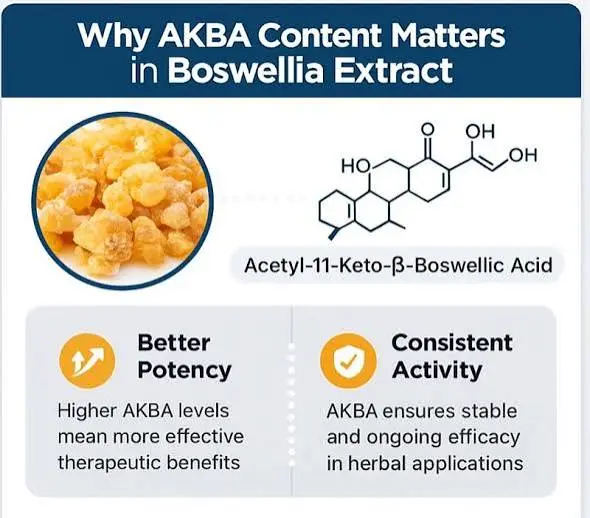
"Boswellic acids" are a family of six major pentacyclic triterpenes: beta-boswellic acid, acetyl-beta-boswellic acid, KBA (11-keto-beta-boswellic acid), AKBA (3-O-acetyl-11-keto-beta-boswellic acid), and their alpha analogs. The keto group is the economically important fraction, and most published research is on AKBA, which is normally just 2-5% of a regular boswellia serrata extract powder, even when total boswellic acids read 65%. A customer who specifies simply the total amount may validly get material with nearly no AKBA. Hongda reports total boswellic acids and AKBA separately on every COA since the two values answer entirely different queries and is how brands wind up with an inert premium product.[1][2][5]
Why the Analytical Method Changes the Result?
This is where most buying disagreements begin. Titration measures overall acidity and will cheerfully count every acidic resin component present, inflating the findings substantially. UV-Vis is only slightly superior, interacting with the chromophore of keto acids, but is readily biased by co-absorbing resin material. HPLC using UV or ELSD detection, conducted against approved reference standards, truly separates and measures each acid separately – and tends to provide the lowest, most honest number. A drum labeled “85% by titration” may be 35-45% by HPLC. Any reputable source of boswellia resin extract will tell you the process next to the number. If the spec only states "65%," ask which method and, if they evade the question, take that as the answer.[2][3]
Method Comparison at a Glance
|
Method
|
What It Measures
|
Typical Reported Value
|
Reliability
|
|---|---|---|---|
|
Acid-base titration
|
Total acidic compounds in resin
|
Inflated, often 80–90%
|
Low — not specific
|
|
UV-Vis spectrophotometry
|
Keto chromophore absorption
|
Moderately inflated
|
Medium — interference-prone
|
|
HPTLC
|
Semi-quantitative band comparison
|
Indicative only
|
Medium — good for ID
|
|
HPLC-UV (250 nm)
|
Individual acids, AKBA resolved
|
Realistic, lower figure
|
High — industry reference
|
|
HPLC-ELSD / CAD
|
Non-chromophoric acids included
|
Most complete profile
|
High
|
|
LC-MS
|
Confirmatory identification
|
Qualitative/quantitative
|
Highest for authenticity
|
Hongda runs HPLC as the release method, with HPTLC fingerprinting for identity and LC-MS confirmation available on request.
Reading a COA Without Being Misled
Three checks capture most errors in wholesale boswellia. First, check that a method is specified and that reference standards were utilized. If it says "in-house method" and no standard is listed, that is a red flag. Second, look for an AKBA figure. If you can't find one, it probably was never measured. Third, look for internal consistency. If total boswellic acids are listed as 65%, but no breakdown of specific acids is given, you cannot verify the amount. Buyers purchasing in bulk should also ask to see the actual chromatogram, not a summary table – peak shape, baseline, and resolution will tell you if the lab really resolved the acids or incorporated a hump. Raw chromatograms will be provided for any lot on request by Hongda.
|
Product Name
|
Boswellia Serrata Extract
|
|
Other Name
|
Boswellia Extract
|
|
Appearance
|
White Fine Powder
|
|
Active Ingredient
|
Boswellic Acid
|
|
Spec
|
45% 65% 95%
|
|
Part
|
Resin
|
|
Grade
|
Food
|
|
Extraction Type
|
Liquid-Solid Extraction
|
|
Packaging
|
Drum Or Polythene Bag
|
|
Sterilization Method
|
Heat& NON-IRR
|
|
Particle Size
|
100% Pass 100 meshes
|
|
Test Method
|
TLC
|
|
Bulk Density
|
40-60g/100ml
|
|
Loss On Drying
|
≤5%
|
|
Ash
|
≤5%
|
|
Heavy Metal
|
≤10(ppm)
|
|
Shelf Life
|
2 Years
|
|
Certification
|
cGMP/FSSC22000/KOSHER/HALAL/ISO9001/ISO22000
|
Verification Step 2 — Confirming the Resin Was Genuine in the First PlaceSpecies Substitution and Resin Adulteration
Frankincense is not solely from Boswellia serrata. B. B. carterii, papyrifera and B. frereana are sold together and have markedly different triterpene compositions — B. frereana, for example, has almost no boswellic acids. Besides species swapping, the market often finds resin diluted with gum arabic, rosin, pine resin, and waste marc from prior extractions.[1][4][5] Hongda macroscopically and organoleptically tests incoming resin, runs an HPTLC fingerprint against authorized boswellia serrate reference material, and performs a baseline HPLC analysis before the resin ever reaches the extraction line. Many weak identities are openly discarded rather than blended down—a discipline that costs money upstream and saves reputations downstream.
Spiking, Dilution and Carrier Detection
Finished-extract fraud is a little more complicated. The tactics that keep coming up include diluting with maltodextrin, rice flour, or dicalcium phosphate, adding unrelated triterpenes or acidic chemicals to inflate titration findings, and mixing real high-grade extract with low-grade stuff to reach a goal inexpensively. Hongda's screening layers: HPLC fingerprint pattern-matching (the six acids must appear in plausible natural proportions, not an arbitrary ratio), ash and loss-on-drying checks that expose mineral carriers, iodine and polysaccharide testing for starch bulking, and method cross-comparison — a large divergence between titration and HPLC values on the same sample is itself diagnostic. Since Hongda does its own extractions, in its own facility, rather than just re-packing traded drums, there is no anonymous mixing stage in the process.
|
Risk
|
Detection Approach
|
Evidence Supplied
|
|---|---|---|
|
Wrong Boswellia species
|
HPTLC fingerprint + LC-MS confirmation
|
Identity report
|
|
Gum arabic / rosin in resin
|
Solubility, ash, fingerprint mismatch
|
Raw-material QC record
|
|
Starch or maltodextrin dilution
|
Iodine test, polysaccharide assay
|
Lab data
|
|
Assay inflation by titration
|
Parallel HPLC quantification
|
Dual-method COA
|
|
Missing AKBA
|
Dedicated AKBA peak quantification
|
Chromatogram
|
|
Residual extraction solvents
|
Headspace GC vs. ICH Q3C
|
GC report
|
|
Heavy metals
|
AAS with chelation-recovery verification
|
AAS certificate
|
Chelation-Recovery Verification for Heavy Metals
Resins are tough matrices, and a slow digestion technique might under-report metal concentration simply because the sample was never completely released. As a boswellia resin extract supplier, Hongda does lead, cadmium, arsenic, and mercury by atomic absorption spectrophotometry against EU Regulation 2023/915 and relevant US state thresholds, and then does a chelation-recovery check — digesting with a chelating agent and comparing spiked recovery against direct acid digestion — to ensure the reported numbers are actual total content. For boswellia serrata extract powder entering heavily controlled markets, a flattering result caused by incomplete extraction is worse than no result at all, since it promotes false confidence.[6]
Verifying a current supplier or qualifying a new one? Email your target specification — total boswellic acid basis, AKBA requirement, method, mesh and certification needs — to duke@hongdaherb.com. Our technical team will return a live batch COA, the full HPLC chromatogram with AKBA resolved, residual-solvent GC data, chelation-verified heavy-metal results, and a free evaluation sample so your own laboratory can confirm before you commit to volume.
Verification Step 3 — Where the Factory Protects the NumberExtraction and Standardisation Control
Boswellic acids are thermally and oxidatively sensitive, and harsh processing destroys the keto acids first – which is exactly why some extracts show good total values and essentially little AKBA.[1][5] Hongda extracts use regulated solvent systems, mapping temperatures, vacuum concentration, and low-temperature drying with limited oxygen exposure. Controlled fractionation is used to standardize to 65%, 70%, or 85% total acids or to defined AKBA levels, not mixed to a number. It has a national patent technology and was given the National High-tech Enterprise status in 2010. The processing is done in 100,000-class purification workshops with more than 150 skilled technicians in more than ten lines.
Batch Release in the SGS-Standardised Laboratory
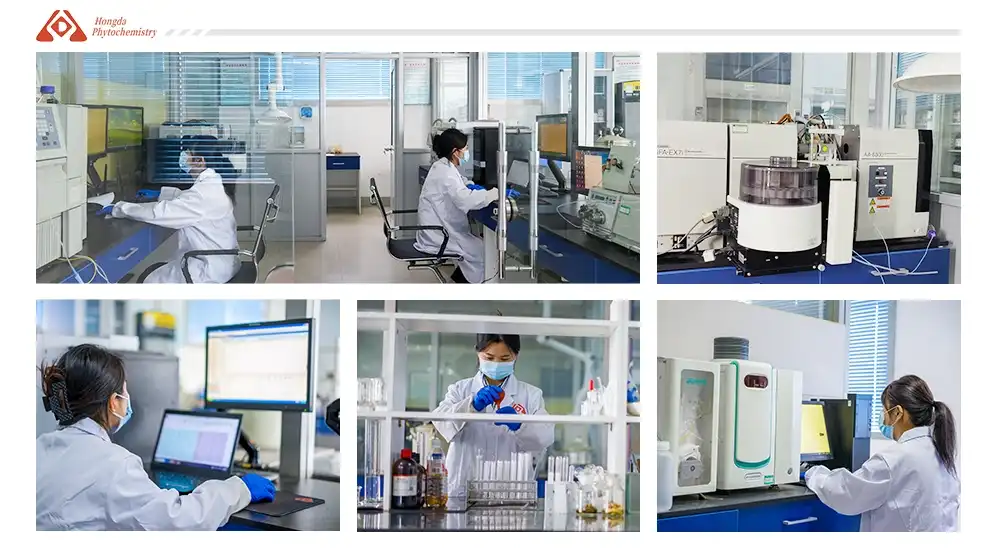
Hongda’s lab, a joint venture with university partners, employs more than 20 professor-level researchers and analysts and performs release testing on HPLC, GC, UV-Vis, atomic absorption spectrophotometers, polarimeters, automated titrators, and incubators. Before it leaves the door, every batch of boswellia serrata extract powder is assayed by HPLC for AKBA profile, identification fingerprint, residual solvents, moisture, ash, heavy metals, pesticide residues, and thorough microbiological testing. The batch records connect resin lot, extraction settings, equipment, operators, and release data. Retention samples are kept for the complete shelf life so every downstream inquiry is evaluated against the actual material rather than rebuilt from memory.
Standard Product Specification
|
Parameter
|
Hongda Standard
|
Method
|
|---|---|---|
|
Botanical source
|
Boswellia serrata gum resin
|
HPTLC identity
|
|
Total boswellic acids
|
65% / 70% / 85% grades
|
HPLC
|
|
AKBA
|
2% / 5% / 10% grades available
|
HPLC
|
|
Appearance
|
Light yellow to pale brown fine powder
|
Visual
|
|
Loss on drying
|
≤ 5.0%
|
105°C / 3 h
|
|
Ash
|
≤ 3.0%
|
Gravimetric
|
|
Residual solvents
|
ICH Q3C Class 3 limits
|
Headspace GC
|
|
Heavy metals
|
Within EU & US limits
|
AAS / ICP-MS
|
|
Pesticide residues
|
EU / NOP multi-residue screen
|
GC-MS, LC-MS
|
|
Microbiology
|
TPC, yeast/mould, pathogens
|
Pharmacopoeial
|
|
Mesh
|
80 mesh standard, customisable
|
Sieve
|
|
Shelf life
|
24 months, sealed, cool, dark
|
Stability study
|
Verification Step 4 — Handling, Compatibility and Compliance
Moisture Uptake, Caking and a Documented Case
Boswellia extract is a resinous powder that tends to soften and agglomerate under warm and humid environments – the two conditions a shipping container guarantees in the summer. If loss on drying is more than around 5%, purchasers perceive hard caking in the drum, bridging in capsule fillers, and darkening. Hongda is supplied in heat-sealed aluminum foil bags with double PE liners in fiber drums at ≤5% moisture.
Desiccant and nitrogen flush are available. A true case: An Italian capsule producer has been chipping caked material out of drums obtained from a prior supplier during delivery in August. Hongda delivered nitrogen-flushed, foil-packed boswellia serrata extract at 3.6% moisture and 80 mesh that suited their filling line. The customer validated free-flowing powder and stable assay at the six-month draw and contracted for quarterly amounts.
Formulation Compatibility
Boswellia is practically never created alone, and the common partners — curcumin, MSM, collagen, glucosamine, ginger and black pepper extract — each raise a concern. Low water solubility implies that dissolving in tablets is very dependent on the choice of disintegrant and particle size. The resinous character may lead to sticking on tablet punches, which is normally handled by the use of magnesium stearate levels according to the grade. Hongda's two in-house R&D institutions hold binary accelerated compatibility holds, monitor assay, AKBA content, color, and moisture, so clients know of an interaction during development rather than at a twelve-month stability pull. It is available in both water-dispersible and granular grades for beverages and direct-compression use.
Documentation for EU and US Importers
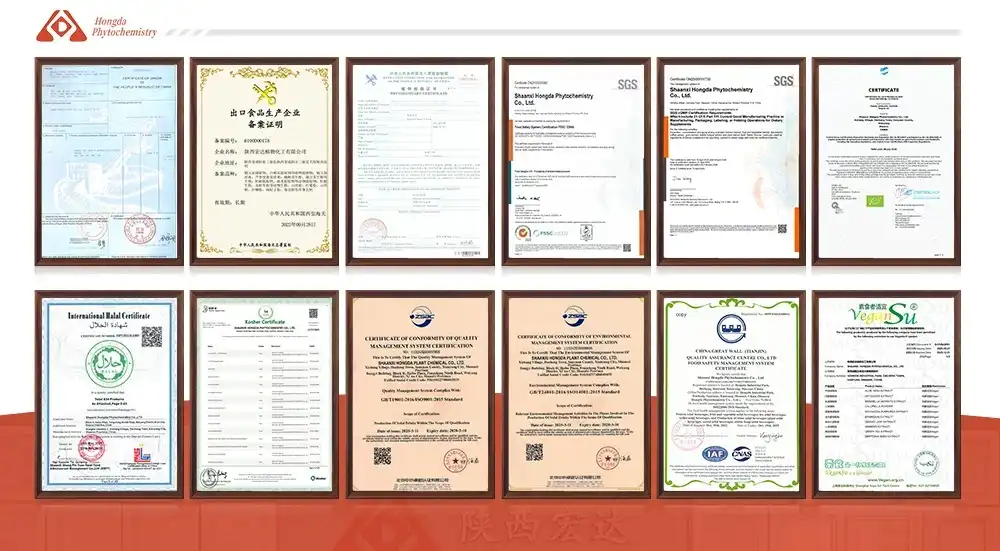
Complete COA, MSDS, specification sheet, production flow chart, allergy, GMO, irradiation and TSE/BSE declarations, solvent and metal reports, and stability data ship with shipments. Hongda's cGMP, ISO 9001, ISO 22000, FSSC 22000, BRC, SC license, FDA registration, Halal, Kosher, EU Organic and USDA NOP portfolio provides a familiar audit framework for imported QA teams, and on-site or remote audits are encouraged. The warehouse is 3,000 m², and inventory is stored in six regulated zones with specialized sanitation workers. Standard grades of wholesale boswellia normally ship within days. Custom AKBA specifications run on planned manufacturing slots.
Conclusion
True boswellic acid content verification in boswellia serrata extract powder requires four things: demand HPLC, not titration; demand an AKBA figure distinct from the total; demand the real chromatogram; and demand species identification by fingerprint before any resin extraction ever. Add residual-solvent data, chelation-verified heavy metals, and a moisture stability record, and the drum you get is the drum you were provided a certificate for. Shaanxi Hongda Phytochemistry offers all of it from its cGMP, BRC, and FSSC 22000-certified manufacturing with an annual capacity of 3,000 tons. Order your sample and entire data set now.
FAQQ1: Why does titration show 85% but HPLC only 40%?
A: All acidic resin components are determined by titration; the individual boswellic acids are determined by HPLC. Always compare using the same method.
Q2: What AKBA levels can Hongda supply?
A: Standard 2%, 5% and 10% AKBA grades, alongside 65%, 70% and 85% total boswellic acid grades.
Q3: How do you confirm it is Boswellia serrata and not another species?
A: HPTLC fingerprinting against authenticated reference material, with LC-MS confirmation available.
Q4: Can you supply the raw chromatogram?
A: Yes — full HPLC chromatograms are provided on request for any released lot.
Q5: How is caking prevented during summer shipping?
A: Moisture held at ≤5%, heat-sealed foil with double PE liners in fibre drums, plus desiccant and optional nitrogen flush.
Verify Before You Buy — Source Boswellia From HONGDA
Anybody can print a percentage. Ask Shaanxi Hongda Phytochemistry Co., Ltd. for evidence on their boswellia serrata extract powder: HPLC chromatogram of resolved AKBA, HPTLC species identification, dual method assay comparison, GC on residual solvents, heavy metal results confirmed by chelation, and a six-month moisture stability record. Test a free sample in your own lab before you place a container order. Our technical team will provide you with a quotation and full compliance dossier (including cGMP, ISO 9001, FSSC 22000, BRC, FDA registration, Halal, Kosher and organic certification) if you tell us your required total boswellic acid %, AKBA target, mesh, dosage format, destination market and annual volume. Email duke@hongdaherb.com today.
References
1. Abdel-Tawab, M., Werz, O., & Schubert-Zsilavecz, M. "Boswellia serrata: An overall assessment of in vitro, preclinical, pharmacokinetic and clinical data." Clinical Pharmacokinetics, 2011.
2. Büchele, B., Zugmaier, W., & Simmet, T. "Analysis of pentacyclic triterpenic acids from frankincense gum resins and related phytopharmaceuticals by high-performance liquid chromatography." Journal of Chromatography B, 2003.
3. Shah, S. A., Rathod, I. S., Suhagia, B. N., et al. "Estimation of boswellic acids from market formulations of Boswellia serrata extract and 11-keto β-boswellic acid in human plasma by high-performance thin-layer chromatography." Journal of Chromatography B, 2007.
4. Gafner, S. Botanical Adulterants Prevention Bulletin: Boswellia serrata. ABC-AHP-NCNPR Botanical Adulterants Prevention Program.
5. Siddiqui, M. Z. "Boswellia serrata, a potential antiinflammatory agent: An overview." Indian Journal of Pharmaceutical Sciences, 2011.
6. European Commission. Commission Regulation (EU) 2023/915 on maximum levels for certain contaminants in food.