




How to stabilise milk thistle extract powder for long shelf life in capsule blends?
Stabilising milk thistle extract powder in capsule blends is one of the biggest challenges for nutraceutical brands seeking a 24-month shelf life without caking, discolouration, or potency loss. As a leading Hongda Phytochemistry specialist, Shaanxi Hongda Phytochemistry Co., Ltd. has spent over two decades refining how to protect the sensitive silymarin complex during extraction, drying, and blending. Our milk thistle extract powder is standardised to 80% silymarin (UV) with tight control of moisture (<5.0%), residual solvents, and particle uniformity, which directly prevents moisture absorption and oxidative degradation in capsules. With advanced low-temperature extraction, vacuum drying, and 100,000-level purification workshops, we deliver a highly stable, free-flowing powder designed for seamless capsule filling and long-term potency retention.
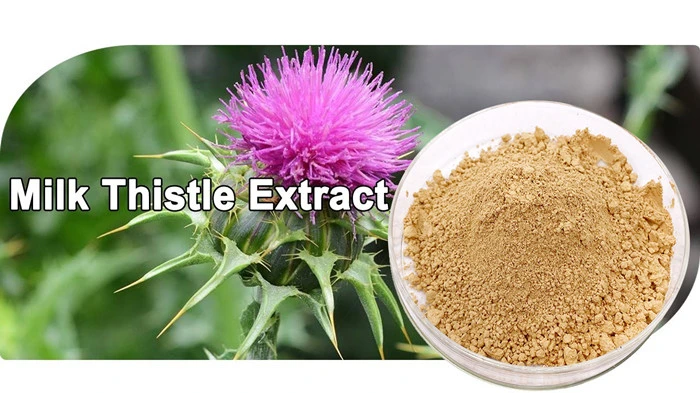
Why Milk Thistle Extract Powder Loses Stability in Capsule Blends
Understanding the root causes of instability is the first step for any formulator who wants to avoid costly batch failures, clumping, and label claim issues after 6-12 months of storage.[1]
Understanding Hygroscopicity and Caking Mechanisms in Silymarin
The hygroscopicity of flavonolignans is the main reason for capsule caking. Milk thistle extract powder will absorb moisture very quickly if it is not dried and protected. This results in particle agglomeration, poor flowability, and softening of the capsule shell.[3] It is difficult to combine the high surface area pure milk thistle powder and the hygroscopic excipients. Hongda adopts vacuum belt drying and precise moisture-locking technology to ensure the water content is less than 5%, far below the industry standard. Our facility can also engineer particle size distribution to D90 uniformity, which helps minimize capillary condensation and keeps powder flowing freely in humid blending rooms.
Oxidation Triggers: Light, Heat, and Residual Moisture
Silymarin, especially silybin A and silybin B, is very sensitive to photothermal oxidation. Any residual moisture acts as a catalyst for oxidation of the active flavonolignans, which leads to darkening of the powder and loss of potency during storage.[2][4] Many brands see their milk thistle extract powder drop from 80% to below 70% silymarin from accelerated stability testing due to insufficient drying or light-permeable packaging. Then we use two-layer light-proof aluminium foil packaging with desiccants. This kind of packaging can block UV and oxygen transmission and keep the characteristic light yellow colour and assay for more than 24 months.
How Standardisation to 80% Silymarin Impacts Stability and Flow
Standardization is not only a question of potency, but also has a direct effect on the physical stability. The silymarin content is inconsistent or uneven, so there are different quantities of plant waxes, oils, and fibers, which cause hygroscopicity and incompatibility.[2] We are professional suppliers of Milk Thistle Extract Powder. We have found that standardizing to a consistent 80% silymarin by UV (silybin content confirmed by HPLC) gives a more consistent crystal structure that resists moisture uptake. Our milk thistle extract powder is standardized to SGS standards for HPLC fingerprinting to ensure each batch has the same ratio of silybin, silychristin, and silydianin. This consistency helps improve blend uniformity and avoids segregation in capsule hoppers, a common soft CTA point for brands that struggle with weight variation during high-speed encapsulation.
Table 1: Technical Specification of Hongda Milk Thistle Extract Powder (Reference: Hongda Plant Extract Lab Data)
|
Test Item
|
Specification
|
Test Method / Standard
|
|---|---|---|
|
Botanical Source
|
Silybum marianum (L.) Gaertn. Seed
|
Botanical Identification
|
|
Active Marker
|
Silymarin ≥80.0%
|
UV-VIS (HPLC for Silybin)
|
|
Appearance
|
Light Yellow to Yellow Brown Fine Powder
|
Visual / Organoleptic
|
|
Loss on Drying
|
≤5.0%
|
USP <731> / ChP
|
|
Heavy Metals
|
Total ≤10 ppm, Pb ≤2 ppm, As ≤1 ppm
|
ICP-MS / AAS
|
|
Pesticide Residues
|
Complies with EU EC 396/2005
|
GC-MS/MS & LC-MS/MS
|
|
Microbial Limits
|
TAMC <1000 cfu/g, Yeast/Mold <100 cfu/g
|
USP <2021> / <2022>
|
Factory-Level Stabilisation: From Low-Temperature Extraction to Moisture Control
True shelf-life stability is built in the factory long before the powder reaches your capsule line. Choosing the right manufacturing partner determines whether your blend will remain stable for two years or fail after six months.
Low-Temperature Extraction and Vacuum Drying for Ultimate Stability
Heat is the enemy of silymarin. Conventional high-temperature reflux extraction degrades heat-sensitive flavonolignans and leaves higher residual moisture that triggers future caking.[5] As an experienced milk thistle extract powder manufacturer, Hongda uses a low-temperature, high-efficiency counter-current extraction followed by membrane concentration and vacuum drying at controlled temperatures below 60°C. This gentle process preserves the native chelation activity of silymarin and keeps the milk thistle extract powder exceptionally low in moisture and free of solvent residues. Our 20,000-square-metre facility operates more than 10 modern production lines and 100,000-level purification workshops, ensuring the extract is never exposed to uncontrolled humidity or cross-contamination during the most vulnerable drying stage.
Anti-Caking Engineering and Particle Size Uniformity
Poor particle engineering will lead to bridging and flow failure in capsule machines, even with low moisture. As a professional milk thistle extract powder factory, we use precision milling and air classification to achieve a narrow, uniform particle size distribution that improves flowability and reduces inter-particle moisture trapping. For highly hygroscopic batches or for tropical markets, we can offer microencapsulation or granulation with clean-label carriers, such as acacia fibre, building a microscopic moisture barrier around each particle without affecting dissolution.[6] Our milk thistle extract powder has been engineered to maintain an angle of repose of less than 40 degrees and a stable bulk density, allowing for consistent high-speed filling with a minimum of anti-caking excipients such as silicon dioxide.
Chelation Rate and Heavy Metal Control to Prevent Oxidative Loss
A rarely discussed stability factor is metal-ion-catalysed oxidation. Trace heavy metals like iron and copper can drastically accelerate silymarin degradation through chelation and redox reactions. Therefore, chelation rate detection is critical. Our SGS-standardised laboratory, jointly established with university professors and staffed by over 20 professor-level R&D personnel, tests every lot of milk thistle extract powder for heavy metals via Atomic Absorption Spectrophotometry and ICP-MS, controlling lead, arsenic, cadmium, and mercury far below EU and USP limits. We also monitor the total chelation profile to ensure the powder does not carry pro-oxidant metals from soil or water. If you are developing a sensitive blend and need to verify chelation data or request a sample COA for excipient compatibility, our technical team is ready to help at duke@hongdaherb.com — we provide formulation support and pre-blend stability recommendations.
|
Test Item
|
Practical Procurement & Manufacturing Meaning
|
Our Available Parameters
|
|---|---|---|
|
Botanical Source
|
Botanical identity traceability
|
Silybum Marianum dried seed
|
|
Appearance
|
Batch visual consistency for blending
|
Light‑yellow to yellow‑brown fine powder
|
|
Silymarin Content
|
Marker compound; two test modes available
|
UV:30%‑80%; HPLC:45%‑60%
|
|
Silybin + Isosilybin
|
Key sub‑fraction for high‑standard markets
|
30% /35% adjustable
|
|
Loss on Drying
|
Prevent caking during long‑haul ocean transit
|
≤5.0%
|
|
Residual Solvents
|
Compliance for EU / US import audit, ICH Q3C
|
Meets ICH Q3C thresholds
|
|
Heavy Metals & Microbes
|
Nutraceutical raw‑material safety
|
Compliant with food‑ingredient standards
|
|
Solubility Property
|
Critical for your finished‑product format
|
Standard fat‑soluble grade / water‑dispersible modified grade
|
|
Shelf‑life
|
Under sealed cool‑dark warehouse storage
|
24 months
|
|
Packing
|
Bulk shipping configuration
|
25 kg food‑grade fibre drum; double PE‑aluminum inner bag
|
|
MOQ
|
Order entry threshold
|
100 kg bulk; small lab trial samples available
|
Formulation Compatibility and Adulteration Defence in Capsule Blends
Even the most stable extract will fail if blended with incompatible excipients or adulterated with low-cost fillers.
Excipient Compatibility Testing: Avoiding Hidden Incompatibilities
Not all the capsule fillers are silymarin-friendly. Milk thistle extract powder is destabilised by moisture transfer and pH shift from acidic excipients, hygroscopic diluents (starch, some), and magnesium stearate (moisture).[6] We are trusted suppliers of milk thistle extract powder and provide a full excipient compatibility matrix based on ICH accelerated studies. We recommend low-moisture MCC and colloidal silicon dioxide in optimal ratios and caution against excessive use of hygroscopic botanical powders in the same blend. For clients looking for a clean label formula, our lab is capable of running a 4-week binary compatibility test on your particular milk thistle extract powder blend to notify you of any browning, caking, or assay loss prior to mass production.
Identifying Adulteration: HPLC Fingerprinting vs. Deceptive UV Assays
A major shelf-life risk comes from adulterated raw material that appears stable initially but degrades rapidly. Some market pure milk thistle powder is spiked with cheaper flavonoids to fake an 80% UV reading, but HPLC analysis reveals a lack of true silybin. This adulterated powder has unpredictable hygroscopicity and stability. Hongda defends against this with dual testing: every batch of milk thistle extract powder is quantified by both UV for total silymarin and HPLC for silybin + isosilybin fingerprint, ensuring authenticity. Our lab is equipped with High-Performance Liquid Chromatographs, Gas Chromatographs, and Spectrophotometers to detect any foreign peaks. We share the full HPLC chromatogram in our COA, so procurement teams can confidently verify identity and avoid purchasing unstable, diluted material that will fail stability.
Real Factory Case: Stabilising a Multi-Botanical Liver Support Capsule
Recently, a US customer contacted us because their liver support capsule, which contained milk thistle extract powder, dandelion, and artichoke extract, had caked badly and lost 12% potency after 9 months. In their R&D lab, they took a look at their retained sample and saw moisture migration from the artichoke extract and a reaction with a starch filler high in moisture. We reformulated the blend using our low-moisture, granulated milk thistle extract powder with a narrow particle size and changed the filler to a low-moisture MCC system with 0.5% silica. We also supplied real production photos and video of the vacuum drying and blending process for their QA audit. After 6 months of ICH accelerated testing (40°C/75% RH), the new blend retained 98.2% silymarin and showed perfect flowability, a soft CTA validated by data, not claims.
Ensuring Long Shelf Life with Batch QC and EU/US Compliance Documentation
For international brands, documentation and reproducible quality are as important as the powder itself. Without a solid compliance dossier, your stable product may never reach the market.
Batch-to-Batch QC: Moisture, Microbial, and Silymarin Consistency
A long shelf life means no variation between batches. A single high-moisture lot can ruin an entire capsule production run. In our milk thistle extract powder factory, every batch of milk thistle extract powder is under a 5-step QC process: raw material pesticide screening, in-process moisture monitoring, HPLC assay, heavy metal and microbial testing, and final stability-indicating assay before packaging. Our warehouse is 3000 m² with six dedicated zones (A-F). Natural plant extracts such as milk thistle are stored in climate-controlled zones. C/D with professional sterilisation management. 3,000 tonnes of annual production; 150+ skilled technicians. Batch-to-batch consistency; silymarin content RSD < 2%; identical performance of your capsule blend from lot 1 to lot 100.
Table 2: Batch QC & Stability Testing Protocol at Hongda Factory
|
QC / Stability Stage
|
Key Test Items
|
Hongda Internal Limit (Stricter than Standard)
|
|---|---|---|
|
Raw Material Intake
|
Pesticide Residues (500+ items), Heavy Metals, Botanical ID
|
Complies with EU & USP <561>
|
|
In-Process Control
|
Extraction Solvent Residue, Moisture, Silymarin Content
|
Moisture ≤5.0%, Ethanol <5000 ppm
|
|
Finished Powder Release
|
Assay (UV/HPLC), Microbial, Bulk Density, Particle Size
|
TAMC <1000 cfu/g, Assay 80-85%
|
|
Stability Program
|
Accelerated (40°C/75% RH, 6M) & Long-Term (25°C/60% RH, 24M)
|
Assay retention ≥95% at 24M
|
Accelerated and Long-Term Stability Testing Protocols (ICH Guidelines)
We do not just claim a 2-year shelf life; we prove it. Following ICH Q1A guidelines, our stability team conducts both accelerated and long-term studies for our milk thistle extract powder in final packaging. Samples are stored at 40°C±2°C/75% RH±5% for 6 months and 25°C±2°C/60% RH±5% for 24 months, with testing at 0, 3, 6, 9, 12, 18, and 24 months for assay, moisture, colour, and dissolution. This data shows our powder retains over 95% silymarin after 24 months when stored correctly. We provide this stability data package to capsule brands so they can confidently set expiry dates and satisfy retailer and regulatory requirements without running their own 2-year study from scratch.
Complete Compliance Dossier for US and EU Market Entry
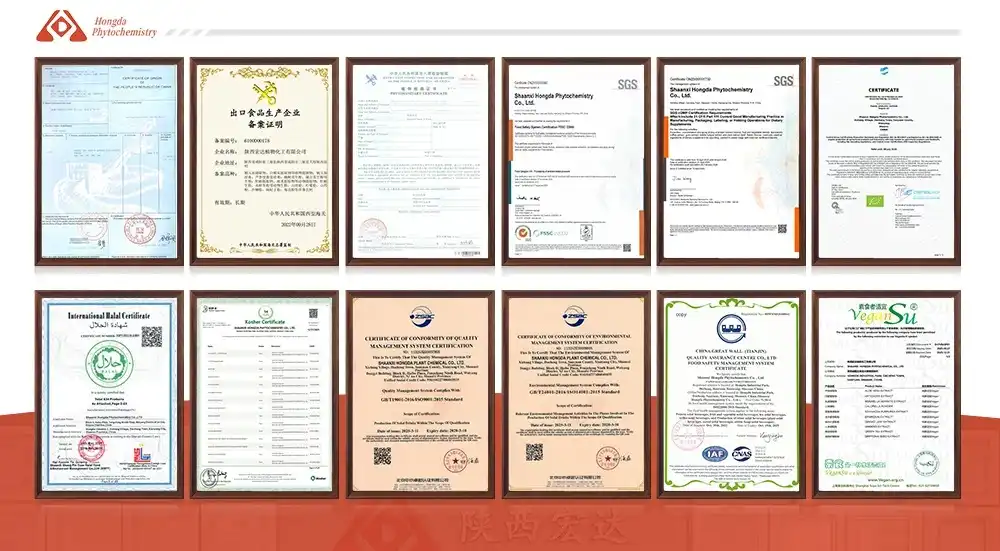
Market access is certification-driven. Ever since 2001, Shaanxi Hongda has been continuously upgrading its qualifications to the most stringent global standards, up to 2025. We are certified with cGMP, FSSC22000, SC, ISO22000, ISO9001, BRC, FDA registration, HALAL, KOSHER, and ORGANIC (EU & NOP), in addition to being a national high-tech enterprise and holding several patented technologies. We are one of the leading manufacturers of milk thistle extract powder, and we provide a complete compliance dossier for our milk thistle extract powder, which includes COA, TDS, MSDS, allergen statement, non-GMO and non-irradiation certificates, and pesticide/heavy metals reports from internationally recognised labs. With this turnkey package, our clients breeze through US FDA and EU border inspections, cutting time-to-market by months.
Conclusion
Stabilising milk thistle extract powder for capsule blends depends on three factory-controlled pillars: ultra-low moisture engineering to prevent caking, anti-oxidative extraction and packaging, and rigorous batch QC with verified excipient compatibility. By partnering with certified milk thistle extract powder suppliers that provide HPLC-fingerprinted 80% silymarin, ICH stability data, and full EU/US compliance, brands can secure a consistent 24-month shelf life and flawless capsule performance. Hongda’s integrated R&D, production, and warehousing system makes that long-term stability achievable and auditable.
Frequently Asked Questions 1. What is the ideal moisture content for long-term capsule stability?
A: For milk thistle extract powder, keep loss on drying ≤5.0%. Hongda controls moisture below this limit via vacuum drying to prevent caking and oxidation.
2. How do you distinguish authentic silymarin from adulterated extract?
A: We use dual UV and HPLC testing. Authentic powder shows a distinct silybin A/B fingerprint on HPLC, while adulterated material fails this pattern.
3. Which excipients are most compatible with milk thistle in capsules?
A: Low-moisture MCC and colloidal silicon dioxide are ideal. Avoid highly hygroscopic starches or acidic fillers without compatibility testing.
4. Do you provide stability data for my product registration?
A: Yes. We provide 6-month accelerated and 24-month long-term ICH stability data, plus COA, TDS, and organic/cGMP certificates.
Partner with HONGDA for Stable, Certified Milk Thistle Capsule Solutions.
Ready to eliminate caking, potency loss, and compliance delays from your capsule project? Shaaxi Hongda Phytochemistry Co., Ltd. operates as a milk thistle extract powder factory, offering more than just an ingredient — we deliver a stability system. With our 20,000㎡ GMP factory, SGS-standardised lab, and complete certification portfolio, your milk thistle extract powder will be batch-consistent, fully traceable, and backed by real stability data. Contact our technical and sales team today at duke@hongdaherb.com for a free sample, COA, HPLC chromatogram, and formulation compatibility consultation. Let’s build your next best-selling liver support capsule together.
References
1. Abenavoli, L., Capasso, R., Milic, N., & Capasso, F. (2010). Milk thistle in liver diseases: past, present, future. Phytotherapy Research, 24(10), 1423-1432.
2. Bijak, M. (2017). Silybin, a major bioactive component of milk thistle (Silybum marianum L. Gaertn.)—chemistry, bioavailability, and metabolism. Molecules, 22(11), 1942.
3. Flora, K., Hahn, M., Rosen, H., & Benner, K. (1998). Milk thistle (Silybum marianum) for the therapy of liver disease. The American Journal of Gastroenterology, 93(2), 139-143.
4. Deep, G., & Agarwal, R. (2010). Antimetastatic efficacy of silibinin: molecular mechanisms and therapeutic potential against cancer. Cancer and Metastasis Reviews, 29(3), 447-463.
5. Hadolin, M., Skerget, M., Knez, Z., & Bauman, D. (2001). High-pressure extraction of vitamin E-rich oil from Silybum marianum. Food Chemistry, 74(3), 355-364.
6. Parveen, R., Baboota, S., Ali, J., Ahuja, A., Vasudev, S. S., & Ahmad, S. (2011). Effects of microencapsulation on the stability and bioavailability of silymarin. Journal of Microencapsulation, 28(5), 406-412.