



_1745918362135.webp)

The chemistry of a calcium component is just as significant as the amount of elemental calcium on a label, since calcium is notoriously hard for the body to effectively absorb. Hongda Phytochemistry’s calcium bisglycinate powder is made with amino acid chelation to help with this absorption problem, helping the mineral pass more easily through the digestive process than standard inorganic salts. Shaanxi Hongda Phytochemistry Co., Ltd. is a specialist producer of this ingredient with documented testing and scaled manufacturing that provides formulators with a calcium source based on absorption studies, not elemental content.[1][2][3]
Why Calcium Absorption Is Harder Than It Looks?
How the Body Absorbs Dietary Calcium?
Calcium absorption occurs predominantly in the small intestine via two principal processes. One is a vitamin D-dependent active transport mechanism, which is particularly efficient at low calcium intakes. The other is passive diffusion, which is more important at high doses. Both pathways compete with the natural tendency of the calcium ion to form insoluble complexes with phytates, oxalates, and other food components prior to absorption. This is aggravated if calcium is consumed alongside foods that are naturally abundant in these binding compounds. This intricacy is also part of why the overall effectiveness of calcium absorption from most food sources and from many supplement forms is not always a high proportion of the total quantity taken, even under favourable digestive circumstances. This is why even highly designed calcium supplements are not a perfect 1-to-1 equivalent for the elemental quantity listed on the label.[1][3][4]
Why Some Calcium Sources Fall Short?
Calcium carbonate is the most prevalent and least expensive type of calcium. However, it has to be dissolved in the right stomach acid before it can be absorbed; thus, its effectiveness might vary quite a little depending on when it is taken and the person’s digestive capacity. This acid dependency is a major barrier for older adults and anyone taking acid-reducing medications, a large segment of the total calcium supplement market, and one that continues to grow as the world population ages and use of acid-reducing medications increases. One reason this was done is the necessity for an absorption pathway that is less reliant on the presence of stomach acid. That’s where the calcium bisglycinate powder came in.
The Chelation Approach Behind Calcium Bisglycinate Powder
Chelation links the calcium ion to two molecules of the amino acid glycine to form a stable ring structure that protects the mineral from some of the digestive interactions that impair absorption efficiency in the case of unbound inorganic salts. Calcium bisglycinate powder is protected by its structure, so it behaves differently from the carbonate or citrate forms in the digestive system. This chelation process is why the formulators of calcium products focused on absorption usually explain why the element acts the way it does across a broad range of consumer demographics, from athletes with high bone-health demands to elderly persons with impaired digestive function.[2][6]
|
Absorption Factor
|
Calcium Carbonate
|
Calcium Bisglycinate Powder
|
|---|---|---|
|
Stomach Acid Dependency
|
High
|
Low
|
|
Vitamin D Reliance
|
Significant
|
Reduced
|
|
Mineral Interaction Risk
|
Higher
|
Lower
|
|
Best Taken With Food
|
Recommended
|
More flexible
|
The Absorption Science Behind Calcium Bisglycinate Powder
Molecular Structure and Calcium Bisglycinate Molecular Weight
Knowledge of the calcium bisglycinate molecular weight also enables formulators to compute precise elemental calcium contributions and to compare specifications from various suppliers on an apples-to-apples basis. The molecular weight is the sum of the weight of the calcium ion and the two glycine molecules attached to it. This molecular weight directly determines the amount of elemental calcium you get per serving for a certain weight of raw powder. Buyers should also ask for this number when comparing quotations for calcium bisglycinate powder, in addition to the elemental calcium percentage. This is because, in some cases, using the elemental percentage alone can mask significant differences in chelate purity between suppliers. This is especially true when two quotations look almost identical on paper, but have radically different levels of actual chelation completeness.
Acid-Independent Absorption Pathway
Because calcium bisglycinate powder does not rely as much on stomach acid for dissolving, it may be absorbed quite effectively with or without food, giving formulators greater freedom in dosage instructions than acid-dependent alternatives need. That is especially useful for products aimed at consumers who are on proton pump inhibitors and other acid reducers, as those consumers tend to have vastly reduced absorption from typical forms of calcium carbonate regardless of when they take the dose in relation to meals. That is a limitation that chelated forms are specifically intended to overcome.
Comparing Absorption to Calcium Carbonate and Citrate
Calcium bisglycinate powder and calcium citrate are typically rated about equal in absorption by studies that compare absorption rates, and both are absorbed better than calcium carbonate when stomach acid is low. The chelated version has the potential additional benefit of amino acid transport over citrate in certain digestive situations, while actual performance still relies on formulation quality and the exact chelate purity offered by a given manufacturer. The published comparison of absorption figures should be treated as directional and not necessarily guaranteed across the board for any given commercial product on the market. Manufacturing quality and batch consistency will ultimately determine whether a particular product will provide the absorption performance set out in the general research literature.[2][4][6]
Factors That Influence Real-World Absorption
The efficiency of absorption is influenced by the total dose size and the source of calcium itself – the body absorbs calcium less efficiently as serving size increases, regardless of the source. This is part of the reason why splitting doses across the day generally improves total absorption compared to a single large dose. Vitamin D status, total dietary calcium intake, and age can significantly impact absorption results. For formulators developing products around calcium bisglycinate powder, these variables should be considered when developing dosing guidance; do not assume chelation alone guarantees optimal absorption, regardless of how a product is actually used, as consumer behaviour around timing and total daily intake plays a real role in outcomes.
Practical Formulation Benefits of Improved Absorption
Smaller Effective Doses Without Sacrificing Results
For a given dosage of elemental calcium, absorption efficiency may be improved enough that a formulator using bulk wholesale mineral powder calcium bisglycinate may provide substantial physiological advantages with a slightly lower amount of elemental calcium than would be required with a less effectively absorbed form, although this should always be tested against current research, rather than assumed. From a formulation perspective, this is an important consideration for brands wishing to reduce the size of their tablets or capsules, as calcium’s generally large elemental requirement is one of the more persistent formulation challenges in the mineral supplement category. The advantage of calcium that can be absorbed with a more manageable serving size is a meaningful practical benefit that can directly improve a product’s shelf appeal and swallowability feedback.
Reduced Mineral Competition in Combination Formulas
Unbound calcium ions in multi-mineral formulations may compete with iron, zinc, and magnesium for common absorption routes, lowering the effective bioavailability of each mineral involved. This competition is reduced with calcium bisglycinate powder because the calcium ion remains chelated through most of the digestive process. This is a big reason you see this ingredient so often in comprehensive daily multivitamin and mineral formulas designed to deliver several nutrients without one undermining another’s absorption, a formulation challenge that becomes more complex as the number of co-formulated minerals rises.[1][3][6]
Supporting Long-Term Compliance Through Better Tolerance
However, if customers quit consuming a product owing to digestive pain, increases in absorption don’t mean much in practice. This is why the milder tolerance profile associated with calcium bisglycinate powder is as important as its absorption chemistry. Bone health results depend on long-term daily intake over years, so a calcium source that can be comfortably consumed every day by consumers, without the bloating or discomfort sometimes reported with calcium carbonate, supports the kind of long-term compliance that ultimately determines whether a supplement delivers real-world results, or ends up unused in a medicine cabinet after a few weeks.[2][5]
Sourcing Calcium Bisglycinate Powder Backed by Absorption Data
What to Request From a Reliable Bulk Supplier Powder Calcium Bisglycinate?
If a buyer works with a reputable bulk supplier of calcium bisglycinate, they should be able to provide evidence for each manufacturing batch on chelation completeness, molecular weight verification, and elemental calcium content. If a supplier can’t explain how those specifications are tested and confirmed, they can’t be in a position to guarantee the absorption performance that justifies this ingredient’s premium over less expensive inorganic alternatives. So this documentation request should be treated as a standard, non-negotiable part of the vetting process, not an optional courtesy question.
Understanding Bulk 20 Percent Powder Calcium Bisglycinate Specifications
The bulk 20 percent powder calcium bisglycinate standard refers to the amount of elemental calcium guaranteed in that specific manufacturing grade. The more we understand this criterion, the better we can work with formulators to provide correct dosing and to eliminate discrepancies between actual calcium delivery and the printed label claim. For this percentage, it is important for buyers to find out whether it is tested by a validated analytical method and what natural variation between production batches can be expected before placing a large purchase order. Unchecked variation can accumulate to a significant labeling discrepancy over many production runs.[1][6]
|
Item
|
Specification
|
|
Product Name
|
Calcium Glycinate
|
|
Appearance
|
White Powder
|
|
Grade
|
Food Grade
|
|
Color reaction of ferric chloride
|
Negative
|
|
Loss on drying
|
≤0.5%
|
|
Arsenic
|
≤2ppm
|
|
Heavy metals
|
≤10ppm
|
|
Sulfated ash
|
≤0.5%
|
|
Solubility
|
Easily dissolve in tetrahydrofuran and hot ethanol
|
Finding Bulk Wholesale Mineral Powder Calcium Bisglycinate Documentation
A bulk wholesale mineral powder calcium bisglycinate supplier that offers full documentation and not just a basic specification sheet may save a lot of time in a brand’s internal quality evaluation procedure. Buyers should directly ask for recent batch history, third-party testing summaries, and stability data for review before committing to volume pricing, as incomplete documentation discovered late in a project timeline may delay a product launch or require a costly last-minute supplier change. If there are any documentation questions unique to your formulation, the technical staff can go over recent batch records in detail. You may reach them at duke@hongdaherb.com.
|
Certification
|
Relevance to Buyers
|
|---|---|
|
ISO 9001 / ISO 22000
|
Documents consistent quality and safety management
|
|
FDA Registration
|
Supports compliant import into the United States
|
|
cGMP / FSSC22000
|
Confirms controlled, hygienic manufacturing practices
|
|
Halal / Kosher
|
Broadens access to dietary-restricted consumer markets
|
Why Shaanxi Hongda Phytochemistry Delivers Consistent Absorption Performance?
Production Infrastructure Supporting Consistency
Shaanxi Hongda Phytochemistry Co., Ltd. operates a roughly 20,000-square-meter facility with more than ten modern production lines and 100,000-level purification workshops, giving the company the infrastructure needed to maintain tight chelation consistency across every batch of calcium bisglycinate powder produced. With an annual output capacity reaching approximately 3,000 tons across its full amino acid and vitamin portfolio and more than 150 workshop operation technicians, the factory supports both formulation trials and sustained bulk commercial volumes, without the extended lead times that smaller blending operations often struggle to avoid during periods of high demand.

In-House SGS Standardized Testing
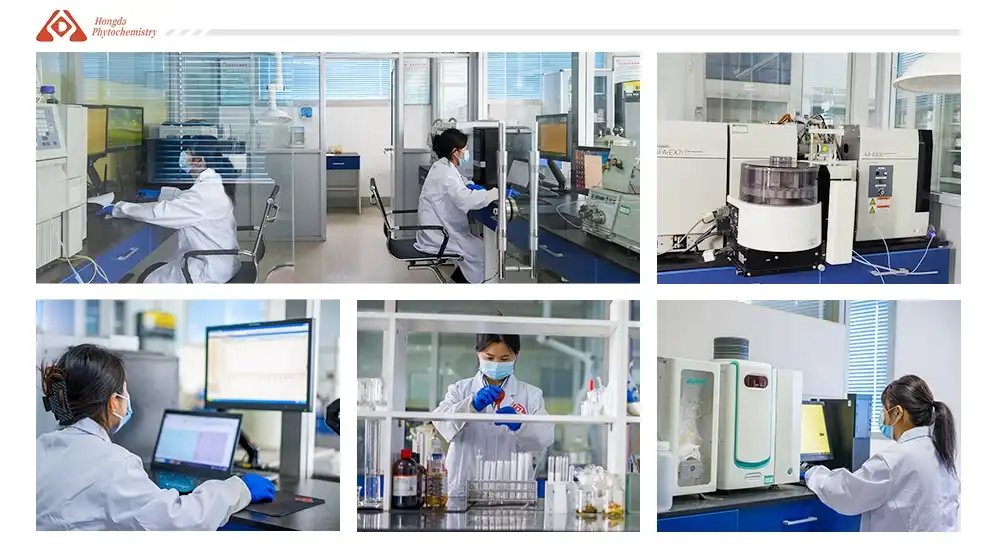
Every batch of calcium bisglycinate powder passes through a laboratory jointly established with university professors and standardized to SGS protocols, staffed by more than twenty professor-level researchers and testing personnel. Equipment including high-performance liquid chromatographs, atomic absorption spectrophotometers, and automatic titrators confirms elemental calcium content, chelation completeness, moisture, heavy metals, and microbial counts before release, giving buyers documented evidence of the absorption-relevant specifications formulators need to trust in their finished products, rather than relying on general assurances alone.
Certifications Enabling Global Market Access
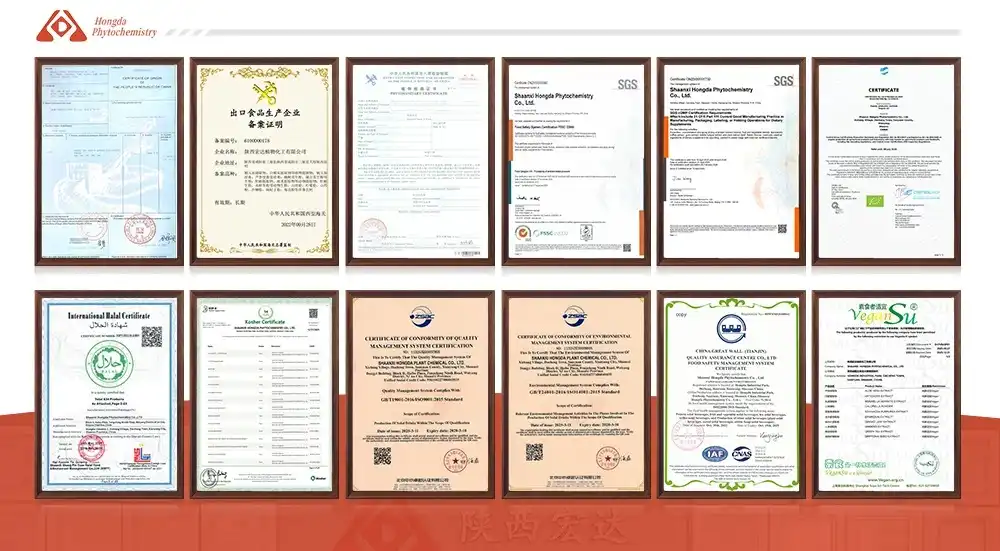
Between 2001 and 2026, Shaanxi Hongda accumulated national high-tech enterprise status, food production and feed additive licenses, halal and kosher certification, BRC, FDA registration, and organic certification. In 2026, the company added cGMP, FSSC22000, SC certification, ISO22000, ISO9001, and EU and NOP organic certification. This expanding certification portfolio supports import compliance and retailer review across international markets for brands building absorption-focused calcium products around this ingredient, reducing the administrative friction that often accompanies entry into newly regulated territories and giving procurement teams a clearer compliance runway.
Conclusion
Calcium bisglycinate powder improves absorption through its chelated structure, which reduces acid dependency and mineral competition compared to conventional calcium salts. For formulators looking for a reliable bulk supplier powder calcium bisglycinate, Shaanxi Hongda Phytochemistry supports this performance with scaled production, in-house SGS-standardized testing, and a growing international certification portfolio. Formulators building absorption-focused calcium products should request documentation and a sample batch before finalizing their sourcing decision, testing dissolution behavior and consumer tolerance directly against whatever calcium source their current formula already uses.
FAQ
1. Why does calcium bisglycinate powder absorb better than calcium carbonate?
Its chelated structure reduces dependency on stomach acid, supporting more consistent absorption across different consumers.
2. What is the significance of calcium bisglycinate molecular weight?
It helps formulators calculate accurate elemental calcium content and compare chelate purity between suppliers.
3. Does calcium bisglycinate powder need to be taken with food?
It offers more flexibility than acid-dependent forms, though consistent daily use matters most for results.
4. What does a 20 percent specification mean for this ingredient?
It refers to the approximate elemental calcium concentration guaranteed in that production grade.
Source Absorption-Focused Calcium From HONGDA
If your team is developing a calcium product built around genuine absorption performance, Shaanxi Hongda Phytochemistry can provide current specifications, certificates of analysis, and sample batches of calcium bisglycinate powder tailored to your formulation. With scaled production capacity, in-house SGS-standardized testing, and certifications supporting global compliance, HONGDA is positioned to be a dependable long-term partner. Reach out today at duke@hongdaherb.com to request documentation and discuss your bulk sourcing needs.
References
1. National Institutes of Health, Office of Dietary Supplements — Calcium Fact Sheet for Health Professionals
2. Journal of the American College of Nutrition — comparative studies on calcium salt bioavailability
3. Linus Pauling Institute, Oregon State University — Micronutrient Information Center, Calcium
4. American Journal of Clinical Nutrition — research on calcium absorption efficiency and dose response
5. International Osteoporosis Foundation — Calcium and Vitamin D Recommendations for Bone Health
6. U.S. Pharmacopeia — Dietary Supplement Compendium, Mineral Chelate Monographs