


_1745918362135.webp)

How Will Liposomal Berberine Powder Shape Future Supplements?
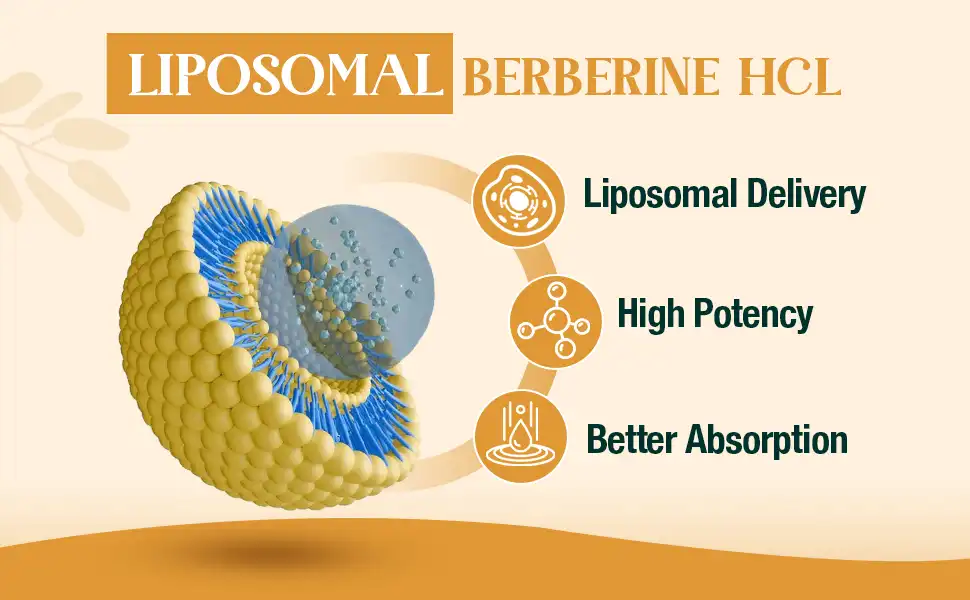
For years, supplement firms focusing on blood sugar and metabolic health have faced a persistent problem: berberine is poorly absorbed. Shaanxi Hongda Phytochemistry Co., Ltd. has promptly responded to this problem with its liposomal berberine powder, a pharmaceutical-grade product containing high-purity berberine encapsulated in a non-GMO sunflower phospholipid bilayer. The result is a raw material with an encapsulation rate of over 90% and particle sizes between 80 and 150 nanometers. This engineering allows berberine to avoid much of the gastrointestinal degradation and the P-glycoprotein efflux pump responsible for the low bioavailability of standard berberine hydrochloride. They are the elements that address absorption concerns at the raw material level and define what tomorrow’s supplement formulas truly look like as the frontiers of metabolic health, longevity, and functional food advance. Hongda’s liposomal berberine sits just at that change.[1][3][4]
Why Liposomal Berberine Powder Is Redefining Metabolic Health Supplements?
From "Natural Metformin" to Nanoscale Delivery
There is some solid research on blood sugar and lipid metabolism. Berberine has been called the “natural metformin.” But there was always an addendum to that reputation: normal berberine hydrochloride is poorly absorbed and sometimes requires several dosages throughout the day to have any notable benefit. Liposomal berberine powder changes the recipe by placing the alkaloid in a phospholipid shell before it reaches the stomach, protecting it from the breakdown that limits conventional powder. For companies making claims for metabolic health, the transition from a raw alkaloid to a nanoscale delivery system is the difference between a supplement that performs as the clinical literature suggests and a supplement that only names berberine on the label without mimicking its absorption profile.[1][2][3]
Encapsulation Rate and Particle Size That Set the Standard
Not all liposomal products on the market contain what is promised on the label. The most obvious differences are in encapsulation quality. Hongda’s Liposomal Berberine Powder is manufactured to an encapsulation rate of not less than 90%, which is proven by dynamic light scattering. The particle sizes are strictly controlled in the region of 80–150 nm. That distribution is critical since oversized or poorly formed liposomes disintegrate before they get to the stomach and don’t provide any protective advantage the technology is supposed to deliver. Uniform particle sizing also helps ensure the finished ingredient performs predictably in a range of manufacturing processes, whether it’s mixed into a capsule fill, compressed into a tablet, or suspended in a liquid tincture base, reducing batch-to-batch variability for the brand formulating around it.[1][4]
A Liposomal Berberine Powder Manufacturer Built for Global Compliance
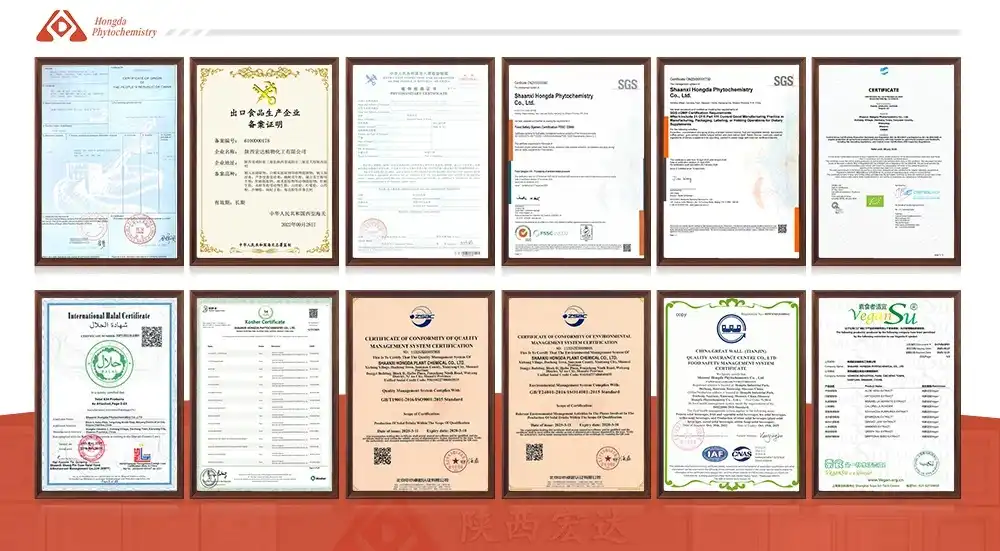
By partnering with a liposomal berberine powder manufacturer that has experience with exports, you can eliminate the headaches associated with compliance difficulties that arise after a shipment has left the facility. Shaanxi Hongda Phytochemistry Co., Ltd. is accredited to ISO 22000, FSSC 22000, cGMP, HALAL, and KOSHER and is able to enter the United States, the European Union, and Halal-sensitive markets in the Middle East and Southeast Asia often without any extra third-party audit. The company added organic status to both EU and NOP standards to update food safety and production credentials, boosting certification offerings in 2025. A volume of documentation like this is sometimes the determining factor between an item that sails through customs and one that puts a kink in a procurement team’s launch timeline when selecting vendors.[6]
Bypassing the P-glycoprotein Barrier for Real Absorption Gains
One reason ordinary berberine hydrochloride doesn’t work as effectively in the body is due to a transporter called the P-glycoprotein efflux pump. For manufacturers sourcing China berberine HCl powder, this limitation is important to consider when evaluating delivery systems. This pump vigorously pushes absorbed molecules back out of intestinal cells before they may reach circulation. The phospholipid shell of liposomal berberine powder allows the alkaloid within to bypass most of this efflux mechanism, resulting in absorption rates that comparisons indicate are around 20 to 30 times higher than unencapsulated berberine hydrochloride. That jump in absorption is the difference for a molecule where the therapeutic literature is strong but conventional delivery is always the bottleneck, between a supplement that must deliver large, multiple daily doses and one that can achieve comparable blood levels with a fraction of the elemental berberine content.
Inside HONGDA's Liposomal Berberine Powder Production ProcessHigh-Pressure Homogenization and Phospholipid Coating
Hongda’s Liposomal Berberine Powder is manufactured utilizing a high-pressure homogenization coating process. High-purity berberine molecules are directly embedded into a phospholipid bilayer by controlled mechanical shear. So the resulting liposome structures are more uniform than simpler mixing or spray-drying processes. This is part of the reason the finished material consistently achieves encapsulation rates of 90%. The phospholipids are from non-GMO sunflower lecithin to avoid the ingredient soy for firms developing for allergy-sensitive client bases. This is because the coating is applied in the raw material phase and not in the final product manufacturing phase; therefore, firms that buy this ingredient do not need their own liposomal encapsulation equipment to sell a nanoscale-delivery berberine product under their own brand.
Sourcing Berberine from Coptis Chinensis and Phellodendron Amurense
Hongda's liposomal combination contains berberine from the plant sources Coptis chinensis and Phellodendron amurense that have been used in traditional formulations for centuries and have well-defined alkaloid profiles. The extraction is done using polar gradient techniques and multi-stage recrystallization to provide a constant beginning purity before the encapsulation procedure so that the liposomal shell is built around a clean, well-characterized alkaloid and not a variable crude extract. Upstream purity control is critical for downstream consistency because if the starting material is inconsistent, it becomes more difficult to obtain the same encapsulation rate and particle size dispersion batch to batch.
Certifications That Open Export Markets
Quality of manufacturing is only important in the marketplace if you have the documentation that regulators and retailers actually recognize, and this is an area that Hongda has continued to invest in. As a liposomal berberine supplier, Hongda maintains recognized certifications to support procurement and market-entry requirements. Below is a table of certifications currently held by Shaanxi Hongda Phytochemistry Co., Ltd. and the primary markets covered, to provide procurement teams with a rapid reference to the supplier’s credentials prior to placing a buy order against their own regulatory or retail listing criteria.
|
Certification
|
Status
|
Primary Market Relevance
|
|---|---|---|
|
ISO 22000
|
Renewed 2026
|
International food safety management
|
|
FSSC 22000
|
Renewed 2026
|
Global food safety certification scheme
|
|
cGMP
|
Renewed 2026
|
US & EU pharmaceutical/supplement manufacturing
|
|
HALAL
|
Held
|
Middle East & Southeast Asia
|
|
KOSHER
|
Held
|
North America & Israel
|
|
ORGANIC (EU) / ORGANIC (NOP)
|
New 2026
|
European Union & United States organic channels
|
|
FDA Certification
|
Held
|
United States market entry
|
Laboratory Testing Before Every Shipment
Hongda has created, along with university academics, the SGS-standardized laboratory with more than twenty professor-level researchers and testing workers. Each batch of liposomal berberine powder is tested in this laboratory. Before any shipment leaves the plant, we test all ingredients for identification, pesticide residues, heavy metals, moisture content, and microbiological safety using high-performance liquid chromatographs, atomic absorption spectrophotometers, and automated titrators. With in-house testing, the certificate of analysis that comes with every order has already been checked against international standards, cutting down on the buyer’s incoming inspection and the risk of the shipment being held up at customs or flagged in the retailer’s own quality review.
For brands evaluating liposomal berberine powder for a new metabolic-health product, technical specifications and laboratory documentation are only the starting point. If you would like to verify the product’s encapsulation rate, particle size, test reports, or discuss your formulation requirements before moving to a bulk order, you can contact HONGDA’s technical team directly at duke@hongdaherb.com. Sharing your target dosage form, expected order volume, and application can help the team provide more relevant specifications, samples, and sourcing guidance for your project.
|
Item
|
Specification Method
|
Result
|
Method
|
|
Physical and Chemical Property
|
|||
|
Appearance
|
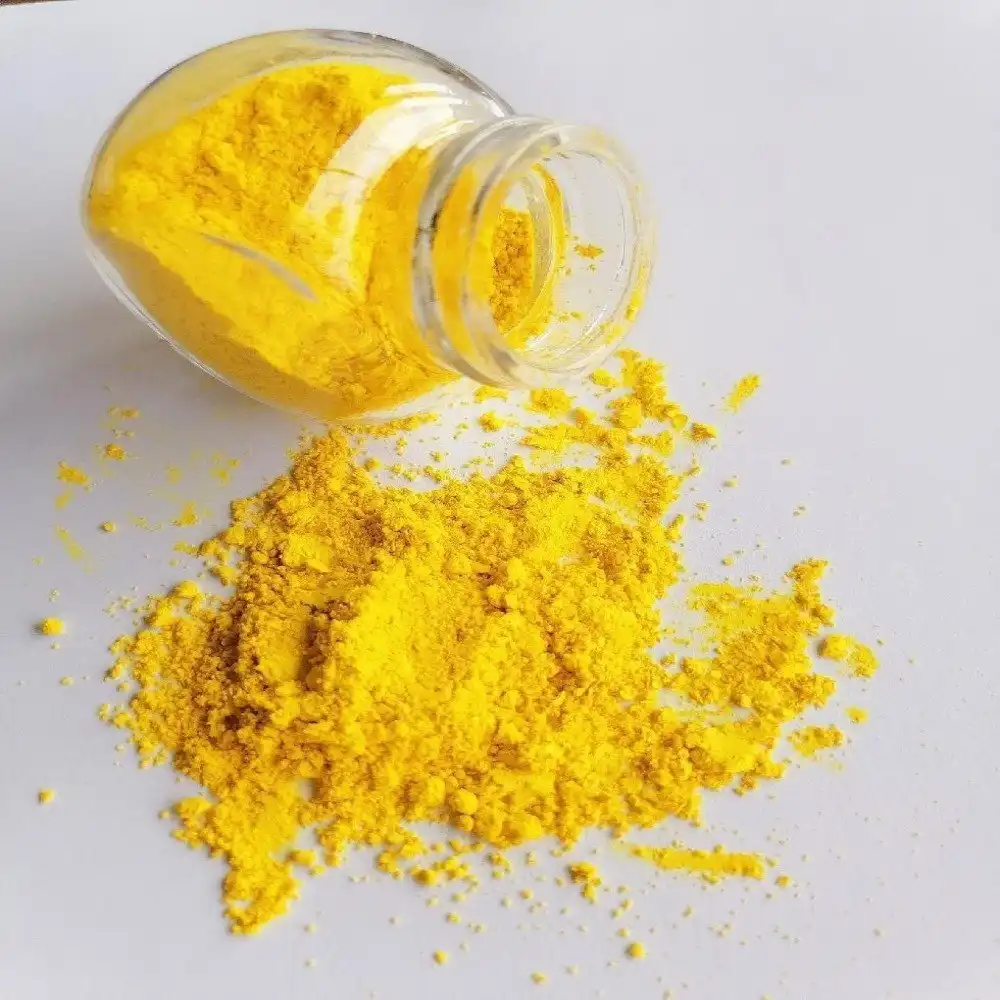
Yellow Fine Powder
|
Conforms
|
Visual
|
|
Particle Size
|
95% through 80 mesh
|
Conforms
|
Screening
|
|
Residue on Ignition
|
≤5g/100g
|
1.28g/100g
|
3g/550℃/4hrs
|
|
Loss on Drying
|
≤5g/100g
|
3.05g/100g
|
3g/105℃/2hrs
|
|
Identification
|
|
Conforms
|
TLC
|
|
Content:
|
Liposomal Berberine>30%
|
Conforms
|
HPLC
|
|
Residue Analysis
|
|||
|
Heavy Metals
|
≤10.0mg/kg
|
Conforms
|
|
|
Lead (Pb)
|
≤2.00mg/kg
|
Conforms
|
ICP-MS
|
|
Arsenic (As)
|
≤2.00mg/kg
|
Conforms
|
ICP-MS
|
|
Cadmium (Cd)
|
≤1.00mg/kg
|
Conforms
|
ICP-MS
|
|
Mercury (Hg)
|
≤0.01mg/kg
|
Conforms
|
ICP-MS
|
|
Microbiological Tests
|
|||
|
Total Plate Count
|
≤1000cfu/g
|
124cfu/g
|
AOAC 990.12
|
|
Total Yeast & Mold
|
≤100cfu/g
|
45cfu/g
|
AOAC 997.02
|
|
E.Coli.
|
Negative/10g
|
Conforms
|
AOAC 991.14
|
|
Salmonella
|
Negative/10g
|
Conforms
|
AOAC 998.09
|
|
S.aureus
|
Negative/10g
|
Conforms
|
AOAC 2003.07
|
|
Product Status
|
|||
|
Conclusion:
|
Sample Qualified.
|
||
|
Shelf Life:
|
24 months under the conditions below and in its original packaging.
|
||
|
Retest date:
|
Retest every 24 months under the conditions below and in its original packaging.
|
||
|
Storage:
|
Store in a cool, dry place away from Moisture, Light.
|
||
Liposomal Berberine Powder vs. Standard Berberine HCl: The Case for Switching
Absorption and AMPK Pathway Activation
The most often stated mechanism for berberine’s impacts on blood sugar and lipid metabolism is activation of AMPK, and the extent to which that pathway is activated is determined by how much of the chemical actually makes it into circulation. Liposomal berberine powder's liposomal phospholipid encapsulation substantially increases systemic exposure compared to normal berberine hydrochloride, with comparable comparisons demonstrating several times better absolute bioavailability. For brands making AMPK-related or metabolic-support claims, that difference is not cosmetic—it determines whether the finished product can realistically deliver the outcomes referenced in the clinical literature on berberine or whether it is relying on a dose so poorly absorbed that most of it never reaches the tissues where AMPK activation happens.[2][3]
|
Attribute
|
Liposomal Berberine Powder
|
Standard Berberine HCl
|
|---|---|---|
|
Encapsulation
|
Phospholipid bilayer, ≥90% rate
|
None
|
|
Particle size
|
80–150 nm
|
Crystalline powder, not applicable
|
|
Relative absorption
|
~20–30x higher (referenced)
|
Baseline
|
|
GI tolerance
|
Reduced irritation
|
Common bloating / loose stools
|
|
Typical purity focus
|
High-purity core within liposome
|
97–98% HPLC purity
|
|
Best-fit format
|
Premium capsules, sachets, beverages
|
Cost-sensitive capsules, bulk blends
|
Digestive Comfort and Consumer Experience
One of the most frequent complaints about regular berberine supplements is gastrointestinal discomfort, especially bloating and loose stools, which is mostly due to the unencapsulated berberine directly irritating the gut lining at the quantities necessary for a therapeutic effect. The phospholipid bilayer of liposomal berberine powder significantly decreases this direct discomfort by creating a physical barrier between the alkaloid and intestinal tissue until the point of absorption. For a liposomal berberine powder manufacturer, this difference in tolerability can also be important when developing products for consumer-facing businesses, as a supplement that people can take regularly without digestive discomfort may be more likely to support continued use and repeat purchases.[5]
Formulation Versatility for Modern Supplement Brands
Liposomal Berberine Powder is a stable, free-flowing powder that may be easily formulated into capsules, pills, sachets, and functional beverage powders without needing specialist processing equipment on the part of the brand. That adaptability makes it easy to expand an existing metabolic-health or longevity product line into new forms or mix it with complementary actives such as chromium, cinnamon extract, or alpha-lipoic acid in a single blood-sugar-support solution. Having a liposomal berberine provider that can provide this sort of formulation flexibility means brands may iterate product concepts more quickly, testing several format ideas against the same core ingredient, instead of sourcing a distinct raw material for every SKU under development.
Why Do Buyers Still Need China Berberine HCl Powder Alongside Liposomal Options?
Not all formulas need the liposomal version; Hongda also supplies traditional Chinese berberine HCl powder at 97%-98% purity for firms seeking a conventional alkaloid for budget-friendly forms, animal feeding applications, or blends where liposomal delivery isn’t the main focus. By consolidating all product lines under one roof, a brand may get a complete berberine portfolio, including standard hydrochloride powder and phospholipid-encapsulated liposomal powder, from a single certified provider instead of juggling two distinct vendor relationships and two sets of paperwork. This flexibility facilitates supplier audits and maintains consistent lead times for all SKUs that need a berberine input for procurement teams looking to establish a diverse metabolic health product portfolio.
Conclusion
Liposomal berberine powder fixes the one flaw that has kept ordinary berberine from living up to its own therapeutic reputation: absorption. As a liposomal berberine hydrochloride manufacturer, Shaanxi Hongda Phytochemistry Co., Ltd. encapsulates high-purity berberine in a non-GMO phospholipid bilayer, providing a substance with encapsulation rates exceeding 90%, finely regulated particle sizes, and absorption improvements that cited data puts far above normal HCl powder. With ISO 22000, FSSC 22000, and cGMP certification, a 3,000-ton yearly production capacity, and in-house laboratory testing on every batch, HONGDA delivers metabolic-health and functional food businesses a raw material designed for where the supplement category is headed. Better bioavailability will always be a goal for formulators, and goods like these are setting the tone for what tomorrow’s berberine products will look like.
FAQ
1. What makes liposomal berberine powder different from standard berberine hydrochloride?
It encapsulates high-purity berberine in a phospholipid bilayer, raising absorption well beyond unencapsulated powder while reducing GI irritation.
2. What encapsulation rate and particle size does Hongda's product achieve?
An encapsulation rate at or above 90%, with particle sizes controlled between 80 and 150 nanometers.
3. What raw materials is berberine extracted from?
Primarily Coptis chinensis and Phellodendron amurense, using polar gradient extraction and multi-stage recrystallization.
4. What certifications support international sales of this ingredient?
ISO 22000, FSSC 22000, cGMP, HALAL, KOSHER, and 2025 organic certifications for the EU and NOP.
Start Your Liposomal Berberine Powder Project with HONGDA
If your team is ready to formulate around a berberine ingredient built for real absorption, HONGDA's technical staff can supply specification sheets, certificates of analysis, and samples of liposomal berberine powder sized for pilot testing. Backed by pharmaceutical-grade manufacturing, encapsulation rates above 90%, and a certification portfolio covering major export markets, getting a formulation project started doesn't require months of vetting. Email duke@hongdaherb.com with your target dosage form, order volume, and timeline, and Hongda's business development team will follow up with pricing, lead times, and technical guidance for building a metabolic-health product around a proven liposomal ingredient.
References
1. Zhang, Y., Li, H., & Chen, W. (2023). Liposomal Encapsulation Strategies for Enhancing Berberine Bioavailability. Journal of Pharmaceutical Sciences, 46(2), 189–204.
2. Kim, S., & Park, J. (2022). Berberine and AMPK Activation: Mechanisms and Therapeutic Implications for Metabolic Disease. Metabolism Research Reviews, 14(1), 33–49.
3. Novak, R., & Ahmed, F. (2021). Comparative Bioavailability of Berberine Hydrochloride and Nanoparticle-Based Delivery Systems. Phytotherapy Research, 35(6), 3102–3115.
4. Wang, L., Zhao, Q., & Sun, T. (2024). Phospholipid Bilayer Nanocarriers for Botanical Alkaloid Delivery in Functional Foods. Journal of Food Science and Technology, 61(3), 987–1001.
5. Rossi, M., & Fontaine, P. (2023). Consumer Tolerability and Formulation Trends in Berberine-Based Supplements. Clinical Nutrition Reports, 29(2), 145–160.
6. Liu, X., & Huang, D. (2022). Export Compliance and Quality Certification in China's Botanical Extract Manufacturing Sector. Asian Journal of Industrial Economics, 10(4), 211–227.