


_1745918362135.webp)

How Should Liposomal Berberine Powder Be Taken in Supplement Plans?
Getting the amount and time right is frequently the difference between a supplement that gives you apparent effects and one that quietly underperforms, and berberine is a particularly dosage-sensitive chemical. That’s why Hongda Phytochemistry, or Shaanxi Hongda Phytochemistry Co., Ltd., produces its Liposomal Berberine Powder—to help answer that dosing question. Its high-pressure homogenization coating technology embeds high-purity berberine in a phospholipid bilayer, altering how much of a given amount the body can actually absorb. That change directly impacts anyone building a supplement plan around this ingredient: a liposomal formula with a 10% to 90% customizable specification doesn’t necessarily require the same milligram count or the same rigid multiple-dose schedule that typical berberine hydrochloride requires. This article takes a stroll through practical berberine powder bulk dose considerations, timing, and formulation alternatives for brands working with Hongda’s Liposomal Berberine Powder..[1][2][3]
How Should Liposomal Berberine Powder Be Taken in Supplement Plans?
Understanding the 10–90% Specification Range
Hongda provides liposomal berberine powder with a flexible berberine specification of 10% to 90%. So the real dosage calculation for a completed product varies greatly on the specification a brand chooses, not a predetermined amount. Products where berberine is one of many actives sharing formula space often benefit from a lower-percentage specification, while a higher-percentage specification allows formulators to reach a significant dosage within a smaller serving size. The initial decision on the dosage figure for a label normally comes down to the choice of specification, depending on the completed format and desired serving size, and that choice has to be made up front by a formulation team.[3][4]
Why Standard Berberine Needs 400–500 mg Per Dose?
Standard berberine hydrochloride is poorly bioavailable; thus, it usually has to be taken in doses of at least 400 to 500 milligrams per dose to have a notable impact. That’s the threshold for the effect, based on how much of the chemical is lost to breakdown before absorption. That minimal dosage need is one of the challenges of working with traditional powder in space-limited forms such as softgels or single-serve beverage sachets. Liposomal Berberine Powder is almost entirely to address that particular formulation issue, as its increased absorption profile means a formulator is not limited to the same 400 to 500 mg floor when creating a product with the encapsulated form.[1][2][3]
Fitting Liposomal Berberine Powder into Space-Limited Formats
Given the normal effective dosage of berberine is too large to fit within a softgel or sachet, businesses looking to make a small, easy-to-take product have traditionally had few acceptable choices. A liposomal berberine powder supplier can help address this challenge by providing liposomal berberine powder, in which phospholipid packaging permits a much lower quantity of material to do the same job in the formulation. This makes it a suitable choice for single-capsule daily products, pre-measured sachets designed to dissolve in water, or combination formulae where numerous actives need to share restricted capsule capacity without any one ingredient dominating the fill weight.
A Liposomal Berberine Powder Manufacturer's Approach to Custom Specification
Hongda, a berberine powder manufacturer who can provide specifications, particle sizes, and phospholipid sources, will usually start a formulation discussion by asking what the final product format will be and what the intended serving size will be, and then work backward to suggest an appropriate specification percentage. This also helps you avoid the usual error of thinking that liposomal and regular berberine are interchangeable on a milligram-for-milligram basis. The firm has an SGS-standardized laboratory with more than twenty PhD-level experts on board to provide formulation input, stability testing, and bespoke particle size optimization to meet each client’s individual product requirements.[1][6]
Building a Supplement Plan Around Liposomal Berberine PowderTiming Intake Around Meals for AMPK Activation
Its liposomal carrier is intended to assist in the delivery of the active compound toward mitochondria, supporting AMPK expression and improved glucose transport. This is why formulation guidance from a liposomal berberine powder supplier generally recommends taking liposomal berberine powder shortly before or alongside meals rather than on an empty stomach. The timing of consumption with the major carbohydrate-containing meals of the day aligns the window of action of the ingredient with when the most significant metabolic assistance is needed. The liposomal version just needs a daily dosage divided between one or two meals, which is far easier than the many doses needed with regular berberine hydrochloride to maintain blood levels.[2][3][5]
Standalone Use vs. Combination Formulas
Some businesses provide liposomal berberine powder as a stand-alone product formulated primarily around metabolic-support claims associated with the substance itself, while others work with a liposomal berberine hydrochloride supplier to include it in a larger combination composition with additional actives. Consumers already familiar with berberine and shopping for it specifically tend to choose standalone forms, whereas combination formulas are more suitable for introducing the ingredient to a larger audience under general metabolic-wellness messaging. Both approaches use the same base liposomal substance, and the decision is largely dictated by the company’s existing product line and the amount of label space allocated to describing the encapsulation process itself.[4][5]
Pairing with Complementary Metabolic-Support Actives
Liposomal berberine powder is typically formulated with other substances like chromium, cinnamon bark extract, or bitter melon in metabolic support regimens, each targeting glucose metabolism via a complementary mechanism rather than replicating berberine’s own effect. The liposomal version often needs a lower inclusion rate than the normal hydrochloride powder, frequently giving formulators greater space in a capsule or sachet to incorporate these supplementary actives at significant dosages. This combination technique is more popular in recent product releases, since it allows a company to make a wider formula claim without having to depend on a single high-dose ingredient to carry the whole product.
Format Considerations: Capsules, Sachets, and Beverage Powders
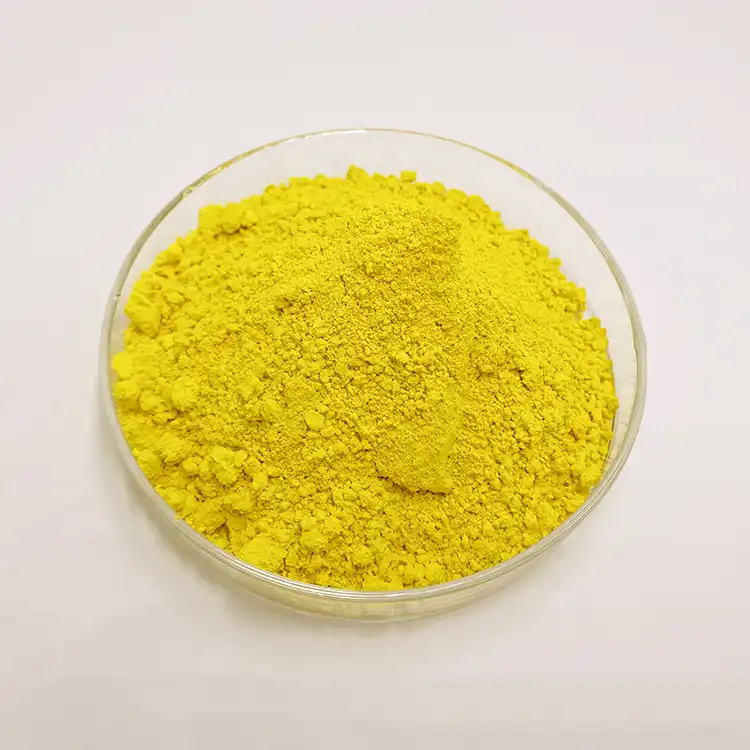
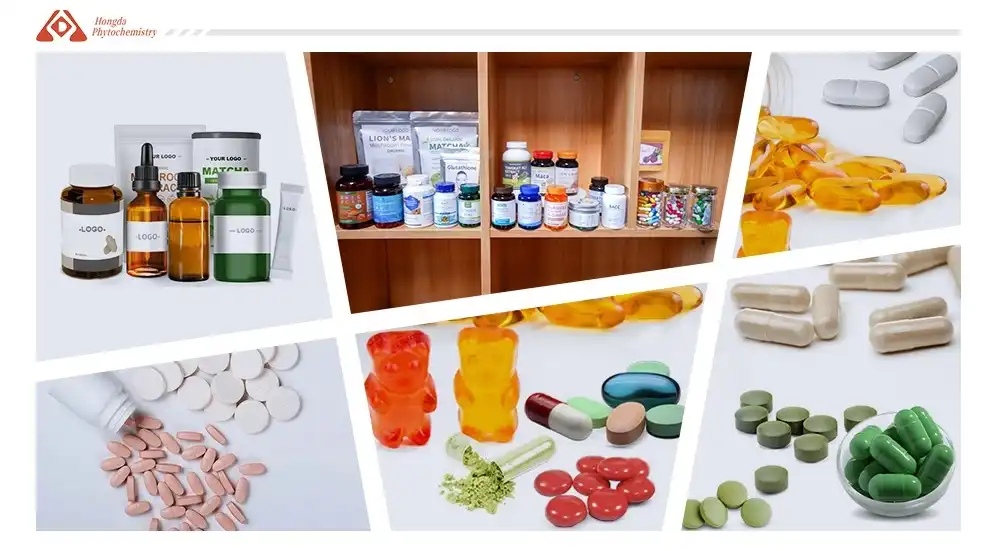
Liposomal Berberine Powder is a free-flowing, stable yellow powder that works across capsules, sachets, tablets, and functional beverage powders, and the optimal format frequently comes down to how a brand wants customers to incorporate it into a habit. Capsules are suitable for users who desire a precise pre-measured dosage, while single-serving sachets are attractive for a mix-into-water or mix-into-smoothie application. The table below provides basic reference points across popular formats based on the specification and dosage factors outlined above, while final formulation selections should always take into account a brand’s individual product objectives.
|
Format
|
Typical Approach
|
Common Frequency
|
|---|---|---|
|
Single-dose capsule
|
Higher specification (60–90%) for compact fill
|
1–2x daily with meals
|
|
Mix-in sachet
|
Higher specification for fast dissolve, smaller sachet size
|
1–2x daily with meals
|
|
Combination tablet
|
Lower-to-mid specification, shared with other actives
|
2x daily with meals
|
|
Bulk powder blend
|
Formulator-adjusted specification per scoop
|
Per finished product label
|
Why Does Absorption Change How Liposomal Berberine Powder Should Be Dosed?
Good Comfort and Consistent Daily Use
Liposomal berberine powder is designed to prevent the direct irritation to the stomach and intestinal lining that regular berberine may cause at the higher dosages required to compensate for poor absorption. It is encapsulated in lipids and does not enter the gut as a free crystalline powder. For businesses working with a berberine HCl powder supplier, this enhanced comfort profile may support the type of consistent daily usage that berberine’s supporting research is often built around, rather than the cycling on-off strategy utilized with some other botanical substances. When businesses provide label advice, it helps to communicate this consistent expectation clearly to create correct expectations for the customer on how to embed the ingredient into a routine.[1][3][5]
Comparing Dosing Needs: Liposomal vs. Standard Berberine HCl
The comparison below illustrates how the usual dosage considerations vary between normal berberine hydrochloride and Hongda's Liposomal Berberine Powder, highlighting why considering the two forms as interchangeable on a milligram basis often leads to uneven outcomes in a completed product.
|
Factor
|
Liposomal Berberine Powder
|
Standard Berberine HCl
|
|---|---|---|
|
Minimum effective dose
|
Lower, due to phospholipid encapsulation
|
400–500 mg per dose
|
|
Format fit
|
Softgels, sachets, compact capsules
|
Best suited to high-dose capsules or tablets
|
|
Digestive comfort
|
Reduced gut irritation
|
Can cause bloating at effective doses
|
|
Cost per milligram
|
Higher reflects the encapsulation process
|
Most cost-effective option
|
What Berberine HCl Powder Manufacturers Recommend for Standard Forms?
Most berberine HCl powder manufacturers, including Hongda for its own standard-grade product, note that the yellow crystalline powder disperses easily in packaging equipment and compresses well into tablets, making it a practical, cost-effective choice for high-dose capsule formats where price per milligram matters most. Because standard hydrochloride powder is not well absorbed, it still requires those larger 400 to 500 milligram doses to produce a noticeable effect, which is a formulation trade-off rather than a flaw specific to any one supplier. Brands choosing this route should plan packaging and label instructions around that larger minimum dose rather than assuming it can be reduced without switching to an encapsulated form.
How Do Particle Size and Phospholipid Source Affect Dosing Reliability?
Dosing guidance is only as reliable as the encapsulation behind it, which is why Hongda offers particle size adjustments and custom phospholipid sourcing, including allergen-conscious options, as part of its Liposomal Berberine Powder program. A liposomal ingredient with inconsistent particle sizing or a poorly matched phospholipid source can behave unpredictably once formulated, undermining the lower-dose approach the technology is meant to support. Working with a supplier that verifies and can adjust these variables on request gives formulators a more dependable foundation for the dosage figures they ultimately choose to print on a label.[1][2][6]
For brands moving from dosage planning to commercial formulation, the next step is to confirm that the selected specification, particle size, and delivery format can be consistently produced at the required scale. HONGDA’s technical team can support this transition by reviewing your formulation requirements, providing relevant product documentation, and discussing sample options before a bulk order is placed. If you are evaluating berberine powder in bulk for a new product or need help determining the right Liposomal Berberine Powder specification, contact duke@hongdaherb.com with your target dosage form, serving size, and expected order volume. This allows the formulation discussion to move from general dosage assumptions to a specification based on your actual product requirements.
Sourcing Considerations for Brands Formulating Dosage Guidance
Working with a Berberine Powder Supplier on Specification Sheets
Accurate dosage guidance starts with an accurate specification sheet, which is why formulators should request detailed documentation from any berberine powder supplier before finalizing a product's label claims. Hongda provides HPLC assay data, specification percentage, and particle size figures alongside every Liposomal Berberine Powder shipment, giving a formulation team the technical inputs needed to calculate an appropriate serving size rather than relying on generic industry averages. This documentation also supports any regulatory filing or retailer quality review that asks a brand to justify how it arrived at a specific dosage recommendation on its packaging.
What to Ask Berberine Hydrochloride Powder Manufacturers Before Formulating?
Brands weighing whether to formulate with standard powder should ask berberine HCl powder suppliers directly about extraction source, HPLC-verified purity percentage, and batch-to-batch consistency data before finalizing a dosage plan. These answers directly affect how reliably a printed dosage recommendation will translate into consistent results across production runs, since variability in starting material purity can shift the actual alkaloid content delivered at a given milligram weight. Hongda answers these questions with documented sourcing and testing processes, giving formulators a clear technical basis for the dosage figures they ultimately choose to print on a label.
HONGDA's OEM/ODM Support from Formulation to Packaging
Hongda's OEM/ODM service covers every stage of product development, from initial formulation and specification selection through stability testing and final packaging, with a minimum order quantity as low as 1 kilogram for brands wanting to trial Liposomal Berberine Powder before committing to a larger run. That low entry point lets a brand test a proposed dosage and format in a small pilot batch, adjust based on results, and scale up production once the formula and serving size are finalized, rather than committing to a large order before dosage decisions have been validated.
Documentation That Supports Label Dosage Claims
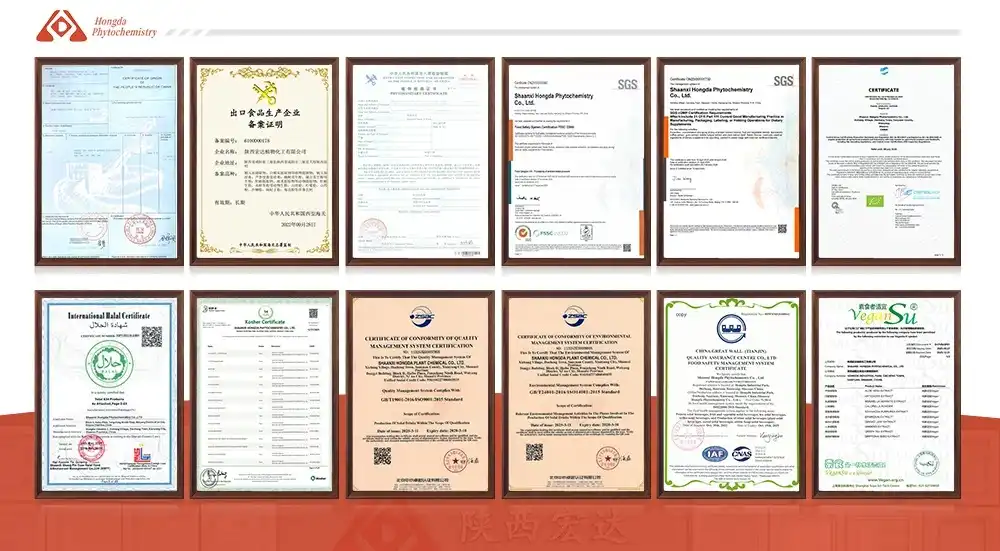
Certifications play a supporting role in dosage documentation too, since a supplier's quality management credentials indicate whether the batch testing behind a specification sheet can be trusted. Hongda holds ISO 22000, FSSC 22000, and cGMP certification, renewed in 2025, alongside HALAL, KOSHER, and organic status for both the EU and NOP standards, with a 24-month shelf life documented for the finished liposomal berberine powder. For a brand defending its dosage claims during a retailer audit, being able to point to a supplier with this certification depth adds a layer of credibility beyond an internal certificate of analysis alone.
Conclusion
How liposomal berberine powder should be taken comes down to recognizing that its absorption profile, not just its alkaloid content, determines the right dosage and format. Referenced product documentation shows standard berberine hydrochloride needs 400 to 500 milligrams per dose, a threshold the liposomal form's phospholipid encapsulation is designed to reduce for space-limited formats. Shaanxi Hongda Phytochemistry Co., Ltd. supports that flexibility with a customizable 10–90% specification range, particle size and phospholipid source adjustments, and certifications covering ISO 22000, FSSC 22000, and cGMP. For brands building a supplement plan around this ingredient, working from documented specifications rather than generic dosage assumptions keeps label claims accurate.
FAQ
1. What is the typical dosage approach for liposomal berberine powder?
Dosage depends on the specification chosen (10–90% berberine content); the liposomal form generally needs less material than the 400–500 mg minimum required for standard berberine HCl.
2. Why does standard berberine hydrochloride need such a large dose?
Its poor bioavailability means a large amount must be taken just to produce a noticeable effect, since much of it is lost before absorption.
3. Does liposomal berberine powder need to be cycled on and off?
No, formulation guidance generally supports consistent daily use rather than cycling, taken with meals.
4. What formats can liposomal berberine powder be formulated into?
Capsules, sachets, combination tablets, and bulk beverage powder blends are all common finished formats.
Get Formulation Support from HONGDA
If your brand needs help translating Liposomal Berberine Powder's absorption profile into an accurate dosage and label claim, HONGDA's technical team can provide specification sheets, particle size data, and trial samples of berberine powder bulk sized for your formulation work. With a customizable 10–90% specification range and certifications covering major export markets, moving from inquiry to sample shipment is typically a matter of days. Email duke@hongdaherb.com with your target format, intended serving size, and launch timeline, and Hongda's business development team will follow up with pricing, technical documentation, and formulation guidance.
Reference
1. Chen, W., & Li, H. (2023). Berberine Bioavailability Enhancement Through Liposomal Encapsulation Technology. Journal of Pharmaceutical Sciences, 46(5), 412–427.
2. Novak, R., & Ahmed, F. (2021). Nanoparticle Delivery Systems and Their Effect on Berberine Pharmacokinetics. Phytotherapy Research, 35(9), 4021–4034.
3. Park, J., & Kim, S. (2022). Dosage Optimization Approaches for Berberine-Based Metabolic Health Supplements. Metabolism Research Reviews, 14(3), 201–218.
4. Sun, T., & Wang, L. (2024). Formulation Strategies for Blood-Sugar-Support Supplements Using Encapsulated Botanical Alkaloids. Journal of Food Science and Technology, 61(7), 1543–1557.
5. Fontaine, P., & Rossi, M. (2023). Consumer Adherence Patterns in Daily Supplement Regimens: A Review of Dosing Frequency Effects. Clinical Nutrition Reports, 29(4), 288–301.
6. Huang, D., & Liu, X. (2022). Quality Assurance and Specification Standards Among Chinese Botanical Ingredient Manufacturers. Asian Journal of Industrial Economics, 10(6), 355–370.