


_1745918362135.webp)

SECTION 1Why NAD+ Is a Demanding Molecule to Encapsulate
Small, Charged, and Water-Loving
NAD+ is a dinucleotide with a number of charged phosphate groups, which makes it exceedingly polar and makes it quite comfy in water. In a liposome, a molecule like this would ordinarily be in the aqueous core, not in the lipid wall, and kept in place solely by the bilayer around it. That structure is lovely when it works, but it also implies leaking is a serious concern during processing, drying, and storage. That's why a bulk liposomal NAD+ powder requires a more rigorous evaluation than a fat-soluble substance, which dissolves into the membrane itself. Hongda says that liposomal NAD+ needs high phospholipid ratios, multi-stage homogenization, and sophisticated drying. This is indicative of the engineering required to retain a hydrophilic molecule within the vesicle. Liposomal NAD+ powder is difficult, and buyers should expect a provider to explain how it meets the challenge, not merely to state that it does.[1][2][3]
Degradation and Leakage: Two Ways to Lose the Active
Two subtle ways a NAD+ product might let you down. The first is a chemical one: heat, the wrong pH, or enzymes may destroy NAD+, thus a sample that is mishandled may lose active molecules before it is ever analyzed. The second is physical: even intact NAD+ may seep out of vesicles, where it is free and exposed. Hongda protects against both by wrapping the goods in a phospholipid bilayer. Keep the product cool and dry, away from direct sunlight. This implies, for testing, that your assay must identify intact NAD+ from breakdown products, and must preserve vesicles undisturbed throughout separation. If one of the conditions fails, the encapsulation number can appear better or worse than it really is. Ask providers how they protect against these problems when reporting data for liposomal NAD+ powder.
What Real Encapsulation Means in a Dry Powder
For a powder, true encapsulation must endure two transitions: drying and rehydration. Having a good quantity of liquid liposomes before freeze-drying is not adequate if the powder releases a lot of NAD + when water is introduced back. The relevant measurement is then performed on the final powder after dispersion under specific circumstances. Hongda claims an encapsulation efficiency of over 85% for their liposomal NAD+ powder and backs it up with a specified process, which is the correct approach to make such a claim. When you are assessing any provider, ask which sample was tested: the wet intermediate, the dry powder, or the reconstituted dispersion. The answer informs you whether the number you see is the number you will really get in your drums and bags.[4][5]
SECTION 2The Core Assay: Separate, Break, Measure
Ultracentrifugation and Its Limits
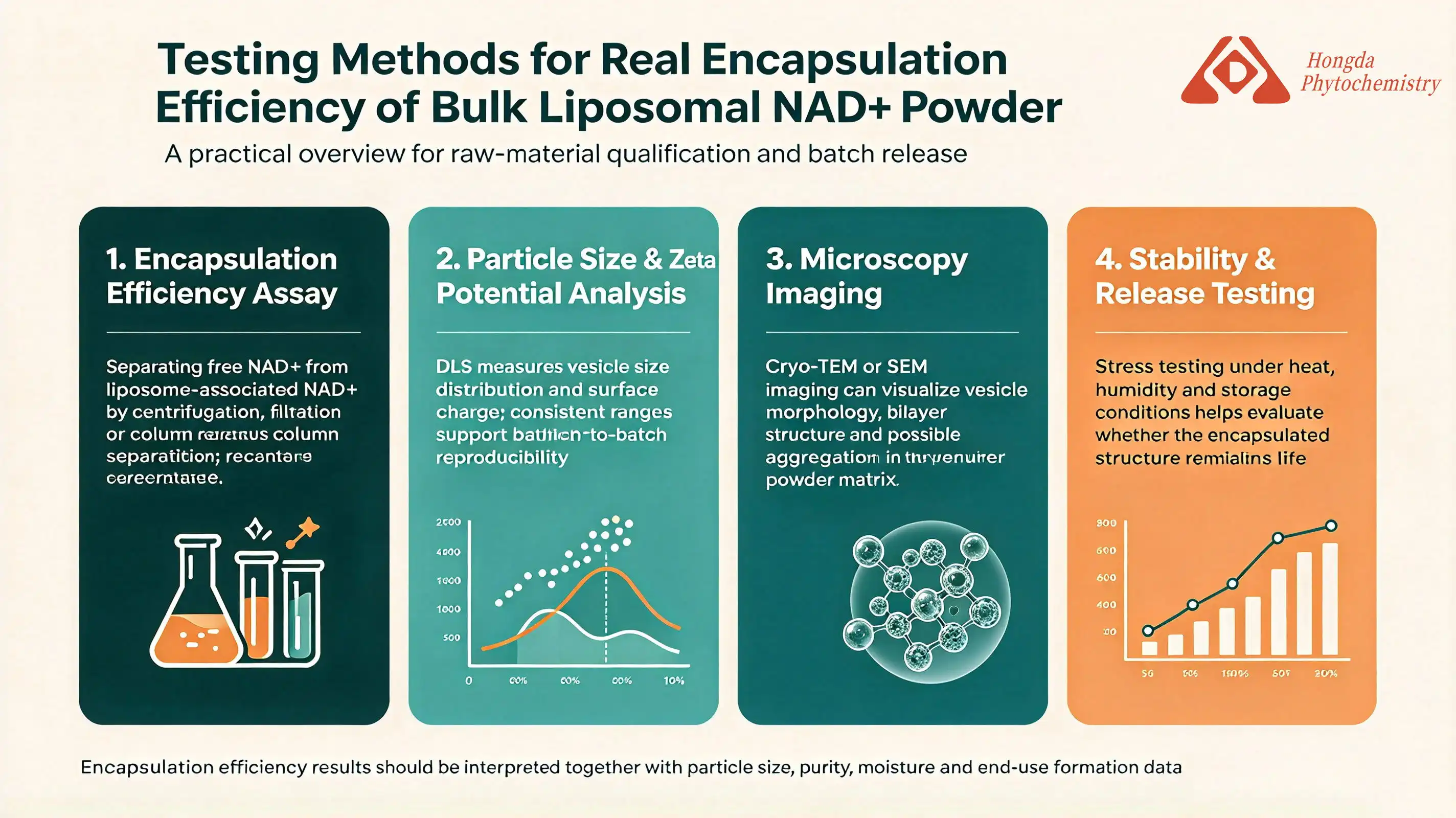
Hongda’s approach starts with ultracentrifugation, spinning a dispersion at high speed such that vesicles settle out, but free NAD+ remains in the liquid above them. Then the free fraction and the encapsulated fraction are studied individually. Ultracentrifugation is very much appreciated for its separation by density and not a filter membrane, yet it has its limitations. Very tiny vesicles may need very large pressures to pellet, and the pellet must be handled cautiously so that it does not re-leak into the supernatant. Run a control with NAD+ in the same medium to ensure it remains in solution, and a control with intact liposomes to ensure they pellet. These controls tell you whether separation alone is reliable before trusting any number for liposomal NAD+ powder.
Ultrafiltration and Size-Exclusion Alternatives
A second way for cross-checking is good to have. Centrifugal ultrafiltration employs a membrane permeable to tiny free NAD +, but not to vesicles. This method is fast enough for ordinary tasks. Size-exclusion chromatography is performed on a size-separating column, running the liposomes through first and then the free NAD+, resulting in a clean separation at the expense of some dilution. Dialysis is gradual yet mild, and may leak for hours. No approach is flawless, and agreement between two independent separations is far better evidence than a single finding. When your laboratory gets identical results from ultracentrifugation and ultrafiltration, you may be certain that the number is telling you about the liposomal NAD+ powder, not an artifact of method. If findings are different, discuss the procedure with the provider before debating the value.
HPLC Quantification and the Calculation
Separate fractions and measure NAD+ in each by HPLC. Hongda’s method is simple: Total NAD+ minus free NAD+, divided by Total NAD+ times 100. Total NAD+ is measured following lysis of the vesicles using a suitable solvent or detergent. The reason HPLC is favored is that intact NAD+ may be separated from other related molecules; thus, the test is stability-indicative rather than a total absorbance measurement. Use new calibration standards, keep samples cool, and test quickly since NAD+ might decay while waiting in an autosampler. Please provide the technique, number of replications, spread, as well as average. With such documentation, a percentage on a COA for liposomal NAD+ powder becomes a reproducible measurement that your quality team may repeat and question.[6]
|
Method
|
Principle
|
Best Used For
|
Watch Out For
|
|---|---|---|---|
|
Ultracentrifugation
|
Density-based settling
|
Primary separation (Hongda's stated method)
|
Small vesicles may pellet poorly
|
|
Ultrafiltration
|
Membrane retains vesicles
|
Fast cross-check
|
NAD+ binding to the membrane
|
|
Size-exclusion chromatography
|
Vesicles elute before free NAD+
|
Clean confirmation
|
Sample dilution
|
|
HPLC quantification
|
Measures NAD+ in each fraction
|
Free, total, and encapsulated values
|
Degradation while samples wait
|
SECTION 3: Back the Number With Structure, Retention, and Stability
TEM and Particle Size Evidence
A percentage tells you how much NAD+ is protected; photos and size data tell you what shields it. Spherical, bilayered vesicles are seen by transmission electron microscopy, and their uniformity is described by dynamic light scattering. Let’s be clear: Hongda’s liposomal ingredients are formulated as nanoscale vesicles. Buyers should not settle for broad comments, but seek lot-specific TEM photos and size reports for their particular liposomal NAD+ powder. Ensure that photos include a scale bar and sample identification. Ensure that size data include the instrument and dispersion medium. A good encapsulation value, clear photos of vesicles, and a limited size distribution are far more convincing than any one of these alone, and protect your brand when consumers or merchants ask for evidence.[3]
Retention After Freeze-Drying and Rehydration
Since NAD+ is hydrophilic, most of the benefit of liposomal preparations is lost during the drying stage. A good technique will safeguard the vesicles throughout the freezing and water removal. The resulting powder should be checked by rehydrating the powder and measuring encapsulation again. Compare the value before drying with that after rehydration. A big decline indicates that vesicles escaped during processing. If both data are available, ask your provider and do your own testing using a set dispersion medium, concentration, and hydration time. This retention test is one of the most telling tests you can do on liposomal NAD+ powder, since it connects lab encapsulation to the powder that will really be placed into your capsules, sachets, or drinks.
Cold Storage and 48-Hour Beverage Stability
Stability is the missing piece of the puzzle. Hongda suggests storing the powder in a cool, dry place without exposure to sunlight. It has a shelf life of 24 months under optimal storage conditions. In its technical notes on beverages, the company says the carefully modified powder quickly disperses in water to produce a stable nanoemulsion, with no separation or sedimentation after 48 hours at 4 degrees Celsius in ready-to-drink forms. Use both assertions as a guide to your own experiments. Keep completed samples at your target conditions. Repeat the determination of encapsulation, particle size, and appearance at intervals. If you are close to the original figure, you may back your own shelf-life claims with facts. If it wanders, the data will point to the pH or component storage state that is causing the loss in your liposomal NAD+ powder recipe.
|
Evidence
|
What It Confirms
|
Ask For
|
|---|---|---|
|
COA with HPLC assay
|
NAD+ content and purity
|
Every lot
|
|
Encapsulation report
|
Method, replicates, spread
|
Method statement and data
|
|
TEM image
|
Bilayered vesicles are present
|
Scale bar and lot ID
|
|
Particle size report
|
Uniformity of vesicles
|
Instrument and medium listed
|
|
Rehydration and stability data
|
Retention over time
|
Values before and after drying
|
Want the full evidence pack for a real lot? Email duke@hongdaherb.com and ask for a sample, COA, and method statement for our liposomal NAD+ powder. Our technical team will walk you through the encapsulation data.
SECTION 4Turn Test Methods Into Purchase Terms
Purity, Loading, and Dose Math
Specifications should make dose calculations easy. Hongda lists NAD+ purity of at least 98% for the ingredient, an HPLC assay, a light yellow to white powder, and a 24-month shelf life, with the product available as powder or liquid. In its example, delivering 200 milligrams of elemental NAD+ typically uses about 1,000 milligrams of powder at 20% active loading, with the lipid carrier accounting for the difference. Confirm the loading of your specific lot, because encapsulation efficiency and active loading are different numbers that answer different questions. Write both into the purchase specification, along with the method for each, so that dose per capsule or sachet can be calculated with confidence. Clear numbers prevent disputes and help your regulatory team prepare accurate label statements about liposomal NAD+ powder.
Reading a COA and Batch Documents
According to Hongda’s specification, a satisfactory COA for bulk liposomal NAD+ powder should include NAD+ testing by HPLC, appearance, loss on drying, and microbiological findings complying with GMP requirements for purity and safety. Add on top the liposome-specific documents: encapsulation efficiency with technique, particle size, and a TEM picture. Match lot numbers across all files so you can track every result back to the drum in your warehouse. Before export, Hongda's factory examines ingredients, pesticide residues, moisture, heavy metals, and microbes, and has an SGS-standardized laboratory equipped with high-performance liquid chromatographs and other analytical equipment. If you want more certainty, ask for the original data. Generally, suppliers that are confident in their liposomal NAD+ powder will embrace this request since open documentation can expedite the qualifying process and create confidence for the long run.
|
Item
|
Standard
|
Results
|
|
|
General Items
|
|||
|
Label
|
Comply with the standard
|
Compliance
|
|
|
Sensory Index
|
Yellow powder, free of peculiar smell, odor, corruption, and mildew, and visible foreign impurities.
|
Coincidence
|
|
|
Loss on Drying
|
≤10.0%
|
8.48%
|
|
|
Lead (Pb)
|
≤2.0mg/kg
|
0.02mg/kg
|
|
|
Arsenic (As)
|
≤2.0mg/kg
|
0.01mg/kg
|
|
|
Customized Items
|
|||
|
NAD+ Content
|
≥50%
|
50.4%
|
|
|
Conclusion
|
Conformed with the requirements of Protocol standards.
|
||
|
Shelf Life
|
24 months under the conditions below, no antioxidant used
|
||
|
Package
|
20 kg/drum outside and double food plastic bags inside.
|
||
|
Storage
|
Store in a cool and dry place away from Moisture, Light, Oxygen
|
||
Choosing a Partner for Long-Term Supply
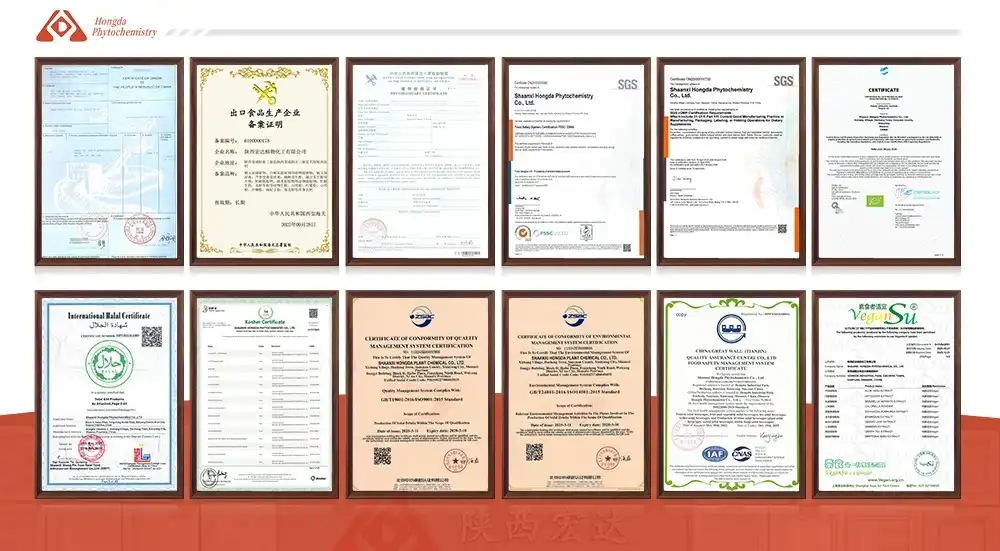
The value of testing procedures is greatest when the same quality comes frequently. Founded in 2001, Shaanxi Hongda covers an area of 20,000 square meters with over 10 manufacturing lines, 100,000-level purification workshops, and more than 150 workshop personnel. It has ISO22000, FSSC22000, halal, kosher, BRC, and US FDA registration certificates, and is adding cGMP in 2025. Hongda provides minimum orders of 1 kilogram for pilot trials, bespoke formulation and packaging options, and often delivers within 1 to 3 days after payment. Tell us your goal dose, dosage form, and relevant documentation, and the technical staff can provide you with a starting specification. Then use the procedures in this article to produce your first sample of liposomal NAD+ powder and let the results drive your future purchase.
Conclusion
Confirming true encapsulation requires a chain of proof for liposomal NAD+ powder. Use carefully controlled techniques such as ultracentrifugation to separate free from encapsulated NAD+ and cross-verify results by ultrafiltration or size-exclusion. Quantification should be done by HPLC, but also supported by TEM images, data on particle size, rehydration testing, and stability trials. Shaanxi Hongda Phytochemistry Co., Ltd. offers its liposomal NAD+ powder with the announced process, encapsulation above 85%, 24-month shelf life, and approved facilities. Buyers are asking for ways, not just statistics, to safeguard their formulae and their trademarks. Request a sample, run the experiment in your own lab, and let the data speak for itself.
FAQ
Q1. How does Hongda measure encapsulation efficiency?
By ultracentrifugation followed by HPLC analysis of the free and encapsulated fractions.
Q2. What is the formula?
(Total NAD+ minus free NAD+) divided by total NAD+, multiplied by 100.
Q3. What encapsulation level is reported?
Above 85% for Hongda's liposomal NAD+ powder.
Q4. Why test after rehydration?
Because NAD+ can leak during drying and rehydration, the finished powder must be checked.
Q5. What are the MOQ and shelf life?
The MOQ is 1 kg, and the shelf life is 24 months, stored cold, dry, and away from direct sunlight.
Request Your Assay Data Pack From HONGDA Today
If you are sourcing liposomal NAD+ powder and want to verify encapsulation for yourself, HONGDA is ready to help. Our team will send a sample with a COA, encapsulation method statement, and TEM and particle size data where available, and can discuss powder or liquid forms and customized packaging. We also quote factory-direct prices with a 1 kilogram minimum order for pilot trials. Tell us your target dose, dosage form, and documentation needs, and we will suggest a practical verification plan from bench test to pilot batch to repeat orders. Write to duke@hongdaherb.com today and let the data speak.
References
1. Covarrubias AJ, Perrone R, Grozio A, Verdin E. NAD+ metabolism and its roles in cellular processes during ageing. Nature Reviews Molecular Cell Biology. 2021;22(2):119–141.
2. Verdin E. NAD+ in aging, metabolism, and neurodegeneration. Science. 2015;350(6265):1208–1213.
3. Barenholz Y. Doxil: the first FDA-approved nano-drug: lessons learned. Journal of Controlled Release. 2012;160(2):117–134.
4. Crowe JH, Crowe LM, Carpenter JF, Aurell Wistrom C. Stabilization of dry phospholipid bilayers and proteins by sugars. Biochemical Journal. 1987;242(1):1–10.
5. Chen C, Han D, Cai C, Tang X. An overview of liposome lyophilization and its future potential. Journal of Controlled Release. 2010;142(3):299–311.
6. Trammell SAJ, Brenner C. Targeted, LCMS-based metabolomics for quantitative measurement of NAD+ metabolites. Computational and Structural Biotechnology Journal. 2013;4:e201301012.