


_1745918362135.webp)

How Is Ferrous Fumarate Powder Used in Functional Foods?
For functional food formulators, there is a long-standing conundrum: Iron is a must, yet most iron compounds either taste metallic, discolour the final product, or just barely survive processing. Hongda Phytochemistry has perfected it for this purpose for over twenty years, and ferrous fumarate powder is one of the few fortificants that bypasses all three. As Shaanxi Hongda Phytochemistry Co., Ltd. continues to serve food and beverage manufacturers around the world, its ferrous fumarate powder excels at being nearly invisible in the finished product, while still delivering iron the body can absorb efficiently, a balance few competing fortificants manage at scale.[1][2]
Why Ferrous Fumarate Powder Works So Well in Fortified Foods?
Low Water Solubility That Protects Taste and Appearance
It is a trade-off for most iron compounds. The more soluble they are in water, the more they react with lipids, proteins, and pigments in a food matrix, leading to rancidity, discolouration, or metallic off-notes during storage. Ferrous fumarate powder virtually eliminates this problem because it is only slightly soluble in water, but readily soluble in dilute acid. Thus, it remains chemically inert in a dry cereal, flour blend, or powdered beverage mix and only becomes bioavailable when it reaches the acidic environment of the stomach. This is exactly the reason why food scientists have preferred ferrous fumarate powder over more reactive salts such as ferrous sulphate for goods with lengthy shelf life.[1][2][4]
High Elemental Iron Content for Efficient Dosing
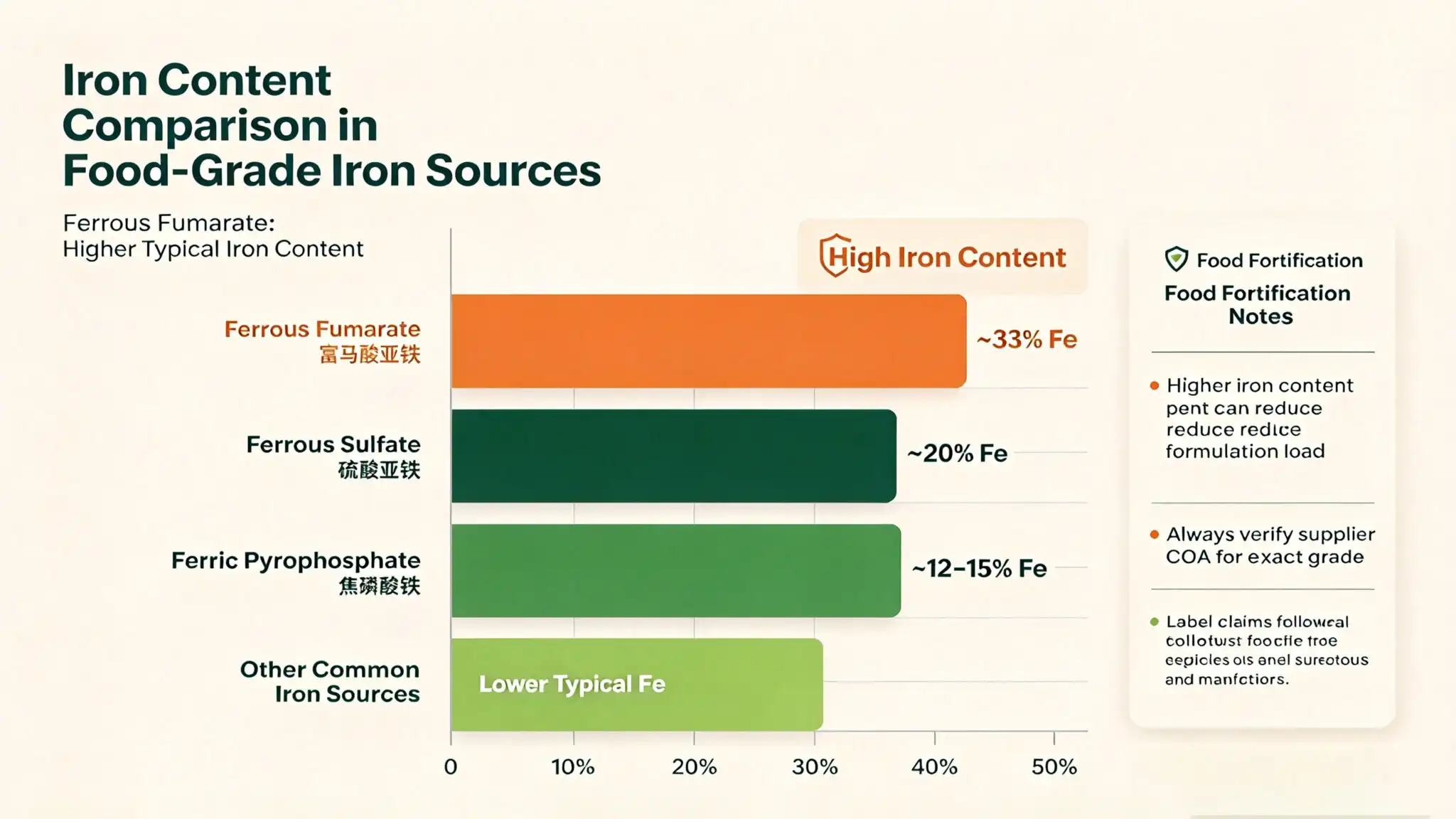
Fortification projects are operating under severe cost and formulation limitations such that the elemental iron yield of the fortificant is as important as its behaviour in the matrix. Hongda's ferrous fumarate powder has around 32.5% to 33% elemental iron by weight, enabling producers to achieve significant fortification levels, often several milligrams per serving, within a tiny percentage of the overall formula weight. That efficiency means ferrous fumarate powder doesn’t take up too much space on a cluttered label with other functional ingredients, whether the base product is a fortified rice cereal, a growing-up milk powder, or a ready-to-mix nutrition beverage.
Absorption Comparable to Ferrous Sulfate Without the Sensory Trade-Off
Food scientists have known for a long time that converting to a milder iron complex usually comes at the cost of bioavailability, although ferrous fumarate powder is one of the exceptions. Ferrous fumarate has been reported to perform comparably to ferrous sulphate in published bioavailability experiments in babies and adults, but with significantly less sensory modification in the final meal, since it dissolves easily once it hits stomach acid. This is the combination that made ferrous fumarate powder the fortificant of choice for goods that must pass taste panels as consistently as they pass a nutritional assay, in a category like baby cereal where regulators and parents look for both good nutrition and good flavour.[1][3][5]
|
Fortificant
|
Elemental Iron
|
Sensory Impact on Food
|
Typical Food Use
|
|---|---|---|---|
|
Ferrous Fumarate
|
~32.5%–33.0%
|
Minimal (water-insoluble)
|
Infant cereal, flour, beverages
|
|
Ferrous Sulfate
|
~20%
|
Noticeable (soluble, reactive)
|
Wet-pack foods, short shelf life
|
|
Ferric Pyrophosphate
|
~24%
|
Minimal but poorly absorbed
|
Cereal, rice fortification
|
|
Electrolytic Iron
|
~97% (elemental)
|
Minimal but low bioavailability
|
Dry cereal, flour premixes
|
Key Functional Food Categories Built on Ferrous Fumarate Powder
Fortified Infant Cereals and Follow-On Foods
The use of ferrous fumarate powder as a food-grade fortificant was pioneered in infant cereal and continues to be the most common use of the component today. Infant cereals are especially susceptible to rancidity and colour change when fortified with soluble iron salts. Therefore, manufacturers have used ferrous fumarate powder specifically to prevent taste and appearance degradation over shelf life while still supporting infants’ higher iron requirements during rapid growth. Hongda's fine-screened grade disperses well in dry cereal bases without the flecking that might result with improperly milled iron powders.
Fortified Wheat Flour, Rice, and Bakery Staples
Both National flour fortification programs and commercial bakery companies use ferrous fumarate powder, often sourced from a reliable ferrous fumarate supplier, to add iron to staple meals without impacting their baking performance or appearance on the market. Ferrous fumarate powder, unlike more reactive iron salts, does not accelerate rancidity in flour during storage or interfere with gluten production during mixing; thus, bread, noodles, and baked items function as bakers anticipate. Its tiny particle size also enables equal dispersion across huge batches of flour, a necessity for all fortificants employed in mandated or voluntary staple-food fortification programs where consistency in every bag is as important as the dosage.
Fortified Beverages, Dairy, and Nutrition Bars
Iron is difficult to formulate in powdered drink mixes, growing-up milks and nutrition bars, since it has to be stable during dry storage and, in certain circumstances, liquid reconstitution. The low water solubility of ferrous fumarate powder prevents early reaction with other minerals, vitamins or flavour components in a beverage premix, therefore minimising off-flavors that may emerge when a more reactive iron salt is sitting in solution. That similar stability preserves texture and shelf colour in nutrition bars and other low-moisture forms, which is why formulators designing fortified snack and beverage lines commonly prefer to ferrous fumarate powder over cheaper but more reactive alternatives.
Need paperwork on particle size, solubility profile, or food grade certifications for a fortification project? Hongda’s technical staff can supply sample kits and certificates of analysis immediately. Contact duke@hongdaherb.com at any time.

Formulation and Processing Considerations for Food-Grade Ferrous Fumarate Powder
Particle Size Control for Even Dispersion in Dry Mixes
Uniformity and fineness of the milling of the fortificant are important for delivering a consistent dosage of iron in each serving of a fortified meal. Hongda screens its ferrous fumarate powder to a regulated particle size range, particularly for food-blend applications, which reduces segregation that may occur with a coarser, denser iron powder settling out during transit or filling. This is of utmost concern in big batch dry-mix manufacturing as even little deviations in particle distribution may lead to servings outside the label claims. Well-screened ferrous fumarate powder provides food makers the batch-to-batch consistency that quality control teams and regulators want from any mandated fortification program.
Stability Through Baking, Extrusion, and Heat Processing
Functional foods are seldom available in their raw powder state, but are baked, extruded, or spray-dried before reaching the store. These operations do not affect the ferrous fumarate powder because the ferrous ions are bound in a fumarate structure that is stable and resistant to decomposition at conventional baking and extrusion temperatures. Ferrous fumarate powder’s heat endurance is one reason it is used in extruded cereal pieces and baked snack bars where more chemically reactive fortificants might break down or cause undesired colour changes under continuous heat. In high-temperature processing lines, formulators report fewer stability concerns when ferrous fumarate powder is substituted for more reactive iron sources.
Combining With Ascorbic Acid to Support Absorption
The absorption of ferrous fumarate powder is dependent upon stomach acid. Formulators typically combine it with ascorbic acid to aid absorption when food is eaten. Published studies on infant feeding have shown that iron bioavailability is enhanced by increasing the ascorbic acid content in combination with ferrous fumarate without the re-emergence of sensory problems associated with more soluble iron salts, as the vitamin C activates only during digestion and not within the dry matrix. This combined technique allows fortified cereals, drinks and bars to bear a significant absorption claim while maintaining the shelf-stable behaviour that made ferrous fumarate powder the fortificant of choice in the first place.[3][5]
|
Grade
|
Particle Profile
|
Best-Fit Food Application
|
|---|---|---|
|
Ultra-Fine Powder
|
<100 mesh, low flecking
|
Infant cereal, growing-up milk powder
|
|
Standard Food Grade
|
Screened, free-flowing
|
Flour fortification, bakery premixes
|
|
Beverage-Ready Grade
|
Fine, low-sediment dispersion
|
Powdered drinks, nutrition bars
|
Meeting Global Food Safety and Quality Requirements
Certifications Required by International Food Brands
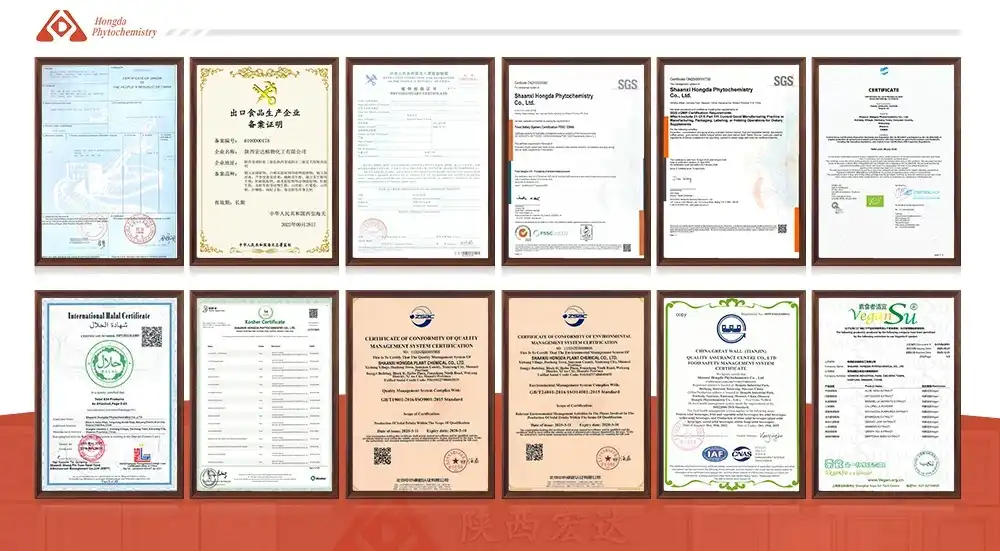
For a food producer procuring an iron fortificant for a regulated market, a good product specification is not enough. They need a paperwork package that will satisfy auditors and regulators before even one shipment leaves port. Shaanxi Hongda Phytochemistry has constructed its certification portfolio with just this in mind, possessing cGMP, FSSC22000, ISO22000, ISO9001, and a food production license in addition to FDA registration, offering food businesses the documentation trail import compliance teams demand. For a corporation buying ferrous fumarate powder through a ferrous fumarate supplement wholesale in China to fortify a nationally distributed cereal or beverage line, this level of certification takes much of the vendor qualification load off their hands that might otherwise hold down a product launch.
Batch Testing for Heavy Metals, Purity, and Microbial Safety
Every batch of ferrous fumarate powder manufactured by Hongda is tested in-house, in an SGS-standardized laboratory, for active ingredient content, heavy metals, moisture, and microbiological contamination, before distribution. This is more critical in food applications than in most other categories since fortified foods are often taken on a regular basis by newborns, children, and other sensitive groups with minimal tolerance for change in purity. Each shipment is accompanied by detailed certificates of analysis that allow food safety teams to verify that the ferrous fumarate powder entering their supply chain matches both internal criteria and the regulatory thresholds of their target market before it even enters manufacturing.
Halal, Kosher, and Organic Compliance for Export Markets
Functional food manufacturers seldom sell into a single area as diet compliance criteria vary dramatically throughout the Middle East, North America, Europe, and Asia. Hongda’s ferrous fumarate powder is certified HALAL and KOSHER and also has EU and NOP organic status; thus, one fortificant supply chain can meet conventional, halal, kosher, and organic product lines without the need for several suppliers for each market. For a food brand with numerous SKUs in different locations, the availability of a ferrous fumarate powder that already meets these certifications makes formulation planning much easier and saves the expense of operating parallel supply chains for the same functional ingredient.
Why Shaanxi Hongda Phytochemistry Is a Trusted Ferrous Fumarate Supplier for Food Manufacturers?
Manufacturing Scale to Support Large-Volume Fortification Programs
A ferrous fumarate provider for national fortification programs and international food brands that can reliably supply volumes without any disruption to manufacturing. Hongda has a plant of 20,000 square meters, with more than ten sophisticated manufacturing lines in purifying workshops of 100,000 levels, so that the firm can produce around 3,000 tonnes of its ingredient portfolio each year. That size allows the firm to have standing inventories of ferrous fumarate powder rather than make-to-order, which is important to food companies operating continuous production lines that cannot afford to be stopped by a raw material shortage during a planned fortification run.
Traceability and In-House Testing From Raw Material to Drum
Increasingly, food safety inspectors want complete traceability and not simply a certificate of finished product. Before leaving the facility, every batch is tested in Hongda’s SGS-standardized laboratory, with more than twenty professor-level researchers and high-performance liquid chromatographs and atomic absorption spectrophotometers. Hongda’s organised six-zone warehouse system segregates and clearly documents inventory. This level of documented traceability minimises the due-diligence cost of certifying a new cross-border raw material source for a regulated food application for first-time food makers sourcing ferrous fumarate supplement wholesale in China.
Wholesale Supply and Custom Grades for Global Food Brands
Not all food manufacturers need the same quality of ferrous fumarate powder, and Hongda’s manufacturing processes are built to handle that difference without delaying delivery times. Buyers may choose ultra-fine grades for baby cereal, normal food-grade powder for fortifying wheat, or beverage-ready dispersions for powdered beverages, all supported by the same certification portfolio and testing requirements. This flexibility, along with a facility constructed for wholesale-volume purchases, is a primary reason global food companies keep coming back to Hongda instead of having to re-qualify a new supplier for each new product line they introduce.
|
Category
|
Detail
|
|---|---|
|
Founded
|
2001
|
|
Facility
|
~20,000 m², 10+ production lines, 100,000-level workshops
|
|
Annual Capacity
|
~3,000 tons
|
|
Warehouse
|
~3,000 m² across six dedicated storage zones
|
|
Certifications
|
cGMP, FSSC22000, ISO22000, ISO9001, HALAL, KOSHER, FDA, Organic (EU & NOP)
|

Conclusion
Ferrous fumarate powder has earned its place in functional foods by solving a problem most iron fortificants cannot: staying sensory-neutral in the finished product while still dissolving efficiently once it reaches the stomach. Hongda Phytochemistry's decades of manufacturing experience, controlled particle engineering, and food-focused certification portfolio give brands a raw material built specifically for cereal, flour, dairy, and beverage fortification. For manufacturers who need reliable iron delivery without compromising taste, appearance, or shelf life, a well-tested ferrous fumarate powder remains one of the most dependable choices on the market today.
FAQ
1. Why is ferrous fumarate powder preferred over ferrous sulfate in fortified foods?
Its low water solubility keeps it sensory-neutral in the food matrix, avoiding the rancidity and discoloration common with more soluble iron salts.
2. Does ferrous fumarate powder affect the taste of fortified cereal or flour?
Minimally. Because it stays largely inert until it reaches gastric acid, it causes far less taste and color change than reactive iron salts.
3. Can ferrous fumarate powder withstand baking or extrusion temperatures?
Yes. Its locked fumarate structure holds up well through typical baking, extrusion, and spray-drying processes used in food manufacturing.
4. What food-grade certifications does Hongda's ferrous fumarate powder hold?
cGMP, FSSC22000, ISO22000, ISO9001, FDA registration, HALAL, KOSHER, and EU/NOP organic certification.
Source HONGDA Ferrous Fumarate Powder for Your Next Fortification Project
If your team is formulating fortified cereal, flour, dairy, or beverage products, Shaanxi Hongda Phytochemistry Co., Ltd. can supply a ferrous fumarate powder built specifically for food-grade performance. Backed by an SGS-standardized in-house laboratory, a certification portfolio spanning cGMP, FSSC22000, HALAL, KOSHER, and organic standards, and a 3,000-ton annual production capacity, HONGDA gives food manufacturers the documentation and supply reliability that cross-border sourcing requires. Whether you need ultra-fine powder for infant cereal or a beverage-ready grade for powdered drinks, our team can send samples, certificates of analysis, and wholesale pricing. Email duke@hongdaherb.com to get started.
References
1. Hurrell, R.F., Furniss, D.E., Burri, J., Whittaker, P., Lynch, S.R., Cook, J.D. "Iron fortification of infant cereals: a proposal for the use of ferrous fumarate or ferrous succinate." American Journal of Clinical Nutrition.
2. Hurrell, R.F. "Preventing iron deficiency through food fortification." Nutrition Reviews.
3. Davidsson, L., Galan, P., Kastenmayer, P., et al. "Iron bioavailability studied in infants: the influence of phytic acid and ascorbic acid in infant formulas based on soy isolate." Pediatric Research.
4. World Health Organization and Food and Agriculture Organization of the United Nations. "Guidelines on Food Fortification with Micronutrients."
5. Hallberg, L., Hulthén, L. "Prediction of dietary iron absorption: an algorithm for calculating absorption and bioavailability of dietary iron." American Journal of Clinical Nutrition.