


_1745918362135.webp)

Why Are Cosmetic Manufacturers Choosing Pure Ferulic Acid Powder for UV Protection?
With the increasing need for plant-derived cosmetic actives that may enhance antioxidant and photoprotective formulations, ferulic acid has continued to garner interest from skincare makers. Hongda Phytochemistry, managed by Shaanxi Hongda Phytochemistry Co., Ltd., provides ferulic acid constituents for formulation development where purity, batch consistency, documentation, and processing performance are critical. While ferulic acid is not a replacement for an authorized UV filter, its antioxidant capabilities make it a valuable supportive ingredient in sunscreen, everyday environmental protection, and brightening and anti-aging formulas. The value of a high-quality ferulic acid extract for manufacturers is not only the plant origin but also the consistency of the raw material in a final cosmetic system.
Why Ferulic Acid Has a Place in Modern UV-Focused Skincare?
Ferulic acid is a naturally occurring phenolic chemical that occurs in a number of plant materials such as rice bran and other cereal-derived sources. Its molecular composition offers it antioxidant capabilities that have made it especially intriguing in formulations aimed to counteract oxidative stress. UV radiation may also contribute to the creation of reactive oxygen species, although oxygen, heat, light, and environmental contaminants can also accelerate oxidation in a cosmetic composition. Such problems explain why formulators typically go beyond UV filters alone when considering the formulation of products meant for everyday photoprotection.
The key difference is that ferulic acid should not be referred to as a traditional sunscreen active. It does not replace UV filters with a defined level of SPF or UVA protection. It may instead have a complementary function in a larger antioxidant system. This difference is especially essential for cosmetic makers since the performance of a completed sunscreen relies on the whole formulation, including the specified UV filters, concentrations, dispersion, film formation, packaging, and necessary regulatory requirements.
So the producers that use ferulic acid are usually looking at it as part of a formulation strategy, not as a single ingredient answer. The aim is to provide a system where UV filters are the main optical protection and antioxidants are used to assist with oxidative difficulties due to light exposure and formulation aging.
How Antioxidant Activity Supports Photoprotective Formulations?
The importance of ferulic acid is that it may be involved in antioxidant defence mechanisms. UV radiation and other environmental factors may initiate oxidative processes that might influence the skin environment and sensitive ingredients in a cosmetic product. Thus, an antioxidant may be utilised in a carefully designed solution to provide an additional level of support to the primary photoprotective actives.
One explanation is that ferulic acid is typically found in formulations with several antioxidant chemicals. Instead of aiming for one molecule to accomplish everything, formulators may set numerous ingredients to work against each other. UV filters protect against incoming radiation, and antioxidants may assist to control oxidative processes. Then humectants, emollients, barrier-supporting chemicals and other actives may be used to address hydration, textural or skin-conditioning requirements.
For manufacturers, this implies flexibility. The well-designed antioxidant system is integrated into serums, creams, lotions, emulsions and other leave-on products without impacting the critical positioning of the formulation. The real advantage is in the end combination, not the presence of ferulic acid alone. The final performance is influenced by concentration, pH, choice of solvent, temperature of processing, packing and interactions with other ingredients.
Why Vitamin C and Vitamin E Are Common Formulation Partners?
Ferulic acid is one of the most renowned substances to utilise with vitamins C and E, respectively. The combination is well known in antioxidant skin care since the three ingredients may function in a complementary manner if designed properly. Yet it is not enough that the manufacturers just combine the three basic materials in a mixing tank to reproduce the functioning of such a system.
Ferulic Acid and Vitamin C Require Careful Formulation Control
Vitamin C (especially pure ascorbic acid) is sensitive to oxidation and formulation conditions. Ferulic acid is usually included in antioxidant systems such as vitamin C. The aim is not to prevent all the degradation of vitamin C by ferulic acid but to create a formulation environment where the antioxidant components may interact in a controlled way.
This is a function of the complete formulation. pH, water content, solvent system, exposure to oxygen, metal ions, manufacturing conditions and packaging may impact the behaviour of oxidation-sensitive chemicals such as ferulic acid extract. A raw material supplier may provide a consistent platform, but the finished product manufacturer must confirm compatibility and stability in the final formulation.
Vitamin E Adds a Different Antioxidant Role
Vitamin E is often added to goods with oil-soluble constituents and may give antioxidant protection in the lipid phase. So when ferulic acid, vitamin C and vitamin E are mixed, the blend may target oxidative processes all throughout the system.
This combination is particularly important for manufacturers of premium antioxidant serums and daily environmental protection products. However, these compounds do not necessarily provide any degree of photoprotection or shelf stability. Features need to be demonstrated by appropriate product development and finished product testing.

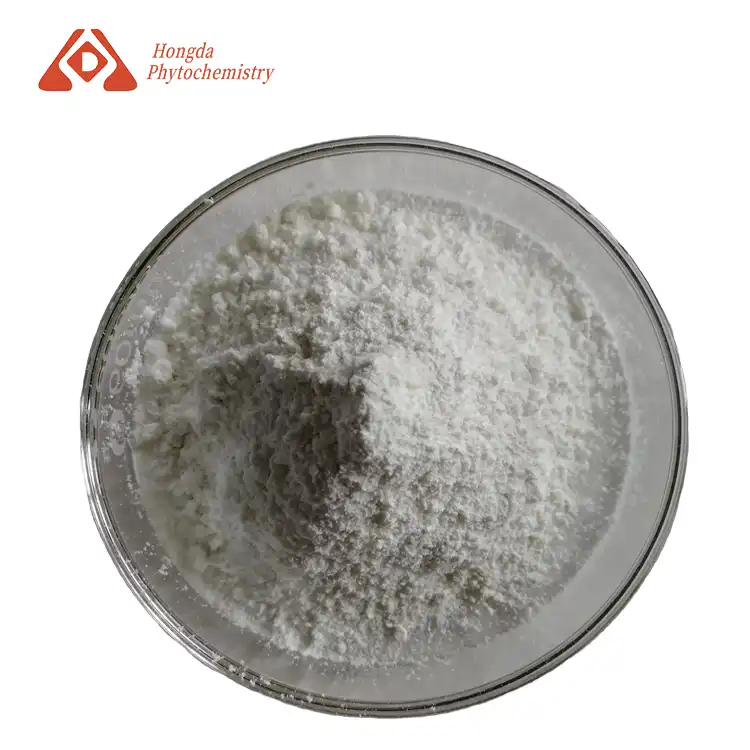
What Pure Ferulic Acid Powder Offers Cosmetic Manufacturers?
The raw-material control may be simplified for a producer selecting a purified powder in preference to an inconsistently described botanical material. The difference matters because "ferulic acid" and a generic plant extract are not always interchangeable from a formulation or buying point of view. A plant extract may be a combination of naturally occurring substances, while a purified ferulic acid ingredient is chosen for a specified chemical identity and more regulated composition.
This is especially the case if the formulation has been designed around a certain active concentration. If the raw material is not consistent from one batch to the next, the producer may need to make adjustments during manufacturing or do further testing to ensure consistency. Well-defined powder is a more predictable starting material in formulation and quality control.
Therefore, purity has to be defined according to the analytical technique and specification of the supplier. Instead of vague marketing claims such as "ultra pure" or "pharmaceutical grade," buying teams should analyze the actual assay need, test technique, batch paperwork, appearance, storage conditions, and pertinent impurity criteria. In the end, the right specification is a function of the intended application and target market.
Formulation Variables That Can Affect Ferulic Acid Performance
The selection of raw material is merely the first step in the development process. Especially if the company is formulating inside a complicated serum, cream, or sunscreen system, the formulation properties of ferulic acid should be evaluated prior to commercial manufacturing.
Solubility Should Be Considered Before Scale-Up
The solubility of ferulic acid might be a practical concern in the incorporation into a completed product. Solvent or carrier used, concentration needed, temperature, sequence of mixing, and presence of additional components may impact dissolution and uniform distribution.
What works well as a formulation on a small lab scale may not behave the same when it is scaled up. Physical behavior of the system may be changed by mixing efficiency, addition order, shear, temperature control, and holding duration. Instead of thinking that the laboratory approach may be easily transferred to a bigger production vessel, manufacturers should consequently ensure that an adequate integration process is established throughout development.
pH and Antioxidant Compatibility Need to Be Evaluated Together
There is no one pH value that is inherently suitable for all ferulic acid formulations. Instead, the target pH should be selected based on the whole system. This is particularly significant when ferulic acid is mixed with vitamin C, plant extracts, preservatives, or other pH-sensitive compounds.
A producer may need to balance active stability against skin compatibility, preservative efficacy, emulsion stability, and the formulation requirements of ferulic acid extract. Therefore, pH correction should be seen as a part of the formulation optimization rather than as an independent technical procedure.
Processing and Packaging Influence Long-Term Quality
Oxidation-sensitive cosmetic chemicals are affected by heat, oxygen, and light. It is consequently possible to add ferulic acid at processing settings adapted to the formulation and controlled, rather than subjecting it to needlessly high temperatures for a lengthy time. The precise stage for addition will need to be determined during development trials since various production systems would need different techniques.
Packaging is just as crucial. Repeatedly opening and closing a clear container of antioxidant serum exposes it to a different environment than the same formula in an opaque or air-limiting device. Therefore, in considering finished-product stability, manufacturers contemplating ferulic acid should examine the raw material and packaging as a whole.
How Manufacturers Should Evaluate Ferulic Acid Quality?
B2B purchasers should look for proof, not marketing rhetoric, from a supplier when assessing raw-material quality. A certificate of analysis may provide batch-specific information about the given material. Technical documentation can assist formulators in the understanding of the handling, storage, and application requirements.
The analytical package should be appropriate for the product specification and the expected use. Depending on the provider and the market, purchasers may look at assay or purity data, identification tests, moisture or loss-on-drying information, relevant impurity limits, microbiological requirements where applicable, and heavy-metal parameters. The testing program should be agreed upon depending on the material and on the regulatory requirements of the client.
Traceability is also vital. If a producer is buying a cosmetic active for ongoing commercial use, they will want to know if the provider can keep to similar criteria in future batches. One good laboratory sample does not constitute a long-term supply dependability. Batch records, quality controls, production consistency, and communication during specification revision might be as critical as the first test result.

Documentation Matters as Much as Raw-Material Purity
Cosmetic manufacturers increasingly need technical documentation that supports internal quality systems and regulatory submissions. For ferulic acid procurement, documentation may include a COA, MSDS or SDS, product specification, storage information, packaging details, and other technical records relevant to the target market.
Shaanxi Hongda Phytochemistry Co., Ltd. can support customers with technical information used during raw-material qualification and formulation development. For international buyers, the value of this documentation is practical: it allows procurement, quality, regulatory, and formulation teams to evaluate the same material from different perspectives.
Manufacturers should also avoid assuming that one certification automatically proves suitability for every cosmetic market. ISO, GMP-related systems, organic certifications, and other quality credentials may demonstrate aspects of manufacturing control, but the regulatory requirements for a finished cosmetic product vary by jurisdiction. The raw-material supplier's documentation should therefore be considered one part of the broader compliance process.
Why Batch-to-Batch Consistency Matters in Commercial Production?
A cosmetic formula can be technically successful in the laboratory and still become difficult to manage commercially if the raw materials fluctuate significantly. Changes in purity, physical characteristics, moisture, or other specification parameters may affect processing behavior or finished-product performance.
For this reason, manufacturers purchasing ferulic acid extract should look beyond the price per kilogram. A lower purchase price may have little commercial value if inconsistent material leads to additional testing, formulation adjustments, production delays, or rejected batches. Consistency is particularly important for brands that intend to keep the same formula in production for several years.
Long-term suppliers should also be able to communicate clearly about production capacity, lead times, packaging formats, storage recommendations, and specification changes. These details may appear secondary during initial sourcing, but they become significant once the ingredient moves from laboratory development into regular commercial production.
Where Ferulic Acid Fits in Today's Skincare Product Development?
Ferulic acid has applications across several categories where antioxidant positioning and environmental protection are relevant. It can be found in antioxidant serums, anti-aging products, brightening formulations, daily skincare products, and systems developed around vitamin C and vitamin E.
Its role can vary considerably from one formula to another. In a vitamin C serum, the focus may be antioxidant synergy and formulation stability. In an anti-aging cream, it may form part of a broader antioxidant strategy. In a sunscreen-related product, it can serve as a supporting antioxidant rather than replacing the UV filters responsible for the product's declared protection.
This versatility is one reason cosmetic manufacturers continue to consider purified ferulic acid powder when developing multifunctional skincare products. Consumers increasingly expect products to address several concerns at once, while manufacturers need ingredients that can fit into sophisticated formulations without creating unnecessary complexity.
Choosing a Ferulic Acid Supplier for Long-Term Production
Supplier selection should begin with the manufacturer's actual formulation and regulatory requirements. A company developing a premium antioxidant serum may prioritize purity, solubility, analytical documentation, and consistent supply, while another manufacturer may place greater emphasis on packaging, delivery schedules, or certification requirements for a specific market.
For international B2B customers, communication is another important consideration. Technical questions about assay methods, storage, packaging, batch specifications, or formulation handling should receive clear answers supported by appropriate documentation. A supplier that can communicate effectively with procurement and technical teams is easier to qualify than one that relies mainly on generic product claims.
Hongda Phytochemistry provides ferulic acid ingredients for customers seeking a controlled raw-material source for cosmetic formulation. By combining product specifications with batch documentation and supply support, Shaanxi Hongda Phytochemistry Co., Ltd. can help manufacturers evaluate the ingredient before moving from laboratory trials toward regular production. The final qualification, however, should always be based on the customer's own specifications, testing procedures, formulation requirements, and applicable regulations.
Conclusion
Ferulic acid extract is valuable in cosmetic formulations not because it replaces conventional UV filters, but because its antioxidant properties can complement broader photoprotective and anti-aging strategies. When combined with ingredients such as vitamins C and E, it can become part of a carefully designed antioxidant system in which each component has a defined role.
For cosmetic manufacturers, the decision to purchase purified ferulic acid powder should therefore involve more than checking a headline purity figure. Solubility, pH compatibility, processing conditions, packaging, batch consistency, analytical documentation, traceability, and long-term supply capability all influence whether an ingredient is suitable for commercial production. A reliable ferulic acid extract supplier should be able to provide clear specifications and batch-level documentation while maintaining consistent quality as demand increases.
For brands and manufacturers developing antioxidant serums, anti-aging products, and UV-focused skincare systems, Shaanxi Hongda Phytochemistry Co., Ltd. offers ferulic acid as a controlled cosmetic raw material supported by technical and supply information for B2B evaluation. The most effective way to assess suitability is to match the material specification with the intended formulation, conduct appropriate compatibility and stability testing, and confirm that the finished product meets the requirements of its target market.
Contact our expert team at duke@hongdaherb.com to discuss custom solutions, request technical specifications, or secure exclusive supply agreements that support your product innovation goals.
References
1. Lin, F.H., Lin, J.Y., Gupta, R.D., Tournas, J.A., Burch, J.A., Selim, M.A., Monteiro-Riviere, N.A., Grichnik, J.M., Zielinski, J., and Pinnell, S.R. Ferulic Acid Stabilizes a Solution of Vitamins C and E and Doubles Its Photoprotection of Skin. The Journal of Investigative Dermatology.
2. Saija, A., Tomaino, A., Trombetta, D., De Pasquale, A., Uccella, N., Barbuzzi, T., Paolino, D., and Bonina, F. In Vitro and In Vivo Evaluation of Caffeic and Ferulic Acids as Topical Photoprotective Agents. International Journal of Pharmaceutics.
3. Graf, E. Antioxidant Potential of Ferulic Acid. Free Radical Biology and Medicine.
4. Mancuso, C. and Santangelo, R. Ferulic Acid: Pharmacological and Toxicological Aspects. Food and Chemical Toxicology.