




Can griffonia simplicifolia seed extract interact with antidepressant prescription medications?
Nutraceutical R&D directors, medical affairs teams, and regulatory compliance officials developing mood and sleep supplements need to know whether or not griffonia simplicifolia seed extract may interact with antidepressant prescription medicines. L-5-Hydroxytryptophan (5-HTP, CAS 56-69-9), the principal bioactive compound in this botanical, is the direct metabolic precursor to serotonin; thus, its concomitant administration with prescription selective serotonin reuptake inhibitors (SSRIs) or monoamine oxidase inhibitors (MAOIs) leads to overlapping serotonergic activity that necessitates clear cautionary product labeling.[1][2][3] Hongda Phytochemistry ( the specialized extraction division of Shaanxi Hongda Phytochemistry Co., ltd ) produces pharmaceutical-grade, Peak-X-free griffonia simplicifolia seed extract ( standardized from 20% to 99% L-5-HTP) within class-100,000 purification workshops, providing ultra-low trace metal pro-oxidants, superior anti-discoloration stability, and full pharmacopeial traceability.
Neurochemical Pharmacokinetics: Why 5-HTP Interacts with Prescription Antidepressants?
Blood-Brain Barrier Transport and Aromatic L-Amino Acid Decarboxylase Kinetics
Unlike dietary L-tryptophan, L-5-HTP from griffonia simplicifolia readily crosses the blood-brain barrier via passive diffusion and active transport, circumventing the need for the rate-limiting enzyme tryptophan hydroxylase or aggressive competition with branched-chain amino acids for entry into the central nervous system. The vitamin B6-dependent enzyme aromatic L-amino acid decarboxylase (AAAD) quickly converts 5-HTP directly to 5-hydroxytryptamine (serotonin) in central serotonergic neurons without physiological feedback inhibition.[1][2]
In dietary supplement brands, high-purity griffonia simplicifolia seed extract is used to ensure predictable clinical efficacy for sleep architecture and emotional equilibrium through unrestricted enzymatic conversion, but it also explains why pharmacokinetic clearance must be carefully modeled during product development.
Pharmacodynamic Overlap with SSRIs, SNRIs, and MAOIs in Clinical Labeling
Prescription antidepressants increase synaptic neurotransmitter levels by blocking presynaptic serotonin reuptake transporters (SSRIs and SNRIs), or by inhibiting the mitochondrial monoamine oxidase enzymes that break down serotonin (MAOIs). A consumer using these prescription pharmaceuticals in combination with a supplement containing griffonia simplicifolia seed extract may have unregulated precursor synthesis colliding with limited synaptic clearance, which may lead to excessive serotonergic buildup..[2][3]
Regulatory affairs teams registering products in North America and the European Union need to understand this dual pharmacodynamic mechanism to successfully draft compliant DSHEA and EFSA label warnings and design daytime or nighttime nutraceutical stacks for strictly non-medicated consumer populations.
Cofactor Complexation and Pro-Oxidant Metal Chelation Rate Testing
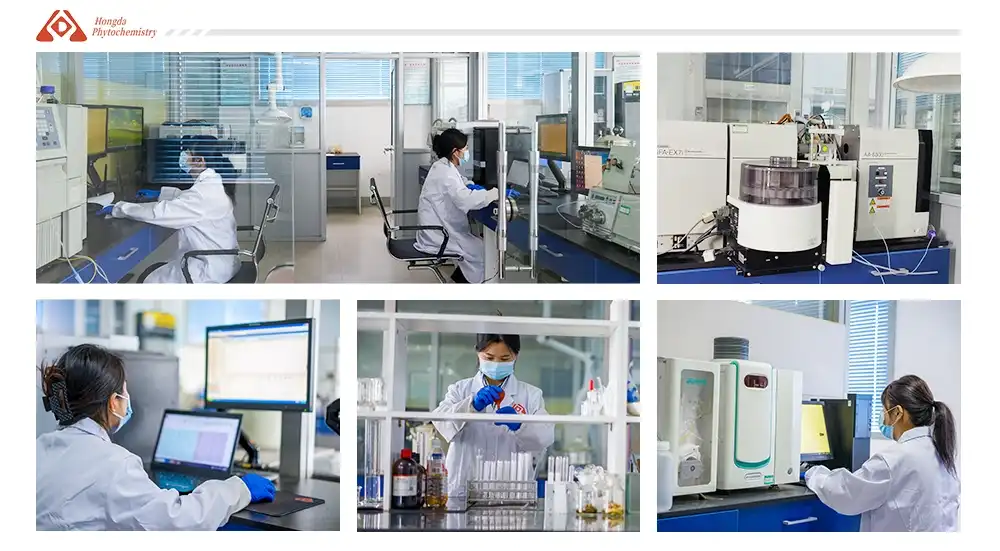
Optimization of the enzymatic cofactor compatibility and elimination of trace metals during the upstream purification are essential for a stable serotonergic supplement formulation. In our university-associated SGS-standardized laboratory, over twenty professor-level analysts audit two vital chelation measures in our griffonia simplicifolia seed extract using atomic absorption spectrophotometry (AAS) and UV-Vis spectroscopy, a level of scrutiny that sets a new benchmark in the griffonia seed extract market.
Secondly, specialist chelating ion-exchange resins have a ≥99.4%≥99.4% chelation and removal rate of free ferric (Fe3+Fe3+) and cupric (Cu2+Cu2+) ions in the mother liquid, therefore inhibiting metal-catalyzed indole oxidation. Secondly, R&D compatibility testing guarantees perfect molecular compatibility with chelated magnesium bisglycinate and pyridoxal-5'-phosphate (active Vitamin B6) to optimize in vivo decarboxylase efficiency.
|
Analytical & Pharmacokinetic Parameter
|
Testing Instrumentation / Method
|
Hongda 99% Grade Specification
|
Industry Standard Grade
|
|---|---|---|---|
|
L-5-HTP Assay (Anhydrous Basis)
|
Reversed-Phase HPLC (UV 275 nm275 nm)
|
≥99.0%≥99.0% (20%−99%20%−99% Available)
|
95.0%−98.0%95.0%−98.0%
|
|
Specific Optical Rotation (Chiral)
|
Digital Polarimeter (20∘C20∘C, H2OH2O)
|
−31.0∘ to −33.0∘−31.0∘ to −33.0∘ (Pure L-Isomer)
|
−28.0∘ to −34.0∘−28.0∘ to −34.0∘
|
|
Melting Point Range
|
Capillary Melting Point Meter
|
270.0∘C−272.0∘C270.0∘C−272.0∘C
|
265.0∘C−273.0∘C265.0∘C−273.0∘C
|
|
Pro-Oxidant Fe3+/Cu2+Fe3+/Cu2+ Chelation Removal
|
Resin Dialysis + AAS
|
≥99.4%≥99.4% Stripped (<2.0 ppm<2.0 ppm Fe)
|
Uncontrolled (15−40 ppm15−40 ppm Fe)
|
|
Peak X / Peak E Indole Impurities
|
LC-MS/MS Trace Screening
|
Not Detected (<0.01%<0.01%)
|
<0.10%<0.10%
|
|
Free L-Tryptophan Residue
|
Gradient HPLC-DAD
|
≤0.20%≤0.20%
|
≤1.50%≤1.50%
|
Upstream Botanical Sourcing and Defending Against AdulterationWest African Pod Maturity and Seasonal Harvesting Protocols
The date of wild collection in coastal West Africa (mostly Ghana and Côte d'Ivoire) has a strong influence on the phytochemical yield and impurity profile of the raw botanical material. As global procurement managers consider griffonia simplicifolia seeds for sale, a typical supply chain failure is collecting immature green pods during the rainy season or storing moist seeds in burlap bags without ventilation. The immature seeds contain <6% native 5-HTP and substantial quantities of reactive phenolic tannins and fungal mycotoxins. Shaanxi Hongda implements stringent agronomic auditing in our griffonia simplicifolia seed extract manufacturing lines, selecting only sun-matured obliquely oblong black pods picked between December and February, yielding 12% to 16% natural L-5-HTP.
Polarimetric and Chiral HPLC Defense Against Synthetic DL-5-HTP Spiking
The upsurge in raw material demand throughout the worldwide griffonia seed extract industry has heightened the temptation for unscrupulous brokers to adulterate low-strength botanical extracts with synthetic racemic DL-5-HTP, fermentative L-tryptophan, or maltodextrin fillers. Synthetic D-5-HTP is physiologically inactive for human serotonin production and introduces unapproved synthetic intermediates that breach natural product rules in the US and Europe. We guarantee 100% botanical authenticity of our griffonia simplicifolia seed extract by chiral HPLC separation of each batch, together with digital polarimetry confirming a specific optical rotation of −31.0°−33.0°, and capillary melting point verification (270°C−272°C), removing any chance of adulteration with the synthetic enantiomer.[4][5]
Ultra-Trace LC-MS/MS Screening to Guarantee Zero Peak X Impurities
In the past, the US FDA strictly regulated tryptophan-pathway supplements because of their low purity and the presence of trace levels of poisonous indole contaminants. These toxins, named "Peak X" (4,5-tryptophan-dione) and "Peak E" (1,1'-ethylidenebis-L-tryptophan), were associated with eosinophilia-myalgia syndrome (EMS). These trace structural analogs cannot be removed by conventional single-step water extraction. In our SGS-standardized laboratory, quality control chemists audit each commercial lot of griffonia simplicifolia seed extract by tandem liquid chromatography-mass spectrometry (LC-MS/MS) and multi-wavelength diode-array detectors. Multi-stage chromatography with macroporous resin and activated carbon filtration guarantees non-detectable levels of Peak X and Peak E (< 0.01% and < 0.01%) and pharmaceutical-level toxicological safety.
Solving R&D Formulation Pain Points: Discoloration, Caking, and CompatibilityPreventing Indole Ring Oxidation and Pink-Brown Powder Discoloration
One of the most aggravating stability problems that contract makers of regular griffonia simplicifolia powder experience is color deterioration. Off-white tablets or clear HPMC capsules may become ugly shades of pink, gray, or dark brown within ninety days after bottling. This color change is attributed to oxidation of the electron-rich 5-hydroxyindole ring to colorful quinone-imine polymers, which is enhanced by residual ferric ions, alkaline excipients, and ambient UV radiation. Our 99% griffonia simplicifolia seed extract has a CIE L∗L∗ whiteness index > 92.092.0 that resists oxidative browning in 36-month stability trials by stripping trace iron < 2.0 ppm2.0 ppm via chelating resins and oxygen-free vacuum recrystallization in class-100,000 cleanrooms.
Anti-Hygroscopic Crystallization to Eliminate Drum Caking and Hopper Bridging
Lower-assay extracts (20% to 50% grades) include hydrophilic seed polysaccharides and plant mucilage that readily absorb ambient moisture and lead to rock-hard caking inside storage drums and significant powder bridging in high-speed rotary tablet presses. Our workshop professionals use precision fluidized-bed vacuum drying, continually monitored by Karl Fischer automated titrators to prevent moisture-induced agglomeration and preserve indole stability. We push total moisture in our griffonia simplicifolia powder to <1.5% (for 98%–99% crystalline grades) and keep free water activity (aw) under 0.25. If your R&D team is struggling with capsule spotting, caking, or assay inconsistency, reach out to our technical director at duke@hongdaherb.com for anti-discoloration samples and stability dossiers.
Multi-Ingredient Compatibility in Nootropic, Sleep, and Mood Premixes
Today you will seldom see 5-HTP alone in neuro-wellness formulas. Formulators will include it with L-theanine, gamma-aminobutyric acid (GABA), saffron extract, melatonin, and alkaline mineral salts. However, direct mixing of unbuffered 5-HTP with high pH magnesium oxide or reducing sugars induces Maillard browning and increases phenolic oxidation inside multi-ingredient capsules. Our two R&D facilities recently reformulated a leading European sleep-aid product experiencing pink capsule spotting with a custom-granulated 80-mesh griffonia simplicifolia seed extract with a micro-crystalline surface morphology and neutral pH profile (6.0−6.86.0−6.8) that eliminated excipient cross-reactions and improved blend content uniformity to ≥99.1%≥99.1%.
|
Solid-State & Formulation Metric
|
Test Protocol / Instrumentation
|
Hongda 98%–99% Crystalline Grade
|
Standard 20%–50% Spray-Dried Grade
|
|---|---|---|---|
|
Appearance & Whiteness (L∗L∗)
|
HunterLab Colorimeter
|
White Fine Crystalline Powder (L∗≥92L∗≥92)
|
Off-White to Light Brown (L∗70−80L∗70−80)
|
|
Loss on Drying / Water Activity
|
Karl Fischer (USP <921>) / Hygrometer
|
≤1.50%≤1.50% Moisture / aw≤0.25aw≤0.25
|
≤5.00%≤5.00% Moisture / aw≤0.40aw≤0.40
|
|
Accelerated Color Stability
|
40∘C/75% RH40∘C/75% RH (180 Days180 Days)
|
ΔE<1.2ΔE<1.2 (No Pink/Brown Shift)
|
ΔE>4.5ΔE>4.5 (Prone to Browning)
|
|
Tapped Bulk Density
|
USP <616> Method I
|
0.48−0.58 g/mL0.48−0.58 g/mL (Direct Encapsulation)
|
0.35−0.45 g/mL0.35−0.45 g/mL
|
|
Residue on Ignition (Sulfated Ash)
|
Gravimetric (USP <281>)
|
≤0.20%≤0.20%
|
≤2.50%≤2.50%
|
|
Heavy Metals (Pb / As / Cd / Hg)
|
Atomic Absorption (AAS / ICP-MS)
|
Pb<0.2 ppmPb<0.2 ppm; As<0.2 ppmAs<0.2 ppm
|
Pb<1.0 ppmPb<1.0 ppm; As<1.0 ppmAs<1.0 ppm
|
Cleanroom Extraction Scale-Up, Batch QC, and US/EU Regulatory DossiersMembrane Resin Purification and Class-100,000 Cleanroom Crystallization
Scaling botanical extraction from pilot lab glassware to multi-ton commercial quantities without heat scorching or solvent contamination needs significant chemical engineering. Shaanxi Hongda covers an area of 20,000 square meters, with more than 10 contemporary manufacturing lines and 150 qualified workshop experts, and an annual production capacity of 3,000 tons.
Starting from certified griffonia simplicifolia seeds for sale through to finished extract, our griffonia simplicifolia seed extract is produced in class-100,000 purifying facilities with closed-loop pure water and food-grade ethanol membrane ultrafiltration and sub-ambient crystallization. Headspace gas chromatography (GC) and biochemical/chemical oxygen demand (BOD/COD) water audits demonstrate zero harmful organic solvent residues, resulting in a clean-label ingredient suited for worldwide commercialization.
Turnkey 2025 cGMP, FSSC22000, and EU/NOP Organic Compliance Packages
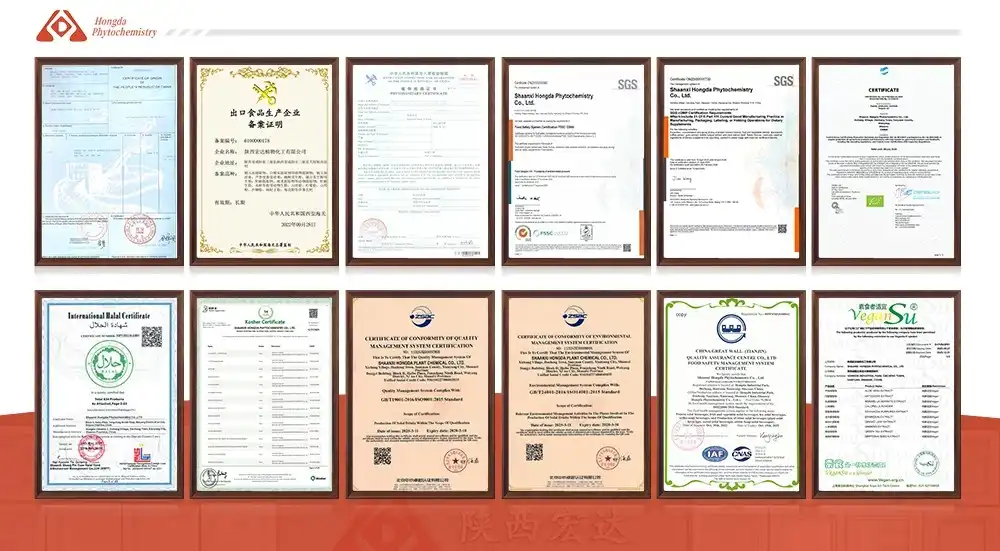
Navigating regulatory inspections and customs clearance in the US and EU requires transparent, third-party-verified paperwork. Shaanxi Hongda was founded in 2001 as a National High-Tech Development Enterprise and has obtained certifications including cGMP, FSSC22000, ISO22000, ISO9001, SC, BRC, FDA registration, Halal, Kosher, dual ORGANIC (EU) and ORGANIC (NOP) certifications, as well as numerous national patent technologies by 2025. Commercial shipments of griffonia simplicifolia seed extract are supported by a full regulatory dossier including batch-specific Certificates of Analysis, Peak-X-free LC-MS/MS spectra, chiral polarimetry logs, 500+ pesticide GC-MS/MS clearance reports, and aflatoxin immunity certificates.
Six-Zone Sterilized Warehousing and 3,000-Ton Supply Continuity
In West Africa, the seed harvest occurs once a year, meaning that supplement companies can face shortages of raw material halfway through the year or are forced to utilize damaged stock if their supplier has the capacity for climate-controlled storage. Our 3,000 m2 GMP warehouse is systematically divided into six special areas (A-F) and is managed by ozone-sterilization personnel. Areas A and B are dedicated to the powder storage of fruits and vegetables, Area C and D are for natural plant extracts, Area E is for vitamins and amino acids, and Area F is for the preservation of archival reference samples. We have griffonia simplicifolia seed extract all year round, and ship it quickly and on schedule by air and water worldwide, sealed in light-blocking, nitrogen-flushed aluminum-foil barrels.
Conclusion
In the presence of controlled Peak X impurities, trace iron oxidation, and powder discolouration, it is crucial to evaluate the interaction of griffonia simplicifolia seed extract with prescription antidepressants for the development of safe, shelf-stable neuro-nutraceuticals. Shaanxi Hongda Phytochemistry Co., Ltd. is a National High-Tech Development Enterprise established in 2001. The company has a 20,000-square-meter campus, with 10 production lines of modern technology, Class 100,000 purification workshops, 3,000 tons of annual output, and 3,000-square-meter, six zones of sterilized warehouse. We have three traceable planting bases, two R&D institutes, an SGS-standardized laboratory staffed by over twenty professor-level researchers, and 2025 certifications such as cGMP, FSSC22000, ISO22000, BRC, FDA, Halal, Kosher, and EU/NOP Organic, guaranteeing unsurpassed botanical purity. Reach out to our staff now for free COAs on Peak-X and free R&D samples.
FAQQ1: Why should supplements containing Griffonia seed extract carry antidepressant interaction warnings?
A: The main ingredient in this supplement, L-5-HTP, is converted directly to serotonin in the body by AAAD enzymes. If a person takes this supplement with prescription SSRIs, SNRIs or MAOIs, it might cause too much serotonin to build up in the synapses.
Q2: How do you prevent your 5-HTP powder from turning pink or brown in capsules?
A: We remove pro-oxidant ferric ions to <2.0 ppm2.0 ppm (≥99.4%≥99.4% chelation removal) and vacuum-crystallize the powder to ≤1.5%≤1.5% moisture (aw≤0.25aw≤0.25) in nitrogen-flushed aluminum drums.
Q3: How do you verify your extract is 100% natural L-5-HTP and free from synthetic DL-5-HTP?
A: Every batch undergoes chiral HPLC and digital polarimetry (−31.0∘ to −33.0∘−31.0∘ to −33.0∘) alongside capillary melting point testing (270∘C−272∘C270∘C−272∘C) in our SGS-standardized laboratory.
Q4: Do you test for Peak X and Peak E contaminants?
A: Yes, we run ultra-trace LC-MS/MS and HPLC-DAD screening on every lot to guarantee non-detectable Peak X and Peak E indole impurities (<0.01%<0.01%).
Q5: What compliance documents accompany bulk orders for US and EU customs?
A: We provide batch COAs, Peak-X clearance reports, raw HPLC/GC chromatograms, 500+ pesticide screens, and 2025 cGMP, FSSC22000, BRC, FDA, Halal, and Kosher certificates.
Secure Pure, Discoloration-Resistant 5-HTP from HONGDA Today
Shaanxi Hongda Phytochemistry Co., Ltd. is dedicated to providing worldwide dietary supplement and pharmaceutical brands with transparent, lab-tested botanical extracts — including griffonia simplicifolia seed extract — on the basis of our fundamental corporate concept of "natural, green, healthy, and serving customers". Our 3 agronomy-supervised planting bases, 2 university-partnered R&D institutions, 150+ workshop technicians, and our newly expanded 2025 portfolio of cGMP, FSSC22000, ISO22000, ISO9001, BRC, FDA, Halal, Kosher, and ORGANIC (EU/NOP) certifications can eliminate your powder discoloration, caking, and regulatory compliance bottlenecks. Be it 99% crystalline L-5-HTP, custom-granulated premix grades, or ready for shipment from our 3,000-square-meter, six-zone sterile warehouse, our staff is your turnkey dependability. Email our senior export director today at duke@hongdaherb.com for wholesale pricing, LC-MS/MS dossiers, and free formulation samples.
References
1. Birdsall, T. C. (1998). 5-Hydroxytryptophan: a clinically effective serotonin precursor. Alternative Medicine Review, 3(4), 271-280.
2. Turner, E. H., Loftis, J. M., & Blackwell, A. D. (2006). Serotonin a la carte: supplementation with the serotonin precursor 5-hydroxytryptophan. Pharmacology & Therapeutics, 109(3), 325-338.
3. Boyer, E. W., & Shannon, M. (2005). The serotonin syndrome. New England Journal of Medicine, 352(11), 1112-1120.
4. Vigliante, I., Mannino, G., & Maffei, M. E. (2019). Chemical characterization and DNA fingerprinting of Griffonia simplicifolia Baill. Molecules, 24(6), 1032.
5. Lemaire, P. A., & Adosraku, R. K. (2002). An HPLC method for the direct assay of the serotonin precursor, 5-hydroxytryptophan, in seeds of Griffonia simplicifolia. Phytochemical Analysis, 13(6), 333-337.