


_1745918362135.webp)

How Does Liposomal Silymarin Powder Perform in Functional Drinks?
When it comes to liver-health claims, functional beverage formulators have a unique challenge: the majority of botanical actives either dissolve poorly, cloud the liquid, or leave a gritty aftertaste that detracts from the overall drinking experience. This problem is solved at the formulation level by liposomal silymarin, and Hongda Phytochemistry, which operates under the name Shaanxi Hongda Phytochemistry Co., Ltd., has designed its version to behave well once it comes into contact with water, rather than only performing well on paper as a purity percentage. Because the active flavonolignan complex is contained within a phospholipid vesicle rather than being a raw crystalline particle, liposomal silymarin disperses into a smooth, largely translucent suspension rather than settling out or clumping. This provides beverage brands with a genuine liver-supporting ingredient that is able to survive the production of drinks in the real world, as opposed to only functioning in a capsule shell.[1][2][4][5]
Professional liposomal silymarin powder supplier/liposomal silymarin powder manufacturer
Why Functional Drink Brands Are Turning to Liposomal Silymarin
The Beverage Solubility Problem: Standard Silymarin Never Solved
Due to the fact that its flavonolignan constituents are poorly soluble in water and have a tendency to separate or float as small particles once dispersed, standard silymarin extract has always been challenging to deal with in liquid forms. When producers of beverages attempted to include traditional milk thistle extract into their beverages, they often found themselves with a hazy and unstable product that settled visibly after a few hours of bottling. It is precisely because of this solubility failure that liposomal silymarin represents such a significant shift for the category. This is because the phospholipid encapsulation completely alters the way in which the active compound interacts with water, thereby opening a formulation path that raw extract could never realistically support at commercial scale.

What Liposomal Silymarin Brings to a Drink Formula
In addition to resolving the issue of solubility, liposomal silymarin provides beverage formulators with a functional narrative that is simple to convey to customers who now anticipate that the ingredients will be transparent. In addition to protecting the active compound, the phospholipid bilayer that is responsible for smoother reconstitution in liquid is also responsible for protecting the active compound. This means that the enhanced bioavailability and improved beverage performance are the result of the same underlying technology rather than two separate engineering solutions. The brand is able to market a greater absorption claim as well as a better sensory experience without adding more stabilizers or emulsifiers to an already crowded ingredient panel. This dual advantage allows the brand to promote both qualities simultaneously.[2][3][5]
The Rise of Functional Beverages as a Liver-Health Delivery Channel
The consumption of functional drinks has emerged as one of the most rapidly expanding delivery methods in the wellness business. This is mostly due to the fact that customers are increasingly favoring the consumption of a supplement rather than the consumption of a pill. The message that pertains to liver health, in particular, is ideally suited to the format of a beverage. This is due to the fact that detoxification and recuperation after a celebration are naturally connected with drinking something rather than taking medications. This shift is perfectly suited to the use of liposomal silymarin because of its structure that is compatible with liquids. This structure enables brands to create detox waters, wellness shots, and recovery drinks that are truly functional, rather than settling for a diluted claim that is borrowed from the supplement aisle without any real formulation substance behind it.[1][5][6]
First-Mover Advantage for Early Adopters
At this point, the majority of functional beverage companies are still using generic antioxidant mixes or plant extracts that are not encapsulated, which leaves a significant amount of space for uniqueness from silymarin powder suppliers. Brands that manufacture using liposomal silymarin ahead of the category curve have the ability to claim a really sophisticated delivery method at a period in time when few rivals have embraced it. This provides early movers with a marketing position that can be defended before the ingredient becomes mainstream. This time advantage is especially important in retail categories where shelf space is limited, and buyers prefer items that have a clear technological differentiation over another entry in a category that is already flooded with detox drinks.
Inside the Formulation: How Liposomal Silymarin Behaves in Liquid SystemsDispersibility and Visual Clarity in Water-Based Drinks
It is the way that liposomal silymarin acts optically after it has been incorporated with water that is one of the most practical benefits that it provides to beverage producers. Not only does properly manufactured liposomal silymarin reconstitute into a pale, largely translucent colloidal suspension, but it also occasionally displays a faint Tyndall effect, which is actually a useful indicator of genuine liposomal structure rather than a simple powder blend. This is in contrast to the formation of visible particulate or a cloudy sediment layer. Because customers assess the quality of a beverage based on its look far before they read an ingredient panel, it is important for businesses that are developing clear or lightly tinted functional waters to ensure that their products have a visual clarity that is comparable to the functional claim itself.[2][5]
Taste and Mouthfeel Considerations
In beverages that do not include a significant amount of flavoring or sweeteners, raw silymarin extract has a taste that is fairly astringent and bitter, and it is difficult to hide this taste. Because liposomal silymarin surrounds the active chemical inside a phospholipid shell, a significant portion of that raw bitterness is muted before it reaches the palate. This provides formulators with greater freedom to create a drink that has a cleaner taste without having to depend on an excessive amount of masking agents. Considering that fewer flavor-correcting chemicals are required when the primary active ingredient itself is already better behaved on the tongue than its unencapsulated equivalent, this is a significant factor for manufacturers who are attempting to maintain a clean-label ingredient panel.
Compatibility with pH and Pasteurization Conditions
The production of beverages requires adjusting the pH, subjecting the product to heat pasteurization, and storing it for a lengthy period of time, all of which have the potential to destroy delicate botanical actives before the product is ever sold to a customer. Formulators should still validate stability under their specific processing parameters, as the pasteurization temperature and hold time vary significantly between production lines. However, the phospholipid bilayer that is present in liposomal silymarin provides significantly better protection against these stresses when compared to the extract that is not encapsulated. A practical technique that helps prevent unpleasant surprises during a pilot production run, rather than after a complete commercial batch has been shipped, is to get the manufacturer's own stability data throughout normal beverage pH ranges. This is a step that may be taken.
Shelf Stability Once Suspended in a Beverage Matrix
Formulators need to test liposomal silymarin specifically within their own drink matrix rather than relying solely on the powder's standalone 24-month rating. This is because the shelf life of a raw ingredient on paper does not automatically translate into stability once it is suspended in a finished beverage due to the fact that it is suspended in the beverage. The length of time that the liposomal structure is able to remain intact in liquid form is determined by a number of factors, including the presence of additional ingredients, the oxygen exposure of the packaging, and the temperature of the storage. Companies that are producing ready-to-drink goods that are shelf-stable should do accelerated stability testing at an early stage in the development process. This is done to ensure that the beverage maintains both its visual clarity and its functional utility over the whole shelf life that was planned for it.[2][5]
|
Parameter
|
Behavior in Beverage Formats
|
|---|---|
|
Appearance in water
|
Pale, translucent colloidal suspension
|
|
Particle size (hydrated)
|
50–200 nm
|
|
Zeta potential
|
-20 mV to -40 mV
|
|
Taste profile
|
Reduced bitterness versus raw extract
|
|
Recommended use
|
Detox waters, wellness shots, drink mixes
|
Specification
|
Analysis Item
|
Specification
|
Testing Method
|
|
Product Name
|
Liposomal Milk Thistle Extract
|
--
|
|
Active Ingredient
|
Silymarin (Total Flavonolignans)
|
HPLC
|
|
Standardized Assay
|
50%, 70%, 80% (Customizable)
|
USP / Internal Method
|
|
Appearance
|
Light Yellow to Yellow Fine Powder
|
Visual
|
|
Liposomal Diameter
|
50nm – 200nm (In aqueous state)
|
DLS/TEM
|
|
Solubility
|
Excellent Water Dispersibility
|
Gravimetric
|
|
Loss on Drying
|
≤ 5.0%
|
105℃, 2h
|
|
Heavy Metals
|
Meets stringent food safety standards
|
ICP-MS
|
|
Microbiological
|
Total Plate Count ≤ 1,000 cfu/g
|
USP Standard
|
Building a Functional Drink Around Liposomal Silymarin
Requesting beverage-specific stability data and a sample batch prior to finishing a recipe is something that beverage makers who are working through a novel formulation are more than welcome to do.
For beverage brands evaluating liposomal silymarin for a new formulation, obtaining a sample and reviewing beverage-specific technical data before finalizing the recipe can help reduce development uncertainty. If you need information on dispersibility, particle characteristics, stability testing, or application compatibility, Hongda's technical team can provide further support. Contact duke@hongdaherb.com to discuss your formulation requirements and request relevant product documentation.
Ready-to-Drink Detox and Wellness Shots
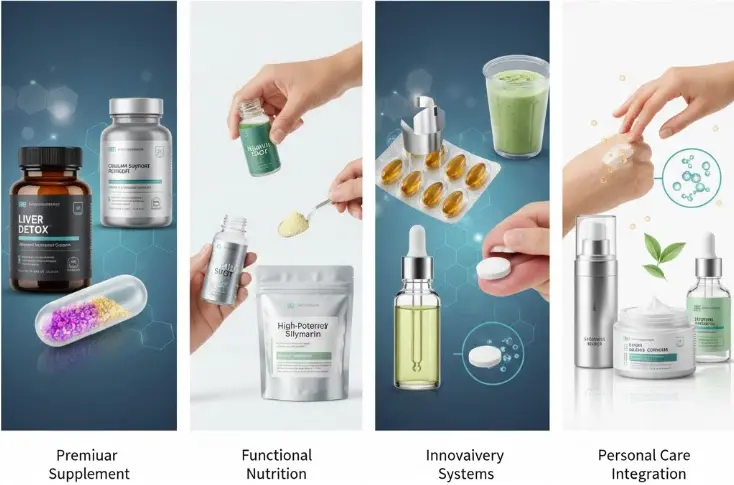
Single-serve detox shots are among the most natural uses for china silymarin powder and liposomal silymarin. This is because the format anticipates a concentrated and rapidly acting functional ingredient, as opposed to a diluted claim that is spread out across a big volume of beverage. Formulators who are developing shots may rely on the increased bioavailability of the ingredient to justify a lower effective dosage within a small serving size. This helps them regulate both the cost and the flavor impact of the product. Because liposomal silymarin disperses cleanly even in concentrated formats, companies are able to avoid the sediment layer that often accumulates at the bottom of shot bottles when using unencapsulated botanical extracts. This allows the product to maintain a cleaner presentation throughout its shelf life.[1][2][3][5]
Instant Powder Sachets and Drink Mixes
Powder sachets that are meant for mixing while on the move are another powerful use. This is because customers anticipate that the powder will dissolve rapidly and completely, without leaving any residue at the bottom of a glass. This expectation is directly supported by the water dispersibility of liposomal silymarin, which may be reconstituted easily even in cold water without the need for strong stirring or additional dispersing agents. This format also provides brands with the flexibility to combine liposomal silymarin with complementary powders such as electrolytes or vitamin blends in a single sachet. This allows for the creation of a more comprehensive functional product without the introduction of the solubility conflicts that are typically caused when raw botanical powders are blended together.
Sports and Recovery Beverages
It is becoming more common for recovery drinks designed for active consumers to seek beyond electrolytes and protein in search of chemicals that assist the body's wider recovery systems. Liposomal silymarin is a perfect match for this extended formulation strategy. The quick uptake profile of this product is in line with the fast-absorption expectations of a post-workout drink. Additionally, the neutral flavor effect of this product means that it can be integrated into a recovery shake without changing the taste profile that athletes already anticipate from a recovery smoothie. Liposomal silymarin may be used by companies that are developing recovery lines that already have an emphasis on liver and metabolic support in addition to muscle recovery. This can be done in order to complete the positioning of the product with a credible and well-documented active ingredient.
Synergistic Pairings for Multi-Benefit Formulas
Because shared delivery technology eliminates the potential for stability conflicts that can occur when combining ingredients with different formulations in a single liquid system, functional beverage brands rarely rely on a single active ingredient. Liposomal silymarin, on the other hand, pairs particularly well with other liposomal actives such as glutathione and vitamin C. This compatibility enables formulators to construct a beverage that is really distinctive and has several benefits, as opposed to a beverage that contains a single ingredient and competes on the basis of a single restricted claim. Many times, companies that are in the process of producing a trademark detox or recovery beverage discover that this sort of synergistic liposomal stack becomes the primary differentiator that differentiates their product from other, more generic entrants on a shelf that is already packed with beverages.[2][5][6]
The Manufacturing Standards Behind a Beverage-Grade Ingredient
Certified Facilities Built for Liquid-Compatible Powders
Producing a silymarin liposomal that performs reliably in beverage applications requires manufacturing infrastructure built specifically for that level of precision. Hongda's facility spans roughly 20,000 square meters and includes more than ten modern production lines within 100,000-level purification workshops, supported by over 150 workshop technicians trained in liposomal-specific processing. This scale of infrastructure matters for beverage-grade ingredients because inconsistent particle formation between batches directly affects how a drink looks and performs on the shelf, and beverage brands cannot absorb the reformulation costs that come with unpredictable raw material behavior.
Testing Protocols That Matter for Beverage Applications
An in-house SGS-standardized laboratory, developed jointly with university professors, gives Hongda the analytical depth needed to verify beverage-relevant quality markers on every batch of liposomal silymarin. Equipment including high-performance liquid chromatographs, spectrophotometers, and particle analysis tools allows the company to confirm dispersibility, particle size, and encapsulation efficiency before shipment rather than relying on a generic certificate of analysis. For beverage manufacturers, this level of testing reduces the risk of receiving a batch that performs differently in liquid than a previous shipment, a problem that can otherwise force costly reformulation mid-production run.

Traceability and Raw Material Quality Control
Hongda maintains dedicated planting bases, including a Chinese medicinal material cultivation site supervised by professional agronomists, ensuring raw milk thistle used in liposomal silymarin production is traceable from field to finished powder as a wholesale silymarin manufacturer. Before shipment, every batch undergoes testing for pesticide residues, moisture, heavy metals, and microorganisms to confirm compliance with international standards relevant to beverage-grade ingredients. This traceability becomes especially important for functional drink brands selling into markets with strict beverage ingredient regulations, where documentation gaps can delay product launches well beyond the original planned release timeline.
Global Certifications Supporting Export-Ready Beverage Brands
Hongda has accumulated national high-tech enterprise status, food production and feed additive licenses, halal, kosher, BRC, FDA registration, and organic certification. the company added cGMP, FSSC22000, SC certification, ISO22000, ISO9001, and both EU and NOP organic certification. For functional beverage brands planning to export liposomal silymarin-based drinks into the United States or European Union, this certification portfolio significantly shortens the supplier due diligence process that regulatory teams typically require before approving a new beverage ingredient.
|
Category
|
Detail
|
|---|---|
|
Facility Size
|
~20,000 m², 100,000-level purification workshops
|
|
Production Lines
|
10+ modern lines, 150+ technicians
|
|
R&D Capacity
|
2 R&D institutions, 20+ professor-level researchers
|
|
2001–2024 Certifications
|
National High-Tech Enterprise, BRC, FDA, Halal, Kosher, Organic
|
|
2025 Certifications
|
cGMP, FSSC22000, ISO22000, ISO9001, EU/NOP Organic
|

Sourcing Liposomal Silymarin for Your Beverage Line
What to Look for in a Liposomal Silymarin Powder Manufacturer
Choosing the right liposomal silymarin powder manufacturer for a beverage application requires looking beyond basic purity specifications toward beverage-specific performance data. A manufacturer worth working with should be able to provide dispersibility results in water at various pH levels, particle size consistency across multiple batches, and guidance on compatible carriers for the specific drink format being developed. Brands that skip this technical vetting step often discover formulation problems only after a pilot batch fails visually or functionally, costing valuable development time that a more thorough supplier evaluation could have avoided from the start.
Comparing Silymarin Powder Suppliers on Technical Merit
When evaluating silymarin powder suppliers for a beverage project, formulators should prioritize technical responsiveness over unit pricing alone, since a supplier unable to answer detailed formulation questions is unlikely to provide meaningful support once production issues arise. Requesting a sample alongside a genuine certificate of analysis, rather than a generic product data sheet, is a practical way to compare suppliers on substance rather than marketing claims. Suppliers offering direct access to R&D personnel for beverage-specific troubleshooting tend to deliver considerably smoother development experiences than those operating purely as order-fulfillment vendors.
Working With a Trusted China Silymarin Powder Source
China remains the primary global manufacturing base for botanical ingredients, but sourcing a genuinely reliable China silymarin powder supplier for beverage applications means confirming in-house testing capability rather than trusting third-party marketing summaries. Buyers should ask direct questions about how a factory verifies liposomal structure, what equipment is used for particle analysis, and whether beverage-specific stability testing has ever been conducted on the product. A supplier able to answer these questions specifically, rather than generically, is far more likely to deliver an ingredient that performs consistently across multiple production runs.
From Sample to Scale: Partnering With a Wholesale Silymarin Manufacturer
Moving from a successful pilot batch to full commercial production requires a wholesale silymarin manufacturer capable of maintaining identical specifications at significantly higher volume. Hongda's annual production capacity of roughly 3,000 tons, supported by a 3,000-square-meter warehouse organized across six dedicated storage zones, gives beverage brands confidence that scaling up will not introduce the batch-to-batch variability that often derails a promising formulation. Brands should confirm lead times and minimum order flexibility early, since beverage production schedules often move faster than raw ingredient sourcing timelines allow for.
Conclusion
Liposomal silymarin from a liposomal silymarin powder manufacturer gives functional beverage brands something raw extract never could: an ingredient that performs as well in a bottle as it does in a bioavailability study. Backed by Shaanxi Hongda Phytochemistry's certified infrastructure, rigorous testing, and beverage-focused technical support, formulators gain a dependable foundation for building genuinely differentiated liver-health drinks. The window for first-mover advantage in this category is open now.
Frequently Asked QuestionsQ1: Why does liposomal silymarin work better in drinks than standard extract?
A1: Its phospholipid encapsulation improves water dispersibility and reduces bitterness, avoiding the sediment and off-taste common with raw extract.
Q2: Does liposomal silymarin survive pasteurization?
A2: It offers better protection than unencapsulated extract, though formulators should validate stability under their own processing parameters.
Q3: What beverage formats work best with this ingredient?
A3: Detox shots, instant powder sachets, and sports recovery drinks are common formats suited to its dispersibility and rapid uptake.
Q4: How can I verify a supplier's liposomal claims for beverage use?
A4: Request dispersibility data, particle size consistency, and beverage-specific stability testing rather than a generic data sheet.
Partner With HONGDA for Your Functional Drink Formulation
If you're developing a detox shot, recovery beverage, or wellness drink mix, Shaanxi Hongda Phytochemistry Co., Ltd. offers a liposomal silymarin ingredient engineered for real beverage performance, backed by certified manufacturing and hands-on technical support. From beverage-specific stability data to full-scale production, our team is ready to help at every stage. Contact duke@hongdaherb.com today to request a sample and start building a functional drink that performs as well in the bottle as it does on paper.
References
1. Federico, A., Dallio, M., & Loguercio, C. (2017). Silymarin/Silybin and Chronic Liver Disease. Molecules.
2. Kalepu, S., & Nekkanti, V. (2015). Insoluble Drug Delivery Strategies. Acta Pharmaceutica Sinica B.
3. Kidd, P. M. (2009). Bioavailability of Phytosome Complexes. Alternative Medicine Review.
4. Csupor, D., Csorba, A., & Hohmann, J. (2016). Analysis of Flavonolignans of Silybum marianum. Journal of Pharmaceutical and Biomedical Analysis.
5. Mozafari, M. R., et al. (2008). Nanoliposomes and Their Applications in Food Nanotechnology. Journal of Liposome Research.
6. Innova Market Insights. Functional Beverage and Clean Label Trends.