


_1745918362135.webp)

How Does Liposomal Vitamin C Powder Bulk Support Collagen Production?
Formulators realize that to produce collagen in skin and connective tissue, you need a steady source of active vitamin C at the cellular level. And that’s where Liposomal Vitamin C Powder Bulk from Hongda Phytochemistry comes in. Standard ascorbic acid oxidizes fast and has difficulty passing cell membranes in significant amounts. Shaanxi Hongda Phytochemistry Co., Ltd. is coating vitamin C with a phospholipid bilayer to preserve it throughout digestion and transfer it straight into fibroblasts, where the collagen-building enzymes go to work. It’s a quantitative delivery-based raw material, not a marketing claim, and that’s why beauty, nutraceutical, and clinical nutrition companies are increasingly asking for this ingredient by name.
Why Is Liposomal Vitamin C Powder Bulk the Cornerstone of Collagen Synthesis?
The Enzymatic Role of Ascorbic Acid in Collagen Hydroxylation
Prolyl hydroxylase and lysyl hydroxylase are two enzymes involved in collagen synthesis by human fibroblasts, and both of them need ascorbic acid as an essential cofactor for the stability of the triple-helix structure of procollagen. At the cellular level, if there is not enough vitamin C, the hydroxylation process halts, and the resulting collagen strands are fragile and readily broken down. Liposomal Vitamin C Powder Bulk is the perfect game changer for skincare and nutraceutical formulators. The phospholipid bilayer prevents the premature oxidation and degradation of the ascorbic acid. So more active vitamin C goes into the fibroblast cytoplasm, where the hydroxylation truly occurs. Shaanxi Hongda Phytochemistry Co., Ltd. created its Liposomal Vitamin C Powder Bulk to overcome this delivery bottleneck, providing formulators with a raw material that offers proven advantages for skin collagen density, not just another antioxidant claim on a label.[1][2]
Bioavailability Comparison: Liposomal vs. Standard Ascorbic Acid
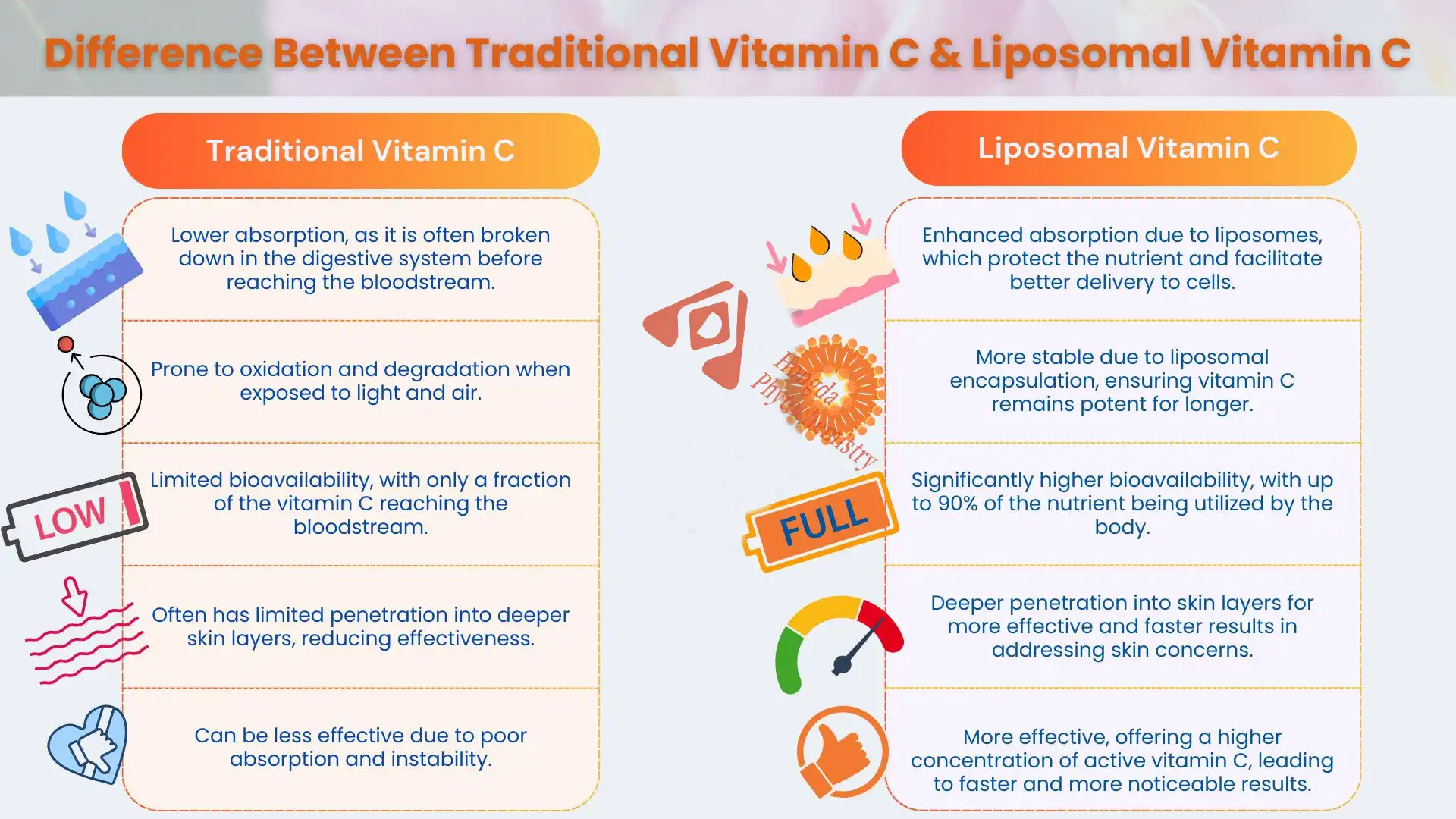
Traditional ascorbic acid powder is water-soluble and employs active transport routes that are fast saturated with intake beyond modest levels, with much being lost to urine before ever reaching connective tissue. Liposomal Vitamin C Powder Bulk has circumvented this barrier by replicating a natural cell membrane in the form of a vesicle, allowing ascorbic acid to merge directly with fibroblast membranes instead of competing for transporter proteins. Liposomal Hongda has been examined and exhibits absorption six to ten times that of ordinary ascorbic acid or sodium ascorbate. For marketers of anti-aging serums, joint-support capsules, or recovery mixtures, that absorption gap translates into a bigger collagen-support promise, since more intact ascorbic acid arrives at the tissue where hydroxylation enzymes are primed to use it.
Why Formulators Choose Liposomal Ingredients in Bulk for Skin Health Lines?
Skincare and nutraceutical companies acquiring liposomal ingredients in bulk aren't chasing a buzzword; they're responding to formulation chemistry consumers can feel. Powders may be entrapped in phospholipid vesicles, leading to a more even distribution in aqueous and lipid systems, decreasing grittiness in a topical serum and increasing mouthfeel in an oral sachet. Shaanxi Hongda Phytochemistry Co., Ltd.’s liposomal vitamin C powder bulk is pharmaceutical-grade pure, so brand teams developing collagen-support product lines may proceed from concept to finished recipe without long reformulation cycles. This also buffers the acidity of the raw ascorbic acid so that the end products are more gentle on sensitive skin and the digestive system, and this is a plus for premium positioning in mature markets such as the EU and North America.[3][6]
Engineering Behind Hongda's Liposomal Vitamin C Powder BulkThin-Film Hydration and Ultrasonic Nano-Shearing Process
Hongda's production method begins with thin film hydration. First, phospholipids are dissolved in a solvent system and dried to form a homogeneous lipid film. This film is then rehydrated with ascorbic acid solution. The resulting lipid structures are then homogenized into vesicles using ultrasonic nanoshearing, a method that allows control of particle size and encapsulation efficiency. Therefore, the vesicles formed are always between 100 and 250 nanometers in size, small enough to readily cross biological membranes. The coupling technique is the core technology of the liposomal vitamin C powder bulk production process. It is difficult for small producers who are still utilizing manual emulsification to achieve batch-to-batch consistency in this process. Shaanxi Hongda Phytochemistry Co., Ltd. has more than ten advanced production lines in 100,000-level purification workshops to carry out this process.
Phospholipid Membrane Composition and Particle Size Control
The vesicle wall of Hongda’s liposomal vitamin c wholesale is constructed from non-GMO sunflower lecithin, which has a phospholipid profile that forms stable bilayers and doesn’t have the allergy issues that may be found with soy lecithin. As a reliable source of liposomal ingredients bulk, Hongda provides raw materials with consistent encapsulation performance. Encapsulation efficiencies in excess of 90% are frequently attained, which means that very little ascorbic acid is lost to the aqueous phase during processing. Hongda’s SGS-standardized facility is equipped with laboratory-grade analytical instruments such as spectrophotometers and specialized sizing equipment to confirm exact particle size control from 100 to 250 nanometers. This tight particle size distribution may frequently be the difference between a usable raw material and one that passes downstream stability testing for clients sourcing bulk liposomal vitamin C for high-purity cosmetics or advanced nutraceutical applications.
Low-Temperature Spray Drying and Long-Term Stability
Hongda employs low-temperature spray drying to convert the liquid vesicles to a stable, free-flowing powder once the liposomal suspension is prepared without collapse of the phospholipid bilayer structure. In this phase, cryoprotectants are added to preserve the vesicle integrity. This is why the liposomal vitamin c bulk has a shelf life of three years at -20°C. This stability profile is significant to international buyers, since bulk shipments might spend weeks in transit or storage before they ever reach a manufacturing line. "Powder formulations decay in humid or ambient conditions, resulting in the costly danger of reformulation, whereas Hongda’s spray-dried format keeps the encapsulated vitamin C intact until it is mixed into a final serum, tablet, or beverage base.
|
Item
|
Specification
|
Test result
|
Test Method
|
|
Vitamin C
|
50%-55%
|
53.38%
|
HPLC
|
|
Appearance
|
White to pink powder
|
Complies
|
Visual
|
|
Odor and Taste
|
Characteristic
|
Complies
|
Sensory
|
|
Loss on Drying
|
≤5%
|
1.60%
|
Ch.P2020
|
|
Residue Solvents
|
Ethanol ≤ 5000ppm
|
Complies
|
GC-HS
|
|
Heavy metal
|
Lead (Pb) ≤3ppm
|
Complies
|
ICP-MS
|
|
Arsenic (As) ≤3ppm
|
Complies
|
ICP-MS
|
|
|
Cadmium(Cd) ≤1ppm
|
Complies
|
ICP-MS
|
|
|
Mercury(Hg) ≤0.1ppm
|
Complies
|
ICP-MS
|
|
|
Total Plate Count
|
≤1000cfu/g
|
Complies
|
USP-NF 2022
|
|
Yeast&Mould
|
≤100cfu/g
|
Complies
|
USP-NF 2022
|
|
E.coli
|
Negative
|
Negative
|
USP-NF 2022
|
|
Salmonella/25g
|
Negative
|
Negative
|
USP-NF 2022
|
|
Staphylococcus Aureus
|
Negative
|
Negative
|
USP-NF 2022
|
|
Storage
|
Preserve in a well-closed, light-resistant, and protect from moisture.
|
||
|
Packing
|
20kg/drum.
|
||
|
Shelf life
|
2 years.
|
||
Formulation Applications Across Skin, Supplement, and Beverage Categories
Topical Collagen-Boosting Serums and Creams
What Bulk Liposomal Vitamin C Powder Does in Topical Formulations: It provides ascorbic acid directly into the dermal layer to aid with collagen hydroxylation, and the phospholipid shell itself functions as a minor penetration enhancer, ensuring serums feel less acidic on the skin barrier than typical L-ascorbic acid formulations. Brand chemists formulating anti-aging or brightening lines may use a smaller percentage of this ingredient than raw ascorbic acid, yet get similar or better results, because so much less of the active ingredient is lost to surface oxidation before it’s absorbed. A key formulation benefit is the compatibility of Hongda’s liposomal vitamin C powder throughout a broad pH range, removing the need for complicated stabilizer systems in final skincare products.[3][4]
Oral Nutraceutical Capsules, Tablets, and Sachets
Bulk liposomal vitamin c has a smoother delivery experience than conventional ascorbic acid. At larger quantities, bulk liposomal vitamin C may provide a more suitable option for oral supplement manufacturers since conventional vitamin C is absorbed by saturable transporters in the stomach. A portion of the dosage escapes this bottleneck in liposomal form, so collagen production may support joint, skin, and connective tissue health without the sour aftertaste many chewable vitamin C products have. Our ingredient is provided as a free-flowing powder for capsule filling, tableting, and single-serving sachets. “Our formulation team can customize the particle properties to fit the customer’s existing production equipment, which reduces the engineering effort to bring a new collagen support SKU to market.”
Functional Beverages and Clinical Nutrition Formats
The liposomal vitamin C powder bulk is most often seen in the ingredients of ready-to-drink beverages and clinical nutrition formulations, as encapsulation improves solubility in hot and cold liquid systems and masks the sour, metallic taste that raw ascorbic acid can leave behind. It is utilized by sports nutrition businesses to help boost the regeneration of collagen in tendons and cartilage after exercise. It is employed by clinical nutrition developers for those who need intensive antioxidant and connective-tissue support without additional digestive work. The vesicles also distribute well and do not clump, eliminating the sediment issues that raw ascorbic acid often causes in bottles sitting on shop shelves for months.[3][5]
For supplement brands evaluating a new Liposomal Vitamin C Powder Bulk supplier, verifying technical documentation before placing a bulk order can reduce formulation risks and shorten the approval process. Buyers can request product specifications, certificates of analysis, stability data, and manufacturing details directly from Hongda’s technical team by contacting duke@hongdaherb.com. This allows brands to confirm particle size, encapsulation efficiency, quality standards, and application suitability before moving from sample testing to large-scale production.
Quality Assurance, Certifications, and Manufacturing Capacity
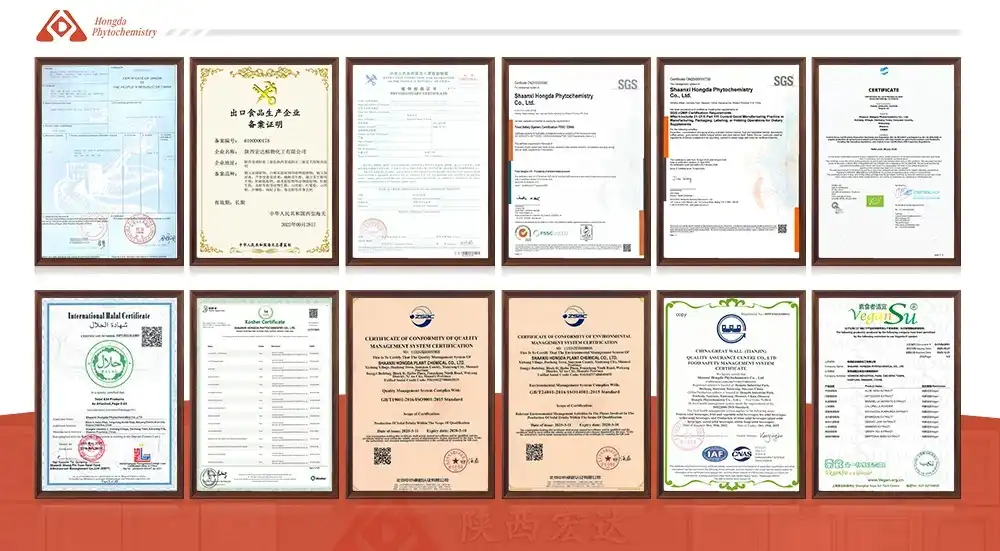
International Certifications: cGMP, ISO, FSSC22000, Halal, Kosher
Shaanxi Hongda Phytochemistry Co., Ltd. is one of the top providers of bulk liposomal vitamin C powder in regulated markets. We have thus produced a suitable portfolio for certification. Bulk buyers of liposomal vitamin C powder in regulated markets want more than marketing promises. They seek facts to support such allegations. The firm has been accorded the status of national high-tech enterprise since 2001 and licenses for food manufacture and feed additives, Halal and Kosher certification, BRC, FDA registration, and organic certification. By 2025, it will have added FSSC22000, SC certification, ISO22000, ISO9001, and both EU and NOP organic certifications, and also additional national patent technology for its encapsulation systems. The growing number of certifications allows Liposomal Vitamin C Powder Bulk to be taken up by purchasing teams for launches in the United States and Europe, where documentation requirements for ingredients with a unique delivery mechanism are becoming stricter and stricter.
|
Certification / Qualification
|
Status
|
|---|---|
|
National High-Tech Enterprise
|
Awarded 2010
|
|
Food Production & Feed Additive Licenses
|
Obtained 2001–
|
|
Halal & Kosher Certification
|
Obtained 2001–2027
|
|
BRC / FDA Registration
|
Obtained 2001–2026
|
|
cGMP
|
Newly obtained 2026
|
|
FSSC22000 / ISO22000 / ISO9001
|
Newly obtained 2026
|
|
SC Certification
|
Newly obtained 2026
|
|
Organic (EU) / Organic (NOP)
|
Newly obtained 2026
|
SGS-Standardized Testing Laboratory and In-House R&D
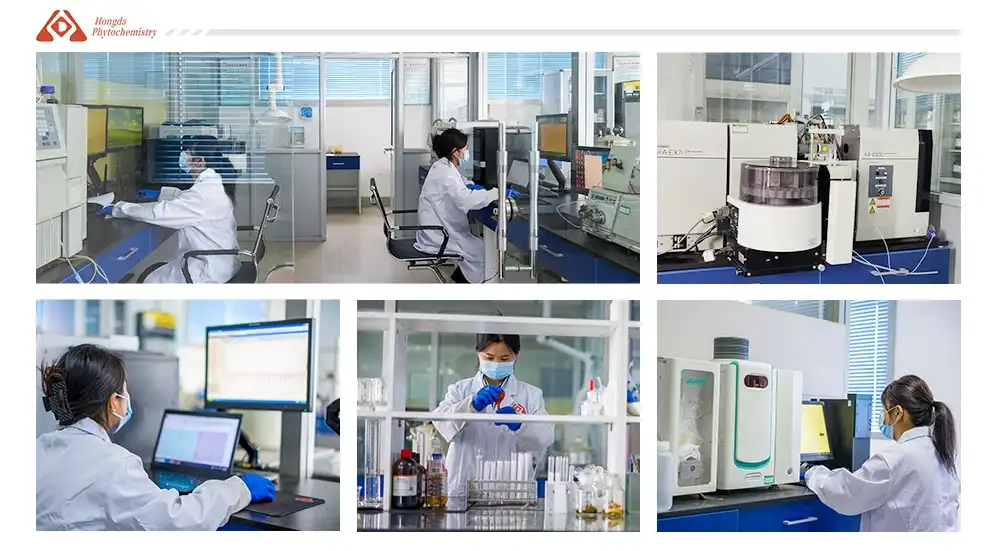
Shaanxi Hongda Phytochemistry has built the laboratory in partnership with the professors of the university and under the standards of SGS to offer quality control for Liposomal Vitamin C Powder Bulk. The study was done by about twenty professor-level scholars and testing specialists. The laboratory is equipped with high-performance liquid chromatography, gas chromatography, spectrophotometers, atomic absorption spectrophotometers, polarimeters, automated titrators, and biochemical and chemical oxygen demand incubators for assurance of purity and stability. Before dispatch, each batch is tested for active compounds, pesticide residues, moisture, heavy metals, and microbiological contamination. The company has progressively increased encapsulation efficiency and particle homogeneity via successive generations of the product, and two dedicated R&D teams are still perfecting the liposomal encapsulation technique itself.
Annual Output, Warehouse Infrastructure, and On-Time Delivery
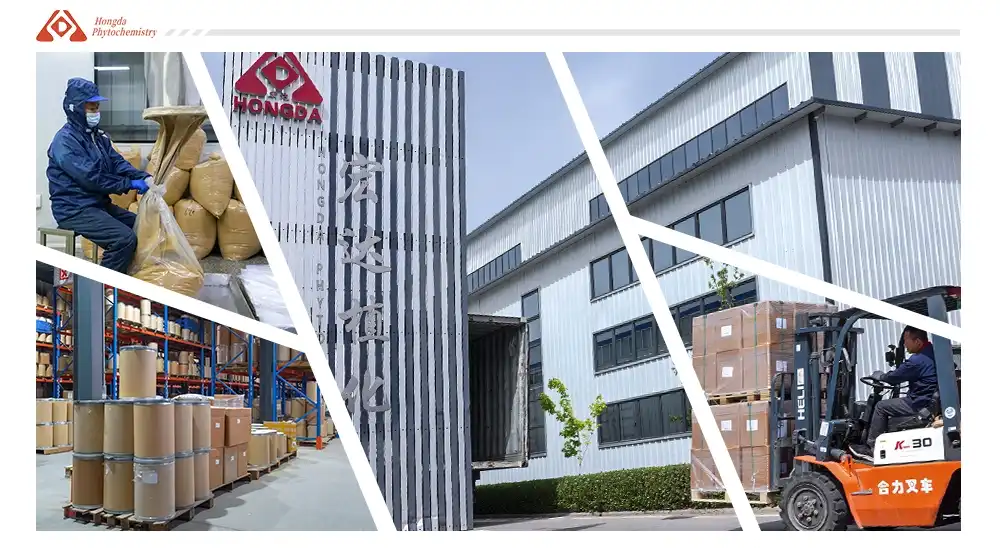
Shaanxi Hongda Phytochemistry has a 20,000-square-meter manufacturing base and more than 10 contemporary lines, with an annual output of around 3,000 tons in the ingredient portfolio. Bulk customers can be certain that big purchase orders of Liposomal Vitamin C Powder Bulk may be sent without delay. The warehouse has a total size of 3,000 square meters and is divided into six different storage rooms, ensuring that liposomal and vitamin goods are stored separately from botanical extracts and raw plant material. In each zone, there are qualified personnel in charge of the sterilizing processes. Bulk liposomal vitamin C orders are sent via standard shipping from the Shaanxi plant, 3-7 working days. The firm already has export contacts in Europe, North America, and Asia, so customs and shipping paperwork is never a hurdle for new overseas consumers.
Conclusion
Liposomal Vitamin C Powder Bulk addresses the core biochemistry of collagen production more directly than standard ascorbic acid, protecting the vitamin through digestion and delivering it into fibroblasts where hydroxylation enzymes put it to work. Shaanxi Hongda Phytochemistry Co., Ltd. backs this ingredient with pharmaceutical-grade manufacturing, an SGS-standardised laboratory, and certifications spanning cGMP, ISO22000, FSSC22000, Halal, Kosher, and organic status. Whether you are formulating a serum, a joint-support capsule, or a functional beverage, sourcing bulk liposomal vitamin c from a manufacturer with documented encapsulation efficiency removes much of the formulation risk. Reach out to Hongda's team to request specifications and a sample before your next production run.
FAQ
1. What makes Liposomal Vitamin C Powder Bulk different from regular vitamin C powder?
Its phospholipid bilayer encapsulation protects ascorbic acid from oxidation and raises cellular absorption roughly six to ten times higher than standard ascorbic acid or sodium ascorbate.
2. How does this ingredient support collagen production specifically?
Ascorbic acid is a required cofactor for the enzymes that hydroxylate and stabilise procollagen; liposomal delivery gets more active vitamin C into fibroblasts where that reaction occurs.
3. What particle size and encapsulation efficiency does Hongda's product achieve?
Vesicles measure 100 to 250 nanometers with encapsulation efficiency above 90 per cent, verified inside Hongda's SGS lab.
4. What is the shelf life and recommended storage for this ingredient?
The powder carries a documented three-year shelf life when stored at -20°C, a result of cryoprotectants used during low-temperature spray drying.
Request Your Liposomal Vitamin C Powder Bulk Quote | Liposomal vitamin c powder manufacturer/Liposomal vitamin c supplier
Formulating a new collagen-support serum, capsule, or beverage line and needing an ingredient that performs under real production conditions? Shaanxi Hongda Phytochemistry Co., Ltd. manufactures Liposomal Vitamin C Powder Bulk at pharmaceutical-grade purity, backed by cGMP, ISO22000, FSSC22000, Halal, and Kosher certification, with documented six-to-ten-times bioavailability over standard ascorbic acid. From trial samples to multi-tonne contracts, the technical team can match particle size, concentration, and packaging to your production line. Email duke@hongdaherb.com today with your target application and order volume for a certificate of analysis, current specifications, and factory-direct pricing.
References
1. Pullar, J.M., Carr, A.C., & Vissers, M.C.M. "The Roles of Vitamin C in Skin Health." Nutrients, 2017.
2. Boyera, N., Galey, I., & Bernard, B.A. "Effect of Vitamin C and Its Derivatives on Collagen Synthesis and Cross-Linking by Normal Human Fibroblasts. "International Journal of Cosmetic Science, 1998.
3. Al-Niaimi, F., & Chiang, N.Y.Z. "Topical Vitamin C and the Skin: Mechanisms of Action and Clinical Applications." Journal of Clinical and Aesthetic Dermatology, 2017.
4. Traikovich, S.S. "Use of Topical Ascorbic Acid and Its Effects on Photodamaged Skin Topography." Archives of Facial Plastic Surgery, 1999.
5. DePhillipo, N.N., et al. "Efficacy of Vitamin C Supplementation on Collagen Synthesis and Oxidative Stress After Musculoskeletal Injuries." Orthopaedic Journal of Sports Medicine, 2018.
6. Shaanxi Hongda Phytochemistry Co., Ltd. Corporate Technical Overview and Certification Records, 2001–2025.