



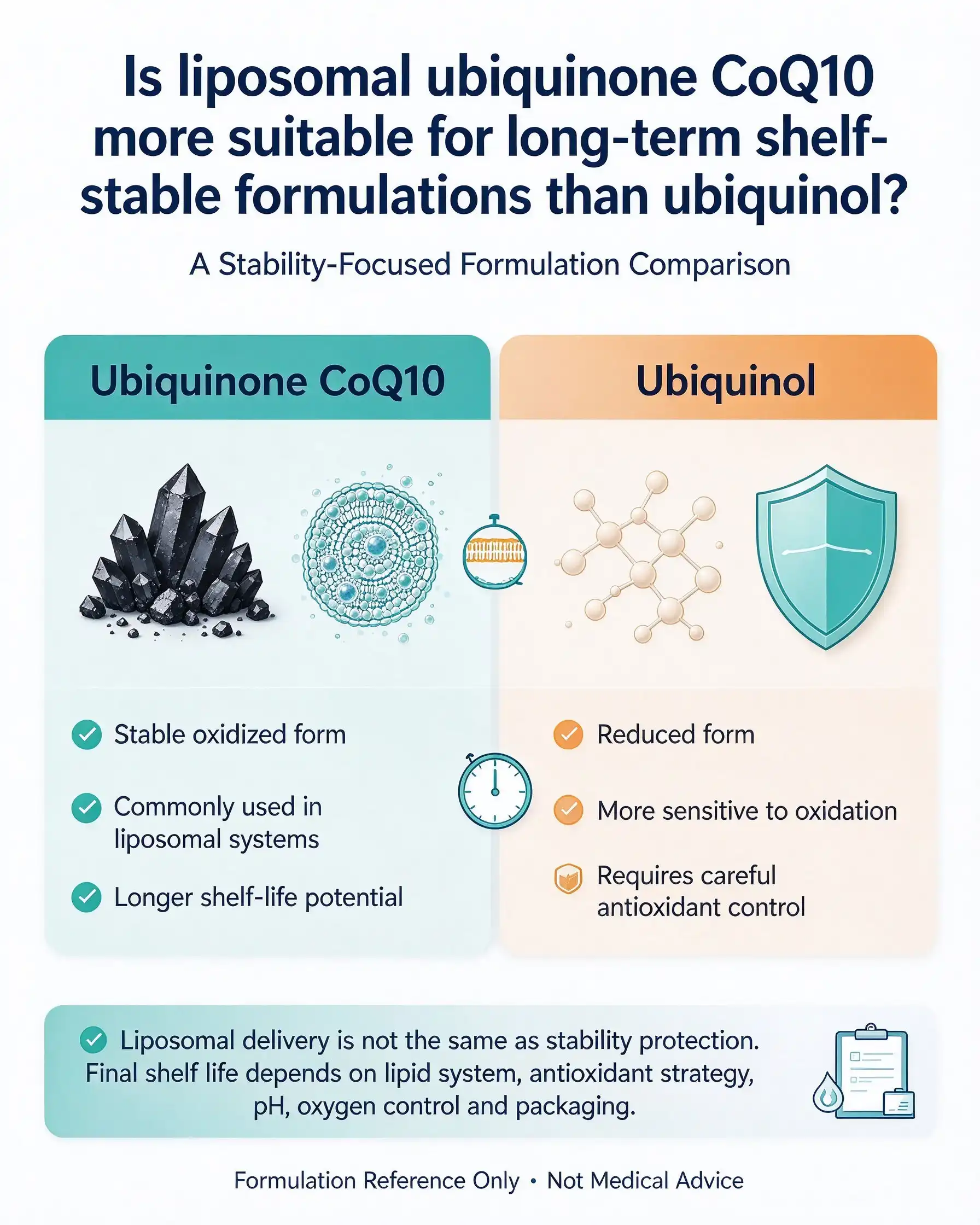
Is liposomal ubiquinone CoQ10 more suitable for long-term shelf-stable formulations than ubiquinol?
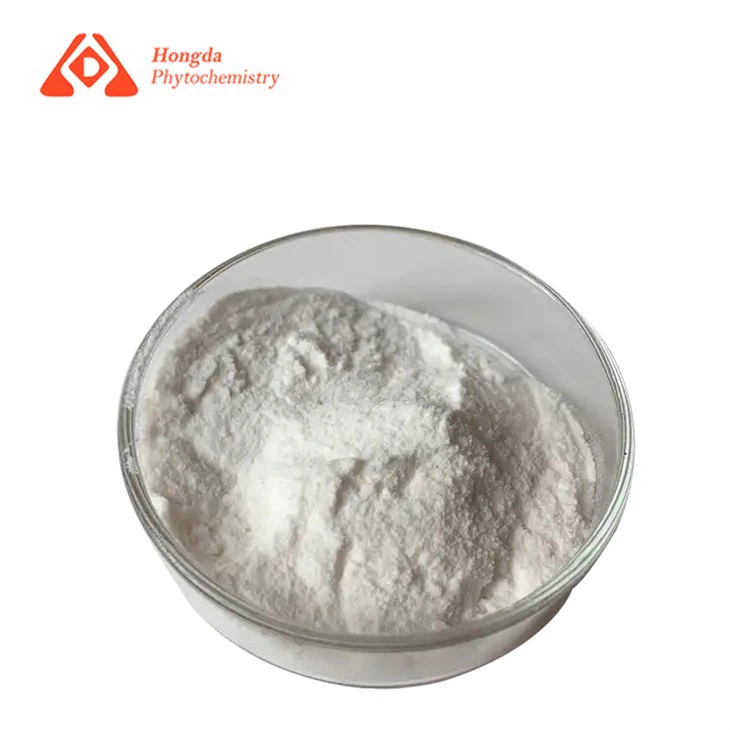
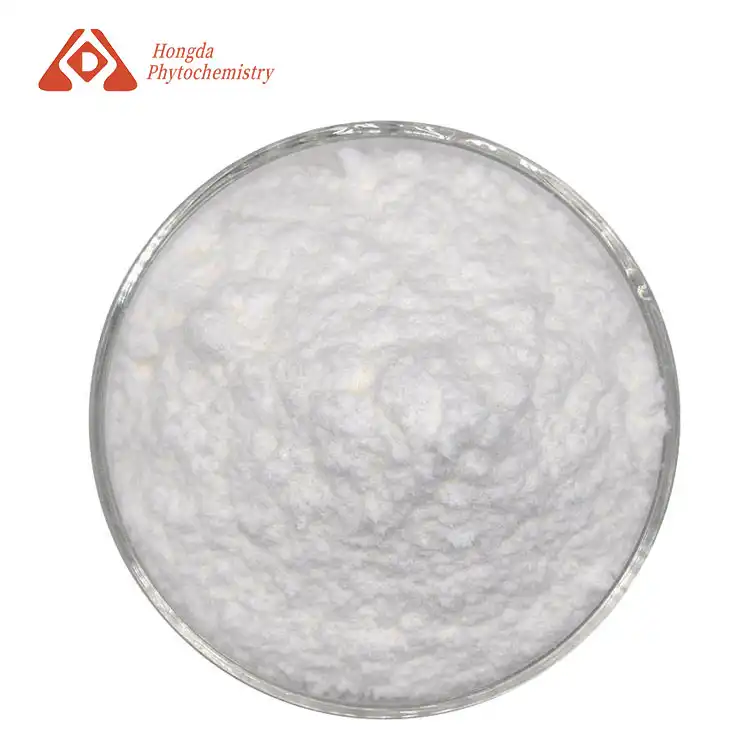
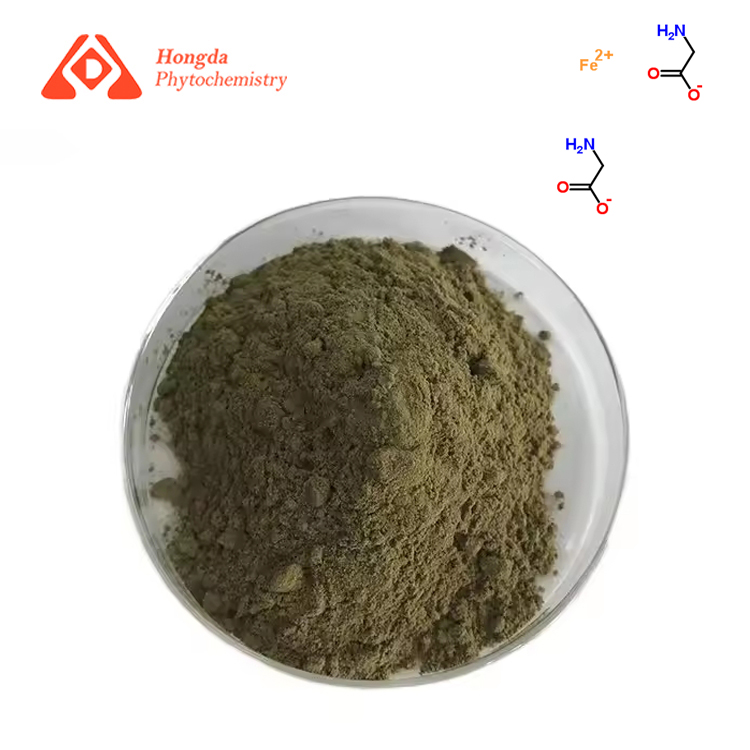
The problem of CoQ10 stability is a business issue for a brand owner or contract producer, not a chemical one: What format still tests at label claim after 18 months in a warehouse and a summer in transit? Hongda Phytochemistry answers with a liposomal coenzyme q10 powder based on ubiquinone, the oxidized form that nothing else has to give up to oxygen. Shaanxi Hongda Phytochemistry Co., Ltd. has encapsulated the crystal in a sunflower-phospholipid bilayer, turning a fat-soluble, light-sensitive molecule into a free-flowing, water-dispersible compound that works like ubiquinol in the body, but stores like ubiquinone in the drum.[1][2][3][4]
Why Shelf Life Decides the CoQ10 Format Before Bioavailability Does
Stability is the first filter, because absorption only matters for material that survives storage.
The Redox Problem: Why Ubiquinol Loses Ground Early
This is the reduced form of coenzyme Q10 and contains more electrons. And that's why it is fragile. Any exposure to oxygen, light, trace metals, or heat changes it back to ubiquinone. In Simulated-gastric work, 54-76% conversion occurred in an hour. The manufacture is made under nitrogen. Finished items must be packaged in an opaque oxygen barrier. Formulators add tocopherols for insurance. But a liposomal coenzyme Q10 powder made from ubiquinone removes the problem totally. The molecule is already oxidized and has no place to fall. Hongda Phytochemistry uses the stable crystal, and adds a physical barrier, a phospholipid bilayer that maintains the payload apart from the headspace, shear, and humidity.[2][4]
What "Shelf-Stable" Means on a Commercial Specification Sheet
The shelf life claim is not a marketing claim, but a set of statistics that may be retested by a QA department. At release and again under accelerated conditions at 40°C and 75% humidity, assay retention, loss on drying, oxidation indicators, particle-size drift, and microbiological count were determined. Hongda Phytochemistry guaranties their liposomal coenzyme Q10 powder shelf life is 24 months and preserves each production batch reserve samples. This allows clients to ask for re-testing in retrospect, rather than rely on a guarantee. The ubiquinone test is monitored in conjunction with encapsulation efficiency and DLS particle size. This is because a liposome that loses its shape loses its usefulness, even if the molecule itself is intact.
Where liposomal coenzyme Q10 powder Sits Between Extremes
The crystalline ubiquinone is stable yet obstinate. It is poorly soluble in water, and absorption depends on fat, such that most of the indicated dose never reaches the plasma. Ubiquinol improves absorption in certain populations but needs cold, dark, and oxygen-excluded logistics that mass market supply chains cannot promise.[1][3] A middle ground is offered by a China coenzyme q10 pure powder manufacturer. The phospholipid layer allows the molecule to go through the intestines without a fatty meal, and the ubiquinone core will not oxidize on the shelf. Industry estimates imply liposomal AUC rises three to six times that of unformulated powder. Hongda predicts a peak concentration more than a dozen times that of normal powder. Premium performance for commodities storage.
|
Shelf-life factor
|
Liposomal ubiquinone
|
Ubiquinol
|
Crystalline ubiquinone
|
|---|---|---|---|
|
Redox state at filling
|
Oxidised, stable
|
Reduced, reverts
|
Oxidised, stable
|
|
Oxygen, light sensitivity
|
Low
|
High
|
Low
|
|
Storage and packaging
|
Cool, dry drum
|
Cold, dark, flushed
|
Ambient drum
|
|
Processing tolerance
|
Blending, encapsulation
|
Heat, shear sensitive
|
High
|
|
Declared shelf life
|
24 months
|
12–24 months
|
24 months
|
Inside the Hongda Production Line: How a Stable Liposome Is Actually Built
Process control, not ingredient choice, decides whether a liposome survives two years.
From Ubiquinone Crystal to Phospholipid Bilayer
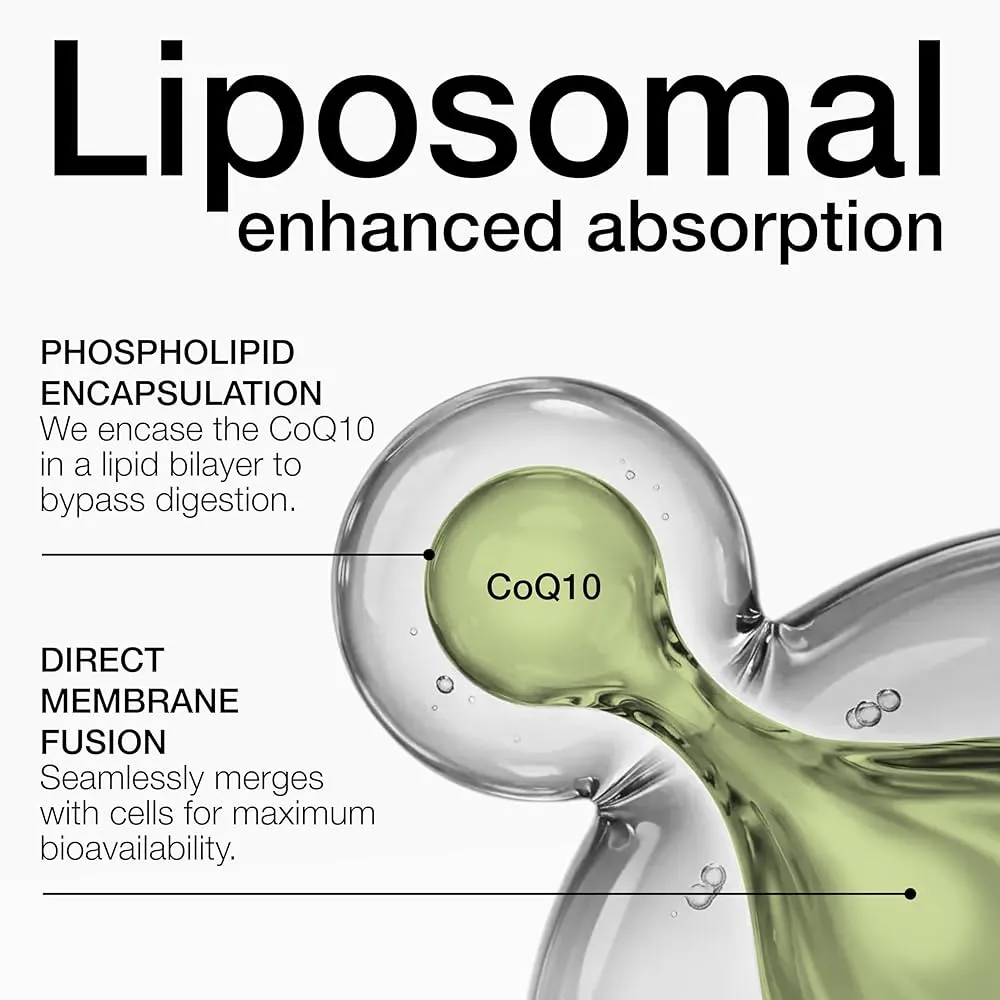
Inbound QC will thoroughly inspect the Ubiquinone CoQ10 raw crystal and phospholipid carrier prior to transferring it to the homogenizer. If identification, oxidation indications, or contaminant levels are outside allowed requirements, the batch is discarded. Only then does high-pressure homogenization occur, which drives the melt through microscopic gaps, resulting in bilayer vesicles instead of a coarse emulsion. This is produced by Hongda Phytochemistry in purifying workshops of 100,000 level, with more than 10 production lines, more than 150 workshop staff, and a yearly output of around 3000 tons. Your trial lot of liposomal coenzyme q10 powder was made on a qualified line, and your routine bulk shipment may be scheduled on the same line.
Why Sunflower Phospholipids Replaced Soy
Hongda Phytochemistry uses non-GMO sunflower phospholipids and has excluded soy altogether from the carrier. One less decision, three commercial hassles out of the way – no more GMO labels on the spec, the soy allergy risk is gone from the final pack, and the ingredient is defensible in vegan and clean label positioning. Cheap lecithin is refined through many stages to eliminate a grassy, oily odor. This is more essential than most customers believe. A liposomal coenzyme Q10 powder that is meant for a ready-to-drink antioxidant beverage or an oral beauty serum will be tasted by a consumer, not taken in a capsule. It reforms into a stable milky white colloid, with no oil separation.[4]
Spray-Drying Into a Powder That Survives Manufacturing
Homogenization creates a dispersion; spray-drying makes it shippable. Drying locks the bilayer into a glassy matrix, decreases molecular mobility, and gives a defined bulk and an accurate density to press capsule fillers and tablet presses against. Hongda's coenzyme powder wholesaler has bulk density 600 g/L, tapped density 918 g/L, 90% passing 20 mesh -- data a formulator may utilize in a hopper calculation. The vesicles are also pressure-robust to 50,000 psi without any loss of cargo. Intermediate sampling is done on both homogenization and drying processes, not only on final powder.
Batch Release Discipline: The Numbers Behind a 24-Month Shelf Life
A certificate of analysis is credible only when generated in-house, batch by batch.
What Every Batch Is Tested For Before Release
Each batch of liposomal coenzyme Q10 powder manufactured at the Xi’an facility is tested against a preset panel before packing: HPLC ubiquinone assay. Reading of encapsulation efficiency. DLS-PDI particle-size scan. Measurement of zeta potential. ICH-Q3C Residual solvent testing. Full screen for contaminants. No shipment is based on a supplier’s word. Encapsulation efficiency is the metric most buyers don’t ask for, and it’s what separates a real liposome from a spray-dried emulsion, since free, unencapsulated CoQ10 works like ordinary crystalline powder once ingested. Hongda also offers independent ISO-17025 third-party verification, and every batch is preserved with a reserve sample for potential re-testing. That's the type of rigor that makes a 24-month claim something a customer can check.
Reading the Actual Certificate of Analysis
A working COA tells a buyer far more than a brochure. The ubiquinone test on Hongda's current batch is 73.1% against a spec of 70% +/- 5%. The loss on drying was 1.2% against a limit of 5.0%. Lead, arsenic, mercury, and cadmium all came back not detected. The story is truly in the space between specification and result. A supplier working at the limit doesn’t have much room to spare for a hot cargo or a late vessel. A liposomal coenzyme Q10 powder starts with headroom and finishes with it. So, on this margin, a serious selection of China coenzyme Q10 pure powder manufacturers should be reviewed.
|
ITEM
|
SPECIFICATION
|
RESULTS
|
|
Assay(CoQ10)
|
70%士5%
|
73.1%
|
|
Appearance
|
Of-white to light yellow Powder
|
Conforms
|
|
Physical& Chemical Characteristics
|
||
|
Particle size(20Mesh)
|
90%
|
Conforms
|
|
Lose on dyring
|
≤5.0%
|
1.2%
|
|
Bulk Density
|
Actual Value
|
600g/L
|
|
Tapped Bulk Density
|
Actual Value
|
918g/L
|
|
Heavy metals
|
||
|
ead(Pb)
|
≤0.5ppm
|
Not Detected
|
|
Arsenic(As)
|
≤2.0ppm
|
Not Detected
|
|
Mercury(Hg)
|
≤0.3ppm
|
Not Detected
|
|
Cadmium(Cd)
|
≤0.3ppm
|
Not Detected
|
|
Microbiological Tests
|
||
|
Total Microbial Count
|
≤10000cfu/g
|
50cfu/g
|
|
Coliforms
|
<10MPN/g
|
0.310MPN/g
|
|
Conclusion:
|
Conform to In-house standard.
|
|
Traceability From Retained Sample to Raw Crystal
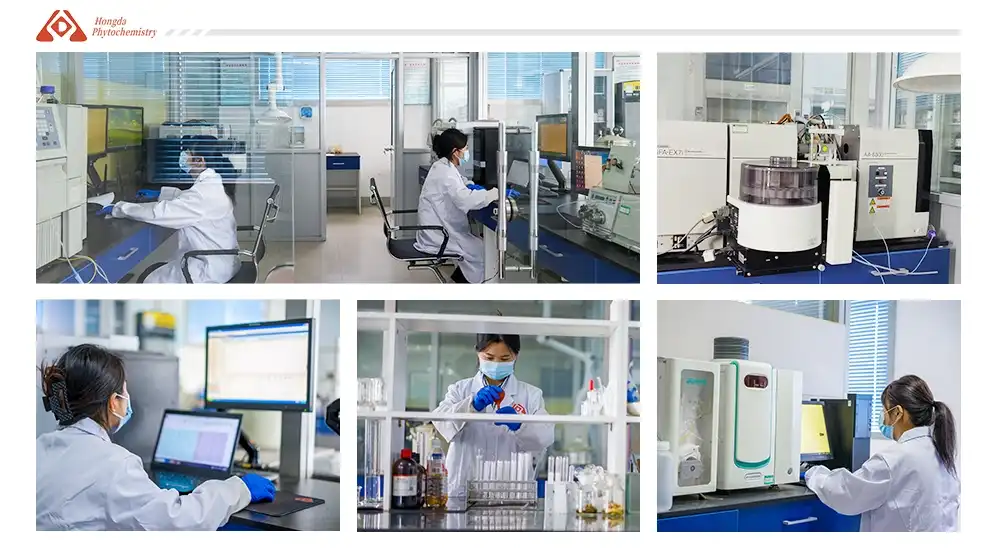
The traceability begins far before the homogenizer. The company has three planting bases: high mountain green tea, Sophora japonica, and Chinese medicinal materials, controlled by experienced agronomists, and applies the same source control to acquired inputs such as the ubiquinone crystal. Shaanxi Hongda Phytochemistry Co., Ltd. An auditor may travel backward through a chain of incoming identification testing, in-process sampling, and kept reserve samples on every batch of liposomal coenzyme Q10 powder. In cooperation with university professors, a standardized laboratory of SGS was established, which has more than twenty professor-level researchers and operates high-performance liquid chromatographs, gas chromatographs, spectrophotometers, and atomic absorption spectrophotometers, so that questions are answered with instrument records.
Qualification, Documentation and What Overseas Buyers Actually Receive
Certificates open the door; samples and logistics close the order.
Certificates That Clear US and EU Audits
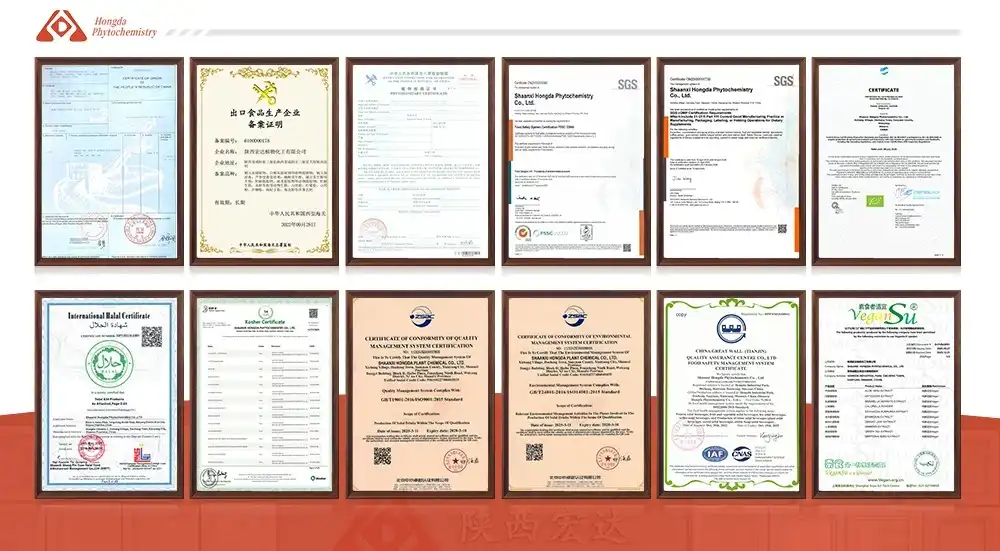
Founded in 2001 and awarded National High-tech Development Enterprise in 2010, Hongda has collected all the documents required by Western procurement teams before they issue their first purchase order: Food production licence, Feed additive production licence, Halal, Kosher, BRC, FDA registration, Organic certification, ISO22000 and ISO9001, with cGMP, FSSC22000, SC certification and EU and NOP organic scope to be added in 2025. That portfolio shaves the typical six-week document chase for a coenzyme powder wholesaler hitting the US market under DSHEA, or an EU launch where notification requirements are in place for nano-characterised chemicals. Halal and Kosher copies are supplied for qualifying lots and independent audits are invited, not rejected.
Samples, MOQ and Real Delivery Times
Commercial phrases are intentionally unglamorous. That is what makes them useful. A study in the laboratory begins with 10-50 g in 4-6 working days. A sample batch is 1 kilogram and a regular bulk shipment is 25 kg, packaged in a light-proof fiber drum with twin food-grade liners. The wait time for bulk is eight to eighteen working days, as supply and scheduling of ubiquinone allow, and warehouses in the United States and Western Europe deliver in three to five business days. Large-volume orders for liposomal coenzyme Q10 powder may be custom-labeled, and a coenzyme powder supplier can develop a supply around a liposome NAD+ plus Q10 premix.
Real Orders, Real Photos: What Buyers Receive
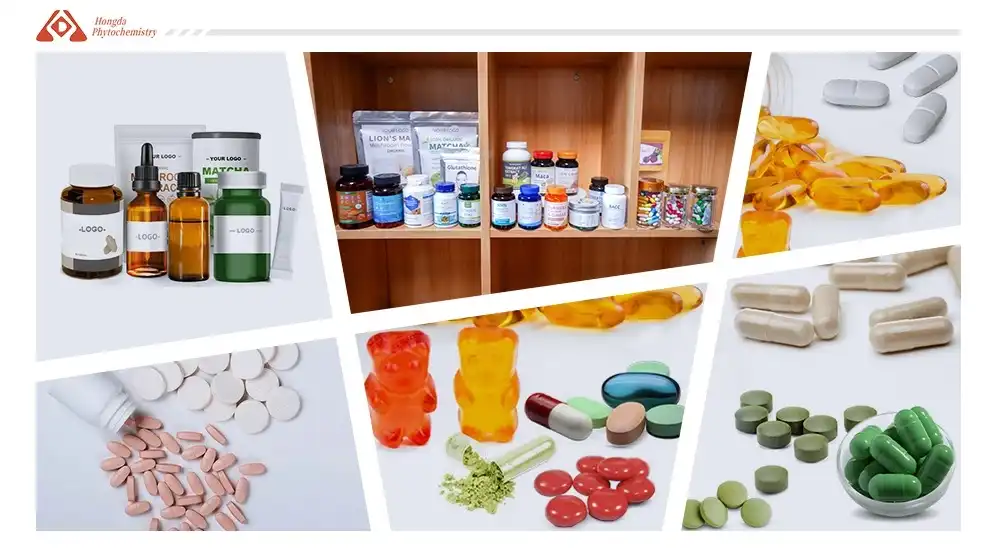
Photographic proof has discreetly been included in supplier certification, and Hongda leans into it. Buyers are provided with lot-stamped photographs of the drum, the inner liner, the retained sample jar and the reconstitution test, showing the powder becoming opaque within seconds. In the laboratory, the footage shows ultracentrifugation, where the real liposomes preserve the active part with the spheres of phospholipids, while the free CoQ10 goes away. If you want to examine the liposomal coenzyme Q10 powder under your own circumstances before you commit to volume, send your specification, dosage form, and market to duke@hongdaherb.com, and the technical team will match a lot, share the full COA set, and dispatch a sample.
Formulation Playbook: Where liposomal coenzyme Q10 powder Wins
Format freedom is where the shelf-life argument turns into margin.
Ready-to-Drink Beverages, Stick Packs, Oral Serums
Very much confined to softgels since ubiquinol is degraded by oxygen and light in water, and plain crystalline ubiquinone will not disperse. A water-dispersible liposomal coenzyme Q10 powder solves both of these constraints at once. It provides a stable, clear dispersion without sedimentation, oil ring, and almost no taste, since multi-stage refining eliminates the oily note of the phospholipid and the bilayer conceals the intrinsic astringency of Q10. That opens up ready-to-drink antioxidant shots, effervescent stick packs, oral beauty serums, and premium instant powders, sectors where a clean, visible dispersion is a quality signal in itself on camera. Hongda specially prepares the content for these uses.
Capsules, Tablets and Multi-Ingredient Premixes
With dry shapes, the advantage is mechanical, not pleasurable. The powder is free-flowing, has specified mass and tapped density, and 90% flows through 20 mesh. It runs on standard capsule fillers and tablet presses without the sticking and bridging that oil-heavy mixtures do. This is significant in multi-ingredient work when a liposomal coenzyme Q10 powder needs to co-exist in the same mix with botanicals, vitamins, and amino acids. Hongda’s premixed powder service is configurable, and its liposome NAD+ plus Q10 system enables businesses to launch a mitochondrial health SKU without having to qualify two delivery systems separately. The release test confirms that the label claim is for the capsule, not the blender alone.
Cost per Absorbed Milligram, Not per Kilogram
And ubiquinol raw material is frequently two to three times more expensive than ubiquinone. Nitrogen flushing, opaque packaging, and cold chain management add to the price. A liposomal material looks expensive on a per kg basis. This is usually backward on a per absorbed milligram basis, mathematically speaking. A smaller liposomal dose may replace a much greater conventional one.[1][3] In projecting annual volume for a coenzyme powder wholesaler, they should collectively consider dose size, assay retention at month eighteen, finished-pack specification, and freight class. Hongda's liposomal coenzyme Q10 powder contains the assay, encapsulation, and particle-size data to run that model, plus a 24-month shelf life that lets you carry inventory through a promotion cycle.
|
Finished format
|
Liposomal ubiquinone
|
Ubiquinol
|
|---|---|---|
|
Ready-to-drink shots
|
Translucent dispersion
|
Oxidises in water
|
|
Stick packs, instant powders
|
Dispersible, neutral taste
|
Not viable
|
|
Capsules, tablets
|
Free-flowing, 20 mesh
|
Softgel only
|
Conclusion
The redox advantage of ubiquinol is a liability it cannot escape for any product that has to sit on a shelf for two years. It begins oxidizing during filling, requiring nitrogen-flushed and light-proof packing, and yet is greatly reconverted on arrival to the gut. A liposomal coenzyme q10 powder based on ubiquinone turns that trade-off on its head, as the phospholipid bilayer gives you the dispersion and membrane attraction that make CoQ10 absorbable without a fatty meal, while the oxidized core holds its assay throughout mixing, shipping, and warehouse heat. The discipline that turns chemical into specification: high-pressure homogenization, a sunflower-phospholipid carrier, batch-by-batch testing, and a stipulated 24-month shelf life. Shaanxi Hongda Phytochemistry Co., Ltd. Select the format that still proves the label claim when the customer opens the bottle.
FAQ1. Is liposomal CoQ10 the same as ubiquinol?
No. The powder carries ubiquinone inside a phospholipid bilayer; the body reduces it after absorption, and most circulating CoQ10 is already ubiquinol.
2. How is the 24-month shelf life verified?
Each lot is tested at release for assay, encapsulation, particle size, and contaminants, and a retained reserve sample is kept for re-testing.
3. What is the minimum order?
Samples run 10–50 g in four to six working days; a trial batch is 1 kg and standard bulk is 25 kg per fibre drum.
4. Which certificates apply?
cGMP, FSSC22000, ISO22000, ISO9001, SC, BRC, FDA registration, Halal, Kosher, and both EU and NOP organic, with ISO-17025 verification available.
5. Can it go into beverages?
Yes. It forms a stable, translucent colloid in water with no oil release, suiting shots, stick packs, instant powders, and oral beauty serums.
Partner With HONGDA for Your Next Liposomal CoQ10 Launch
Shaanxi Hongda Phytochemistry Co., Ltd. has refined plant-derived actives since 2001, operating roughly 20,000 square metres of workshops, more than ten modern production lines and 100,000-level purification areas, with annual capacity near 3,000 tons and a 3,000-square-metre warehouse. Two R&D institutions, an SGS-standardized laboratory built with university professors and over twenty senior researchers, keep the pipeline moving. Whether you need a 10–50 g sample, a 1 kg trial batch or a 25 kg bulk shipment of liposomal coenzyme q10 powder, the team will match your specifications and ship from US or Western Europe stock within days. Email duke@hongdaherb.com for a quotation, the complete COA set, and formulation support.
References
1. Bhagavan, H.N. and Chopra, R.K. (2006). Coenzyme Q10: absorption, tissue uptake, metabolism and pharmacokinetics. Free Radical Research, 40(5), 445–453.
2. Littarru, G.P. and Tiano, L. (2007). Bioenergetic and antioxidant properties of coenzyme Q10. Molecular Biotechnology, 37(1), 31–37.
3. Miles, M.V. (2007). The uptake and distribution of coenzyme Q10. Mitochondrion, 7(Suppl. 1), S72–S77.
4. Akbarzadeh, A., et al. (2013). Liposome: classification, preparation, and applications. Nanoscale Research Letters, 8, 102.