


_1745918362135.webp)

The Quick Verdict for Supplement Brands
Two Ingredients, Two Different Roles
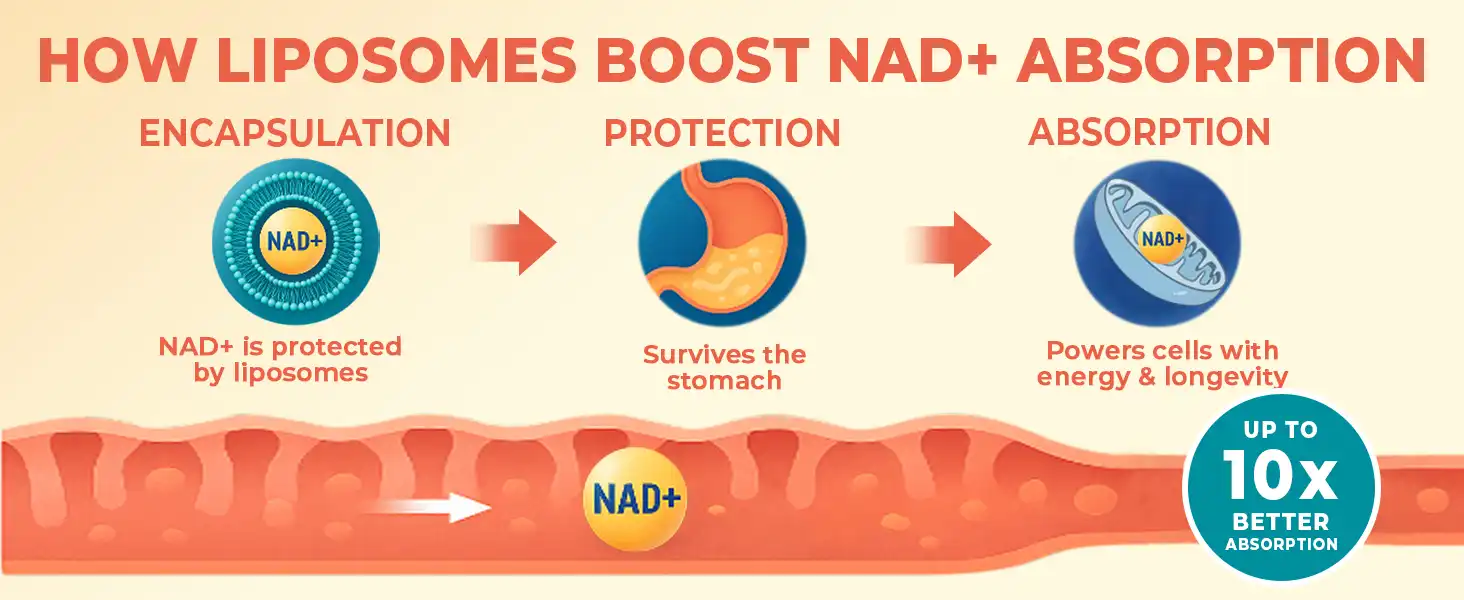
NR and NAD+ are commonly shown as enemies, yet they really have distinct places in the same route. NR is a precursor, and the body transforms it to NAD+ in numerous enzymatic processes. Liposomal NAD+ powder provides NAD+ itself; however, the NAD+ is protected in transit via digestion by a phospholipid bilayer. That distinction informs practically everything else, from the marketing language to the formulation to the pricing. NR is a mature, well-studied substance that is recognized by regulators in several markets. Liposomal NAD+ is a newer, distinct solution that appeals to companies that seek a direct NAD+ narrative backed by delivery technology. Neither is superior in all cases. The proper decision relies on your target client, your claims strategy, your budget, and the amount of technical storytelling you want to employ on the label.[1][4][5]
Where Liposomal NAD+ Powder Stands Out
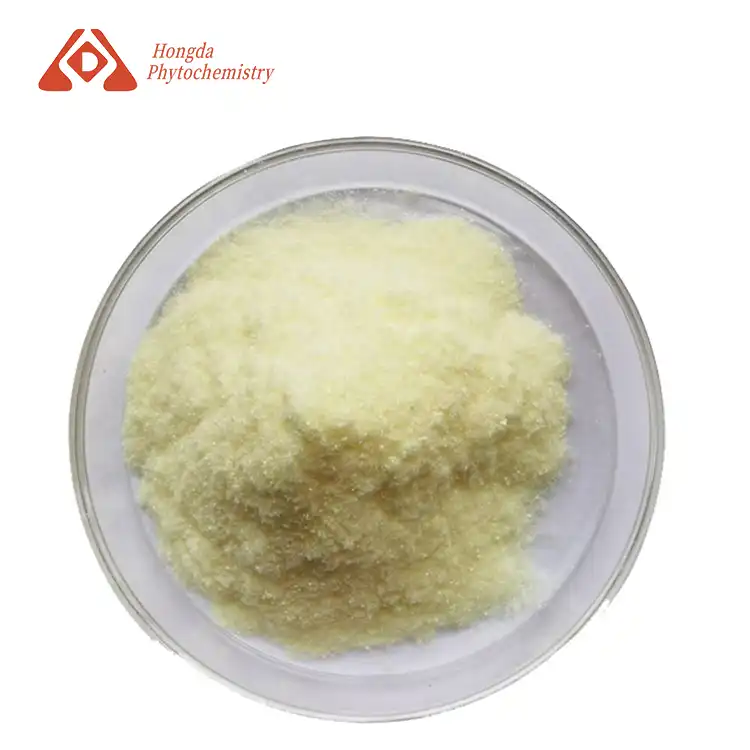
Liposomal NAD+ powder provides a brand with something that ordinary precursors can’t: a delivery-technology story based around the chemical that consumers already know. Hongda’s solution utilizes a phospholipid bilayer to protect NAD+ from stomach acid, provides >85% encapsulation, and may be delivered in powder or liquid form to support several forms. The powder is light yellow to white, with NAD+ purity of at least 98% by HPLC test, and technical remarks indicate ready-to-drink stability with no stratification or sedimentation after 48 hours at 4 degrees Celsius. Encapsulation may be validated by technique and data. Brands can substantiate their positioning using documentation. That combination of familiar brand, quantifiable delivery technology, and format flexibility is why several premium longevity lines are adding liposomal NAD+ powder to, or in place of, traditional precursors.
Where NR Still Wins
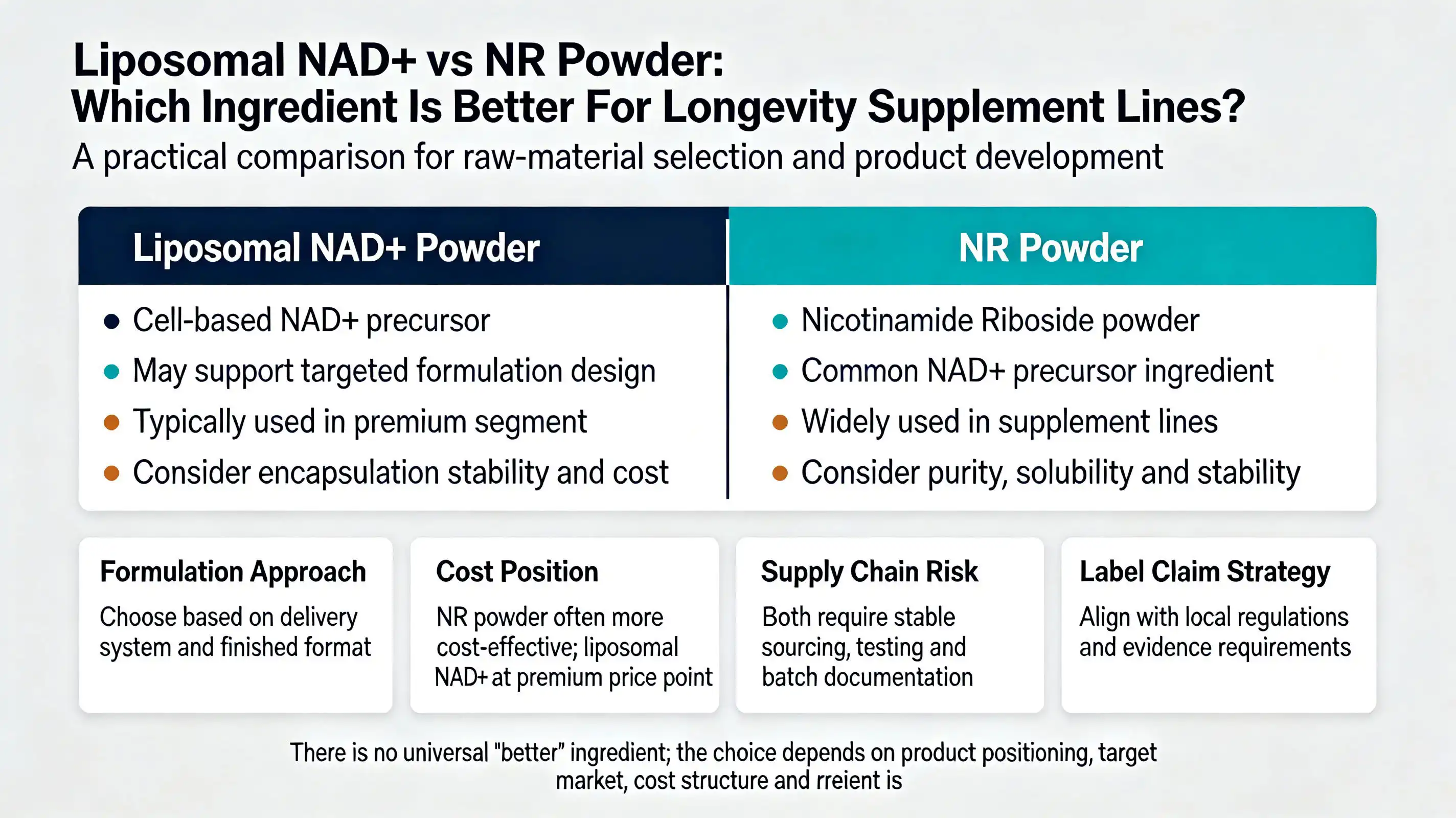
A fair comparison has to give credit to NR. It is a crystalline, chloride-stabilized substance accessible from numerous vendors, having a lengthy history in dietary supplements and recognized under regulations such as the EU Novel Food list. The simple, water-soluble powder can easily be dry-blended into capsules, and the dosage calculation is simple: 100 milligrams of nicotinamide riboside chloride delivers about 88 milligrams of nicotinamide riboside. There have been human trials looking at the impact of NR on blood NAD+ levels, and marketers have a corpus of data they can carefully quote. Brands focused on regulatory familiarity, reduced cost of ingredients, and straightforward capsules may well go for NR. Those looking for a distinct premium tale frequently couple it with or go toward liposomal NAD+ powder. Positioning the pair as complementary, not competitive, aids portfolio planning and preserves your credibility in your message.[2][3][4][6]
|
Feature
|
Liposomal NAD+ Powder
|
NR Powder (Chloride)
|
|---|---|---|
|
Role
|
NAD+ delivered directly in liposomes
|
Precursor converted to NAD+
|
|
Form
|
Light yellow to white powder; liquid also available
|
White crystalline powder
|
|
Key strength
|
Delivery-system story; encapsulation above 85%
|
Established, widely studied precursor
|
|
Verification
|
HPLC assay, encapsulation method, TEM
|
Purity and identity by HPLC
|
|
Storage
|
Cold, dry, away from light; 24-month shelf life
|
Dry and protected from heat and light
|
|
Positioning
|
Premium, differentiated
|
Familiar, accessible
|
How Each Ingredient Behaves in the Body and the Lab
The NR Route: From Precursor to NAD+
Cells take up NR, and nicotinamide riboside kinases phosphorylate NR to nicotinamide mononucleotide, which is subsequently transformed to NAD+. Because the process employs the body’s own enzymes, NR has become the standard for precursor methods and is included in many published human research assessing blood NAD+ levels. For a formulator, the attraction is simplicity: a tiny, water-soluble molecule that mixes readily into powders. The trade-off is that the conversion pathway, dosage, and result are person-to-person, and the tale is about promoting NAD+ production rather than delivering NAD+ itself. When comparing NR to liposomal NAD+ powder, note that you are comparing two strategies: providing the body building blocks or delivering a protected form of the final molecule. Every technique has its audience, and each requires clearly modest wording on the label.
The Delivery Challenge for NAD+ and the Liposomal Answer
However, plain NAD+ is a big, highly charged molecule that is easily degraded in the digestive system, which is why it has to be encapsulated in a liposome. According to the product site, Hongda’s liposomal NAD+ powder utilizes high-pressure homogenization to encapsulate high-purity NAD+ in a natural phospholipid bilayer, which acts as a protective barrier against stomach acid and enables it to be transported via a fusion process with cell membranes. The manufacturer claims better bioavailability than ordinary NAD+, but brands should consider any multiple-supplier claim to be validated in their own investigations. What can be checked directly is the delivery method itself. Encapsulation efficiency can be determined by ultracentrifugation and HPLC, TEM pictures, and particle size reports. These materials let a business describe the working of liposomal NAD+ powder without making ambiguous claims.
Evidence and Claims: What You Can Say Responsibly
Evidence demands caution considering that longevity is a claims-based category. NR has more published human evidence on boosting NAD+ levels. Research on oral liposomal NAD+ in humans is currently limited, which is usual for a novel delivery technology. That’s not to say the ingredient is out of the question; rather, your label and marketing must keep within structure-function language suited to each market, avoid illness claims, and depend on quantified quality data rather than hyperbolic promises. Concentrate on what you can substantiate: purity, encapsulation efficiency, particle architecture, and stability of your liposomal NAD+ powder. Have your regulatory advisors analyze the claims for each target area, since substance status and permissible language change. Responsible claims defend your brand from complaints and regulatory attention.[2][3][4]
Formulation and Manufacturing Realities
Stability, Storage, and Handling
Both elements command respect on the manufacturing floor. NR chloride is a crystalline salt, selected because it is more stable than the free form, although it is still subject to degradation by heat and moisture and must be maintained dry and protected from light. There is another point to consider with the liposomal NAD+ powder: phospholipid vesicles are more stable when kept cold. The shelf life of the powder is 24 months if stored properly, and Hongda suggests storing it in a cool, dark, and dry place. Plan your warehousing, shipping, and filling environment appropriately and utilize barrier packaging to restrict moisture and light. Wherever feasible, do a modest stability study on your own completed product, since the findings are influenced by the excipients and dosage forms. Regardless of what you choose, good handling maintains the ingredient you paid for and safeguards the reputation of your longevity line.
Dose Math and Cost per Serving
Price per kilogram is misleading since the two substances provide different quantities of active per gram. NR chloride is a very pure crystalline substance; therefore, a capsule may contain a few hundred milligrams of active. The liposomal NAD+ powder has a lipid carrier. For example, in Hongda’s example, delivery of 200 milligrams of elemental NAD+ generally requires around 1,000 milligrams of powder at a 20% active loading. Hongda states liposomal solutions may lower the quantity required per dosage, thanks to enhanced transport, but that advantage should be tested in your individual formulation. Calculate the cost per completed serving, including capsule size, number of capsules, and packaging, and compare it to the amount you can charge for a differentiated premium product. The cheapest raw material pricing doesn’t necessarily translate into the highest profit.
Dosage Forms: Capsules, Sachets, and Ready-to-Drink
NR powder is suitable for basic capsules and dry mixes. Hongda provides liposomal NAD+ powder in powder or liquid form, offering more flexibility, and specifies a particular modified powder that may disperse in water to form a stable nanoemulsion, showing no stratification or sedimentation for 48 hours at 4 degrees Celsius in ready-to-drink applications. That opens up beverage and sachet forms that are tough for many lifespan ingredients. Capsule fillers should be tested for flow and fill weight, as a powder containing lipids would act differently than a crystalline salt. Beverage producers should evaluate pH, temperature, and partner ingredients using the genuine liposomal NAD+ powder. No matter what format you decide to go with, remember that packaging selections impact dose, pricing, and user experience all at once, so get samples from your supplier early and execute a bench trial before you finalize your packing.
|
Question
|
NR Powder
|
Liposomal NAD+ Powder
|
|---|---|---|
|
Active per gram
|
About 88 mg NR per 100 mg NR chloride
|
Example: 200 mg NAD+ from about 1,000 mg powder at 20% loading
|
|
Best formats
|
Capsules and dry blends
|
Capsules, sachets, ready-to-drink; powder or liquid
|
|
Storage
|
Dry, protected from heat and light
|
Cold, dry, out of direct sunlight
|
|
Shelf life
|
Varies by supplier
|
24 months
|
|
Pilot order
|
Varies by supplier
|
MOQ 1 kg
|
Building the Longevity Line: Strategy and Sourcing
Single Hero, Duo, or Full Stack
Most brands seldom have to pick one. You may have a single-hero product with liposomal NAD+ powder as the premium centerpiece, clear label, and compelling quality narrative. Hongda’s staff can help with tailored coating solutions that also incorporate NMN, and a duo might combine it with resveratrol. A larger stack may be able to provide NR in an entry-level product and liposomal NAD+ in a premium tier, offering clients a clear upgrade route. Consider the shelf: several levels, each with a narrative, limit competition inside the shelf and enable you to address different price points. Test each notion with your target clients before you finalize. Have ingredient documentation for merchants that question why the tiers are different. A portfolio of honest disparities is more likely to age well than a portfolio of overstated superiority, and a liposomal NAD+ powder is a good match for that.
Regulatory and Documentation Checks
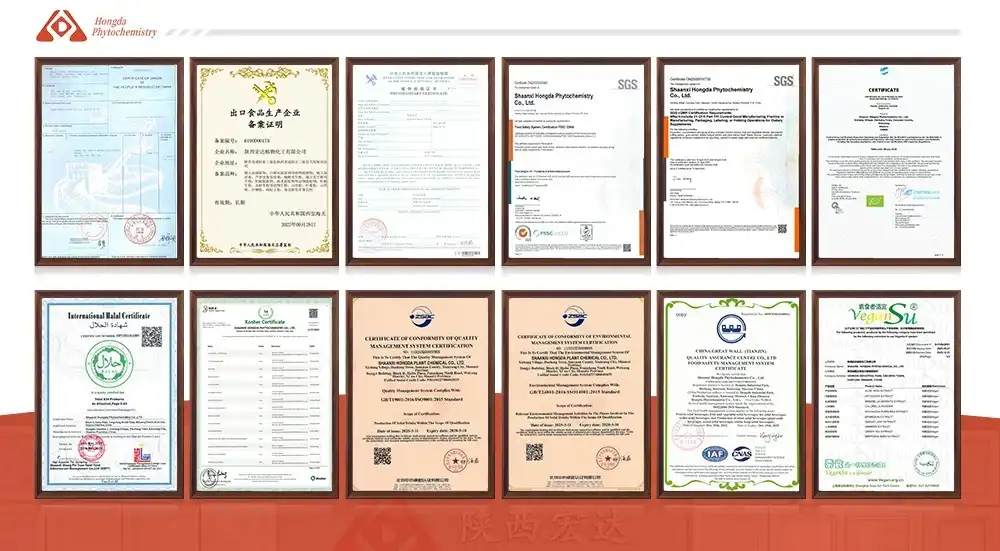
Check how each element is handled in each target market before you launch. Regulatory status varies by area and may vary for NAD+ precursors and NAD+ itself, so engage your regulatory experts early and retain records. Ask your supplier to provide a COA with HPLC testing, GMP-compliant microbiological findings, the encapsulation procedure, and TEM and particle size data for liposomal NAD+ powder. Hongda factory tests the ingredients, pesticide residues, moisture, heavy metals, and microbes before shipping. Hongda factory has ISO22000, FSSC22000, halal, kosher, BRC, and US FDA registration; cGMP will be added in 2026. Retailers and marketplaces are asking for this paperwork more and more, and having it available shortens approvals. Don’t let paperwork be an afterthought. Treat it as part of the product.
Choosing Hongda as Your Liposomal NAD+ Partner
If you decide to include a liposomal option, choose a partner who can prove quality and deliver consistently. Shaanxi Hongda was established in 2001, operates about 20,000 square meters of factory space with more than 10 production lines and 100,000-level purification workshops, and employs more than 150 workshop technicians backed by an SSGS-standardizedlaboratory. Hongda offers a 11-kilogramminimum order for pilot work, customized formulation and packaging, and usually ships within 1 to 3 days of payment. Its technical team can share encapsulation data and help you plan trials for capsules, sachets, or beverages. Send your target dose, format, and market, and request a sample of liposomal NAD+ powder so your team can compare it directly against your current NR formula.
|
Brand Goal
|
Better Fit
|
Why
|
|---|---|---|
|
Lowest entry price, simple capsule
|
NR powder
|
Crystalline, familiar, easy to dry-blend
|
|
Premium, differentiated positioning
|
Liposomal NAD+ powder
|
Delivery-system story backed by verifiable data
|
|
Sachet or beverage format
|
Liposomal NAD+ powder
|
Powder or liquid; ready-to-drink stability data
|
|
Tiered portfolio
|
Both
|
NR entry tier, liposomal premium tier
|
Conclusion
NR and liposomal NAD+ powder are not competing products but separate tools. NR provides familiarity and ease of handling and a solid research background. Liposomal NAD+ delivers a distinct delivery narrative, format flexibility, and encapsulation data that can be confirmed. Often the smartest longevity lines utilize both, deploying both where their qualities suit the client and the price range. Shaanxi Hongda Phytochemistry Co., Ltd. offers a liposomal side with encapsulation over 85%, a 24-month shelf life, a 1-kilogram minimum order, and certified facilities. Compare samples in your own formulas, calculate cost per serving, keep claims responsible, and let your data guide the decision.[3][4]
FAQ
Q1. Is liposomal NAD+ powder the same as NR?
No. NR is a precursor converted to NAD+, while liposomal NAD+ delivers NAD+ itself inside phospholipid vesicles.
Q2. What encapsulation level does Hongda report?
Above 85%, measured by ultracentrifugation followed by HPLC analysis.
Q3. Which formats suit liposomal NAD+ powder?
Capsules, sachets, and ready-to-drink products; it is also available as a liquid.
Q4. How much powder delivers 200 mg of NAD+?
In Hongda's example, about 1,000 mg at 20% active loading.
Q5. What are the MOQ and shelf life?
The MOQ is 1 kg, and the shelf life is 24 months, stored cold, dry, and away from direct sunlight.
Start Your NAD+ Line With HONGDA Today
If you are planning a longevity line and want to compare liposomal NAD+ powder with your current NR formula, HONGDA is ready to help. Our team will send a sample with a COA and encapsulation method, share formulation ideas for capsules, sachets, and beverages, and quote factory-direct prices with an 11-kilogram minimum order for pilot trials. Tell us your target dose, format, and market, and we will suggest a practical path from bench trial to pilot batch to repeat orders. Write to duke@hongdaherb.com today and build your next premium product on data you can verify.
References
1. Bieganowski P, Brenner C. Discoveries of nicotinamide riboside as a nutrient and conserved NRK genes establish a Preiss-Handler independent route to NAD+ in fungi and humans. Cell. 2004;117(4):495–502.
2. Trammell SAJ, Schmidt MS, Weidemann BJ, et al. Nicotinamide riboside is uniquely and orally bioavailable in mice and humans. Nature Communications. 2016;7:12948.
3. Martens CR, Denman BA, Mazzo MR, et al. Chronic nicotinamide riboside supplementation is well-tolerated and elevates NAD+ in healthy middle-aged and older adults. Nature Communications. 2018;9:1286.
4. Yoshino J, Baur JA, Imai SI. NAD+ intermediates: the biology and therapeutic potential of NMN and NR. Cell Metabolism. 2018;27(3):513–528.
5. Liu L, Su X, Quinn WJ 3rd, et al. Quantitative analysis of NAD synthesis-breakdown fluxes. Cell Metabolism. 2018;27(5):1067–1080.
6. Conze D, Brenner C, Kruger CL. Safety and metabolism of long-term administration of NIAGEN (nicotinamide riboside chloride) in a randomized, double-blind, placebo-controlled clinical trial of healthy overweight adults. Scientific Reports. 2019;9:9772.