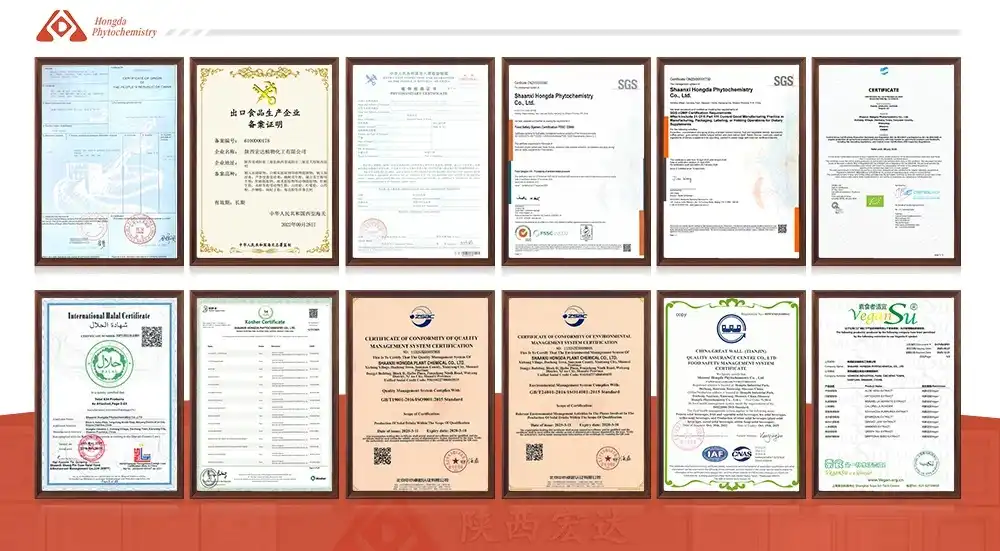
When buying iron supplements in bulk, the licenses of the company that sells them are just as important as the iron supplements themselves. There are differences between companies that make ferrous bisglycinate powder. The difference between a certified and inspected plant and one that isn't certified can mean the difference between a product getting through customs and one not getting through. Hongda Phytochemistry, whose full name is Shaanxi Hongda Phytochemistry Co., Ltd., has spent more than 20 years building a collection of certifications that buyers in the US, EU, and other places can trust. Their ferrous bisglycinate powder is made and checked to meet the standards that global buying teams actually need. These standards include cGMP, FSSC22000, Halal, Kosher, and Organic (both EU and NOP).[5][6] These concerns are especially relevant given that iron is a fundamental essential nutrient in human physiology and global iron deficiency remains one of the most widespread micronutrient issues worldwide.[3][4]
Why Are Certifications the First Thing Serious Buyers Check?
The Link Between Certification and Market Access
Certifications are more than just awards; in many places, they are required by law or business. Most well-known brands won't even try to sell a food product with iron glycinate powder in the US without FDA compliance paperwork or GMP certification. In the same way, European buyers need FSSC22000 or ISO22000 as a minimum standard for managing food safety. If a provider has these qualifications, it means that their whole production system has been checked by a third party against widely recognized standards, from receiving raw materials to releasing the last batch.[5][6] For sellers, that means less work for auditors, faster hiring, and no need for expensive in-house proof.
Quality Systems Behind the Credentials
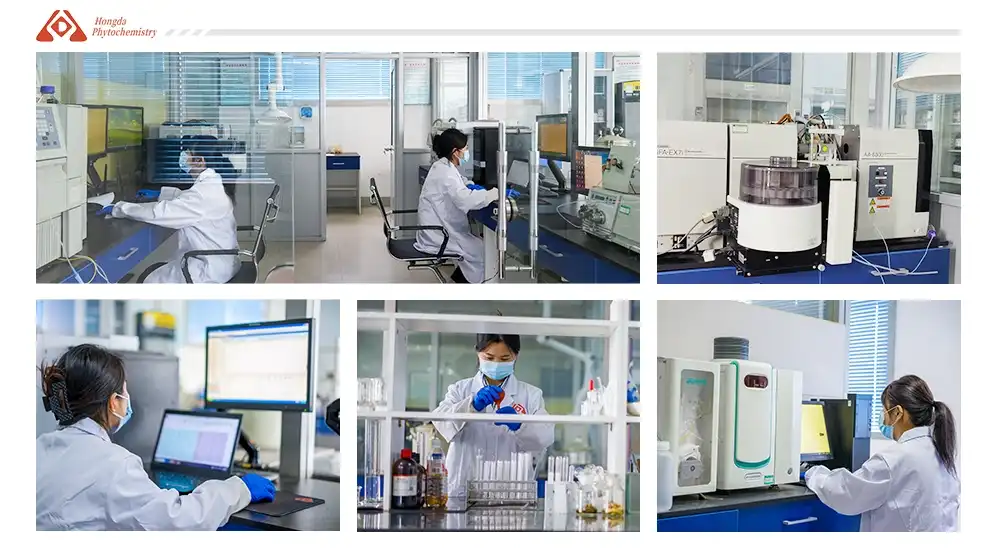
It's not enough for an ISO9001 approval to say "this product is good." It means that the provider has a written quality control system that can be used again and again. This system keeps track of deviations, takes corrective actions, and builds ongoing improvement into the workflow. This kind of system-level control is necessary for a product like ferrous bisglycinate powder that is very sensitive to technical issues. From a nutritional science perspective, iron status and deficiency continue to be major public health concerns across both developing and developed markets.[3][4] The absorption is directly affected by the binding rate, particle size distribution, and stability under processing conditions.[1][2] Over 20 professor-level R&D and testing staff work in Shaanxi Hongda's SGS-standard laboratory. They do regular research using HPLC, gas chromatography, atomic absorption spectrophotometry, and other methods.[6] That's not just acts of compliance; it's also practical science.
What Do Buyers Lose Without Verified Suppliers?
Working with a ferrous bisglycinate maker that isn't approved comes with risks that don't usually become apparent until it's too late. These risks include chelation rates that aren't consistent between runs, heavy metal content that isn't revealed, pesticide residue violations at customs, or bacterial contamination. When these things go wrong, it can cost a lot more than the money you saved by buying from a cheaper, less reliable source.[5] A single FDA import alert or EU border rejection costs a lot more than buying from a source who is properly approved from the start.
Core Certifications Every Ferrous Bisglycinate Powder Supplier Should Hold
Shaanxi Hongda holds every single certification in the table below, including cGMP and FSSC22000, newly obtained in 2025—reflecting a proactive approach to meeting evolving global standards rather than simply maintaining historical compliance.[5][6]
|
Certification
|
Scope
|
Why It Matters for Iron Supplements
|
|
cGMP
|
Manufacturing process compliance
|
Ensures consistent production quality and cleanliness standards
|
|
ISO9001
|
Quality management systems
|
Validates systematic quality controls across all operations
|
|
ISO22000 / FSSC22000
|
Food safety management
|
Required for food-grade supplement ingredients in major markets
|
|
HALAL
|
Religious dietary compliance
|
Essential for Middle East, Southeast Asia, and Muslim-majority markets
|
|
KOSHER
|
Religious dietary compliance
|
Required for Jewish-market distribution and many US natural health brands
|
|
BRC (BRCGS)
|
British Retail Consortium standards
|
Key for UK and EU retail supply chains
|
|
Organic (EU) / Organic (NOP)
|
Certified organic sourcing
|
Supports clean-label and organic product formulations
|
|
FDA Registration
|
US regulatory compliance
|
Required for products entering or manufactured for the US market
|
cGMP: The Baseline for Pharmaceutical and Supplement Manufacturing
When buying drugs in the US or other countries, many people first check to see if they are approved under cGMP. For companies that sell ferrous bisglycinate powder, it makes sure they follow rules that keep things quiet, clean, and free of mistakes while the powder is being made.[6] In places that follow cGMP rules, temperature and humidity rules are very strict during the spray-drying process. This is especially true for iron that has been chelated. To keep the chemical link clean, this has to be done. The uptake of ferrous bisglycinate is better than that of other iron salts because of this. Hongda has cleaning workshops that are up to the level of 100,000 and at least 10 current production lines that can work in these conditions. For a lot of people, they can make up to 3,000 tons of things a year.
FSSC22000 and ISO22000: Food Safety as a System, Not an Afterthought
Food safety shouldn't be an aside; it should be a part of the whole. A standard called FSSC22000, which stands for "Food Safety System Certification," is accepted by the GFSI. It combines ISO22000 with other prerequisite programs that are specific to the food business. FSSC22000 is becoming more and more important for ingredients that will be used in functional foods, baby formula with extra vitamins and minerals, ferrous bisglycinate powder, and clinical nutrition products. It means looking at dangers, keeping track of goods, dealing with pests, and keeping an eye on sources, among other things.[5][6] The raw materials that Hongda needs come from three clearly marked growing bases. Professional agronomists keep an eye on one of these sites, which is a place to put Chinese medicine materials. From here on out, the seeds can be followed all the way through the package.
Halal and Kosher: Unlocking Global Market Segments
Companies that make iron glycinate powder in bulk don't always have both Halal and Kosher certifications, but when they do, they can sell to a huge range of people. In the Middle East, Southeast Asia, and North Africa, where people follow strict religious diets and need iron pills, you can sell your goods if they are halal. In the US and around the world, many natural health brands and Jewish groups need kosher approval. A lot of people who aren't religious see it as a sign of quality that goes beyond religious rules. Both approvals have always been up to date at Shaanxi Hongda. This means that customers can change the label or recipe without having to switch their iron source.
How Does Hongda's Manufacturing Infrastructure Support Certification Claims?
Scale That Doesn't Compromise Precision
Certifications only mean something if the facility behind them can actually deliver consistently at scale. Shaanxi Hongda's factory covers approximately 20,000 square meters and runs more than 10 modern production lines. The warehouse alone spans 3,000 square meters with six dedicated storage zones—vitamins and amino acid products, including Ferrous Bisglycinate Powder, are stored in Zone E under controlled conditions with professional sterilization protocols. This level of infrastructure is what allows Hongda to guarantee a 3–7 working day lead time while maintaining the batch-to-batch consistency that certified manufacturing demands.
Proprietary Technology That Elevates Product Quality
Certifications verify process controls, but Hongda's product quality advantage goes deeper. Their core "all-aqueous phase chelation + constant temperature spray drying" technology achieves a chelation rate greater than 95%, with iron bioavailability 3–4 times higher than conventional inorganic iron salts. This means less elemental iron is needed per dose to achieve the same therapeutic or nutritional effect — a meaningful formulation advantage for supplement developers managing label claims and dosage economics. The resulting ferrous bisglycinate powder (CAS No. 20150-34-9, specification >20% elemental iron) presents as a dark brown or grayish-green powder with consistent particle size and excellent stability in both solid and liquid formulations.
Testing Protocols That Go Beyond Minimum Compliance
Before any shipment leaves Hongda's facility, each batch of ferrous bisglycinate powder and iron glycinate powder is tested for active ingredient content, pesticide residues, moisture levels, heavy metals, and microbiological parameters. This multi-point testing regime is conducted in Hongda's SGS-standardized laboratory using equipment including high-performance liquid chromatographs, atomic absorption spectrophotometers, and melting point meters. It reflects not just what certifications require but also what buyers actually need to clear import controls in the US, EU, and other regulated markets.
For product developers and procurement teams evaluating new suppliers, it is often helpful to request detailed specifications, certification documents, and sample testing reports directly from the manufacturer to ensure full alignment with regulatory and formulation requirements. If you would like to review technical documentation or discuss bulk supply options for ferrous bisglycinate powder, you can contact the Hongda team at duke@hongdaherb.com for direct support and product information.
Matching Certifications to Your Target Market
Hongda's certification matrix covers every major regulated market, making them one of the few ferrous bisglycinate manufacturer options capable of supplying a single product into multiple regions simultaneously—without reformulation or recertification on the buyer's side.
|
Target Market
|
Required / Strongly Preferred Certifications
|
|
United States
|
cGMP, FDA Registration, Kosher (often expected), ISO9001
|
|
European Union
|
FSSC22000 or ISO22000, BRC, Organic EU (if applicable)
|
|
Middle East / GCC
|
Halal, ISO9001
|
|
Southeast Asia
|
Halal, ISO22000
|
|
United Kingdom
|
BRC (BRCGS), ISO9001
|
|
Global Clean Label / Organic
|
Organic NOP (US), Organic EU, Non-GMO documentation
|
Organic Certification: Meeting the Clean-Label Demand
Both EU Organic and NOP (National Organic Program, US) certifications were newly obtained by Shaanxi Hongda in 2025, reflecting a deliberate expansion into the premium clean-label segment. As consumers and brands increasingly demand organic-certified ingredients—even in functional nutrition and supplement categories—having a certified ferrous bisglycinate powder source gives formulators a competitive edge. Hongda's organic certifications are backed by their planting base operations, where professional agronomists manage cultivation without prohibited inputs, ensuring traceability from soil to shelf.
BRC Certification and European Retail Supply Chains
The BRCGS (formerly BRC) Food Safety Standard is a prerequisite for supplying to most major UK and European retailers and contract manufacturers. It covers product safety, quality, operational criteria, and supplier management in depth. For a bulk ingredient like ferrous bisglycinate powder, BRC certification signals to European buyers that the supplier has been independently audited against a rigorous, retail-grade standard—not just the regulatory minimum. This is particularly relevant for buyers supplying supermarket-branded supplements or private label health products in the UK or mainland Europe.
National High-Tech Enterprise Status and Patent Portfolio
Beyond international certifications, Shaanxi Hongda holds China's "National High-Tech Enterprise" designation—awarded in 2010 and maintained since—along with multiple national patent technologies. This status reflects recognized innovation capability, not just manufacturing compliance as a ferrous bisglycinate manufacturer. It also supports Hongda's two dedicated R&D institutions, which employ more than 20 experienced researchers continuously developing new products and improved processes. For buyers interested in custom specifications, novel delivery formats, or co-development projects involving iron glycinate powder, this R&D depth is a significant differentiator.
Conclusion
Choosing a certified bulk ferrous bisglycinate powder supplier isn't about checking boxes—it's about protecting your supply chain, your customers, and your market access. Shaanxi Hongda Phytochemistry Co., Ltd. has built a certification portfolio that covers every major regulated market: cGMP, FSSC22000, ISO9001, ISO22000, BRC, Halal, Kosher, FDA, and both EU and NOP Organic. Backed by 24 years of manufacturing experience, a 3,000-ton annual capacity, and proprietary chelation technology, Hongda offers what most suppliers can't—verified quality at commercial scale.
FAQ
1. What is ferrous bisglycinate powder used for?
It is a chelated iron supplement used to prevent and treat iron deficiency anemia, widely used in dietary supplements, infant formula, and fortified foods due to its high bioavailability.
2. What certifications does Shaanxi Hongda hold for ferrous bisglycinate powder?
Hongda holds cGMP, FSSC22000, ISO9001, ISO22000, BRC, Halal, Kosher, FDA, Organic (EU), and Organic (NOP) certifications, among others.
3. What is the MOQ and lead time for bulk orders?
Hongda offers flexible MOQ options, especially for new customers. Standard packing is 25 kg/drum, with a typical lead time of 3–7 working days.
4. How does Hongda's Ferrous Bisglycinate Powder differ from regular iron supplements?
Hongda's proprietary chelation technology achieves a chelation rate >95%, delivering iron bioavailability 3–4 times higher than conventional inorganic iron salts, with superior stability in both solid and liquid formulations.
References
1. Hurrell, R., & Egli, I. (2010). Iron bioavailability and dietary reference values. The American Journal of Clinical Nutrition, 91(5), 1461S–1467S.
2. Bovell-Benjamin, A. C., & Guinard, J. X. (2003). Novel approaches and application of contemporary sensory evaluation practices in iron fortification programs. Critical Reviews in Food Science and Nutrition, 43(4), 379–400.
3. Yip, R., & Dallman, P. R. (1996). Iron. In E. E. Ziegler & L. J. Filer (Eds.), Present Knowledge in Nutrition (7th ed., pp. 277–292). ILSI Press.
4. Lynch, S. R. (2011). Why nutritional iron deficiency persists as a global problem. Journal of Nutrition, 141(4), 763S–768S.
5. Codex Alimentarius Commission. (2015). General Principles of Food Hygiene (CAC/RCP 1-1969, Rev. 4). Food and Agriculture Organization of the United Nations.
6. International Organization for Standardization. (2018). ISO 22000:2018 — Food Safety Management Systems: Requirements for any organization in the food chain. ISO Publishing.




_1745918362135.webp)