



What is the difference between raw griffonia seed powder and standardized griffonia simplicifolia seed extract?
Brands that make sleep, mood, and appetite supplements for dependable results must understand the difference between raw griffonia seed powder and standardized griffonia simplicifolia seed extract. They both come from the same shrub in Africa but are very different in potency, stability, and regulatory value. "Hongda Phytochemistry is a professional manufacturer of high-purity griffonia simplicifolia seed extract standardized to 20%-99% natural 5-HTP by HPLC, ultra-low moisture (<5%), strict heavy metal control, and complete traceability. Shaanxi Hongda Phytochemistry Co., Ltd. Our extract has consistent dosing from batch to batch, excellent fluidity, and 24-month stability for capsules, tablets, and premixes. Our extract is produced in 100,000-level purification workshops to meet global market requirements, rather than crude powder with variable activity.
At a Glance: Raw Griffonia Seed Powder vs. Standardized Extract
For busy procurement and R&D teams, the fastest way to evaluate total cost-in-use is to compare specifications, not just price per kilogram. This high-traffic overview helps you avoid under-dosed or unstable finished products.
What Raw Griffonia Seed Powder Actually Is
Raw griffonia seed powder is simply the dried and milled seed of the griffonia simplicifolia plant without concentration or standardization, which fundamentally limits its use in modern supplements. The natural 5-HTP content in wild seeds fluctuates between 5% and 15% depending on season, soil, and maturity, so every lot of raw powder delivers a different dose and forces brands to overfill to meet label claims. The powder retains oils, fibers, and pigments that increase moisture uptake, caking, and microbial load due to minimal processing. Buyers tempted by low-cost griffonia simplicifolia seeds for sale often face hidden costs later in failed assays, darkening, and unstable blends. In contrast, a professionally purified griffonia simplicifolia seed extract removes these matrix compounds and concentrates the active into a controlled, pharma-grade ingredient.
What Standardized Griffonia Simplicifolia Seed Extract Really Means
Standardized Griffonia simplicifolia seed extract is defined by a guaranteed percentage of natural 5-Hydroxytryptophan (5-HTP), usually 20%, 30%, 95%, 98%, or 99% by HPLC. This means that every kilo of griffonia simplicifolia seed extract is a verified, repeatable dose, so you can know exactly how strong your capsules are without any guesswork. Hongda Phytochemistry can ensure this consistency by low-temperature ethanol-water extraction and then purification by macroporous resin and vacuum drying at 60 degrees C to retain 5-HTP activity and reduce the moisture and residual solvents to pharma-grade limits. The resulting griffonia simplicifolia seed extract is off-white to white in color and free-flowing. It retains 95-105% assay after accelerated testing, ensuring reliable performance for brands from pilot to mass production.
Quick Decision Matrix for Capsule and Blend Brands
In dosage, logistics, and shelf life, standardized extract is clearly superior to raw powder when the cost-in-use is considered. While it may appear to be more economical to use crude powder, it takes five to ten times the amount of material to get the same 5-HTP dose as concentrated griffonia simplicifolia seed extract, which means larger capsules, higher excipient loads, and increased shipping weight. Standardized griffonia simplicifolia seed extract also simplifies QC, as you test one potent marker instead of a moving target, reducing lab costs and batch rejections. Importantly, sourcing from a qualified producer ensures full traceability, COA, and stability data that raw powder traders are unlikely to supply, enabling brands to get through retailer audits faster. The predictable performance is what has led top sleep and mood brands to now require standardized griffonia simplicifolia seed extract.
Table 1: Raw Powder vs. Standardized Griffonia Simplicifolia Seed Extract (Ref: Hongda Product Specification)
|
Attribute
|
Raw Griffonia Seed Powder
|
Hongda Standardized Griffonia Simplicifolia Seed Extract
|
|---|---|---|
|
5-HTP Content
|
5-15% variable, no guarantee
|
20%–99% guaranteed by HPLC
|
|
Appearance
|
Dark brown, coarse, fibrous
|
Off-white to light beige, fine powder
|
|
Loss on Drying
|
8-12%, highly hygroscopic
|
≤5.0%, vacuum-dried
|
|
Heavy Metals / Pesticides
|
Often unscreened
|
Tested to EU EC 396/2005, USP limits
|
|
Application
|
Unstable for precise dosing
|
Ideal for capsules, tablets, premixes
|
The 5-HTP Core: Potency, Stability, and Discoloration Control
The value of any griffonia simplicifolia seed extract is determined by authentic 5-HTP activity and its ability to remain stable and visually clean throughout shelf life.
Why Exact 5-HTP Percentage Determines Dose Accuracy
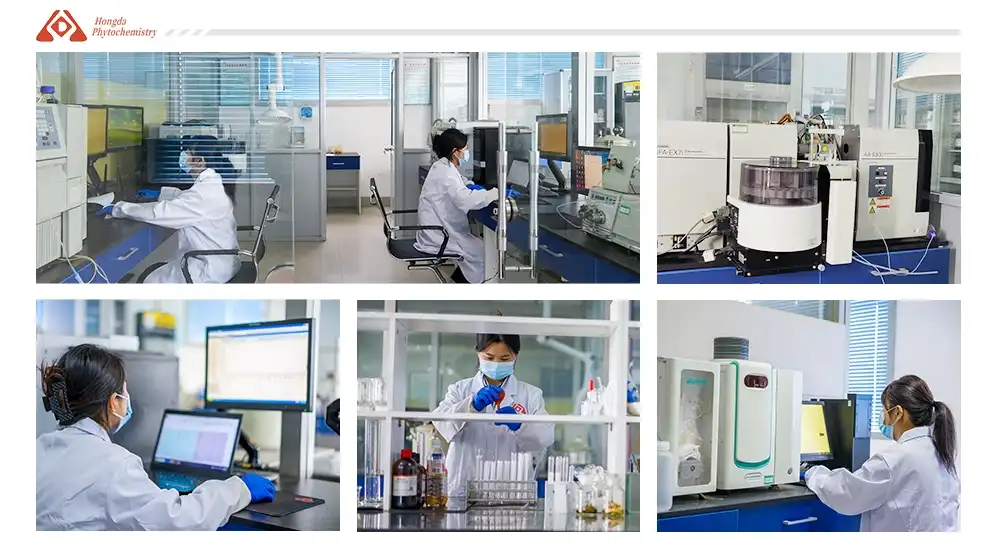
The effectiveness of griffonia simplicifolia seed extract comes from the natural, bioactive 5-HTP in the seed, not the synthetic fermentation. HPLC shows true activity at 218nm with a characteristic retention time.[3] Hongda's griffonia simplicifolia seed extract shows a single dominant 5-HTP peak with ≥98% purity in high-grade material, confirmed in our SGS-standardized laboratory with high-performance liquid chromatographs and spectrophotometers. Low-grade material can lead to an overestimation of UV readings, but fails HPLC fingerprinting, leading to under-dosed capsules and an inconsistent supply of serotonin precursors. Reputable griffonia simplicifolia seed extract suppliers will provide dual UV+HPLC verification of every lot, letting formulators target 50-100 mg 5-HTP per serving with confidence. That precision is important for capsule brands, which need to hit exact claims on their labels and pass retailer testing.
Hygroscopicity and Caking: How Moisture Destroys Potency
Even high-purity griffonia simplicifolia seed extract is hygroscopic because 5-HTP contains amino and hydroxyl groups that readily bind ambient water. Moisture above 5% causes rapid caking, darkening, and assay loss. Many of the capsule failures are due to moisture migration during the blending process, especially with hygroscopic botanicals. Hongda achieves this by vacuum belt drying at 60 degrees C, then immediately milling under nitrogen protection and double-layer aluminum foil packaging with desiccants to lock moisture under 4.5%. Our Griffonia simplicifolia seed extract is processed to a uniform particle size to reduce surface exposure and improve flow, thereby eliminating bridging during high-speed encapsulation. If you are experiencing caking or weight variation, please reach out to our team at duke@hongdaherb.com for a free compatibility check, moisture isotherm review, and sample COA.
Powder Discoloration: Oxidation Triggers and Factory Prevention
When fresh and of high purity, it should be off-white to light beige in color. Grey-brown or pinkish in color indicates oxidation or residual impurities from incomplete purification. Heat, light, and trace metal ions catalyze oxidative degradation of 5-HTP to inactive pigments with resulting discoloration, a process that is accelerated by high moisture and iron contamination. At Hongda, we use low-temperature concentration, controlled pH level activated carbon decolorization, and chelation rate detection screening for pro-oxidant metals such as Fe³⁺ and Cu²⁺ by atomic absorption spectrophotometry. Each batch of griffonia simplicifolia seed extract is tested for color, light exposure assay retention, and metal chelation profile to ensure visual and chemical stability for 24 months. The control makes for a cleaner-looking capsule and tells consumers that the active has not degraded.
From Harvest to HPLC: Factory Process and Batch Quality
Stability and purity of griffonia simplicifolia seed extract are built in the factory long before the powder reaches your blending line, starting with how the seed is harvested.
Harvest Window and Seed Maturity: The Origin of High Yield
The journey to a stable griffonia simplicifolia seed extract begins in the savannas of Ghana and Togo, where the griffonia simplicifolia plant grows wild. Seeds harvested too early contain immature 5-HTP and excess moisture, while overripe seeds suffer mold and pesticide accumulation that complicate purification. Hongda works with GAP-managed bases and contract collectors who harvest at peak maturity when pods turn dark brown and 5-HTP peaks, with agronomists supervising traceability from farm to factory. Unlike spot traders offering griffonia simplicifolia seeds for sale with no documentation, we log geolocation, harvest date, and drying conditions for every lot that becomes griffonia simplicifolia seed extract. This discipline ensures higher initial potency, lower bioburden, and fewer pigments to remove, resulting in a whiter, more stable extract and faster batch release.
Low-Temperature Extraction and Chelation-Controlled Purification
The factory process determines whether your griffonia simplicifolia seed extract retains full activity or arrives partially degraded. Hongda’s 20,000-square-meter facility operates more than 10 modern production lines and 100,000-level purification workshops where extraction uses food-grade ethanol-water at a controlled low temperature, followed by macroporous resin purification and membrane concentration that avoids thermal stress. Critically, we integrate chelation rate detection during purification to remove metal ions that would otherwise bind to 5-HTP and accelerate oxidation in storage. Our SGS-standardized lab, staffed by over 20 professor-level analysts, quantifies residual metals to ppm levels via atomic absorption and ICP-MS, ensuring each batch of griffonia simplicifolia seed extract meets strict EU and USP limits. This chelation-controlled process is a soft CTA for R&D teams seeking reproducible, long-term inertness in capsule blends.
Real Factory Case: Stabilizing Color and Moisture for a European Client
We were approached by a European private label brand that had a sleep capsule with a griffonia simplicifolia seed extract that was turning brown after three months when mixed with magnesium citrate. We invited their QA team for a live video audit and showed actual production pictures of vacuum drying, sieving, and foil packaging under dehumidified conditions (RH <30%). They had already tested their griffonia simplicifolia seed extract and found it to be high in iron and to contain 6.8% moisture, which caused oxidation. The solution was to use Hongda’s low-moisture, chelation-controlled Griffonia simplicifolia seed extract with uniform particle distribution. ICH accelerated studies at 40 °C/75% RH for 6 months demonstrated retention of 98.1% in the assay, and the color remained off-white. We also gave them batch-specific HPLC chromatograms & climate-controlled Zone C/D warehouse records, which gave confidence to their team to scale 500 kg quarterly orders rather than buying griffonia simplicifolia seeds for sale.
Table 2: Hongda Griffonia Simplicifolia Seed Extract Specification & QC (Ref: Hongda Lab Data)
|
Test Item
|
Specification
|
Test Method / Standard
|
|---|---|---|
|
Active Marker
|
5-HTP 20%–99%
|
HPLC (UV at 218 nm)
|
|
Appearance
|
Off-white to white fine powder
|
Visual / Organoleptic
|
|
Loss on Drying
|
≤5.0%
|
USP <731>
|
|
Heavy Metals
|
Pb ≤2 ppm, As ≤1 ppm, Total ≤10 ppm
|
ICP-MS / AAS
|
|
Pesticide Residues
|
Complies with EU EC 396/2005
|
GC-MS/MS & LC-MS/MS
|
|
Microbial Limits
|
TAMC <1000 cfu/g, Yeast/Mold <100 cfu/g
|
USP <2021>
|
Procurement and R&D Playbook: Anti-Adulteration and Global Compliance
For international brands, choosing the right griffonia simplicifolia seed extract means solving adulteration, compatibility, and documentation challenges before they become costly recalls.
Adulteration Identification: HPLC Fingerprinting vs. Fake Synthetic 5-HTP
The number one procurement risk in the 5-HTP market is adulteration, with some suppliers spiking low-grade powder with synthetic 5-HTP produced by fermenting L-tryptophan to make a 99% assay look legitimate. UV testing cannot differentiate the source, but HPLC fingerprinting and optical rotation can: natural griffonia simplicifolia seed extract shows specific chiral purity and minor companion peaks not seen in synthetic material. Hongda’s answer has been to double-test each lot, testing UV for total 5-HTP plus HPLC and polarimeter verification to confirm natural origin. Our griffonia simplicifolia seed extract is also tested for tryptophan residues by gas chromatography to ensure that no synthetic adulterant can sneak in. We are an audited supplier of griffonia simplicifolia seed extract, and we publish the full chromatogram and optical rotation data in the COA so buyers can verify authenticity and avoid regulatory risk.
Formulation Compatibility and Psychotropic Drug Interaction Risk
Formulators must consider compatibility both inside the capsule and on the label, because griffonia simplicifolia seed extract is often combined with magnesium, valerian, or theanine. Inside the blend, 5-HTP is sensitive to alkaline excipients and high-moisture botanicals, which can cause browning and potency loss if not pre-tested. We offer a 4-week binary compatibility protocol for each griffonia simplicifolia seed extract lot against common excipients to flag interactions before mass production. Beyond the capsule, brands targeting the US and EU must note that 5-HTP is a direct serotonin precursor, so products containing griffonia simplicifolia seed extract require careful label wording regarding concurrent use with prescription psychotropic agents such as SSRIs or MAOIs, advising consumers to consult healthcare professionals.[1][2][4][5] Our team provides this compliance wording and documented compatibility data upfront to de-risk both stability and review.
EU/US Compliance Dossier: What a Professional Supplier Must Provide
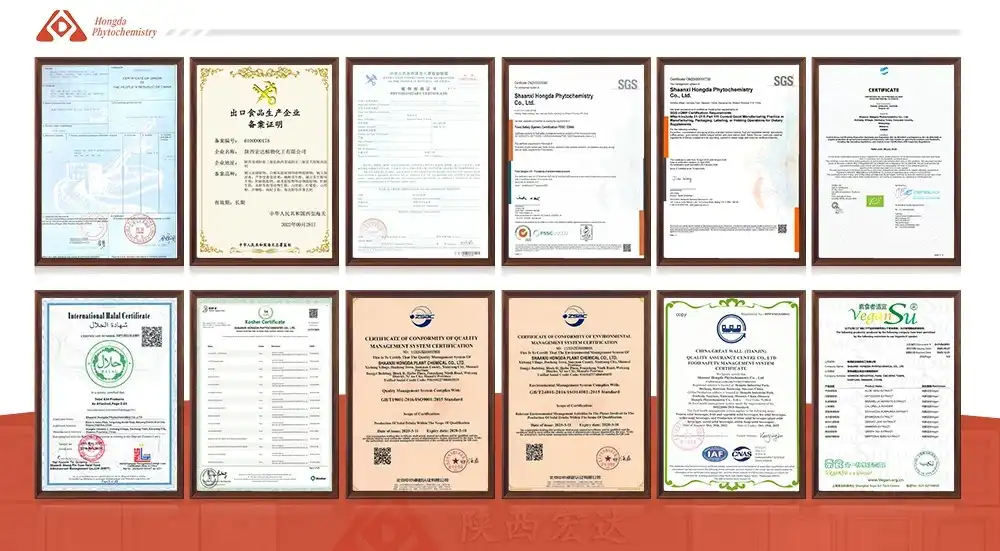
Without a complete dossier, even the most stable griffonia simplicifolia seed extract cannot enter the US or EU market. From 2001 to 2025, Shaanxi Hongda has built a globally recognized portfolio including cGMP, FSSC22000, SC, ISO22000, ISO9001, BRC, FDA registration, HALAL, KOSHER, and ORGANIC (EU & NOP), plus national high-tech enterprise status and multiple patents. For every shipment of griffonia simplicifolia seed extract, we deliver a ready-to-submit package containing COA, TDS, MSDS, allergen, non-GMO, and non-irradiation statements; pesticide and heavy metal reports from accredited labs; and ICH-compliant 24-month stability data. Our 3,000-square-meter warehouse with six climate-controlled zones ensures on-time delivery with lot traceability, while 3,000-ton annual capacity guarantees supply continuity. Choosing a certified griffonia simplicifolia seed extract supplier like Hongda saves months of document chasing and ensures first-time audit success.
Conclusion
Raw powder from the griffonia simplicifolia plant offers variable 5-HTP and high instability, while standardized griffonia simplicifolia seed extract delivers guaranteed potency, low moisture, and proven shelf life. Shaanxi Hongda Phytochemistry Co., Ltd., established in 2001 with a 20,000㎡ GMP factory, SGS lab, and 3,000-ton capacity, uses low-temperature extraction and chelation-controlled QC to ensure HPLC-verified 5-HTP from traceable harvests. With full cGMP, ISO, and Organic certifications, we help brands secure stable, compliant capsules—contact us to accelerate your next launch.
Frequently Asked Questions
1. What is the main difference between raw powder and standardized extract?
A: Raw powder has 5-15% variable 5-HTP; standardized griffonia simplicifolia seed extract guarantees 20%–99% by HPLC for precise dosing and stability.
2. Why does my 5-HTP powder turn brown or clump?
A: High moisture and trace metals cause oxidation. Hongda’s griffonia simplicifolia seed extract controls moisture ≤5.0% and tests for chelation to prevent discoloration and caking.
3. How do you verify natural 5-HTP and detect adulteration?
A: We use UV plus HPLC fingerprinting and optical rotation. Natural griffonia simplicifolia seed extract shows a distinct chiral profile versus synthetic adulterants.
4. Is griffonia extract compatible with magnesium or valerian blends?
A: Yes, with pre-testing. We provide 4-week compatibility data for griffonia simplicifolia seed extract to avoid moisture or pH interactions in capsules.
Choose a Certified HONGDA Partner for Stable Griffonia Supply
Ready to replace inconsistent powder with a stable, fully documented griffonia simplicifolia seed extract? Hongda Phytochemistry offers SGS-verified 5-HTP, low-moisture engineering, and a complete EU/US compliance package from our 20,000㎡ GMP factory. Whether you need 30% for cost-effective blends or 99% for high-potency capsules, we ensure batch-to-batch consistency, real production transparency, and on-time delivery. Contact our technical team today at duke@hongdaherb.com for a free sample, HPLC chromatogram, and formulation compatibility support to de-risk your next product launch.
References
1. Birdsall, T. C. (1998). 5-Hydroxytryptophan: a clinically effective serotonin precursor. Alternative Medicine Review, 3(4), 271-280.
2. Turner, E. H., Loftis, J. M., & Blackwell, A. D. (2006). Serotonin a la carte: supplementation with the serotonin precursor 5-hydroxytryptophan. Pharmacology & Therapeutics, 109(3), 325-338.
3. Lemaire, P. A., & Adosraku, R. K. (2002). An HPLC method for the direct assay of the serotonin precursor, 5-hydroxytryptophan. Journal of Pharmaceutical and Biomedical Analysis, 31(1-2), 187-192.
4. Das, Y. T., Bagchi, M., Bagchi, D., & Preuss, H. G. (2004). Safety of 5-hydroxy-L-tryptophan. Toxicology Letters, 150(1), 111-122.
5. Hinz, M., Stein, A., & Uncini, T. (2012). 5-HTP efficacy and contraindications. Neuropsychiatric Disease and Treatment, 8, 323-328.