




If a beverage company wants to know which particle size data are most important for liposomal iron powder, it is the mean diameter, distribution width, surface charge, and how they respond to water, acid, and heat. Shaanxi Hongda Phytochemistry Co., Ltd. has developed the plant, laboratory, and quality system delivering liposomal iron powder with formulator-usable data for over two decades. Since 2001, the company measures lot numbers instead of assuming them, with more than ten advanced production lines, a 100,000-level purification workshop, and an SGS-standard laboratory. Use the following assistance to decide which figures to put on the specification sheet.
Why Size Data Comes First on a Buyer's Spec Sheet?
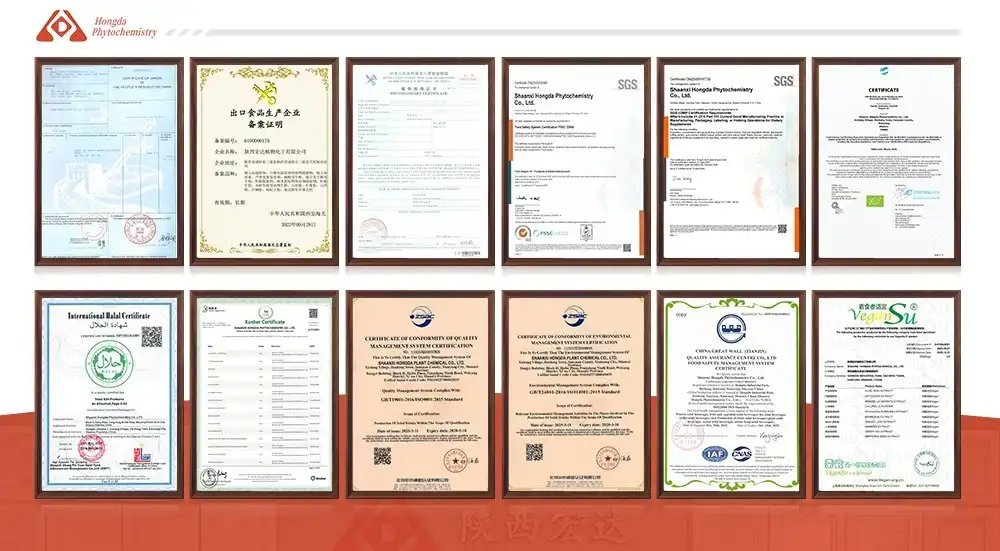
What Hongda Brings to the Table
Liposomal iron powder dissolving without any metallic edge, gritty finish, or rusty haze means a good beverage brand. That challenge is overcome by the supply side of Hongda Phytochemistry. A 20,000 square-meter facility with a capacity of 3,000 tons and 150 workshop staff ensures batch uniformity. Ingredients, pesticide residues, moisture, heavy metals, and microorganisms are examined before delivery. FSSC 22000, ISO 22000, BRC, FDA, halal, and kosher certifications provide easy access to US and European markets. The Hongda liposomal iron powder is a narrative of particle size data and quality records. Ask for the story before comparing sellers of liposomal iron for ready-to-mix sticks or functional injections.
Why Buyers Treat Size as a Quality Signal
The quickest technique to assess the performance of liposomes is particle size. Weak homogenization, improper choice of lipids, or drying aggregation may lead to sediment, off-flavor, or irregular iron delivery. That’s why skilled procurement teams are looking for big outcomes and not cost. Good, well-documented size data on a sample batch of liposomal iron powder is a trial run that will enable formulators to analyze mouthfeel, clarity, and dosage accuracy. International clients favor suppliers who provide figures, since clean data implies simpler clearance processes and less involvement with regulatory experts. Start by discussing size with your provider, not after you’ve made up your mind on the recipe.[1][3]
How Size Connects to Taste, Clarity, and Marketing Claims
Smaller homogeneous vesicles scatter less light, and hence liposomal iron powder in sparkling water or light colored juice remains clear. The size of the lipid shell is significant in hiding the mineral from the tongue, and a correctly produced product will taste softer than a simple iron salt in the same beverage. Marketing teams win. Many liposomal iron brands are highly absorbed and acceptable; the liposomal ferrous glycinate source ensures consistent vesicle integrity, and a consistent nanometer size range provides a technological background. This is not a substitute for expert dietary advice, but it may be understood by merchants and consumers. Size data therefore reinforces sensory quality, shelf appearance, and proper communication with distributors and OEM partners.
The Three Numbers That Describe a Liposome Population
Mean Diameter: Your Primary Benchmark
The mean diameter, which is commonly reported in nanometers using dynamic light scattering, tells you what the average vesicle size is in a reconstituted sample. Buyers of liposomal iron powder for use in drinks often desire something in the nanometer range rather than the micrometer range, since smaller vesicles stay suspended for longer and have a silkier mouthfeel. Ask your liposomal ferrous glycinate supplier whether the number relates to the original liposome dispersion or to the powder after rehydration, since the two are considerably different. A good report contains the instrument, the dilution medium, temperature, and number of repeat readings. Without such knowledge, it’s hard to evaluate one figure against the next supplier. Hongda Phytochemistry may talk about these test settings in the open, which means that your technical team can correlate the results to internal permission needs before initiating a pilot-scale run.[1][2][3][4]
Polydispersity Index: How Even the Population Really Is
Two samples may have the same mean diameter and behave very differently, since in one example the vesicles are of about the same size, whereas in the other case there is a combination of tiny and large particles. That spread is measured as the polydispersity index, or PDI, which may be anywhere from zero to one. The lower the number, the more uniform and tight the population of liposomes, and many formulators see a value less than around 0.3 as sufficient homogeneity. A low PDI in liposomal ferrous glycinate supplier means more consistent flavor masking and fewer surprises when reconstituted in cold or warm water. On a certificate of analysis, the mean diameter must always be accompanied by PDI, because a broad distribution hides, in general, some huge aggregates which produce sedimentation. Looking at the two values together tells you a lot more than looking at them individually.
Zeta Potential: The Stability Clue in Surface Charge
The surface electrical charge of each vesicle is known as the zeta potential. That’s what makes regular atoms push away or snuggle up to each other. A higher magnitude, positive or negative, usually signifies a stronger repulsion and a more consistent dispersion. Values above around plus or minus 30 millivolts are generally indicated as a good rule of thumb. This is particularly relevant for liposomal iron powder, since liquids include acids, minerals, and sweeteners that may neutralize the surface charge and cause aggregation. So it is more beneficial to ask for zeta potential at the same pH as your desired drink rather than a value in pure water. The ability to produce a liposomal iron carrier that can give charge data across a small pH range is indicative of real process knowledge. Your formulation team will get an early warning of any compatibility issues.[2][3]
|
Metric
|
Common Method
|
What It Tells You
|
Practical Reading
|
|---|---|---|---|
|
Mean diameter
|
Dynamic light scattering
|
Typical vesicle size
|
Nanometer range preferred for drinks
|
|
PDI
|
Dynamic light scattering
|
Population uniformity
|
Below about 0.3 often targeted
|
|
Zeta potential
|
Electrophoretic light scattering
|
Colloidal stability
|
Beyond about ±30 mV suggests repulsion
|
|
D90 / upper tail
|
Laser diffraction
|
Presence of large particles
|
Flags aggregates; a mean value can hide them
|
Want these figures for your own recipe? Email the Hongda team at duke@hongdaherb.com with your target beverage format, and ask for size data and a sample of liposomal iron powder to test in your base.
Testing Size Under Real Beverage Conditions
Reconstitution Behavior in the First Ten Minutes
A powder that looks nice on paper still needs to rehydrate well in a real bottle or shaker. The size measurements performed immediately after mixing, then after ten and sixty minutes, demonstrate whether the liposomal iron powder gently regroups its vesicles or aggregates into larger structures. So stirring speed, water temperature, and sequence of mixing are all factors. So a clever liposomal ferric glycinate manufacturer will provide a recommended production method with the data. Help may come from Hongda Phytochemistry, a factory of liposomal ferrous glycinate, equipped with a lab of more than twenty R&D and testing personnel. This early window is also the best time for the product manufacturer to visually evaluate foam, wetness, and dispersibility, since good size data and good handling tend to go hand in hand with a well-made powder.
pH and Ionic Strength: Where Beverage Chemistry Pushes Back
Fruit juices, sports drinks, and enhanced waters are full of acids and salts that would assault any frail vesicle. At low pH, the surface charge may be altered, and dissolved minerals may compress the electrical layer surrounding each particle, facilitating aggregation. Testing the liposomal iron powder in the pH and electrolyte concentration of your genuine recipe, instead of distilled water, may tell you whether the mean diameter and PDI are steady. A practical approach to accomplish this is to run 3 pH values (e.g., neutral, somewhat acidic, and your objective) and record size at each point. If the numbers are correct, then the formula is solid. If they rise higher, a buffering salt or a milder acidulant may be the solution. This one test may save weeks of reformulation later in the project.[1][2][3]
Heat and Shelf Life: Watching for Size Drift
Size is not a one-time measurement. Beverages are poured, stored, distributed, and sometimes warmed. Each phase might lead a liposome population to larger or more heterogeneous particles. The liposomal ferrous glycinate manufacturers are often subjected to stability programs, which consist of measuring the mean diameter and PDI at predetermined time periods at room temperature and accelerated conditions and comparing them to the original results. If the changes are minor and gradual throughout the expected shelf-life, then the component is stable. However, if there are quick jumps, it might indicate aggregation or breakdown of lipids. “It’s often more stable than the liquid liposomes, so marketers have a head start, but the dispersed beverage itself has to have its own data. Do a quick hold test in-house and ask your supplier for stability data before placing a large production order.
|
Project Stage
|
What to Measure
|
Decision It Supports
|
|---|---|---|
|
Incoming powder
|
Rehydrated mean size and PDI
|
Accept or reject the lot
|
|
Pilot mixing
|
Size at 0, 10, and 60 minutes
|
Refine the mixing protocol
|
|
Recipe pH trial
|
Size and zeta potential at target pH
|
Choose buffer or acidulant
|
|
Stability hold
|
Size at set intervals
|
Confirm the shelf-life window
|
Turning Size Data Into a Smart Sourcing Decision
Methods and Reports Worth Requesting
Typically, comprehensive packages comprise dynamic light scattering for mean size, laser diffraction for upper-tail particles and, if available, cryo-electron microscopy for shape and lamellarity. Request the liposomal iron provider to send representative scans or reports, not just summary lines. This way, your quality team will be able to comprehend the process of generating data for each batch of liposomal iron powder. An analytical certificate should contain iron, moisture, heavy metals, and microbiological data to relate physical performance to safety. This entire report is complemented by high-performance liquid chromatographs, spectrophotometers, and atomic absorption equipment. Hongda cooperates with international testing agencies to assure quality. Consistency between lots, therefore, is proven by collecting data from two or three batches.[1][2][3][4]
Working With a Dependable Liposomal Ferrous Glycinate Supplier
Vesicle size and iron form are both important. Beverage producers want a moderate form and a liposomal iron supplier that can explain the mineral and lipid shell. Confirm supply dependability as well as technical fit. Hongda Phytochemistry has six storage zones in a 3,000-square-meter warehouse to satisfy delivery dates. Long-term investment in traceability and innovation for 2 R&D centers and 3 planting bases. Request samples. Double-check size reports, and make sure the liposomal iron powder you are testing matches what is being provided. Regular data is the best sales argument a powerful supplier has, so they take that comparison.
Matching Specifications to Your Beverage Format
Single-serve stick pack: crystal-clear functional water, creamy plant-based drink. Available in a variety of sizes. Use the smallest and most uniform vesicles for clear beverages to avoid cloudiness. A larger distribution may be used for opaque drinks, provided sedimentation is controlled. Stick packs provide more variables since users adjust water volume and temperature themselves at home. Establish specific acceptance criteria for mean diameter, PDI, and zeta potential and include them in your purchase agreement to ensure consistent evaluation of each lot of liposomal iron powder. It’s popular with international distributors since it makes complaints and audits simpler. “Quality discussions are short, honest, and friendly when requirements meet use cases.”[1][2][3]
|
Beverage Format
|
Size Priority
|
Key Watch-Out
|
|---|---|---|
|
Clear functional water
|
Smallest, most uniform vesicles
|
Haze or loss of sparkle
|
|
Fruit-juice shot
|
Stability at low pH
|
Charge loss and aggregation
|
|
Protein or plant shake
|
Moderate distribution acceptable
|
Sedimentation and flavor
|
|
Stick pack or mix powder
|
Reliable rehydration
|
Variable water and temperature
|
Conclusion
Flavor, clarity, stability, and source all share particle size. Mean diameter, PDI, and zeta potential are the most indicative of liposomal iron powder in drinks. To transform raw statistics into anything relevant, you have to measure them after reconstitution, at the pH of your recipe, and throughout shelf life. Supplier engagements are honest and cost-efficient, with multi-batch data and acceptability restrictions built in. Shaanxi Hongda Phytochemistry Co., Ltd. is a suitable partner for organizations looking to access the United States and European markets with a 20,000-square-meter facility, a standardized laboratory, and international certifications. Brands that get size data early, compare honestly, and test in their own base avoid expensive shocks later. Take a sample. Work hard at studying the facts. Let the figures lead you to your formula.
FAQ
Q1: Which beverage particle size measure matters most?
Mean diameter, PDI, and zeta potential provide the most accurate depiction.
Q2: Which PDI value is normally acceptable?
Below 0.3 is considered a uniform liposome population.
Q3: Should I test liposomal iron powder at my recipe's pH?
Yes. Size should be tested at the desired pH since acids and minerals modify surface charge.
Q4: Can Hongda give quality samples and documentation?
Hongda inspects every batch for ingredients, heavy metals, dampness, pesticide residues, and microbes before shipping.
Request Your Sample | HONGDA
If particle size data is steering your next beverage launch, let Hongda Phytochemistry help you read the numbers with confidence. Shaanxi Hongda Phytochemistry Co., Ltd. offers liposomal iron powder backed by a modern factory, an SGS-standardized laboratory, ample inventory, and certifications that open doors in the United States and Europe. Tell us your beverage format, your preferred iron form, and your target size limits, and our team will respond with practical guidance and sample options. Whether you are a formulator, an OEM brand, or a distributor, start the conversation today and let our experienced specialists help you shorten development time. Write to duke@hongdaherb.com and move from questions to a tested, market-ready formula.
References
1. Danaei M, Dehghankhold M, Ataei S, et al. Impact of Particle Size and Polydispersity Index on the Clinical Applications of Lipidic Nanocarrier Systems. Pharmaceutics. 2018;10(2):57.
2. Bhattacharjee S. DLS and Zeta Potential: What They Are and What They Are Not? Journal of Controlled Release. 2016;235:337-351.
3. Bozzuto G, Molinari A. Liposomes as Nanomedical Devices. International Journal of Nanomedicine. 2015;10:975-999.
4. International Organization for Standardization. ISO 22412:2017 Particle Size Analysis: Dynamic Light Scattering (DLS).
_1756102508452.jpg)