


_1745918362135.webp)

How to Verify the Purity of Liposomal Curcumin Powder?
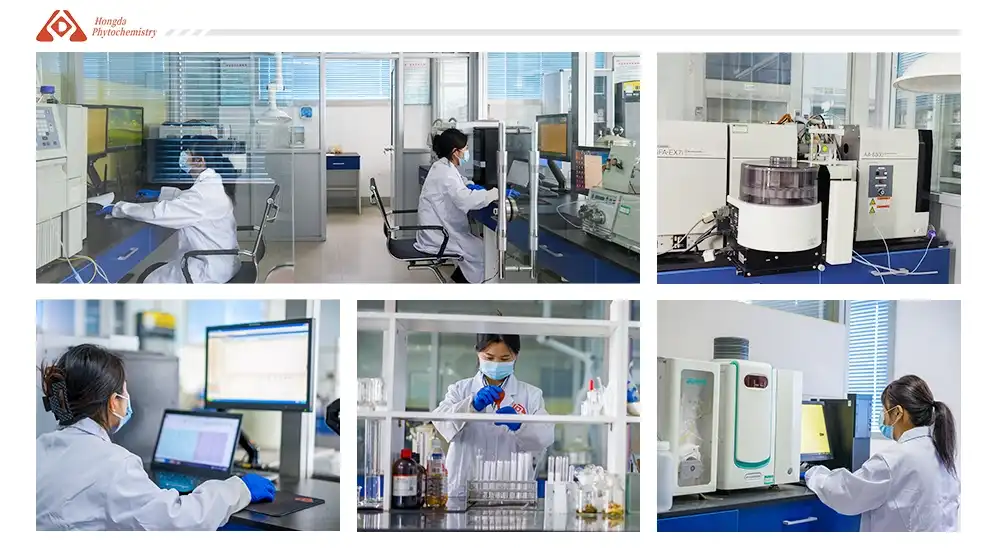
When it comes to supplement ingredients, Liposomal Curcumin Powder is in a unique situation because the most important quality factor is often missed by normal scientific tests. A simple HPLC purity check can tell you how much curcumin is in a sample, but it doesn't tell you if the curcumin is really enclosed in phospholipid bilayer vesicles or if it's just mixed with phospholipid powder in a way that gives it the same look and COA but a very different absorption profile.[5] Hongda Phytochemistry, which does business as Shaanxi Hongda Phytochemistry Co., Ltd., directly fills this gap by providing structural images and HPLC data for each batch of its Liposomal Curcumin Powder. These images show that the curcumin molecules are actually enclosed within bilayer vesicle structures and not just mixed with phospholipids. With an SGS-certified lab that has more than twenty professor-level researchers and high-performance liquid chromatographs, gas chromatographs, spectrophotometers, and atomic absorption spectrophotometers, Hongda gives buyers the information they need to tell the difference between a real liposomal product and a likely fake before they place an order. Here is a step-by-step guide that shows how that checking process works.
Why Standard Purity Testing Is Insufficient for Liposomal Products?
The main problem with Liposomal Curcumin Powder analysis is that the testing methods that most buyers ask for can't see the ingredient's most important quality feature: real phospholipid bilayer encapsulation. With HPLC, you can find out that 95% of a sample is made up of curcuminoids. It can't tell if the curcuminoids are inside liposomal vesicles that are still whole, if they are just stuck to phospholipid surfaces, or if they are mixed loosely into a lecithin matrix. In real life, this difference is very important: real liposomal encapsulation allows the membrane-fusion uptake mechanism and gastric protection that give liposomal delivery its bioavailability advantage, but a simple phospholipid-curcumin blend does not.[1][2][6] If a buyer only checks the purity of curcuminoids as a main quality check, they are actually checking the ingredient that they could have bought for a lot less money instead of the liposomal delivery method that they paid for.
What HPLC Purity Data Does and Does Not Confirm?
HPLC measures the amount of curcuminoid in a sample compared to other things in it. This shows that curcumin, demethoxycurcumin, and bisdemethoxycurcumin make up a certain percentage of the total mass. It doesn't tell the difference between curcumin that is inside whole vesicles and curcumin that is free, attached to the surface, or mixed with phospholipid powder.[3]
The Physical Structure Gap in Standard COA Documentation
Most certificates of analysis for liposomal ingredients list the amount of curcumin, how the ingredient looks, and sometimes the size of the particles. However, the size of the particles by itself cannot prove the presence of a bilayer structure. By using mechanical processing, a mix of phospholipids and curcumin can make particles in the nanoscale range, but it can't form real lipid bilayers or encapsulate things very well. The actual building needs to be checked out in person.
Why Encapsulation Efficiency Is the Missing Metric?
The Liposomal Curcumin Powder product's encapsulation efficiency, or the amount of total curcumin that is actually contained within intact liposomal vesicles instead of being free in solution, tells you if it lives up to its claims. Hongda's Liposomal Curcumin Powder achieves encapsulation efficiency at or above 80% for food-grade material and at or above 90% for pharmaceutical-grade applications. These numbers can be checked using standard separation methods instead of self-reported numbers.
How Legitimate Suppliers Differ From Those Cutting Corners?
If a seller of liposomal curcumin powder can't show data on capsule efficiency along with curcuminoid purity, they are probably selling a phospholipid mix instead of a real liposomal product. It is possible to do the test, and any company that makes real liposomes should offer it. This is because the data points that support the product's high price point are the ones that matter.
The Key Analytical Methods That Actually Verify Liposomal Structure
Correctly verifying Liposomal Curcumin Powder requires a suite of analytical tools that complement each other rather than a single definitive test. Each method answers a different question about what is actually in the sample, and the combination of all of them provides a picture no single technique can produce alone. Buyers who understand what each method confirms — and what it cannot confirm alone — are in a much stronger position when evaluating competing supplier claims.
|
Analytical Method
|
What It Confirms
|
What It Cannot Confirm Alone
|
|---|---|---|
|
HPLC
|
Total curcuminoid percentage in the sample
|
Whether curcumin is encapsulated or free
|
|
Transmission Electron Microscopy (TEM)
|
Physical bilayer vesicle structure; confirms genuine liposomes
|
Encapsulation efficiency or curcumin concentration
|
|
Dynamic Light Scattering (DLS)
|
Particle size distribution (100–200 nm expected range)
|
Bilayer structure or encapsulation efficiency
|
|
Tyndall Effect
|
Confirms colloidal suspension character of reconstituted powder
|
Cannot distinguish genuine liposomes from other stable colloids alone
|
|
Encapsulation Efficiency Assay
|
Proportion of curcumin genuinely inside intact vesicles
|
Physical vesicle structure or particle size
|
|
Zeta Potential Measurement
|
Colloidal stability; predicts aggregation behavior
|
Curcumin content or encapsulation rate
|
Transmission Electron Microscopy as the Gold Standard for Structure Confirmation
TEM imaging directly visualizes the bilayer membrane structure of liposomal vesicles at nanometer resolution, producing visual evidence that curcumin is enclosed within genuine lipid bilayers rather than simply co-present with phospholipids. Hongda Phytochemistry provides TEM structural images on request for its Liposomal Curcumin Powder, making this the most straightforward way for buyers to distinguish genuine encapsulation from a phospholipid blend without running their own analytical tests.
The Tyndall Effect as a Simple Reconstitution Check
When genuine Liposomal Curcumin Powder is dissolved in water, it produces the Tyndall effect — a visible light-scattering band when a beam passes through the solution — because the colloidal vesicle suspension scatters light differently from a true solution. This test can be performed without laboratory equipment and provides a rapid initial quality check that a truly liposomal product passes and a simple curcumin-phospholipid blend typically does not.
Dynamic Light Scattering for Particle Size Verification
DLS confirms that particle sizes fall within the expected range for liposomal vesicles — between 100 and 200 nanometers for Hongda's Liposomal Curcumin Powder — and provides the particle size distribution data needed to confirm batch-to-batch consistency. Significant variation in particle size distribution between batches from the same supplier is a warning sign that manufacturing process control is insufficient.
Zeta Potential and Colloidal Stability Prediction
Zeta potential measurements assess the surface charge on liposomal vesicles and predict their stability in suspension over time. Hongda's Liposomal Curcumin Powder maintains stable electrostatic repulsion in the pH range of 3.0 to 7.0, preventing aggregation or precipitation in both capsule filling processes and beverage applications, a property that is directly confirmed by zeta potential data rather than assumed from particle size alone.
|
No.
|
TEST ITEM
|
SPECIFICATION
|
RESULT
|
|||
|
1
|
Description
|
Yellow Powder
|
Conform
|
|||
|
2
|
Particle size (20 mesh)
|
≥90%
|
Conform
|
|||
|
3
|
Loss on drying
|
≤5.0%
|
2.33%
|
|||
|
4
|
Bulk Density
|
Measured value
|
368g/L
|
|||
|
5
|
Tapped Bulk Density
|
Measured value
|
721g/L
|
|||
|
6
|
Heavy Metals
|
Arsenic (As)
|
≤2.0ppm
|
Conform
|
||
|
Lead (Pb)
|
≤0.5ppm
|
Conform
|
||||
|
Mercury (Hg)
|
≤0.3ppm
|
Conform
|
||||
|
Cadmium (Cd)
|
≤0.3ppm
|
Conform
|
||||
|
7
|
Microbiological
|
Total plate count
|
≤10000cfu/g
|
10cu/g
|
||
|
Total molds and yeasts
|
≤1000cfu/g
|
10cfu/g
|
||||
|
Coliforms
|
≤10MPN/g
|
≤0.3MPN/g
|
||||
|
E.Coli
|
Negative/25g
|
Negative
|
||||
|
Salmonella
|
Negative/25g
|
Negative
|
||||
|
Staphylococcvs
|
Negative/25g
|
Negative
|
||||
|
8
|
Assay
|
Curcumin
|
70.0%±5%
|
71.6%
|
||
|
Phospholipids (NON-GMO)
|
15.0%±5%
|
12.9%
|
||||
|
Fatty Acids
|
15.0%±5%
|
13.8%
|
||||
|
Conclusion
|
Meet the in house standard.
|
|||||
Contaminant Screening That Matters Beyond the Curcumin Itself
Verifying genuine liposomal structure and curcuminoid purity addresses the ingredient's primary quality attributes, but it does not complete the verification picture. Liposomal manufacturing involves solvents, processing aids, and phospholipid raw materials that introduce their own contamination risks, and the phospholipid source — sunflower, soy, or synthetic — carries its own traceability and allergen implications. Comprehensive verification of Liposomal Curcumin Powder requires contaminant screening that covers all of these dimensions, not just the curcumin fraction.[4] Buyers who want to see Hongda's full contaminant testing package — covering residual solvents, heavy metals, microbial counts, and phospholipid source documentation — can request the complete technical file at duke@hongdaherb.com before placing any order.
Residual Solvent Screening in Liposomal Products
Liposomal manufacturing typically involves organic solvents at some stage of the lipid film preparation or encapsulation process, and residual solvent concentrations in the finished Liposomal Curcumin Powder need to comply with ICH Q3C limits for whichever solvents were used. Gas chromatography is the standard method for residual solvent screening, and any credible supplier should be able to provide GC-based residual solvent data for each batch.
Heavy Metal Limits for a Long-Term Use Ingredient
Liposomal Curcumin Powder is typically formulated into products intended for daily, long-term use, which makes heavy metal screening more important than for shorter-term supplement ingredients. As a liposomal curcumin powder manufacturer, Hongda's pre-shipment testing screens for lead, arsenic, cadmium, and mercury against internationally recognized limits, with atomic absorption spectrophotometry confirming results at trace levels.
Phospholipid Source and Allergen Implications
Soy-derived phospholipids are the most common source for liposomal manufacturing globally, but Hongda's Liposomal Curcumin Powder uses non-GMO sunflower seed phospholipids specifically to eliminate the GMO and soy-allergen concerns that soy lecithin-based products carry into clean-label and allergen-sensitive markets.
Microbial Testing for a Powder Intended for Oral Consumption
Total aerobic plate count, yeast and mold, and absence-of-pathogen testing (particularly Salmonella and E. coli) round out the contaminant screening picture for any Liposomal Curcumin Powder intended for oral supplementation, ensuring that the manufacturing environment and storage conditions have not introduced biological contamination alongside excellent physical and chemical purity.
Building a Complete Verification Checklist for Supplier Qualification
Pulling all of these verification requirements together into a practical supplier qualification checklist helps procurement teams avoid the most common sourcing mistakes in the liposomal ingredient category. A liposomal curcumin powder manufacturer who can respond positively to every item on this list is demonstrating the kind of manufacturing discipline and documentation culture that supports a long-term supply relationship, while one who deflects, delays, or provides vague answers to any of the key questions is signaling risks that will surface later in a formulation program.
|
Verification Item
|
What to Request
|
Red Flag If Missing
|
|---|---|---|
|
Curcuminoid identity and purity
|
Batch-specific HPLC report with chromatogram
|
Generic specification sheet without batch data
|
|
Genuine liposomal structure
|
TEM images showing bilayer vesicles
|
Particle size data only, no structural images
|
|
Encapsulation efficiency
|
Numerical result with method description
|
Not provided or referenced as "proprietary"
|
|
Particle size distribution
|
DLS report for the specific batch
|
Single mean particle size only, no distribution data
|
|
Residual solvents
|
GC report against ICH Q3C limits
|
Not included in COA documentation
|
|
Heavy metals
|
AAS or ICP-MS results for Pb, As, Cd, Hg
|
Absent from COA or reported as "compliant" without data
|
|
Phospholipid source
|
Declaration of origin (sunflower vs. soy) and GMO status
|
Source undisclosed or unable to confirm GMO status
|
|
Certifications
|
Current copies of cGMP, ISO9001, ISO22000, and market-specific certs
|
Certificates expired or not applicable to the specific product
|
Requesting the Full Technical Package Before Sampling
Rather than waiting until after a sample is received to discover documentation gaps, experienced procurement teams request the full technical package — COA, TEM images, encapsulation efficiency data, and certification copies — before agreeing to sample any batch of Liposomal Curcumin Powder. This filters out unsuitable suppliers at the document stage rather than wasting formulation time on samples that fail qualification later.
Aligning Verification Depth With the Intended Product Grade
A functional beverage application requires a different verification depth than a pharmaceutical-adjacent capsule product. Beverage formulators need confirmed pH stability data (3.0–7.0 for Hongda's product) and reconstitution behavior alongside purity; pharmaceutical-grade applications additionally need the tighter encapsulation efficiency specification and more rigorous residual solvent documentation.
Using Independent Third-Party Testing for High-Value Orders
For first-time orders or high-value commercial batches, sending a representative sample of Liposomal Curcumin Powder to an accredited third-party laboratory for TEM imaging and encapsulation efficiency testing adds a verification layer that no amount of supplier-provided documentation can fully replicate, and the cost is negligible relative to the risk it manages. Any credible liposomal curcumin powder manufacturer should actively support this step rather than discourage it, since genuine manufacturing quality holds up under independent scrutiny.
What a Truly Qualified Supplier Makes Easy?
A legitimate liposomal curcumin powder supplier who operates genuine manufacturing processes has every incentive to make verification easy, because their documentation is real. The pattern to watch for is suppliers who offer smooth sales processes but slow, vague, or incomplete responses to specific analytical requests — a combination that consistently predicts documentation problems discovered after payment rather than before.

Conclusion
Verifying Liposomal Curcumin Powder purity requires going beyond standard curcuminoid HPLC testing to confirm genuine bilayer encapsulation through TEM imaging, encapsulation efficiency data, and complementary physicochemical characterization. Hongda Phytochemistry provides this full documentation package as a standard part of its qualification process.
FAQ
1. Can HPLC alone verify that Liposomal Curcumin Powder is genuinely liposomal?
No. HPLC confirms curcuminoid purity but cannot distinguish encapsulated curcumin from free or surface-adsorbed material. TEM imaging and encapsulation efficiency testing are required.
2. What is encapsulation efficiency and why does it matter?
It measures the proportion of curcumin genuinely inside intact vesicles. Hongda's product achieves ≥80% food-grade and ≥90% pharmaceutical-grade, confirming genuine liposomal delivery.
3. How can I perform a quick visual check on a Liposomal Curcumin Powder sample?
Dissolve the powder in water and shine a light beam through the solution. A genuine liposomal product produces the Tyndall effect — a visible light-scattering band — confirming colloidal vesicle structure.
4. Why does phospholipid source matter for clean-label products?
Soy-derived phospholipids carry GMO and allergen concerns. Hongda uses non-GMO sunflower seed phospholipids, eliminating both issues for allergen-sensitive and clean-label markets.
Request Hongda's Complete Verification Package Before You Order | HONGDA
Genuine Liposomal Curcumin Powder verification starts with the right documentation — not a marketing claim. Hongda Phytochemistry provides TEM structural images, batch-specific HPLC reports, encapsulation efficiency data, residual solvent results, and full certification documentation as standard. Email duke@hongdaherb.com with your specification, grade, and volume requirements and receive the complete technical file before any purchase commitment is made.
References
1. Anand, P., Kunnumakkara, A.B., Newman, R.A., Aggarwal, B.B. (2007). "Bioavailability of curcumin: problems and promises." Molecular Pharmaceutics, 4(6), 807–818.
2. Zheng, B., McClements, D.J. (2020). "Formulation of more efficacious curcumin delivery systems using colloid science: Enhanced solubility, stability, and bioavailability." Molecules, 25(12), 2791.
3. USP Therapeutic Peptides and Lipid-Based Drug Delivery Expert Panel (2022). "Characterization of Liposomal Drug Products: Analytical Considerations." Pharmacopeial Forum.
4. ICH Harmonised Tripartite Guideline Q3C (2011). "Impurities: Guideline for Residual Solvents." International Council for Harmonisation of Technical Requirements for Pharmaceuticals for Human Use.
5. Banerjee, P.G., et al. (2025). "A comprehensive review of enhanced bioavailability, nutraceutical efficacy, and superior manufacturing quality of Liposomal Curcumin." Acta Traditional Medicine.
6. Dei Cas, M., Ghidoni, R. (2019). "Dietary Curcumin: Correlation between Bioavailability and Health Potential." Nutrients, 11(9), 2147.