




What challenges arise when formulating saw palmetto extract into softgel capsules?
Saw palmetto seems like a natural fit for a softgel; it's a lipophilic plant, it mixes well with oil, and the dosage is moderate. Then, the first pilot run. The fill is separating in the hopper. The gelatin ribbon is starting to soften. The capsules are darkening by week six. The HPLC reveals the fatty acid profile drifting out of spec. These are not unusual concerns; they are the predicted outcome of a lipid-rich extract encountering a water-containing gelatin shell. That's where Hongda Phytochemistry partners with softgel makers. Shaanxi Hongda Phytochemistry Co., Ltd. was established in 2001, with over 20,000 m2 of facilities, more than 10 manufacturing lines and 100,000-class purification workshops, and has an SGS-standardised laboratory created with university professors. Its saw palmetto extract powder and oil-grade extracts are fully GC fatty-acid profiled, with authenticity fingerprinting, peroxide and moisture data, heavy-metal findings, and comprehensive EU/US compliance paperwork.
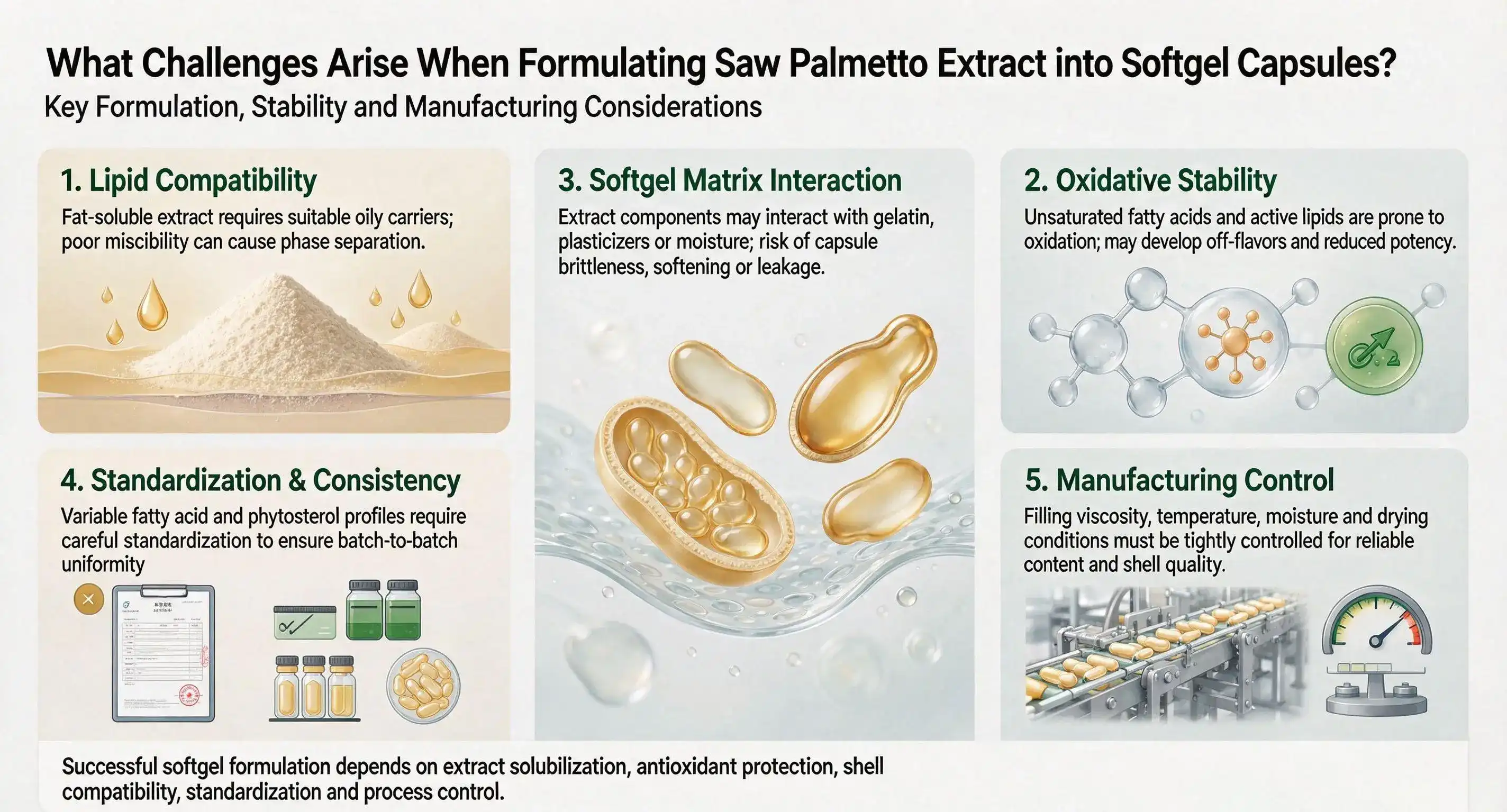
Challenge Set 1 — The Chemistry That Makes Softgels Difficult
A Lipid Extract Meeting a Water-Containing Shell
At the time of encapsulation, the gelatin softgel shell contains around 30-40% water; however, most of this water is lost during drying. The active portion of saw palmetto is a combination of free fatty acids, fatty acid ethyl esters, phytosterols, and fatty alcohols – basically an oily matrix with a quantifiable free-acid content.[2][4] Free fatty acids migrate into the shell, plasticize the gelatin, and over months generate soft, sticky, or leaky capsules. In the opposite way, water migrates inwards and increases hydrolysis and oxidation of the fill.[5] The issue doesn't go away if a brand decides to use saw palmetto extract powder instead of oil; it just changes. The powder has to be suspended in a carrier oil, and if the suspension is not well formulated, the solids settle in the hopper and dosage uniformity breaks down during a single manufacturing shift.
Free Fatty Acid Content and Shell Interaction
The most important metric in determining softgel compatibility is the free fatty acid concentration, commonly given as acid value. High levels of free-acid material are more hostile to gelatin and more prone to cross-linking reactions that delay dissolution – a well-documented cause of softgels passing test but failing dissolution at the twelve-month pull. Hongda gives the acid value on each lot, so formulators may establish an incoming specification, rather than guessing. If a customer's shell system is sensitive, the technical staff may suggest a lower acid grade or advise buffering in the fill. A good b2b supplier of saw palmetto fruit powder should know how to determine the acid value; if the talk ends at "85% fatty acids," you are talking to a trader, not a producer.
Oxidation, Peroxide Value and Colour Drift
Unsaturated fatty acids oxidize, and this is particularly unwanted in a softgel as it darkens the fill, provides rancid fragrance notes that customers sense instantly on opening the container, and destroys the actives the label promises. The peroxide value at the time of reception is therefore as important as the test.[5] Hongda is processed under low-oxygen circumstances, packed under nitrogen in light-blocking containers, and peroxide value is reported every batch. Antioxidant systems such as mixed tocopherols or rosemary extract may be included on request. Oxidative protection is much more critical for bulk organic saw palmetto fruit powder for use as solution fillers, as finely split powder provides huge surface area to any headspace oxygen remaining.
Challenge Set 2 — Verifying You Bought Real Saw Palmetto
The Fatty Acid Profile Is the Fingerprint
Saw palmetto is one of the most adulterated botanicals on record, and the diagnostic technique is well established: gas chromatography of the fatty acid profile.[1][3] The real Serenoa repens has a typical distribution, mostly lauric and oleic acids, some myristic, palmitic, linoleic, and capric acids, and a significant amount of caprylic and capric acids that the cheaper replacements cannot imitate. Hongda does a complete GC profile on every batch of saw palmetto extract powder and lists every fatty acid, not just a "total fatty acids" figure. A provider that provides merely the aggregate number is omitting precisely the data that would show replacement – which in a category this contaminated should be an answer in itself.[1][2][3]
Common Substitutes and How They Are Caught
|
Adulterant
|
Why It Is Used
|
Detection at Hongda
|
|---|---|---|
|
Coconut/palm kernel oil
|
Cheap, lauric-acid rich, mimics total FA
|
GC profile — wrong capric/caprylic ratio
|
|
Canola or soybean oil
|
Low-cost bulking
|
Elevated linolenic/erucic markers
|
|
Animal-derived fats
|
Cheap lipid filler
|
Sterol profile + GC pattern mismatch
|
|
Non-Serenoa palm fruit
|
Visual similarity in raw fruit
|
Botanical/microscopic identification
|
|
Unripe or stem material
|
Lower-cost harvest
|
Low total FA, altered sterol content
|
|
Maltodextrin/rice carrier
|
Dilutes powder grades
|
Ash, polysaccharide, iodine testing
|
|
Added synthetic fatty acids
|
Inflates assay
|
Isotope / profile-ratio anomaly
|
Sterol analysis adds a second layer — beta-sitosterol, campesterol and stigmasterol ratios differ measurably between authentic saw palmetto and vegetable-oil substitutes. Hongda combines GC fatty-acid data, sterol profiling, and botanical identification of incoming fruit, so authenticity is established at raw material intake rather than argued about after shipment.[1][2][4]
Raw Material Origin and Traceability
Serenoa repens is native to the southeastern United States. The harvest is seasonal, restricted to Florida, and may vary widely in quality depending on the freshness of the berries. The fatty acid content of berries gathered too early is greatly reduced. Hongda tests arriving fruit for species identification, moisture, maturity indications, and baseline fatty acid levels before accepting it, and tags it with a traceability identifier connecting origin, arrival, extraction batch, and storage zone. For customers ordering bulk organic saw palmetto fruit powder from an organic saw palmetto powder supplier, the file is sent to the organic certification chain and is the paperwork required for EU equivalence checks and NOP audits, and is increasingly sought by US merchants operating their own supplier-qualification programs.
Planning a softgel trial? Send your fill specification — extract grade, carrier oil, target fatty acid percentage, and shell system — to duke@hongdaherb.com. Our technical team will return a current batch COA with full GC fatty-acid breakdown, acid and peroxide values, heavy-metal data, and a free small-trial sample sized for a pilot encapsulation run. We also meet customers face to face each year at CPHI, Vitafoods Europe and Food Ingredients Europe, where sample evaluation can be arranged on the spot.
Challenge Set 3 — Practical Formulation and Process Fixes
Suspension Design, Settling and Dose Uniformity
If you use powder instead of oil, the fill is a suspension. Suspensions settle out. The typical failure is in the middle of a manufacturing run, when early capsules are over-filled, and later ones are under-filled, and content homogeneity is out of spec. The fixes are widely known; however, they rely on supplier-side data. Particle size must be tight and small. Hongda sells saw palmetto extract powder in regulated mesh with stated particle-size distribution, since a wide dispersion assures differential settling.
Suspending ingredients such as beeswax, hydrogenated vegetable oil or colloidal silicon dioxide increase the fill viscosity, while continual hopper agitation and regulated fill temperature do the rest. Hongda has bulk density, particle size, and oil dispersibility data on each batch so the formulator may model the suspension before spending gelatin on an unsuccessful experiment.
Moisture Control and Caking Before the Fill Is Even Made
Problems with damp powder grades occur before encapsulation: clumping in the drum, bridging in the dispensing hopper, inadequate wetting in the carrier oil, and rapid hydrolysis of free fatty acids. As a saw palmetto fruit powder b2b supplier, Hongda is supplied in heat-sealed aluminum foil bags with double PE liners within fiber drums at ≤5% loss on drying. Desiccant and nitrogen flush are available for humid locations.
One recorded case: A North American softgel contract maker experienced lumping and variable fill weights following monsoon-season shipping from a prior supplier. Hongda supplied nitrogen-flushed material at 3.7% moisture with a tighter particle-size window; the customer validated free-flowing powder, steady suspension viscosity, and equal fill weights over a 300 kg validation test and proceeded to planned quarterly orders.
Shell Compatibility and Antioxidant Strategy
Fill chemistry has much more interaction with shell choice than most briefs would accept. Bovine and fish gelatin respond differently to free-acid exposure, while vegetarian shells based on modified starch or carrageenan have their own moisture-transfer properties, sometimes a plus with lipid fillings, sometimes a minus in humid storage.
Hongda's two in-house R&D institutes are running accelerated compatibility holds, coupling the extract with suggested carrier oils, surfactants, antioxidants and shell materials, measuring acid value, peroxide value, color and assay over predetermined intervals. When there is a possibility of cross-linking, the common suggestions are to reduce the free acid load, to avoid excipients that generate aldehydes, to add chelating agents to inhibit trace-metal catalysis, and to add tocopherols at approved amounts.
Core Specification for Softgel Applications
|
Parameter
|
Hongda Standard
|
Method
|
|---|---|---|
|
Botanical source
|
Serenoa repens fruit
|
Botanical/microscopic ID
|
|
Total fatty acids
|
25% / 45% / 85% grades available
|
GC
|
|
Lauric acid
|
Conforms to authentic profile
|
GC
|
|
Oleic acid
|
Conforms to authentic profile
|
GC
|
|
Total sterols
|
Reported per lot
|
GC
|
|
Acid value
|
Reported per lot
|
Titration
|
|
Peroxide value
|
Reported per lot
|
Titration
|
|
Loss on drying
|
≤ 5.0%
|
105°C / 3 h
|
|
Residual solvents
|
ICH Q3C Class 3 limits
|
Headspace GC
|
|
Heavy metals (Pb, Cd, As, Hg)
|
Within EU & US limits
|
AAS / ICP-MS
|
|
Pesticide residues
|
EU / NOP multi-residue screen
|
GC-MS, LC-MS
|
|
Particle size
|
Controlled, customisable
|
Laser diffraction/sieve
|
|
Shelf life
|
24 months, sealed, cool, dark
|
Stability study
|
Challenge Set 4 — Qualification, Compliance and Scale-Up
Why Small-Trial Sampling Should Come First?
Every expert softgel formulator has learned the same lesson -- a spec sheet can't anticipate how a fill will act in your particular shell, on your particular machine, at your particular fill temperature. Consequently, Hongda delivers trial amounts for actual pilot encapsulation, not token 20 g sachets, including the data necessary to evaluate the outcome - GC profile, acid and peroxide values, particle size, bulk density, and dispersibility. Customers often do a 5-10 kilogram trial, run accelerated stability at one and three months, then scale up. An organic saw palmetto powder provider that promotes this procedure avoids a ruined manufacturing batch later, and costs a few weeks up front.
Batch Release and Factory Quality Control
The release is at Hongda's SGS-standardized lab, where more than 20 professors and analysts at the professor level are running GC, HPLC, UV-Vis, atomic absorption spectrophotometers, automated titrators, and incubators. As a saw palmetto fruit powder bulk supplier, we ensure no lot leaves without fatty-acid profile, sterol confirmation, acid and peroxide values, moisture, residual solvents, heavy metals, pesticide residues, and complete microbiology.
Production is made in 100,000-class purification workshops. More than 150 skilled technicians are working on the ten-plus lines. The company is backed by national patent technologies and was granted the National High-tech Enterprise in 2010. Batch records tie together raw-material lots, equipment, operators, and in-process data. We save samples for the whole shelf life so each downstream question is checked against the original material.
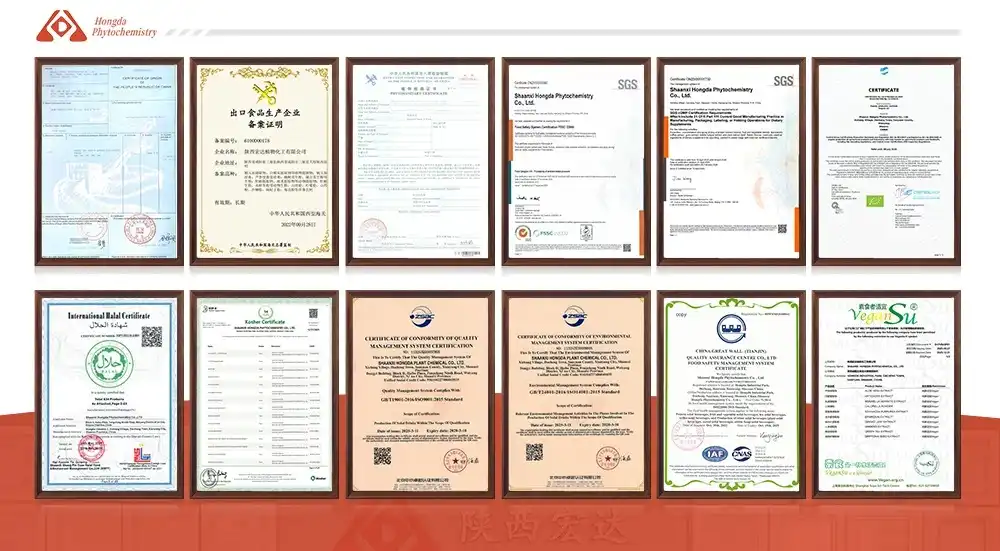
Documentation, Certification and Supply Reliability
|
Document
|
Hongda Status
|
|---|---|
|
Manufacturing standard
|
cGMP certified, SC production licence
|
|
Quality & food safety
|
ISO 9001, ISO 22000, FSSC 22000, BRC
|
|
Regulatory
|
FDA-registered facility
|
|
Organic
|
EU Organic and USDA NOP certified lines
|
|
Religious
|
Halal and Kosher
|
|
Enterprise status
|
National High-tech Enterprise, multiple patents
|
|
Per shipment
|
COA, MSDS, flow chart, spec sheet, allergen / GMO / irradiation / TSE statements, stability data
|
Inventory sits across six controlled zones within a 3,000 m² warehouse with dedicated sanitation staff, so standard grades usually ship in days while custom profiles run on scheduled slots. As a saw palmetto fruit powder bulk supplier serving EU and US customers, Hongda welcomes on-site and remote audits, and its regular presence at CPHI, Vitafoods and FIE gives buyers a chance to review documentation and samples in person before committing to a container.
Conclusion
Softgel formulation using saw palmetto extract powder fails for predicted reasons: free fatty acids plasticizing the shell, oxidation darkening the fill, suspensions settling mid-shift, and contaminated source material that never had the proper fatty acid profile initially. If the provider offers true data, including GC profile, acid and peroxide levels, particle size, moisture, and authenticity confirmation, each is doable. Shaanxi Hongda Phytochemistry supplies all of it from cGMP, BRC, and FSSC 22000-certified manufacturing, with nitrogen-protected packaging and pilot-scale sampling assistance. Request your trial sample and complete data pack now.
FAQ
Q1: Why do my saw palmetto softgels soften over time?
A: Free fatty acids migrating into the gelatin shell. Check acid value on incoming material — Hongda reports it per lot.
Q2: How do you prove the extract is authentic Serenoa repens?
A: Full GC fatty-acid profiling plus sterol analysis and botanical identification of incoming fruit, not just a total-FA figure.
Q3: Which grades are available?
A: 25%, 45%, and 85% total fatty acid grades, in powder and oil forms, with organic-certified options.
Q4: How is settling prevented in suspension fills?
A: Tight particle-size control with reported distribution, plus viscosity modifiers and continuous hopper agitation.
Q5: What packaging protects against oxidation?
A: Nitrogen-flushed, light-blocking foil with double PE liners, shipped at ≤5% moisture with reported peroxide value.
Formulate With Confidence — Partner With HONGDA
Late discovery of softgel issues is costly. Ask Shaanxi Hongda Phytochemistry Co., Ltd. for the data that keeps them from it: complete GC fatty-acid breakdown, sterol profile, acid and peroxide values, particle-size distribution, residual-solvent and heavy-metal reports, and moisture stability record. Then do a true pilot-scale sample of your saw palmetto extract powder on your own encapsulation line before you sign. Simply tell us your desired fatty acid grade, carrier oil, shell system, destination market, and yearly volume, and our technical team will provide an estimate with the whole compliance dossier attached, encompassing cGMP, ISO 9001, FSSC 22000, BRC, FDA registration, Halal, Kosher and organic certification. Meet us at CPHI, Vitafoods, or FIE — or simply email duke@hongdaherb.com today.
References
1. Booker, A., Suter, A., Krnjic, A., et al. "A phytochemical comparison of saw palmetto products using gas chromatography and 1H nuclear magnetic resonance spectroscopy metabolomic profiling." Journal of Pharmacy and Pharmacology, 2014.
2. Penugonda, K., & Lindshield, B. L. "Fatty acid and phytosterol content of commercial saw palmetto supplements." Nutrients, 2013.
3. Gafner, S., & Baggett, S. Botanical Adulterants Prevention Bulletin: Saw Palmetto (Serenoa repens). ABC-AHP-NCNPR Botanical Adulterants Prevention Program, 2017.
4. Habib, F. K., & Wyllie, M. G. "Not all brands are created equal: a comparison of selected components of different brands of Serenoa repens extract." Prostate Cancer and Prostatic Diseases, 2004.
5. Gullapalli, R. P. "Soft gelatin capsules (softgels)." Journal of Pharmaceutical Sciences, 2010.